Summary
Real-time decisioning uses live customer signals to determine the best action, channel, and timing instantly. A unified architecture minimizes latency between decision and delivery, enabling more relevant customer experiences than static segmentation.
A customer visits the same product page three times in one session. Your campaign platform’s next scheduled batch run isn’t due for another 90 minutes. By the time a generic re-engagement email arrives, the customer has already converted on their own, lost interest entirely, or moved on to a competitor.
That gap, between signal and response, is the core operational problem that real-time decisioning is designed to close. Knowing what it is and building a stack that actually closes it are genuinely different challenges.
The issue is rarely a shortage of data or AI tools. Enterprise marketing organizations commonly operate with customer data platforms (CDPs), behavioral analytics, and some form of journey automation already running.
The structural problem is that decisioning engines and execution layers are frequently purchased, deployed, and maintained as separate systems. Every handoff between them introduces latency, context loss, and the kind of personalization decay that makes “real-time” a claim rather than a reality.
This article examines that gap, why it persists, and what closing it actually requires.
How marketing execution became a decisioning problem
When signals replaced schedules
For most of the 2010s, campaign execution was fundamentally a scheduling problem. You built a segment, designed a message, set a second time, and fired. The sophistication lived in the creative and the targeting logic, not in the timing or the channel selection.
That model worked because customer behavior was relatively predictable and brand touchpoints were limited enough to plan around.
The shift happened as digital touchpoints multiplied and customer behavior became more signal-rich. A customer browsing on mobile during a lunch break, abandoning a cart on desktop, and opening a push notification that evening is not following a journey you designed in advance.

They are producing data that should be driving decisions in real time. Scheduled batch campaigns push a message when you choose; event-triggered, signal-based execution responds to what the customer is doing right now.
Those are architecturally different approaches, and the gap between them widens as the volume and velocity of behavioral signals grow.
From scheduling to simultaneous evaluation
A marketing decision engine doesn’t just ask “who gets this message?” It evaluates a set of concurrent questions: what is the next best action for this customer, given everything known about them at this moment?
Which channel are they most likely to respond on right now, and what offer aligns with their propensity score and recent purchase history?
Have they been messaged recently enough that another contact would create fatigue rather than value? Rules-based segmentation workflows can approximate some of these answers, but they evaluate them sequentially and statically.
A real decision engine evaluates them simultaneously, in real time, against a live profile. That simultaneity is what closes the window between intent and response before it disappears.
The decisioning-execution gap: where personalization dies
In most enterprise stacks, the customer data platform (CDP) or AI model produces a decision, and then that decision needs to travel through an API call, a data sync, or a file transfer to an email service provider (ESP), a push notification platform, or an SMS tool to actually execute. Every hop in that chain takes time and loses context, and the two problems compound each other.
The cost of latency at every handoff
Latency at each handoff is a known operational cost. Sometimes it is measured in seconds; sometimes in minutes. But customer intent is perishable. A customer who was actively comparing products five minutes ago is in a qualitatively different state from where they were during that window.
A decision that was contextually correct when the AI model made it may be irrelevant, or even jarring, by the time it reaches the customer through a disconnected execution layer.
The business costs compound quickly. Suppression logic that lives in the ESP but not in the decisioning engine means a customer receives a message they should have been excluded from.
Frequency caps that are not enforced across channels mean a customer who has already converted gets re-messaged on push. A propensity score that is updated in the CDP does not reach the journey canvas in time to change the message variant being sent.
Each failure is manageable in isolation, but together they produce exactly the kind of experience customers describe as irrelevant, intrusive, and tone-deaf. The AI model may have made the right call; the customer never sees it because the gap swallowed the signal.
What a unified decisioning-execution architecture actually looks like
Closing this gap requires more than faster APIs. It requires a structural shift: the decisioning logic and the execution engine need to operate on the same unified data layer, without a handoff between them.
The three non-negotiable components
Three components define this architecture, and all three must be present to eliminate the gap rather than simply narrow it.
A live unified customer profile, with updates that occur in real time as customer behavior happens across every channel and touchpoint. The profile must be instantly accessible to both the decisioning logic and the execution engine, not synced every few hours and not rebuilt overnight from warehouse exports.
An inline AI decisioning step, where the AI evaluation happens inside the journey canvas rather than upstream of it. The model accesses the live profile, evaluates the relevant signals, and routes the customer to the right message, channel, and offer as part of the same execution step, not as a pre-processing stage that feeds a separate tool.
A multi-channel execution engine that fires without a handoff delay. Email, SMS, push notifications, onsite experience, WhatsApp: the execution layer is native to the same platform, so when the decisioning step resolves, delivery follows immediately without a round-trip to an external system.
The copilot model vs. the agentic model
There is an important distinction between two modes of AI involvement. In the copilot model, AI assists marketers in building rules and segment conditions. The marketer still designs the logic; AI accelerates the process or surfaces recommendations.
In the agentic model, AI makes and refines decisions autonomously within guardrails the marketer sets. The marketer defines the objectives and constraints; the AI determines the optimal action for each individual customer at each moment, without requiring manual rule updates when behavior shifts.
The agentic approach is where measurable lift actually lives. Insider One’s Agent One™ operates in this mode: it recalibrates decisions continuously so the execution layer always acts on the most current signal available. This is also what distinguishes AI-driven personalization that scales from AI-assisted personalization that still hits a human bottleneck at the critical moment.
Real-time signals that should be driving decisions right now
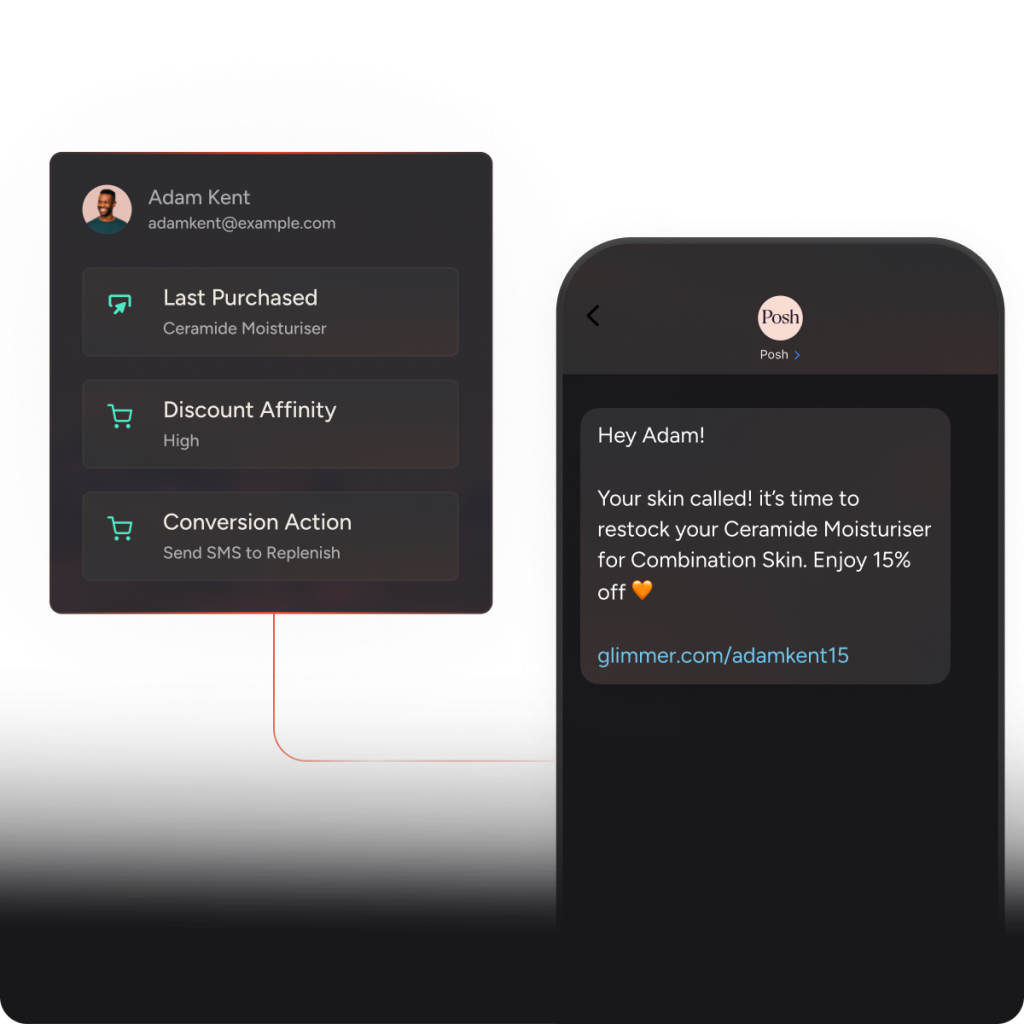
The signals that matter most for real-time decisioning fall into two categories: in-session signals that reflect immediate intent, and cross-session signals that provide behavioral context. Both are necessary, and neither is sufficient alone.
High-value signals and the ones teams consistently underuse
In-session signals, including browser abandonment, product page depth, cart additions, search queries, and time-on-page, are the most direct indicators of current intent.
A customer who visits the same product three times in a single session is demonstrating something qualitatively different from a customer who viewed it once, and that distinction should change both the decision and the delivery timing. Cross-session signals, particularly recency of last purchase, channel engagement history, and cumulative propensity scores, provide the behavioral frame that makes in-session signals interpretable.
A high-propensity customer who has not purchased in 60 days should be treated differently from a high-propensity customer who bought last week. Next-best-action logic needs both dimensions to produce a decision that is genuinely calibrated to the individual rather than approximated from a persona.
The most consistently underused signal in enterprise stacks is channel reachability combined with real-time engagement propensity. Teams know which channels a customer has opted into, but they often do not dynamically weight channel selection based on when that customer is most likely to engage.
A customer who opens push notifications on weekday mornings but consistently ignores SMS should not receive an SMS at 9am on a Tuesday. That is a decision that requires live signal weighting, not static channel preference rules set at onboarding.
New Balance achieved a 556% uplift in conversion rate through more precisely targeted, behaviorally driven personalization. The signal fidelity behind that result, real-time behavioral data feeding a decisioning layer connected directly to execution, is what separates outcomes like that from campaigns that produce incremental rather than significant results.

Evaluating your stack against a real-time decisioning standard
If you are assessing whether your current platform, or a platform you are evaluating, actually delivers real-time decisioning, the vendor’s positioning is not the right starting point. Architecture is.
A practical evaluation checklist
• Profile update latency: How long does it take for a behavioral event (cart addition, page visit, purchase) to update the unified profile that the decisioning engine reads from? Sub-second is the target; anything measured in minutes is near-real-time at best.
• System hops between decision and delivery: Count the integrations, API calls, or data transfers that stand between a decision being made and a message being delivered. Every hop introduces latency and a potential context failure.
• Inline AI availability in the journey canvas: Can the AI decisioning step run natively within the orchestration tool, or does it require an external call to a separate model that returns a payload to the canvas? Native inline evaluation is what makes the agentic model viable at scale.
• Suppression and frequency capping across channels: Are suppression rules and frequency caps enforced at the decisioning layer, before execution, and across every channel simultaneously? Or are they enforced separately per channel after the decision has already been made?
• Real-time segment qualification: Does a customer’s segment membership update in real time as their behavior changes, or does re-qualification happen on a scheduled batch cycle?
Stress-testing “real-time” vendor claims
“Real-time” is one of the most overused terms in marketing technology. When a vendor claims real-time capability, ask for specifics: what is the latency service-level agreement (SLA) between a behavioral event and a profile update? What is the latency between a profile update and a decision step? What is the latency between a decision step and channel delivery?
Some platforms that describe themselves as real-time are running micro-segmentation batch jobs on short intervals, often ranging from five to 30 minutes. That is near-real-time at best, and it is not sufficient for high-intent moments like browse abandonment, where the window for a relevant response is measured in single-digit minutes.
Omnichannel marketing automation done at the speed these moments demand requires a platform that treats decisioning and execution as a single continuous process, not two processes connected by an integration.
Insider One’s journey orchestration layer is built on this architecture: the AI decisioning step runs inline within Architect, against a live unified profile, and fires to the appropriate channel without a round-trip to an external system.
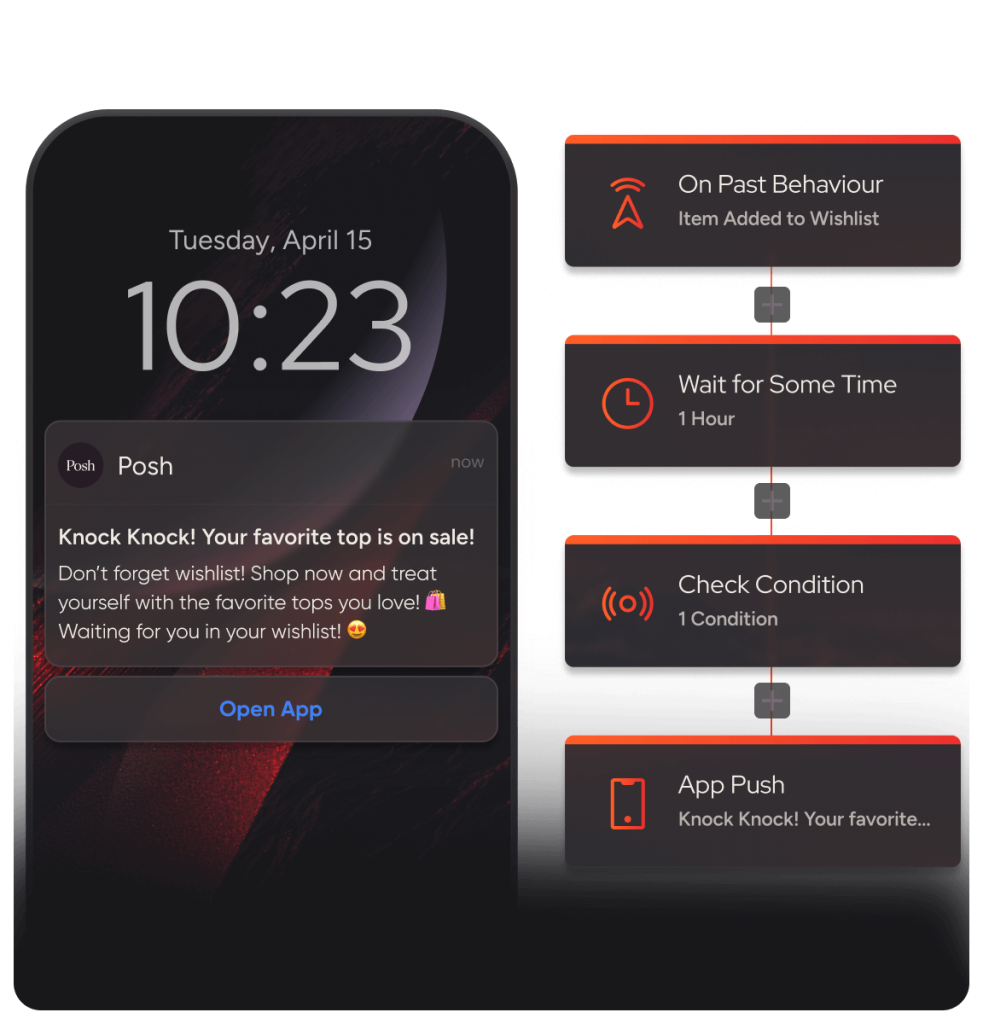
Adidas achieved a 259% increase in average order value and a 13% conversion rate lift in a single month by deploying this kind of unified, signal-driven approach rather than maintaining separate layers for decisioning and execution.

If you want to see how Insider One’s Architect turns live customer data into coordinated, revenue-driving experiences, book a personalized demo to see the exact use cases, decision logic, and growth levers most relevant to your team.
FAQs
Triggered automation fires a pre-set message when a specific event occurs: an abandoned cart triggers a cart recovery email. Real-time decisioning evaluates multiple variables simultaneously, including channel, timing, offer, and propensity, to determine the optimal action for that specific customer at that moment. The trigger is the same; what happens next is fundamentally different.
Not necessarily, but the CDP needs to support sub-second profile updates and expose the live profile to an inline decisioning layer. If the CDP updates on a batch schedule or requires an intermediate data transfer to feed the AI model, the real-time capability is constrained regardless of how fast the decision engine is.
The agentic model does not remove marketers from the loop; it changes where their judgment applies. Marketers define the objective (maximize conversion, protect brand experience, minimize churn), set the guardrails (frequency caps, channel eligibility, suppression rules, brand safety constraints), and the AI operates within those parameters. The marketer’s expertise shapes the decision space; the AI optimizes within it.
At minimum: real-time session behavior (page views, cart events, search), recency and frequency of purchase history, channel engagement history, and current propensity score. With those four inputs, a next-best-action model has enough to outperform most static persona-based segmentation in conversion rate and revenue per communication.