There’s an old saying, “No tree grows straight to the sun.”
Throughout history, the greatest of all inventions eventually run their course. Such is the case with the search engine, which many argue was the most transformative innovation for organizing information and making it useful.
But here we are in 2026, and all the trends around buyer behavior beg the question: Are search engines giving way to what’s next?
To answer this question, I recently published an in-depth analysis on LinkedIn. There, I drew the comparison between the evolution of search engines and the Yellow Pages.
Below, I’ve summarized that piece to address the key questions marketers are asking the most.
What is buyer journey compression?
Buyer journey compression is the process of reducing the time to find and evaluate products or services.
The Yellow Pages compressed local services into one book. Search engines compressed the world’s information into the first page of search results. Answer engines now compress product discovery into a single AI-generated answer.
How has the buyer journey compressed over time?
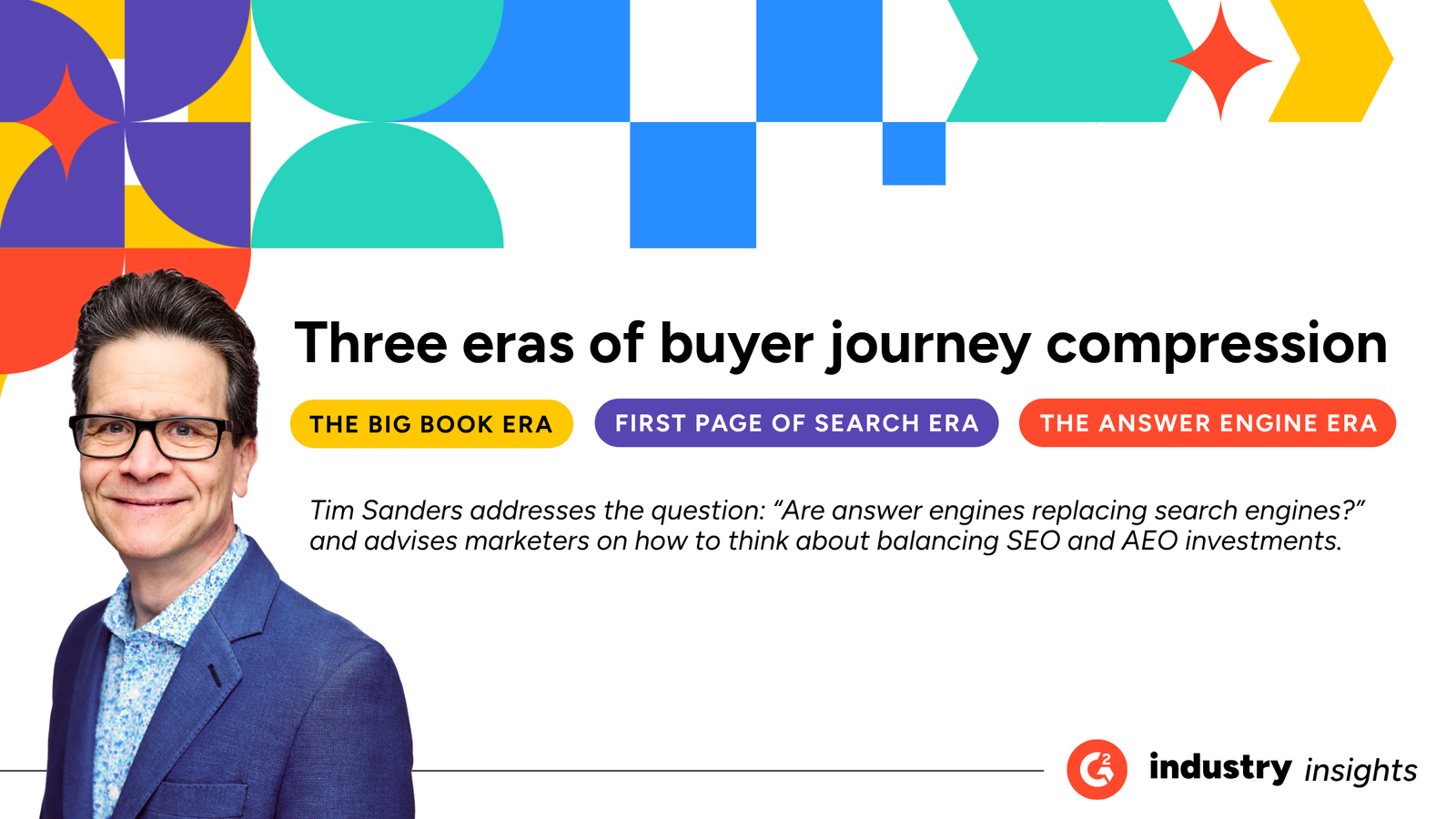
Over the last few centuries, disparate buyer options have compressed into a single place, offering marketers a strategic option to reach them at the point of greatest need. There have been three eras of that compression over time: the Big Book era (Yellow Pages), the First Page of Search era (search engines), and the Answer Engine era (AI search).
The Big Book era
Telephone directories introduced classified listings, leading to the Yellow Pages, a single book compressing myriad services for buyers. They became a bustling industry with a 30% operating profit margin, emerging as a multi-billion-dollar industry by the 1980s.
The industry peaked in 2007, just as the internet era was gaining steam, as buyers flocked to the World Wide Web to find products and services. Over the coming years, it shrank both in relevance and revenue.
The First Page of Search era
Google was founded with a laser focus on improving search quality by organizing the world’s information, and its PageRank algorithm delivered, shifting buyer behavior for millions of people.
Within a few pages of search results, most buyers found helpful resources to inform their decisions and secure solutions. Marketers scrambled to earn their way onto the first page of results, where the clickthrough rate to their websites was the highest.
The Answer Engine era
Instead of requiring buyers to sort through myriad websites Google’s blue links sent them to, AI search provided them an answer directly. One prompt, and boom, they have their answer.
Buyers could now simply leverage generative AI to reason over a vast amount of data — no more traversing dozens of blue links.
Has AI search actually changed the way people find and buy software?
A G2 research report, based on a March 2026 survey of 1,000 B2B software buyers, found that AI chatbots have fundamentally changed how 93% of respondents conduct research. My thesis from the beginning has been that buyers of all types will flock to the most productive tool that helps them get the right product at the right time.
How many buyers are using AI search instead of traditional search?
Consider the split to be roughly 50-50 — but it’s shifting fast.
On the B2B side, our research report found that 51% of software buyers now start their purchase journey on ChatGPT.
On the B2C front, SEMrush’s 2026 report found that 57% of consumers use chatbots to narrow down their shortlists, and about half return to AI search to make their final decision.
Expect the fork to lean heavier towards answer engines in 2027, especially now that Google has made AI Mode even more visible for searchers.
How is AI search changing the buyer journey?
Today’s buyer starts with a new tool that’s ruthlessly efficient with their time.
As noted above, 51% of B2B software buyers said they start their purchase journey on an AI chatbot like ChatGPT versus a traditional search engine like Google, a 71% increase in less than one year. With Google emphasizing AI Mode and Gemini, it wouldn’t be surprising to see this percentage rise sharply over the coming year
It’s not just the adoption of answer engines, but how buyers use them that’s so disruptive. G2’s research revealed that the most common first prompt buyers use is “give me the best ______ for ________.” They aren’t asking for a collection of websites; they are asking for the shortlist.
Historically, B2B buyers invested hours building their shortlist. Today, what took them hours, they now get with a single prompt. According to a late 2025 report by 6sense, 9 out of 10 buyers chose the winning vendor from their day-one shortlist.
If you haven’t figured out how to “win the answer,” your problems with AI search go far beyond losing traffic from zero-click sessions. You are being boxed out of the game.
Are marketers still heavily investing in traditional search?
Despite the market split, the lion’s share of budgets is still flowing to the search-engine-based buyer journey.
Mordor Intelligence found that companies will spend a whopping $83 billion on SEO services this year. Marketers will also spend another $1.33 billion on SEO software.
Meanwhile, investments in Answer Engine Optimization (AEO) tools and services are paltry in comparison. According to QYR Research, 2026 AEO spending will be around $1.5 billion.
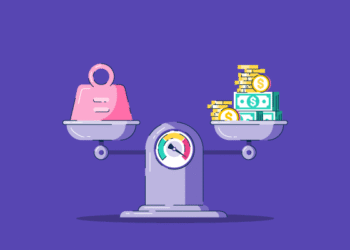
To put that in perspective, for every dollar marketers spend on AEO this year, they’ll spend $60 on SEO.
How should marketers move SEO dollars to support AEO?
Marketers will likely need to strategically allocate some SEO dollars to AEO.
One good cut candidate is generic blogs currently aimed at SEO, such as low-intent “what is” articles or keyword-variant content.
Look for duplicate SEO tools to consolidate, especially dashboards that don’t have some correlation to pipeline in this zero-click environment that answer engines are creating.
Link-building efforts should give way to authority-building efforts.
It is also important not to cut technical SEO because that’s foundational to organic traffic and stability between these two periods.
What’s the right budget split between SEO and AEO?
Research from Conductor, canvassing 250 leading-edge enterprise marketers, revealed that they planned to invest 12% of their digital budget in AEO in 2026. That aligns with what CMOs are saying in conversations right now. While that still leaves the lion’s share of the budget for SEO efforts, it would be a great start.
Is Sponsored Search still worth the investment in the age of AI search?
This is a burning question marketers will need to answer in the next year.
The value of Google Ads is falling, likely driven by the migration to AI search. Triple Whale’s 2025 Google Ads benchmark, based on more than 18,000 brands, found Google Ads ROAS fell 10.03% year over year, while conversion rates fell 9.28% and CPA rose 12.35%.
You might be thinking: “But isn’t Google reporting breakout ad numbers?”
It makes sense that marketers facing a zero-click world of declining organic traffic will throw good money after bad. Remember, the yellow pages had their best years from 2004 to 2007, as advertisers needed to spend more to maintain foot traffic during the internet migration period for buyers.
Should marketers experiment with paid AI visibility?
Earlier this year, OpenAI introduced its version of an ads product to enable brands to invest in paid AI visibility. Early feedback suggests their pricing was too aggressive, and they are still feeling out the space.
Digiday reported “chronic underdelivery” for early campaigns, although OpenAI has recently shown progress, with fill rates rising to 50%.
As this is a big priority for OpenAI’s future revenue strategy, expect to see improvements in pricing, delivery, measurability, and results over the next year. Plan on running a pilot by the end of 2026, with money you can afford to lose in an effort to learn.
Meanwhile, Google has astutely introduced ads for AI Overviews. They claim that the performance for AI Overviews rivals Sponsored Search, which could make this a safe place to test reallocation.
While there is no announcement of ads coming to the Gemini app (yet), Google has introduced ads for AI Mode. This is a new service that lets users prompt to get an AI-generated answer, and then enter chat (just like Gemini) to go further.
TechCrunch reported that “advertisers already using its Performance Max, Shopping, and Search campaigns with ‘broad match’ will be eligible to have their ads shown in AI Mode. Users in the U.S. will see ads, specifically Search and Shopping ads for now, in AI Mode across desktop and mobile.”
This is likely something you can look at strategically today, as you rebalance your dollars to win in the age of answer engines.
Is the shift to AI search permanent — or will buyers return to search engines?
One thing we shared in our latest research report was that people are more productive using AI search. We saw a significant jump in this sentiment between 2025 and 2026. When we find a quicker route to get from point A to point B, we stay on that path. We never return to the slower, harder, more painful ways of working once we discover the new thing.
What should marketers do to prepare for the shift to AI search?
Plan on AI search becoming the dominant way people find your products and services in the near future. If possible, create a three-year plan to transition and meet the moment.
If you are still in the mode of buying a low-cost AI visibility solution and taking a lot of meetings to discuss this trend, that’s okay — you are not alone. But you may not have time to spare when it comes to leaping into action.
The best time to plant a tree was 20 years ago. The next best time is today.
For more AI research and insights, subscribe to my LinkedIn newsletter: “AI Update with Tim Sanders.”
Edited by Supanna Das