Every great company has a rhythm.
Not the noise of activity. Not the constant motion of campaigns, launches, dashboards, meetings, announcements, and new tools. The rhythm is quieter than that. It is the pattern underneath the work, the discipline, instinct, obsession, and judgment that shape how a company moves, decides, and becomes unmistakably itself.
Beneath every conversation about growth, about AI, about what the next two years actually require of the people running companies, there is a question that does not get asked directly. It sits under the metrics, the strategy decks, the board updates, the category rankings.
What does it actually take to win?
Not to start. Not to raise. Not to optimize. TO WIN. To build something that holds up when the market turns, when the board conversation gets uncomfortable, when the renewal call reveals whether what you built is real or something else entirely.
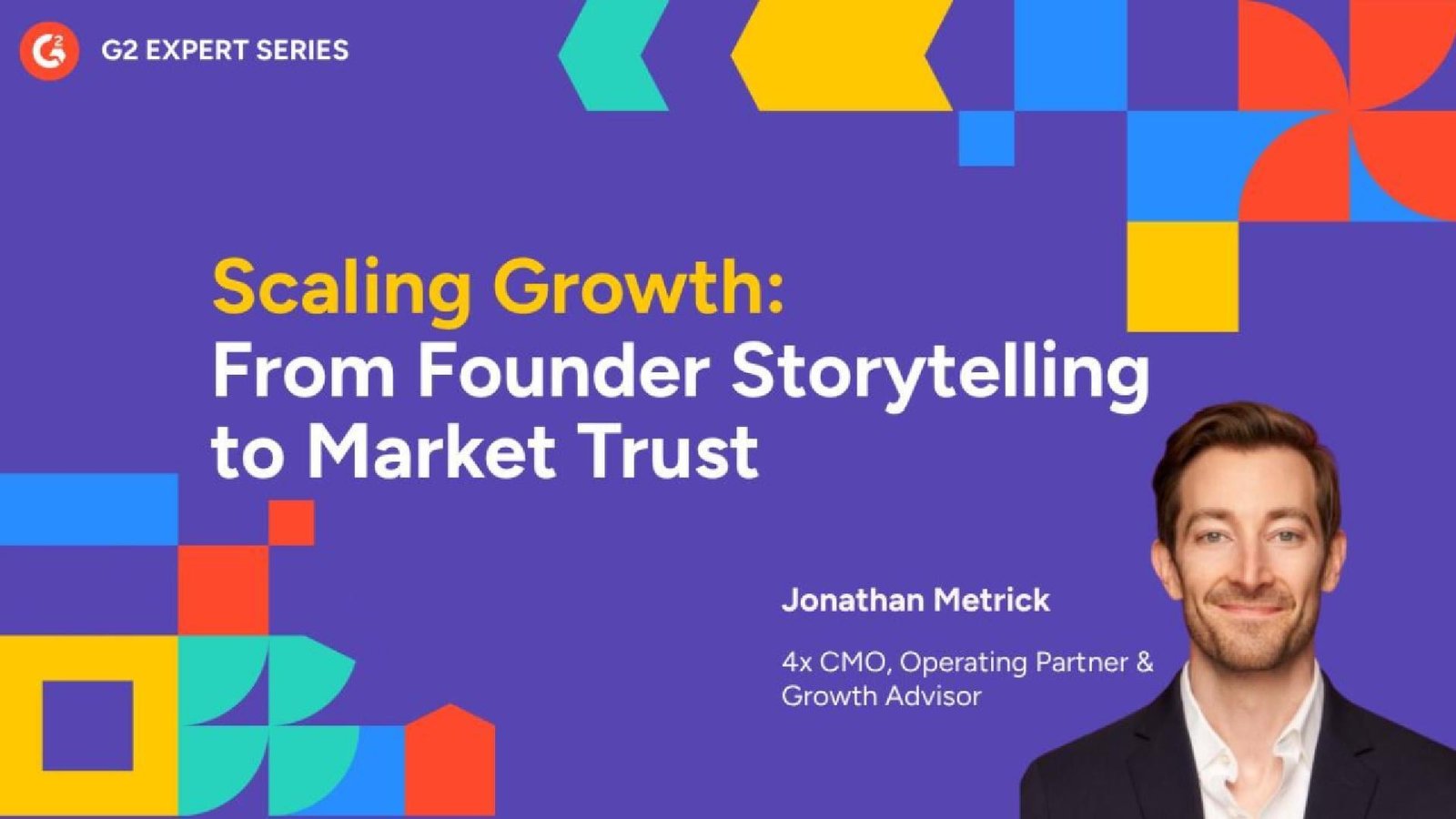
Jonathan Metrick has spent his career inside the rooms where that question gets answered.
He is a four-time CMO who has built growth engines at Wealthsimple, PolicyGenius, Tiffany and Co., Live Nation, and Procter and Gamble. He is Partner and Chief Growth Officer at Sagard, where he has worked across 100-plus companies over the last six years and watched that question get answered well and answered poorly, at every stage, in every market condition. He has published in MIT Sloan Management Review, TechCrunch, Forbes, and The Globe and Mail. He runs a session called CMO Show and Tell where portfolio CMOs demo what is actually working in AI right now, not what they are planning, not what they are testing, what is working.
His core argument is not that AI changes everything. It is that AI makes a company’s underlying rhythm harder to fake.
AI cannot decide what is worth doing. It cannot manufacture taste. It cannot replace judgment. It cannot create customer understanding where none exists. It cannot turn a weak organizational muscle into a strong one by producing more output around it.
That was the deeper lesson of G2’s Expert Series conversation with Metrick: the fundamentals do not become obsolete in a revolutionary technology cycle. They become more important.
Because in the age of AI, companies are not the sum of their ideas. They are the amalgamation of what they execute well, repeatedly.
The session was structured the way the best conversations always are: like a coffee chat between two people trying to get at the truth of something. No slides. No polished positioning. Just the questions that needed to be asked and the answers that came from someone who has actually seen it play out, at scale, across a hundred companies, in a real market.
What emerged was less of a forecast and more of an operating philosophy for growth in the age of AI.
The Superpower Test
Your phone buzzes. It is 6 a.m.
A news producer wants to know if you can be in the studio by 8 a.m.
Two kinds of leaders emerge in that moment.
One checks the calendar, does the math, and asks whether next week might work.
The other says yes and is already on their way.
Metrick has watched both responses play out across his portfolio. The difference between these operators is not always talent, capital, network, or even opportunity. Often, it is something older and harder to manufacture: the relationship a leader has with the thing they are built to do.
“There’s certain CEOs in our portfolio that are always in the news. The reason is, when they receive a text at 6 o’clock in the morning from a news outlet saying, could you be in our studio by 8 a.m., they say yes. And other founders are like, oh, maybe I could come in next week.”
Jonathan Metrick
Companies often grow according to the superpower of the people at the top.
The data-driven founder builds a company with data superiority. The engineering-led founder solves problems through product. The editorially minded founder creates an aesthetic and voice competitors struggle to replicate because it came from a person before it became a process.
Metrick’s advice is simple: “Don’t lose sight of what is your organizational superpower, and ensure that you’re doubling down on that. It’s going to be very hard for anyone to catch up with you on that.”
The test for finding that superpower is brutally simple.
“The stuff you’re willing to do on a Saturday afternoon because you find it fun, that’s gonna be the thing that differentiates and gets you better at something than someone who’s like, oh gosh, I gotta do this again.”
In a world where AI makes more teams competent at more things, the person who cannot stop doing the thing may be the only one who becomes exceptional at it.
That is the part no model can manufacture: the private appetite for the work itself.
Companies are not shaped by their best ideas alone. They are shaped by the ideas they execute, the bad bets they survive, the instincts they repeat, and the work they keep returning to when no one is watching.
That is the difference between borrowed momentum and native rhythm.
AI Is a Magnifier, Not a Maker
Every team has the tools now. The creative tools. The analytics tools. The research tools. The workflow tools. The barriers that used to separate well-resourced teams from scrappy ones have collapsed faster than most organizations know how to process.
“AI accelerates expertise. It doesn’t replace core capabilities. A company using AI to amplify an effective creative process can do great things. A non-creative company using AI to produce amazing creative? That’s not really what’s happening.”
Jonathan Metrick
The tools make it easier to look like something is happening. They do not make it easier to have something worth saying.
They compress the time between idea and execution, but they do not manufacture the idea that matters. They amplify what is already there. Companies with a strong foundation, customer understanding, a genuine point of view, an earned narrative, a disciplined operating model, can move faster now.
Companies using AI as a replacement for the foundation are simply producing more output in the wrong direction.
Metrick learned what a real foundation looks like at Procter and Gamble, before the internet, before performance marketing, before any of the channels that consumed the last two decades of marketing energy. Consumer research. Positioning. Unmet needs. The work before the campaign. The work of knowing who you are actually talking to and why they should care.
“The foundations of marketing, understanding your consumer, understanding an unmet need of theirs, how you are better solving their problem, regardless of the technology innovation we face, be it the internet, be it mobile, be it AI, those foundations stay the same,” he said. “Despite how much marketing changes because of technology, the best practices and the foundations are evergreen.”
Metrick is, as of this month, rereading David Ogilvy on Advertising.
Not a book about AI. Not a framework built for this moment. A book published in 1983, drawing on campaigns from an era when the urgent media question was not which model to use, but where on television to run the ad: which program, which slot, which audience, which night.
Ogilvy was mapping a new distribution environment the same way marketers are now trying to map AI discovery: where attention lives, how trust is built there, and what works when the medium is new and the playbook does not yet exist.
Different tools. Same instinct.
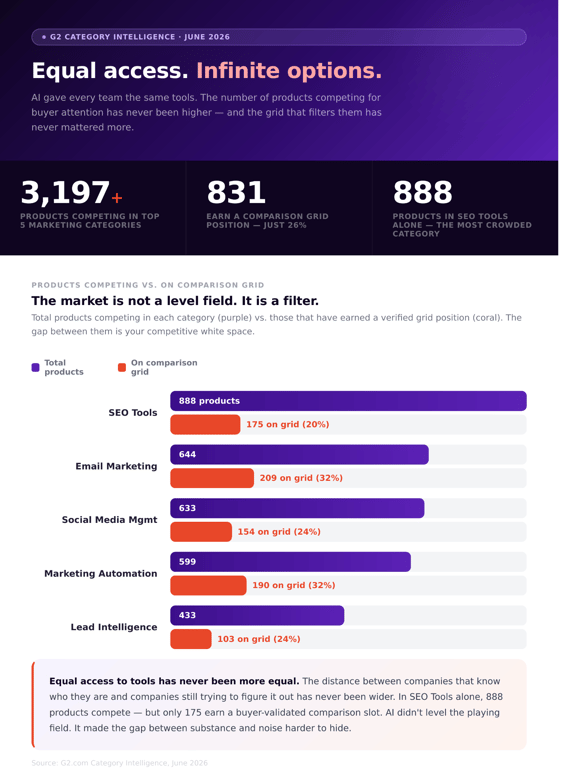
When the tools change this fast, the people who understand the principles underneath them are not just holding ground. They are lapping the field. Equal access to tools has never been more equal. The distance between companies that know who they are and companies still trying to figure it out has never been wider.
Growth That Survives Scrutiny
“Not all growth is created equal. Not all leads are created equal, not all revenue is created equal, not all customers are created equal.”
Jonathan Metrick
The most consistent mistake Metrick sees – across stages, sectors, and market conditions – is mistaking motion for progress.
“Not all growth is created equal,” he said. “Not all leads are created equal, not all revenue is created equal, not all customers are created equal.”
The customers who matter are the ones who love the product, pay for it, use it often, renew when given the opportunity, expand over time, and tell someone else.
The customers who make the dashboard look good but never become durable are different. They do not fully understand the product. They do not use it deeply. And at the first opportunity, they churn.
The growth-at-all-costs era produced the second kind at massive scale.Revenue that looked clean in a board deck until a renewal cycle, down market, or uncomfortable conversation revealed what it actually was. Customers acquired with incentives who were never going to stay. Growth engines running full speed toward the wrong audience.
“The music stops, and those customers go away” Metrick said. “You can spend a lot of money building a growth engine with the wrong audience.”
The businesses that compound know exactly who their customer is. Not only as a demographic or persona, but as a behavioral pattern. Who buys? Who renews? Who expands? Who refers? Who gets value quickly and keeps coming back?
That clarity is a data problem before it is a marketing problem. Without it, no amount of creative output changes the underlying math.
“Without the data foundation, it’s really difficult to understand,” Metrick said. “We don’t have unlimited budgets, we don’t have unlimited time. The better you understand your target customer, the easier it’s going to be to grow profitably.”
That is why the companies Metrick is watching right now are not the flashiest AI interfaces,but they are actually the data infrastructure companies, Datadog, Snowflake, and the unsexy systems that make the glamorous work possible.
“If you have a solid data foundation, you can do a lot of cool stuff,” he said. “But if you don’t, you’re really not gonna get there.”
Eric Gilpin, G2’s President of Go-to-Market, sees the same distinction across software markets:
“Most of what people call growth is just noise wearing a number. Durable growth has a through-line: a clear ICP, a product that actually delivers on its promise, and a customer base that renews and expands because they got what they came for. Everything else is rented. When things get scrutinized, a down market, a board conversation, a renewal call, the truth shows up fast.”
Eric Gilpin
President of GTM, G2
Trust Travels Before You Do
Vendors often show up to strategy conversations asking where they belong.
They want a category, a ranking, a position in the market. But the ones that have not done the foundational work first, the research, the origin story, the precise understanding of who buys their product and why they stay, are treating visibility as a tactic to game when it is actually a signal.
Visibility tells the market whether you know who you are.
Metrick knows, on sight, when someone’s content is not really theirs. His own LinkedIn voice is brief, specific, and recognizable. When someone else suddenly sounds nothing like themselves, the market notices.
“I know you didn’t write this,” he joked. “This would have taken you the whole weekend, and I saw you out on Saturday night.”
The volume of AI output has not made content less important. It has made point of view, craft, and specificity more important.
“Talk is cheap,” Metrick said. “What’s hard is doing something well, over and over again. That’s differentiation”
In the age of AI, when teams can produce something quickly, the bar does not go down. It goes up.
“The bar for trust, the bar for quality, has just gone up,” he said. “People are expecting excellence immediately. They’re expecting excellence every time.”
That is the danger of outsourcing the core too quickly.
“I would be a little nervous at hearing a firm outsourcing its core positioning to AI without any sort of human or expert overseeing it,” Metrick said. “You could quickly end up going in the wrong direction.”
Palmer Houchins, G2’s VP of Brand and Communications, frames the brand implication this way:
“A story becomes market trust when it stops being about what a company wants to say and starts reflecting what buyers can validate for themselves. In an AI-first world, G2’s role is to make that trust visible, structured, and useful wherever buyers are making decisions, whether that’s on G2, in search, or inside AI-generated answers.”
Palmer Houchins
VP of Brand and Communications, G2

That also changes the way teams should think about brand and demand.
“In a zero-click world, brand and demand can’t be treated as separate motions. Demand captures intent, but brand creates the memory, credibility, and confidence that make buyers choose you before they ever fill out a form.”
Palmer Houchins
VP of Brand and Communications
A company can narrate its own ambition. But the market decides what becomes believable. That is the new burden of growth: not simply to tell a sharper story, but to build one buyers can verify before a rep ever enters the conversation.
The Full-Stack Growth Operator
For much of the last decade, the marketing org chart was increasingly settled.
Demand generation. Lifecycle. SEO. Paid. Creative. Product marketing. RevOps. Analytics.
Roles became specialized. Career paths narrowed into lanes. The specialist era had rules, structure, and rewards for people who went deep in one direction.
AI is now blurring the lines of that structure.
“Teams are leaner,” Metrick said. “AI allows one individual to do the full stack, something that used to require three separate people, the graphic designer, the copywriter, the analyst.”
That does not mean expertise matters less. It means the most valuable operators may increasingly be the ones who can move across functions with instinct, technical curiosity, and commercial judgment.
Emily Greathouse, G2’s Senior Director of Market Research and Data Ops, who co-hosted the session, pushed Metrick directly on this: with all of the CMOs he sees in his Show and Tell sessions, what’s actually moving the needle – not the theory, but the reality?
The use cases that stick are not the flashy ones. They are the ones eliminating friction that was consuming hours from the best people. Automated paid media dashboards that push three optimization recommendations to your inbox at 8:30am. Operating systems that ingest everything and surface what needs attention today. As Metrick put it: “If it’s Friday at 4 in the afternoon, are you going to do that, or are you going to do something else?”
Marketing engineers. Go-to-market engineers. Full-stack operators combining RevOps, outbound, content, data, automation, and experimentation into roles that did not exist in the same form a few years ago.
Metrick pointed to companies like Profound and Clay as examples of how quickly this shift is moving. These are not traditional teams with AI layered on top. They are organizations designing the operating model differently because the technology allows them to.
The specialist is not disappearing. But the generalist is gaining more prominence.
Not the vague generalist. The builder-generalist. The operator who gets bored in a lane, works across data and creative and strategy, and picks up the new tool before the playbook exists.
Stage-specific experience still matters. The gap between what a $2 million company needs from a marketing leader and what a $200 million company needs has never been wider.
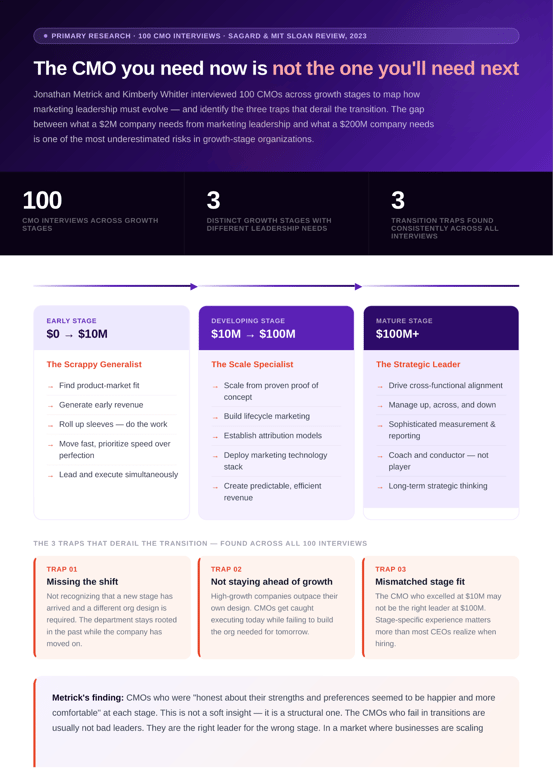
But the opening for full-stack growth talent is real, and it is right now.
“Businesses are scaling faster,” Metrick said. That creates urgency around whether the people leading commercial functions have both the ability and the interest to take the company to the next level as quickly as it is growing. “I think it creates better work. It’s really exciting to see what marketing engineers are going to build.”
The Next Discovery Arbitrage
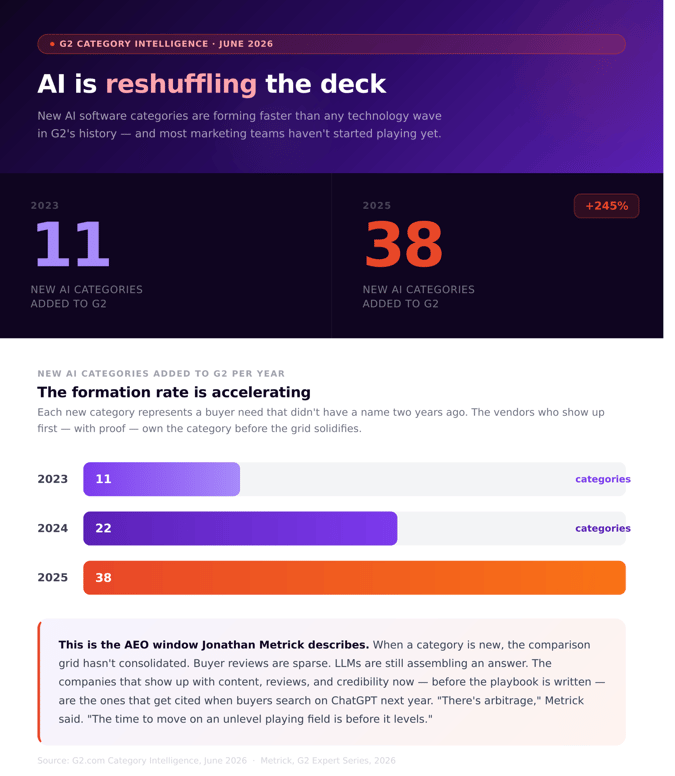
When SEO emerged, the companies that moved early built structural advantages that later entrants spent years trying to close. Most companies waited until the playbook was written. The companies already there held the ground.
Metrick sees AEO, optimizing for AI-generated answers rather than traditional search rankings, as that kind of moment.
“I take a look at my nieces who don’t use Google but ChatGPT for their first point of search and discovery. And I think more consumers will start to do that.”
The scope is wider than SEO ever was.
Large language models pull from Reddit threads, listicles, YouTube transcripts, podcasts, review sites, community signals, and third-party validation. A smart Reddit strategy, the right content architecture, credible reviews, and being cited in the right places are becoming signals in a game many marketing teams have not yet started playing.
The companies that move now may be able to leapfrog incumbents that have held category positions for years.
“There’s arbitrage,” Metrick said. “There’s opportunity for businesses testing in this area. Maybe they can leapfrog an incumbent by having a smart Reddit strategy or creating content that LLMs will pick up on, and when customers are searching on ChatGPT, maybe they show up before the established player.”
The time to move on an unlevel playing field is before it levels.
Eric Gilpin, G2’s President of Go-to-Market sees this as a fundamental shift in where proof has to live:
“Buyers are now arriving at decisions before a rep ever enters the conversation, shaped by AI overviews, peer reviews, and community signals they found on their own. The question for any GTM team isn’t how do we interrupt that journey. It’s are we visible and credible when it happens? At G2, we’re building the trust layer for that moment, the proof that travels even when your team isn’t in the conversation.”
Eric Gilpin
President of GTM, G2
No One Gives You Time to Fix the Foundation
The mistake most incoming CMOs make is not purely strategic. It is structural. Metrick has seen it across the 25-plus CMOs he has hired, his portfolio and four CMO roles of his own.
The moment a CMO starts, they are immediately responsible for the KPI. This month. Next month. This quarter.
That is true even if they were hired to rebuild the infrastructure, reposition the company, improve the operating model, and create the medium-term growth engine.
“If you take your eye off the immediate-term targets, you’re gonna be in trouble,” Metrick said. “You gotta keep it in the air while you’re up-leveling the airplane.”
The second trap is insularity. The best work rarely comes from inside marketing alone.
“A lot of the best work you’re gonna do is actually gonna come from partnering with your cross-functionals,” Metrick said. “Working in tandem with sales, with product, with finance, to unlock multi-divisional creativity and remove roadblocks. Sometimes CMOs come in and focus too inwardly. That’s not where exponential growth is going to come from.”
Growth leaders do not get to choose between short-term performance and long-term transformation. They have to earn the credibility to do both.
If you are leading growth right now, this is the uncomfortable audit: where has the urgent work started crowding out the important work and where has the future-state strategy become an excuse for missing the number in front of you?
The P&L Is the Proof
Every guest in G2’s Expert Series leaves two things: a signal they are watching and a question to carry forward.
Metrick’s signal is the real ROI on AI.
“There is no disputing that AI is adding value,” he said. “But to what degree, and how much should we be paying for it? What are the use cases meaningfully moving the P&L? We want profit, cost savings, revenue generation. That is the signal versus noise I’m watching for.”
The proof-of-concept phase is ending. The organizations that win the next three years will not be the ones with the longest list of tools. They will be the ones that can point to the line item and say: here, this is where AI moved the business forward.
There is no deus ex machina for an unresolved business. AI will not arrive at the end of the play to save the plot, not if the economics are weak, the positioning is unclear, or the growth motion was never durable to begin with.
If the business does not move, the transformation has not happened. The machine only made the illusion more convincing.
The Proof Layer G2 Is Building For
G2 is not watching this shift from the sidelines.
For vendors, the implication is direct. The companies that win are the ones doing the foundational work: a clear ICP, a product that earns renewal, a story buyers can validate, and a market presence built on proof rather than performance. The vendors trying to manufacture visibility without earning trust are running the same play as companies that optimized for volume without the foundation beneath it. Eventually, the music stops.
For buyers, the discovery journey has changed faster than most GTM teams are moving to meet it. AI overviews, peer reviews, category intelligence, and community signals are shaping decisions before a rep ever enters the conversation. The proof layer is now doing work that used to happen in a sales call.
That is where G2’s role becomes more important, not less.
The category is the credential. The review is the signal. The buyer behavior is the proof. In a world where that proof is increasingly synthesized by machines and surfaced to buyers who may never visit the original source, what sits underneath the signal matters more than ever.
G2’s work is to make that trust visible, structured, and useful wherever software decisions are happening: on G2, in search, inside AI-generated answers, and across the surfaces where buyers are already forming belief.
Growth Has Nine Lives
When Metrick was asked for one word to describe the state of growth in 2026, he chose curiosity. Not efficiency. Not automation. Not disruption.
Curiosity.
It is a revealing answer from someone rereading Ogilvy on Advertising while everyone else debates which model, workflow, or AI tool will define the next era. Metrick is not looking backward because he believes the past has better answers. He is looking for the principles that keep surviving the death of every tech advancement.
The tv killed one version of growth. The internet killed another. Mobile rewrote the rules again. AI is now reshuffling the deck at a speed that makes even recent best practices feel unstable.
If curiosity killed the cat, and the cat had nine lives, what life would you be on?
That may be the more useful frame for growth now. Every cycle ends something. A channel stops working. A tactic gets crowded. Buyer behavior changes. A metric stops meaning what people thought it meant. A team realizes the motion it scaled was never as durable as the dashboard made it look.
The companies that survive are not the ones that refuse to change. They are also not the ones that chase every new tool until they forget who they are. They are the ones curious enough to meet the moment, and grounded enough to carry the right instincts with them.
That is why Metrick’s question lands:
“What is an evergreen principle that has stood the test of time?”
Customer understanding. A clear ICP. A product that delivers on its promise. Repeated excellence. A superpower the organization can scale.
These are not artifacts of another era. They are the things that keep showing up after each version of the playbook dies. AI will kill some habits. It will expose weak assumptions. It will make certain workflows, roles, and tactics look outdated faster than companies are ready for.
But it will not kill the need to know the customer.
It will not kill the need to earn trust.
It will not kill the need to execute.
The question is not whether growth has another life.
The question is what a company is willing to learn before it spends it.
The Growth Audit
This is not only a recap. It is a challenge.
Read it once as a takeaway. Read it again as an audit of your own organization.
1. Find the rhythm before you run the campaign.
Before the next launch, hire, or channel test, answer the foundational question: who is my actual customer? Not the demographic. The behavioral pattern. Who buys without heavy prompting? Who renews without rescue? Who refers without an incentive? If that answer is not precise, the foundation is not ready to scale.
Prompt: “List the last 10 customers who renewed without outreach. What do they have in common? Start building my ICP from them, not from the persona deck.”
Prompt: “Pretend you are my best customer. Tell me what you bought, why you stayed, and what would make you leave. Be specific.”
2. Name your superpower and build around it.
My organizational superpower is not my category or my feature set. It is the thing my founding team or leadership does better than anyone else because they cannot stop doing it. Find it. Scale it. Do not diversify away from it because a competitor looks different.
Prompt: “Send a message to my leadership team asking: what would we still be doing on a Saturday if no one was paying us? The answer is their superpower. Now ask: are we doubling down on it, or managing it?”
Prompt: “Create a power map for me and show me the gaps in our leadership skills and thinking, our executive presence, and where we consistently outperform. What pattern do you see?”
Prompt: “Build me a Personal Intelligence Plan. Map my strengths, weaknesses, and the areas where I have the most to gain. Then argue with me about what unsettles me in those results. Once we’ve worked through it, give me: 3 people I should be talking to, 3 resources worth my time, and a 90-day plan for building the infrastructure I need to find, scale, and own my superpower.”
3. Audit growth for quality, not volume.
Pull the last 12 months of new customers. Segment them by renewal, expansion, usage, and referral behavior. The customers who compound are the real ICP. The ones who churn at the first opportunity are not growing. Know the difference before you scale the engine.
Prompt: “Of my last 50 closed-won customers, how many expanded without a proactive touch from my team? What does their profile look like compared to customers who churned in the same period?”
4. Move on AEO before the playbook is written.
Search your category, company name, and core use case on ChatGPT, Perplexity, Claude, and AI overviews. Who shows up? Who appears before you? What sources are cited? The gap between the answer you want and the answer that appears is your discovery roadmap.
Prompt: “What are the best tools for [my category]?’ Why is [my company] trusted in this space?’ The gap between those two answers is my AEO work.”
Prompt: “Incentivize my reps to ask one question on every discovery call: ‘How did you first hear about us?’ Offer a spiff for the most specific answer. The pattern in those responses is my AEO roadmap.”
5. Measure AI by the business, not the activity.
For every AI tool in the stack, assign it to cost savings, revenue generation, profit improvement, or time reallocated to higher-value work. If it does not clearly move one of those outcomes, ask whether it belongs in the stack at all.
Prompt: “List every AI tool in my marketing stack. For each one: what line item on the P&L does this move? If I canceled it tomorrow, what would break?”
6. Build for the next stage, not the last one.
The marketing leader a company needs at $2 million in revenue may not be the same leader it needs at $200 million. Stage-specific experience matters. So does the ability to work across sales, product, finance, and data instead of running marketing inward.
Prompt: “Map my current marketing leader’s strengths against what my company needs at [current ARR] versus what I will need at [next ARR milestone]. Where are the gaps? What cross-functional partnership could close the most distance in the next quarter?”
7. Carry the evergreen question forward.
Ask which parts of your strategy would still make sense if the channel changed tomorrow. Then ask which parts only work because of a tool, tactic, or distribution advantage that could disappear. The first list is your foundation. The second is your risk.
Prompt: “List the five things my company does that would have worked exactly the same in 2005. Now list the five things that only work because of a channel or tool that could disappear. Which list could have been longer?”
8. Treat executive attention — not presence, like a finite resource — because it is.
The best outreach does not explain everything. It earns the next conversation. Before any CEO, CRO, or board-level email goes out, run it through a forcing function: does this give them one clear reason to respond, or does it give them five reasons to defer? Brevity is not a style choice. It is a conversion strategy. Research consistently shows shorter executive outreach drives higher response rates — the question is how short, and what to cut.
Prompt: “Please tighten this email draft to [Name] at [Company] to 100 words to maximize the likelihood of a response. Confirm what the research says about optimal email length for CEO-to-CEO outreach. What is the single most important line, and what can be removed without losing the ask?”
9. Know exactly where you are losing before your competitor figures it out first.
Enterprise deals are won or lost in evaluation cycles most teams never fully debrief. The bottleneck is rarely the product. It is the narrative gap — the moment between when a buyer starts comparing and when your story runs out of evidence. If you do not know what that gap is, you are losing deals to a problem you cannot name. Map it before the next eval begins.
Prompt: “Start by suggesting in 100 words how [insert company] can win faster in [insert initiative]— fill in the gaps based on what you know about our category and competitors. Then tell me: what is our most likely current bottleneck to winning, and what would it take to remove it in the next 90 days?”
10. Position yourself with AUTHORITY — Your Career is your Product Market Fit
The full-stack growth operator is a Specialized Generalist. Specialized Generalists operate within a context e.g. “commercial teams, growth, marketing” but are generalist able to run across all sub functions within their area. They are a builder who moves across data, creative, strategy, and execution with taste and commercial judgment and picks up the new tool before the playbook exists. The question is not whether that archetype is real. It is whether you are building toward it, or whether you are optimizing inside a lane that is getting narrower. AI does not wait for org charts or years of experience to catch up.
Prompt: “Map everything I did as a marketer last week. Tell me which work required genuine taste, judgment, or strategic thinking — and which could have been done by a well-prompted AI agent. What does that ratio tell me about where I am adding real value? Now tell me: what is the one skill, capability, or tool I should build fluency in over the next 90 days to become harder to replace and more dangerous to compete with?”
The Winners of Today and the Builders of Tomorrow
AI has made it easier for companies to sound ready before they are.
The message can be cleaner. The campaign can move faster. The market map can look sharper. The first draft can feel more convincing. But the market still has a way of finding what is underneath: weak customer understanding, rented growth, unclear positioning, or a product that does not hold.
It also finds the opposite. The company that knows its buyer. The leader who understands the organization’s superpower. The team that can execute the hard thing well enough, long enough, for trust to begin compounding.
That is the distinction Metrick keeps returning to. AI may change the speed of growth, but it does not remove the burden of becoming a company worth trusting.
You are the culmination of your worst ideas and your greatest executions. The future will reward speed. But it will still belong to the companies that become undeniable.
So what will you execute well enough, long enough, for the market to believe? Build the rhythm the market cannot ignore.
To win, find your superpower, and scale it.
Watch the full Expert Series recording and explore how the marketing technology category is evolving on G2.
Jonathan Metrick is Partner and Chief Growth Officer at Sagard. Published in MIT Sloan Management Review, TechCrunch, Forbes, and The Globe and Mail. Follow him on LinkedIn.
This post is part of G2’s Expert Series at G2.AI