
Key takeaways:
- Energy management system development cost in Australia ranges from AUD $70,000 for an MVP to over $800,000 for enterprise or utility-grade platforms.
- AI-powered energy optimisation, predictive analytics, and real-time monitoring are now standard requirements in competitive enterprise EMS builds.
- Regulatory compliance, including the NER/NERR metering framework, AEMO DER Register, Privacy Act, and Consumer Data Right for energy, carries real development overhead that most cost estimates ignore.
- The largest cost drivers are system architecture, third-party integrations, analytics engines, cyber security controls, and ongoing regulatory alignment.
A custom energy management system in Australia typically costs between AUD 70,000 for a minimum viable product and AUD 800,000 or more for a utility-grade or enterprise-scale deployment.
The variance is not arbitrary. It reflects the complexity of Australia’s distributed energy landscape, where over 4.3 million households now have rooftop solar totalling 28.3 GW and where grid orchestration, DER coordination, and compliance obligations are reshaping what a functional EMS must actually do.
Australia sits at an inflection point in its energy transition. The combination of record distributed energy resource (DER) penetration, a mandated national smart meter rollout by 2030, and tightening AEMO market participation requirements means that energy sector can no longer rely on passive monitoring tools.
Energy management system software today needs to handle real-time telemetry, bidirectional asset control, market signal response, and compliance reporting, often simultaneously, across a heterogeneous mix of meters, inverters, batteries, and building systems.
The energy management system development cost in Australia reflects that technical reality. A platform scoped only for dashboards and alerts sits at a very different price point than one designed for VPP dispatch, automated demand response, or grid-edge DER coordination.
This blog is written for CTOs, CIOs, energy retailers, commercial and industrial operators, network businesses, and VPP aggregators who are evaluating the cost to develop an energy management system in Australia. It breaks down where the money actually goes, which compliance obligations cannot be skipped, and how delivery decisions change the final invoice.
Planning an Energy Management System for your business?
Get a tailored cost estimate based on your facilities, energy assets, integration requirements, and operational goals.
Types of Energy Management Systems: What You Are Actually Building
Determining the types of energy management systems is the first step in controlling the cost of EMS development in Australia. The 4 types of energy management systems: HEMS, BEMS, IEMS, and utility-grade EMS are not interchangeable terms. Each carries a distinct architecture, regulatory exposure, and integration surface. Confusing them at the scoping stage is one of the more common way to blow a software development cost in Australia.
Difference Between the 4 Core Types of EMS: IEMS vs HEMS vs BEMS vs Utility Grade EMS
| System Type | Primary Use Case | Typical Buyer | Indicative Development Costs |
|---|---|---|---|
| HEMS (Home EMS) | Residential solar, battery, EV, load scheduling | Proptech, energy retailers, utilities | AUD 70,000 – 150,000+ |
| BEMS (Building EMS) | Commercial/industrial energy monitoring, HVAC, lighting, BMS integration | Property, C&I operators, government | AUD 150,000 – 300,000+ |
| IEMS (Industrial EMS) | Manufacturing, data centres, process optimisation, SCADA integration | Heavy industry, mining, infrastructure | AUD 300,000 – 500,000+ |
| Grid/Utility EMS | DER aggregation, VPP, network SCADA, dynamic operating envelopes | Distribution networks, retailers, AEMO participants | AUD 500,000 – 800,000+ |
Where Custom EMS Software Fits
Monitoring, control, optimisation, billing, and DER coordination are the five functional layers that define energy management system software scope. A home energy management system built for a proptech company managing solar-plus-battery residential portfolios sits at one end. An AI-based energy management system coordinating thousands of distributed assets across a VPP sits at the other. The cost to develop a custom energy management system (EMS) in Australia scales directly with where on that spectrum the platform needs to operate.
Type of Energy Assets Being Managed
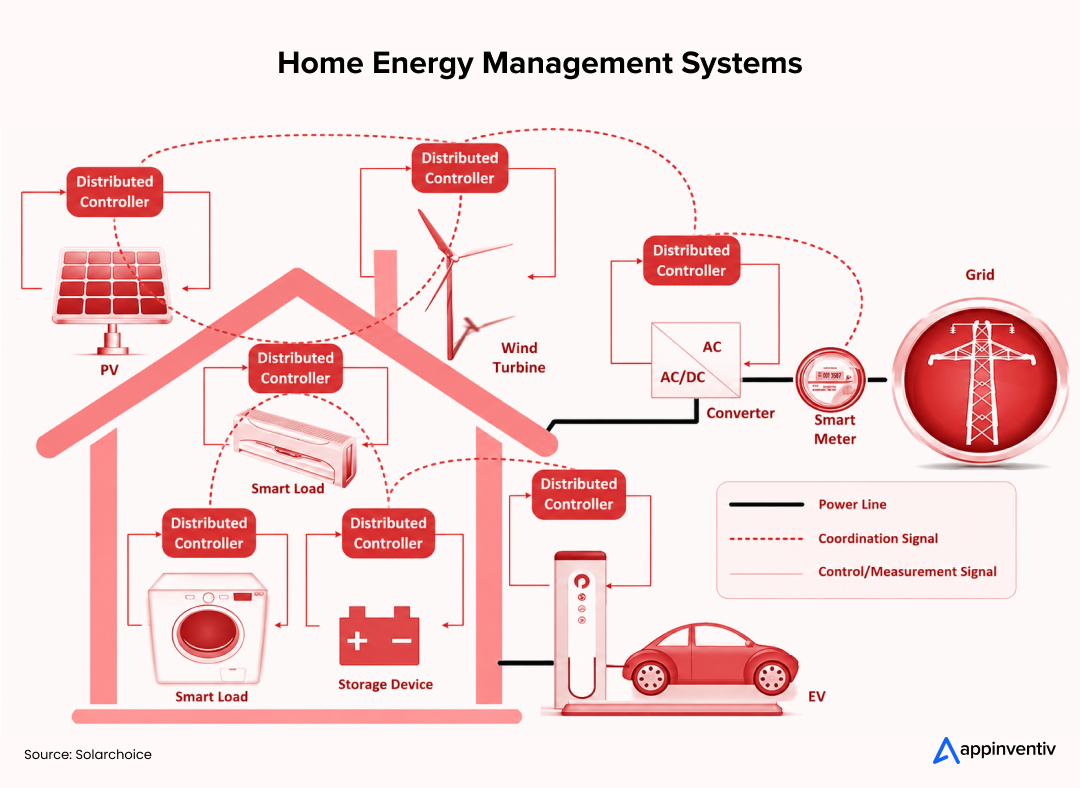
Asset scope also matters in determining energy management system development cost in Australia. Systems managing electricity-only loads are structurally simpler than those tracking gas, water, solar generation, wind, battery storage, and EV charging stations simultaneously. Each additional asset class introduces protocol diversity, data normalisation overhead, and integration complexity that compounds across the build.
Also Read: AI in Smart Homes in Australia: Use Cases, Cost & Real-Examples
Why EMS Demand Is Surging in Australia Right Now
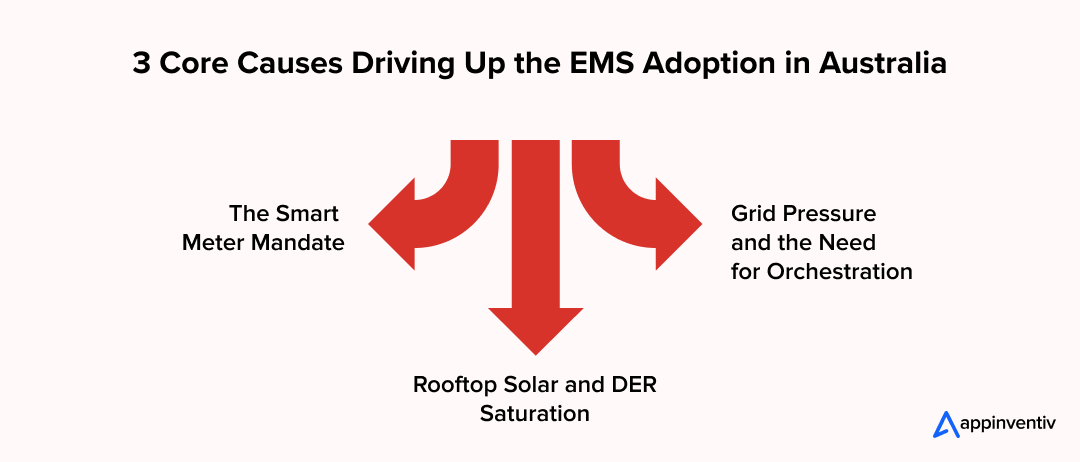
Three structural shifts are driving investment in energy management systems in Australia: a mandated smart meter rollout, rooftop solar saturation that is straining network stability, and the orchestration complexity that comes with grid modernisation. These are not market trends; they are regulatory and engineering realities that are forcing action.
The Smart Meter Mandate
The Australian Energy Market Commission has confirmed universal smart meter deployment across the NEM by 2030, with legacy Type 5 and 6 meters replaced under a Legacy Meter Replacement Plan by 1 December 2030.
The AEMC projects that 100% smart meter penetration will deliver approximately $507 million in net benefit to national electricity market regions, including NSW, QLD, the ACT and SA.
For organisations building or upgrading an energy data management system, this rollout fundamentally changes what metering integration can and must do.
Rooftop Solar and DER Saturation
Australia leads the world in residential solar adoption. Approximately 43% of Australian households now have rooftop solar, and rooftop PV delivered 12.4% of total national generation in 2024.
AEMO’s Integrated System Plan projects roughly 36 GW rooftop solar in the NEM by 2030 and 42.5 GW by 2036. The Cheaper Home Batteries program accelerated this further, with 183,245 batteries installed in the second half of 2025 alone
EMS that cannot handle bidirectional flows, battery dispatch, and solar curtailment logic is already architecturally underpowered for the Australian market.
Grid Pressure and the Need for Orchestration
VPPs, dynamic operating envelopes, and network constraint management are not future concepts. AEMO and distribution network service providers are actively implementing them today.
Organisations building a smart energy management system in this environment need platforms that can ingest market signals, respond to dispatch instructions, and maintain audit trails that satisfy AEMO DER Register requirements and network operator expectations.
The business energy management system of five years ago, focused primarily on dashboards and reporting, is no longer fit for purpose in this context.
Also Read: AI Implementation in Australia (2026): Use Cases & Costs
EMS Development Cost in Australia at a Glance
On average, the cost to develop an energy management system in Australia ranges between AUD 70,000 and AUD 800,000. However, this is just a rough estimate; the actual cost ranges vary substantially across system types, organisational scale and various other factors (details later)
The table below is structured around delivery tiers, which gives decision-makers a more accurate basis for budget planning than a single indicative figure.
| Tier | AUD Range | Timeline | System Type |
|---|---|---|---|
| MVP / Pilot | 70,000 – 150,000 | 3–5 months | HEMS, basic BEMS |
| Mid-Tier | 150,000 – 400,000 | 6–10 months | BEMS, IEMS, energy data management system |
| Enterprise | 400,000 – 800,000+ | 12–18+ months | Utility EMS, AI-based EMS, VPP platforms |
Energy Management System Cost Estimator
| Expense Category | Estimated (AUD) | Share |
|---|---|---|
| Architecture | 105,000 | 56.0% |
| Integrations | 45,000 | 24.0% |
| Analytics | 37,500 | 20.0% |
| Security | 60,000 | 10.0% |
EMS Development Cost by Project Stage
Energy management system development costs in Australia are not uniformly distributed across a delivery programme. Discovery and architecture investment at the front end consistently reduces remediation costs later. The table below reflects proportional budget allocation across a typical enterprise EMS build.
| Stage | % of Total Budget | Key Activities |
|---|---|---|
| Discovery & Energy Assessment | 8–12% | Requirements analysis, energy asset mapping, regulatory review, data flow design |
| Architecture Planning | 10–15% | System design, cloud/edge topology, protocol selection, security architecture |
| UI/UX Design | 14–20% | Dashboards, operator workflows, mobile interfaces, accessibility |
| Core Development | 30–40% | Data ingestion, analytics engine, control logic, API framework |
| Integration Phase | 15–20% | Smart meter, BMS, SCADA, ERP, solar/battery/EV connections |
| Testing & Validation | 8–12% | Load testing, failover, energy accuracy validation, penetration testing |
| Deployment & Training | 5–8% | Environment setup, cutover, operator training, documentation |
| Ongoing Optimisation | Ongoing | Model retraining, regulatory updates, feature iteration |
Key Factors That Determine the Cost to Develop an Energy Management System in Australia
Treating an EMS as a monolithic product is an error. The final investment required depends entirely on the features of an EMS you choose to prioritise, system type, integration complexity and so on. Here are the key factors affecting the cost of building energy management systems.
Scope and System Type (around 25% of cost variance)
Scope definition is the single biggest cost lever. A home energy management system serving thousands of consumer accounts has different scaling economics from a single utility grade control room platform. Organisations that enter development with ambiguous scope consistently overspend relative to those with a disciplined requirements process. So, decide the category first. Everything else follows.
Feature Complexity (around 20%)
Real-time monitoring, automated control, ML-based forecasting, and market-responsive dispatch represent a significant jump in cost from basic reporting. For instance, an AI-based energy management system with load prediction and self tuning optimisation usually pays for itself within two billing cycles for large consumers, but it sits at the top of the feature cost curve.
| Feature module | Indicative cost (AUD) |
|---|---|
| Monitoring dashboards and alerts | 5,000 to 10,000 |
| Reporting and ESG exports | 8,000 to 12,000 |
| Tariff optimisation engine | 12,000 to 30,000 |
| Billing and settlement | 10,000 to 35,000 |
| Automated control and demand response | 20,000 to 40,000 |
| ML forecasting and self tuning optimisation | 30,000 to 45,000 |
Hardware and Protocol Integration (around 18%)
Smart meters, IoT sensors, Modbus, BACnet, DNP3, MQTT – the protocol surface of an Australian EMS build can be wide. Each integration point carries cost not just in development hours but in testing rigour, particularly where safety-critical systems such as SCADA or industrial control systems are involved. This is not an area where shortcuts hold.
Data Architecture, Cloud, and Real Time Processing (around 12%)
High-frequency telemetry at scale demands careful data architecture decisions. Time-series databases, edge processing, real-time streaming, and cloud storage for historical analytics all carry licensing and infrastructure costs that compound over the platform’s life. Data sovereignty expectations push most enterprise buyers toward onshore cloud regions, which affects hosting cost. Decisions made at architecture stage have long tails.
UI/UX Design Depth (around 8%)
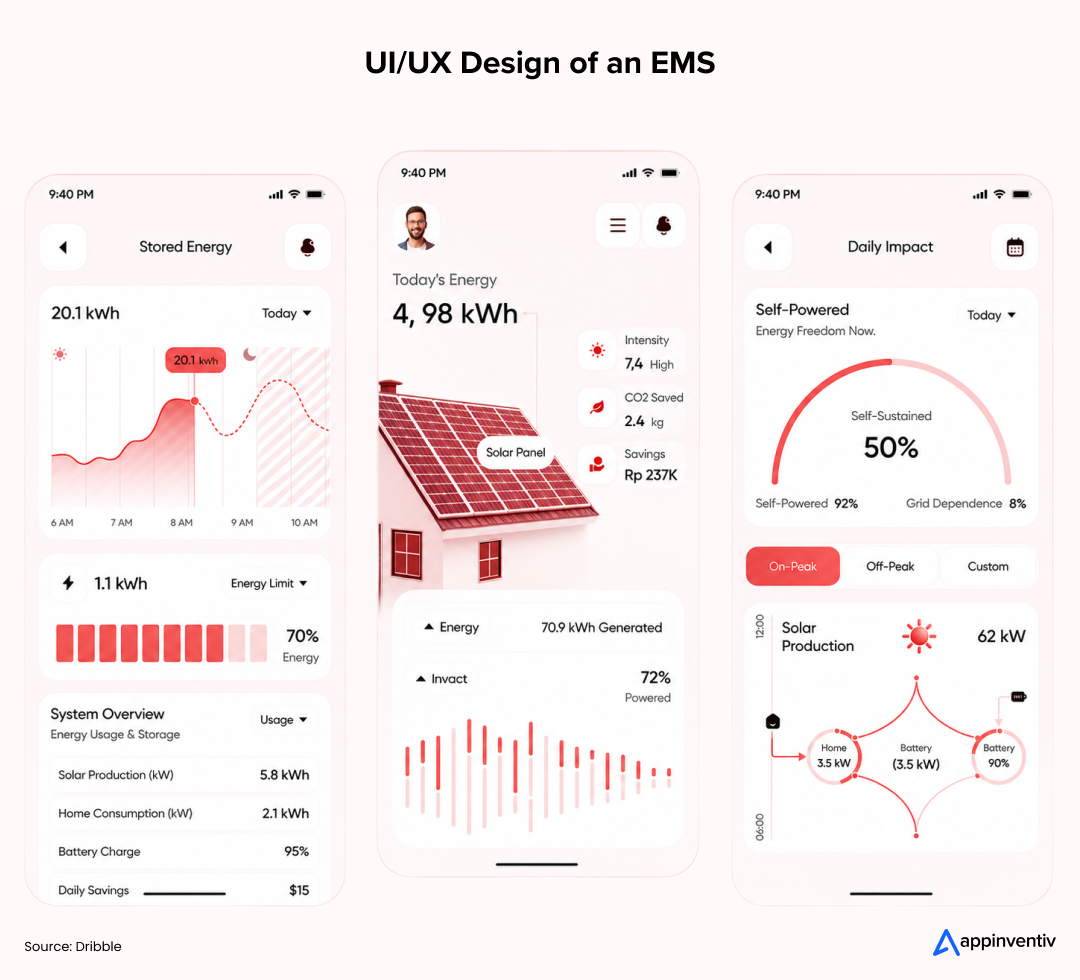
Operator consoles, executive dashboards, and consumer mobile experiences are three different design problems. A control room interface used around the clock justifies far more design investment than an internal reporting screen. Expect AUD 25,000 to 45,000 depending on user roles, accessibility requirements, and whether a white label theme layer is needed.
Australian Compliance and Security Overhead (around 10%)
Compliance is a cost centre in Australian EMS builds in a way that does not apply equally in other markets. The privacy obligations under the Privacy Act, CDR for energy, AEMO DER Register requirements, and the cyber security expectations (Covered in detail below) that come with critical-infrastructure-adjacent systems add engineering overhead that is non-negotiable. Organisations that treat these as afterthoughts pay for them twice.
Team Model and Location (around 7%)
Onshore senior engineers in Australia command salaries that put a fully local build out of reach for many mid market budgets. Blended delivery models, with onshore architecture and governance plus offshore build capacity, routinely reduce total cost by 30 to 40% without giving up accountability.
Integration Costs: The Budget Line Most Estimates Miss
Integration is consistently the most underestimated cost category in energy management system development in Australia. The interfaces between an EMS and third-party systems like metering, building controls, enterprise platforms, and renewable energy assets, are where project budgets most frequently run over schedule and over spend.
Integration commonly consumes 15 to 20% of the budget, and on brownfield industrial sites it can exceed 30%.
| Integration Type | Examples | Cost Indicator | Key Complexity Drivers |
|---|---|---|---|
| Smart Meters | Type 4 NMI meters, AEMO metering data | Medium-High | MDFF/NEMREADS format, data latency requirements |
| SCADA Systems | GE CIMPLICITY, Ignition, Wonderware | High | Real-time control, security isolation, custom drivers |
| ERP Platforms | SAP S/4HANA, Oracle Fusion, Microsoft Dynamics 365 | Medium | Data model alignment, billing integration, master data |
| Solar Platforms | SolarEdge, Fronius, SMA inverter APIs | Medium | Inverter protocol variation, generation data normalisation |
| Battery Management Systems (BMS) | Tesla Powerwall, Sonnen, Alpha-ESS | Medium-High | State-of-charge reporting, dispatch command interfaces |
| EV Charging Networks | OCPP 1.6/2.0, ChargePoint, Evie Networks | Medium-High | Load management, smart charging profiles, billing |
| Utility Data Providers | Energy Made Easy, AEMO market data feeds | Low-Medium | API rate limits, data quality, consent frameworks |
Australian Regulatory and Compliance Costs You Cannot Ignore
Regulatory alignment in Australian EMS development is not a documentation exercise. It shapes architectural decisions from data residency through to access controls and audit logging. The cost of building compliance in from the start is consistently lower than retrofitting it after an audit or incident.
Energy Market Rules
The National Electricity Rules (NER) and National Energy Retail Rules (NERR) govern metering, data access, and DER registration. Platforms that interact with the market, including those supporting VPP operations, demand response, or embedded network management, must comply with the AEMO DER Register and metering framework obligations.
These are not optional. Non-compliance creates operational risk that boards and risk committees in ASX-listed and regulated organisations take seriously.
Data and Privacy Obligations
The Privacy Act and the Consumer Data Right (CDR) for energy introduce specific obligations around data handling, consent, and portability that have direct implications for how an energy data management system stores, processes, and exposes customer data.
CDR for energy is expanding, and platforms that do not account for accredited data recipient obligations at architecture stage will face costly rework as the regime matures.
Cyber Security Expectations
An EMS operating in proximity to grid infrastructure or critical industrial systems is expected to meet a security baseline that aligns with the Australian Cyber Security Centre’s Essential Eight and, where applicable, the Security of Critical Infrastructure Act 2018 obligations.
For organisations operating in regulated industries such as energy networks, financial services, government, these requirements carry board-level accountability. Designing for least privilege access and audit logging from the start typically adds 8 to 12 percent. Bolting it on later costs multiples of that.
How Long Does It Take to Build an EMS in Australia?
Timeline and cost are tightly coupled. Compressed delivery timelines increase cost; under-resourced timelines increase both project drag and opportunity cost. The ranges below reflect realistic delivery at each tier with an experienced team and defined scope.
| Tier | Timeline | Key Milestones |
|---|---|---|
| MVP / Pilot | 4–6 months | Discovery, core monitoring, 1–2 integrations, basic dashboard, user acceptance |
| Mid-Tier | 6–10 months | Full feature set, 3–5 integrations, analytics, compliance review, staged rollout |
| Enterprise | 10–18+ months | Full architecture, AI/ML layer, 6+ integrations, regulatory alignment, phased deployment |
How to Reduce EMS Development Cost Without Compromising Quality
Cost reduction in EMS development does not mean building less. It means sequencing investment intelligently, reusing proven frameworks, and adopting an MVP-first methodology. The four approaches listed below consistently lower the Energy Management System development cost in Australia without weakening the product:
- Build MVP first. Prove value on monitoring and alerting for one site class, then fund control and optimisation from demonstrated savings.
- Phase the rollout. Sequence sites by data quality and meter readiness rather than attempting a big bang cutover.
- Reuse proven integration frameworks. Pre built NEM12, Modbus, and inverter connectors can remove 200 to 400 hours of bespoke work.
- Choose a tech partner with energy domain expertise. A generalist team learns the NEM on your invoice. A specialist energy software/system development company arrives with that knowledge already paid for.
How to Monetise Your Energy Management System in Australia
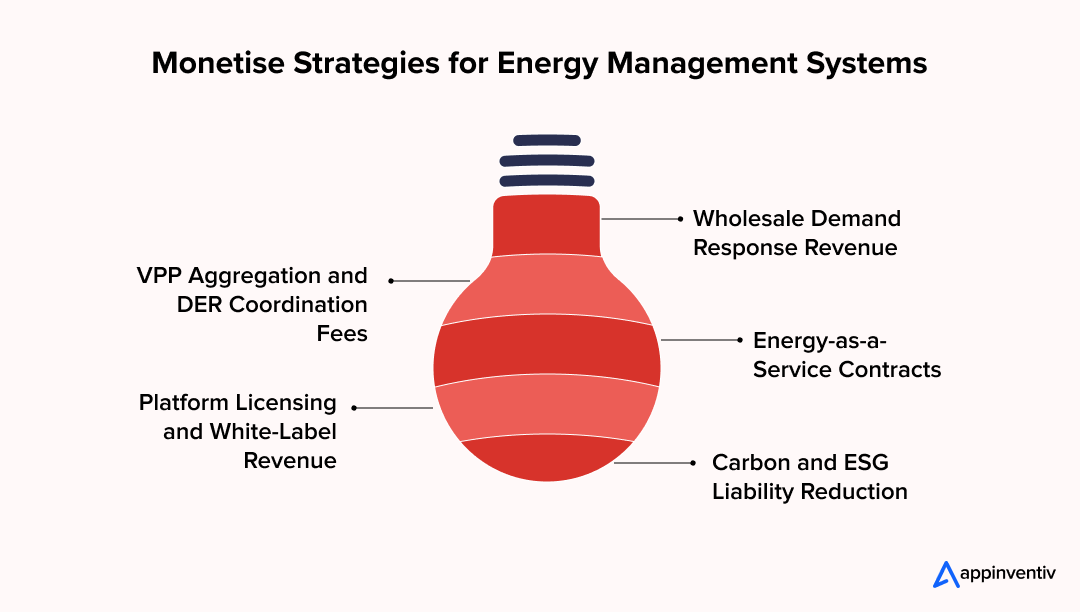
The platform economics of an EMS extend well beyond operational cost reduction. Organisations that design for monetisation from the start build significantly more durable commercial cases. The ROI levers below are not theoretical; each is operational in the current Australian energy market.
Wholesale Demand Response Revenue
AEMO’s Wholesale Demand Response Mechanism allows market participants to bid flexible load reductions directly into the NEM spot market. An EMS with automated dispatch capability, able to respond to price thresholds or AEMO instructions within defined response times, can generate direct market revenue from load assets that were previously passive. For C&I operators with significant interruptible load, this is a recurring income stream that materially improves the platform’s payback period.
VPP Aggregation and DER Coordination Fees
Virtual Power Plant aggregators generate fee-based revenue by coordinating distributed battery and solar assets to deliver grid services on behalf of network operators or retailers. An EMS built with the dispatch architecture, DER Register compliance, and metering integration to support VPP operations creates a platform that third-party asset owners will pay to join. The commercial model is established, several Australian retailers and technology companies are already operating at scale in this space.
Energy-as-a-Service Contracts
Energy-as-a-Service (EaaS) arrangements, where the EMS underpins an outcome-based commercial contract rather than a software licence, are gaining traction in Australian C&I markets. The platform operator takes on energy cost risk in exchange for a share of verified savings. This model requires an EMS with robust metering, baselining, and verified savings reporting – capabilities that, once built, also satisfy the measurement and verification requirements that underpin green financing and ESG-linked debt instruments.
Platform Licensing and White-Label Revenue
An EMS built on a well-designed multi-tenant architecture can be licensed to energy retailers, network businesses, or facility management companies who need the capability but lack the engineering resource to build it. White-label distribution has proven commercially viable for several Australian energy technology companies and represents a path from internal tool to product revenue without a proportional increase in operating cost.
Carbon and ESG Liability Reduction
One of the tangible benefits of implementing an AI energy management system for your business is the quality of emissions data it produces. Automated, meter-verified carbon accounting reduces the manual overhead of sustainability reporting, supports Scope 1 and Scope 2 disclosure under the Australian Sustainability Reporting Standards (ASRS), and provides the audit trail that boards, lenders, and institutional investors increasingly require.
For organisations with net-zero commitments, the EMS is not a discretionary investment; it is the operational infrastructure that makes those commitments credible and reportable.
Accelerate your ESG and sustainability initiatives with intelligent energy management.
Build a platform that delivers real-time energy visibility, compliance reporting, and optimization insights across your operations.

In-House vs Outsourced EMS Development: Cost and Trade-offs
Selecting the right delivery model is as consequential as the budget decision. Each delivery model carries a distinct risk profile, cost structure, and capability requirement. Most large Australian enterprises do not have the specialist EMS engineering depth to execute a complex build in-house without significant external augmentation.
| Model | Indicative Cost Premium | Key Advantages | Key Risks |
|---|---|---|---|
| In-House Build | Highest (salary + infrastructure) | IP ownership, deep domain knowledge over time | Talent scarcity, long ramp-up, ongoing retention cost |
| Fully outsourced with local presence | High | Lowest unit cost, AU market knowledge | Cost premium, limited at scale |
| Hybrid | Medium | Compliance alignment,, Onshore accountability with offshore scale | Communication overhead, time zone management |
The common challenges with energy management system development in Australia (integration complexity, regulatory alignment, data sovereignty requirements, and the specialist skill set required for grid-connected builds) all favour hybrid or outsourced delivery partners with demonstrated AU market experience over in-house or offshore models.
How Appinventiv Builds Energy Management Systems in Australia?
The energy management system development cost in Australia is a significant investment, but the cost of inaction in a rapidly modernising grid is far higher. If your leadership team is evaluating the technical feasibility and commercial viability of a custom build, consulting with an experienced energy software development company in Australia (like Appinventiv) is non-negotiable.
We engineer resilient, compliant digital assets designed to perform flawlessly within the complex Australian energy market. Our team of 1600+ tech experts have engineered solutions ranging from complex renewable energy software to secure energy trading platforms, consistently driving efficiency gains of up to 35% for our enterprise clients.
Our EMS builds incorporate proven integration frameworks for smart meters, BMS, SCADA, and major renewable energy platforms, reducing integration risk and delivery timeline. We bring AI/ML engineering capability for advanced analytics, predictive optimisation, and demand forecasting.
We do not just write code; we deliver strategic operational capability. With over a decade of APAC delivery experience and more than 3000 digital assets deployed locally, we understand the nuances of the NEM. We hold ISO 27001, ISO 9001, and SOC2 certifications, maintaining a 99.50% security compliance SLA.
If you are scoping the cost to develop an energy management system in Australia and need a delivery partner who can pressure-test the architecture, validate the compliance approach, and execute against a defined business case, we would welcome a direct conversation with your technology leadership team.
Talk to Appinventiv’s energy technology team about your EMS development project today.
Frequently Asked Questions
Q. What is the difference between HEMS, BEMS, and a utility EMS?
A. The difference between HEMS, BEMS, and a utility EMS are as follows:
- A home energy management system (HEMS) is designed for residential assets such as rooftop solar, batteries, EV charging, and household load management.
- A BEMS manages commercial or industrial building systems including HVAC, lighting, and BMS-connected equipment.
- A utility or grid EMS operates at network scale, coordinating DER assets, managing grid services, and interfacing with AEMO market systems.
Each type carries different architectural requirements, integration surfaces, and compliance obligations.
Q. What are the benefits of implementing an AI energy management system for your business?
A. An AI-based energy management system delivers predictive rather than reactive energy management. The core benefits include: ML-driven demand forecasting that reduces peak demand charges; automated dispatch of flexible loads and battery storage in response to price signals or grid conditions; anomaly detection that identifies equipment faults before they become failures; and continuous optimisation as the model trains on historical operational data. For Australian C&I operators, these capabilities translate directly to measurable reductions in energy costs and improved ESG reporting.
Q. How much does it cost to develop an energy management system?
A. The cost to develop an energy management system in Australia ranges from AUD 70,000 for an MVP to AUD 800,000 or more for an enterprise or utility-grade platform. Key variables include system type (HEMS vs BEMS vs utility EMS), feature complexity (especially AI and real-time control capabilities), the number and complexity of third-party integrations, and the regulatory compliance overhead specific to the operating context.
Q. How do you develop an energy management system?
A. Developing a custom energy management system (EMS) in Australia involves eight strategic steps: discovery and energy assessment, architecture planning, UI/UX design, core development, integration with hardware and enterprise systems, testing and validation, deployment and training, and ongoing optimisation.
The process to build energy management software in Australia also includes a regulatory review phase that addresses metering framework obligations, AEMO DER Register requirements, Privacy Act compliance, and cyber security architecture.
Q. Which industries benefit most from energy management systems?
A. Commercial real estate, manufacturing, mining, data centres, healthcare, utilities, and government are the primary beneficiaries of business energy management systems in Australia. Any organisation with significant energy spend, complex tariff structures, or DER assets to manage and particularly those with ESG reporting obligations has a strong commercial case for EMS investment.
Q. How do energy management systems work?
A. Energy management system software collects data from meters, sensors, IoT devices, and connected assets; normalises it into a unified data model; runs analytics and control logic against predefined objectives (cost minimisation, peak demand reduction, carbon targets); and executes automated or operator-confirmed actions. Modern platforms include real-time dashboards, alerting, API-based integrations with third-party systems, and in more advanced builds, AI-driven optimisation layers that adapt to changing operational conditions.
Q. What is the ROI of an energy management system?
A. The ROI of an energy management system in Australia is driven by energy cost reduction (typically 10-30% of operational spend), demand charge avoidance, carbon liability reduction, and where the platform supports market participation, wholesale demand response or VPP revenue. For enterprise builds, the payback period is typically two to four years, with the business case strengthened by long-term energy price volatility and tightening ESG disclosure requirements.