[ad_1]
In this article, you will learn how to future-proof your AI engineering career for 2026 by deepening core fundamentals, embracing system-level automation, and aligning your work with open source and evolving policy.
Topics we will cover include:
- Mastering mathematical and systems foundations that outlast tools.
- Turning automation into leverage through meta-engineering and cross-disciplinary fluency.
- Building production-grade infrastructure and operationalizing ethics and compliance.
Let’s get to it.
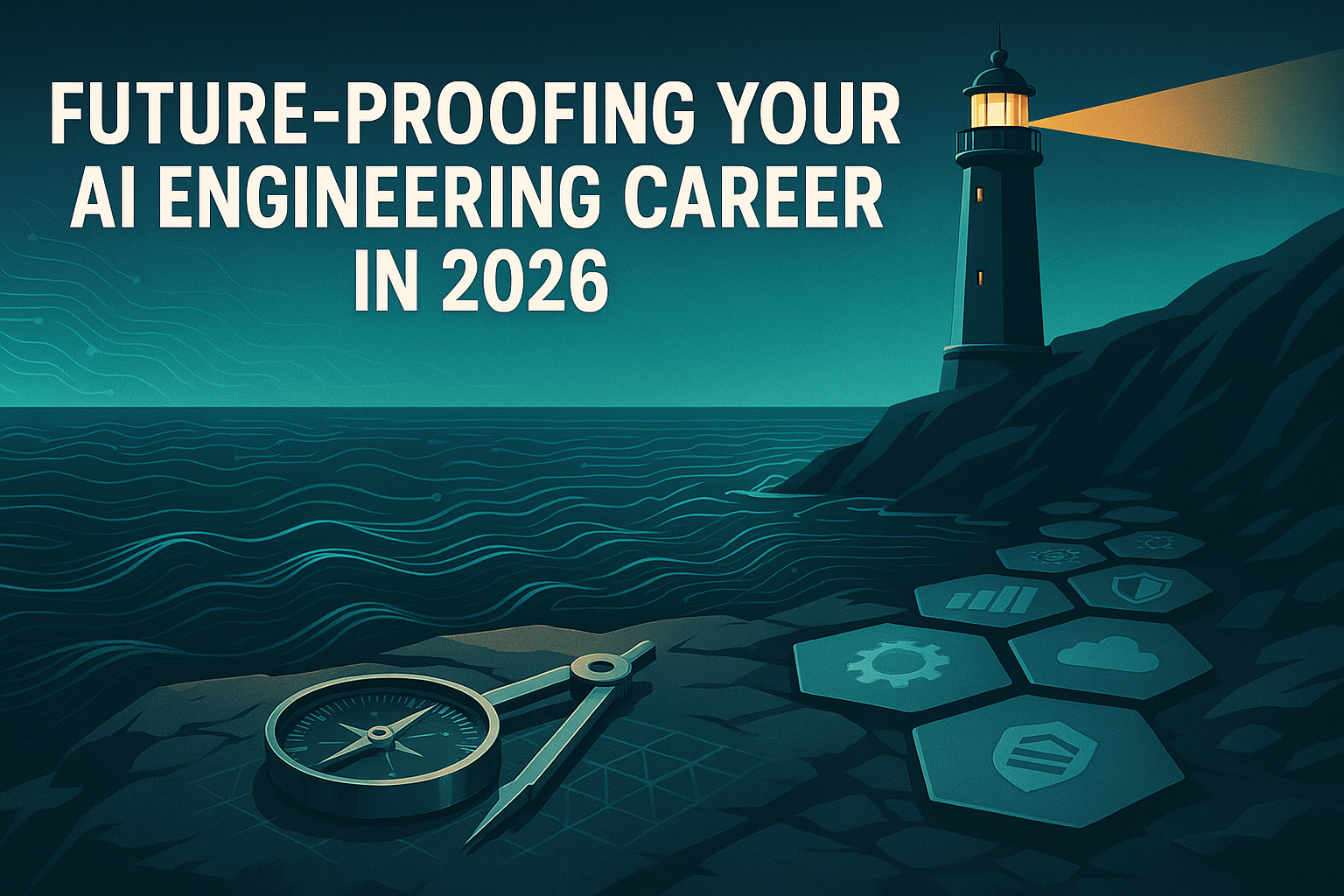
Future-Proofing Your AI Engineering Career in 2026
Image by Editor
Introduction
AI engineering has shifted from a futuristic niche to one of the most in-demand tech careers on the planet. But here’s the uncomfortable truth: the skills that made AI engineers successful five years ago might not hold up much longer.
The pace of innovation is ruthless, and automation is even starting to encroach on its own creators. So, how do you make sure you’re not replaced by the very models you help build? Future-proofing your AI engineering career isn’t just about chasing the latest tools — it’s about adapting faster than the industry itself.
Mastering the Foundations Others Skip
Every new AI trend — be it generative agents, multimodal transformers, or synthetic data pipelines — builds on the same fundamental principles. Yet many engineers race to learn frameworks before understanding the math behind them. That shortcut works only until the next architecture drops. Those who understand linear algebra, optimization, probability theory, and information theory can rebuild their mental models no matter how technology shifts.
Deep learning libraries like PyTorch or TensorFlow are powerful, but they’re also temporary. What lasts is the ability to derive a loss function, understand convergence behavior, and reason about data distributions. These foundations form the backbone of long-term technical resilience. When new paradigms emerge — quantum-inspired AI, neurosymbolic reasoning, or self-supervised architectures — engineers who know the underlying math can adapt immediately.
The paradox of AI careers is that the deeper you go into theory, the more versatile you become. Being the person who can diagnose why a model collapses during training or who can spot instability in gradients will be sought after everywhere. Whether it’s the compliance minefield of medical devices or the turbulent financial industry, AI engineers will be as indispensable as executives and managers are now.
Staying on the Right Side of Automation
AI engineering is one of the few fields where automation directly threatens practitioners. AutoML platforms, code-generation models, and automated data labeling tools are getting frighteningly competent. But the trick isn’t to fight automation, it’s to manage and extend it. Engineers who can fine-tune automation tools or integrate them into larger systems won’t be replaced by them.
Understanding where human intuition still outperforms machines is essential. For example, prompt engineering might fade, but prompt strategy — how and when to integrate language models into workflows — is here to stay. The same applies to AutoML: the platform might build the model, but it takes human judgment to interpret, deploy, and align it with business constraints.
In short, the future AI engineer won’t just code models; they’ll orchestrate intelligent systems. The key skill is meta-engineering: building the infrastructure that lets automation thrive safely, efficiently, and ethically.
Building Cross-Disciplinary Fluency
The next generation of AI engineering will be less about isolated model performance and more about integration. Employers increasingly value engineers who can translate technical systems into business, design, and ethical contexts. If you can talk to a data privacy lawyer, a UX researcher, and a DevOps engineer in the same day, you’re indispensable.
AI systems are leaking into every corner of the enterprise stack: predictive analytics in marketing, LLM copilots in customer service, edge AI in manufacturing. Engineers who can bridge gaps — like optimizing inference latency and explaining fairness metrics to non-technical teams — will lead the next wave of AI leadership.
In 2026, specialization alone won’t cut it. Cross-disciplinary fluency gives you leverage. It helps you anticipate where the industry is moving and lets you propose solutions others can’t see. Think less in terms of models and more in terms of systems—how they interact, scale, and evolve.
Learning to Leverage Open Source Ecosystems
Open source has always been the heartbeat of AI progress, but in 2026 it’s more strategic than ever. Companies like Meta, Hugging Face, and Mistral have shown that open ecosystems accelerate innovation at an impossible pace. AI engineers who can navigate, contribute to, or even lead open projects gain instant credibility and visibility.
The best way to future-proof your skill set is to stay close to where innovation happens first. Contributing to repositories, building lightweight tools, or experimenting with pre-trained models in novel ways gives you intuition that closed environments can’t replicate. It also builds reputation—one pull request can do more for your career than a dozen certificates.
Moreover, understanding how to evaluate and combine open-source components is a differentiator. The ability to remix tools—like pairing vector databases with LLM APIs or combining audio and vision models—creates custom solutions fast, making you invaluable in small, fast-moving teams.
Understanding AI Infrastructure, Not Just Models
The model is no longer the hardest part of the pipeline; the infrastructure is. Data ingestion, GPU optimization, distributed training, and model serving now define production-level AI. Engineers who understand these systems end to end can command entire workflows, not just one piece of it.
Cloud-native MLOps with Python, containerization with Docker and Kubernetes, and frameworks like MLflow or Kubeflow are rapidly becoming essential. These tools allow AI models to survive outside notebooks, scaling them from prototypes to revenue-generating systems. The more fluent you are in building and maintaining these pipelines, the less likely you are to be replaced by automation or junior engineers with narrow skills.
By 2026, every AI team will need hybrid professionals who can blend research insight with deployment expertise. Knowing how to push a model into production — and make it observably robust — is what separates practitioners from professionals.
Adapting to Ethical, Legal, and Societal Shifts
AI’s future won’t just be written in code, it will be written in policy. As regulations evolve, from the EU AI Act to U.S. data transparency frameworks, compliance knowledge will become part of the AI engineer’s toolkit. Understanding how to embed fairness, accountability, and explainability into your models will soon be non-negotiable.
But ethics isn’t only about avoiding legal trouble; it’s a design constraint that improves systems. Models that respect privacy, maintain interpretability, and minimize bias gain trust faster, which is increasingly the competitive edge. Engineers who can operationalize these values turn abstract principles into measurable, enforceable safeguards.
AI engineers of the future won’t just code — they’ll mediate between technology and humanity. Being able to predict the societal ripple effects of automation will make your work both defensible and desirable.
Conclusion
The AI engineer of 2026 won’t survive on technical skill alone. The ones who thrive will blend strong fundamentals with cross-disciplinary intuition, system-level understanding, and ethical foresight. Tools will change, APIs will die, and new architectures will dominate, but adaptability never goes out of style.
Your greatest advantage isn’t mastering what exists now — it’s being ready for what doesn’t exist yet. Build fluency, stay close to open innovation, and keep questioning your assumptions. That’s how you ensure your career evolves faster than the machines you create.
[ad_2]
Source_link