Key takeaways:
- Autonomous LangChain agents now orchestrate finance, support, compliance, and IT workflows across enterprise systems in real time.
- LangGraph enables long-running, stateful AI workflows with checkpoint recovery, branching execution, and human approval controls.
- Enterprise AI agents require orchestration, governance, observability, and memory management beyond traditional prompt engineering techniques.
- Multi-agent architectures are replacing static automation systems across procurement, enterprise search, and operational decision pipelines.
- Organizations deploying production-grade AI agents already report measurable ROI, lower operational overhead, and faster workflow execution.
Most enterprise automation systems still follow fixed rules. They move data from one system to another, trigger alerts, or complete repetitive tasks. The problem with standard LangChain agents development starts once workflows become unpredictable. A support ticket changes priority. A finance request needs approval from three teams. An API call fails halfway through execution. Traditional automation tools struggle in these situations.
This shift has pushed enterprises toward enterprise AI workflow automation at scale. Modern agents can store context, call external tools, retrieve data, and continue tasks across long execution cycles. They do not operate like simple chat interfaces. They function more like orchestration layers connected to APIs, vector databases, ERP platforms, and internal business systems.
LangChain gained traction through this transition. LangGraph expanded that capability with stateful execution, checkpointing, branching logic, and workflow recovery. Deep Agents pushed the model further with support for long-running and non-deterministic tasks.
Enterprise deployment still requires careful engineering. Memory handling, observability, fallback logic, RBAC policies, audit logs, and human approval systems shape real production environments.
Teams that treat AI agents like operational infrastructure are already seeing measurable results. Recent enterprise research shows 80% of organizations report measurable ROI from AI agent deployments, and 57% already use agents for multi-stage workflows across operations.
88% Report Positive Agentic ROI
Long-running AI workflows are already reducing operational delays, fragmented execution paths, and enterprise process bottlenecks at scale.
How to Build LangChain Agents for Autonomous Workflows Step by Step
Building enterprise-grade autonomous agents requires more than prompt engineering. Teams need orchestration control, runtime visibility, memory persistence, and governance layers from the start.
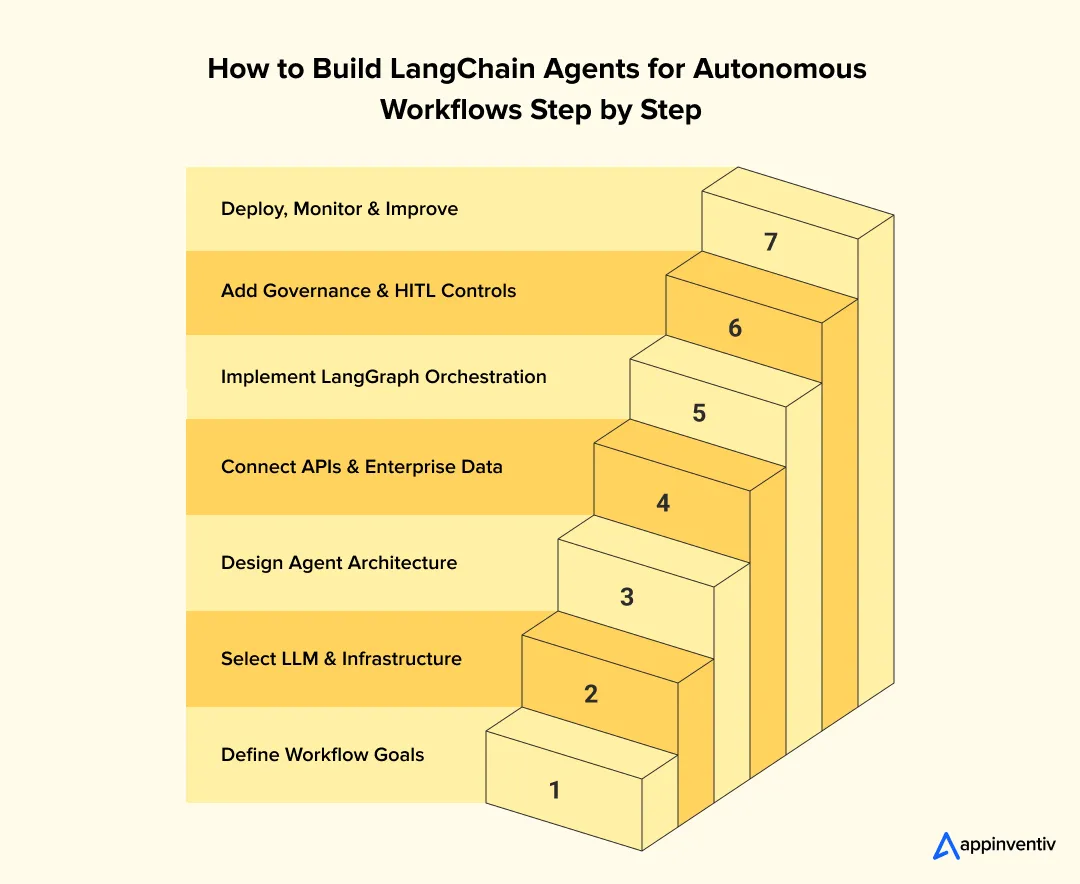
Step 1: Define Workflow Boundaries and Agent Objectives
To build AI agents with LangChain effectively, start with tightly scoped workflows. Most enterprise failures happen when agents receive broad autonomy without execution limits.
Break workflows into smaller stages:
- Data retrieval
- Validation
- Action execution
- Approval handling
- Escalation
Define measurable outcomes early.
Teams often track:
- Resolution time
- Workflow completion rate
- API failure rate
- Human escalation frequency
Escalation conditions should remain explicit. High-risk actions such as payment approvals or compliance updates should always trigger human review.
Step 2: Select the Right LLM and Hosting Infrastructure
Model selection affects latency, runtime cost, and deployment control. Hosted APIs reduce infrastructure overhead and speed up development.
Self-hosted models provide stronger control over:
- Data residence
- Compliance
- Internal governance
Many enterprises now combine both approaches through model routing systems. Smaller models process repetitive tasks. Larger models handle reasoning-heavy workflows.
Teams should evaluate:
- Inference cost
- Token throughput
- Regional hosting requirements
- GPU availability
- Context window limits
Design the LangChain Agent Architecture and Execution Topology
LangChain agents development at the architecture stage shapes workflow reliability. Single-agent systems work well for narrow workflows. Multi-agent systems perform better across large orchestration environments.
Many enterprises now separate workflows into:
- Planner agents
- Executor agents
- Verifier agents
Strong enterprise architectures also separate deterministic automation from adaptive reasoning systems. Fixed workflows work better for approvals, invoice routing, and compliance validation. Autonomous reasoning works better for workflows with changing context and incomplete inputs.
Distributed execution models help large workflows run across several systems without blocking runtime performance.
Step 4: Build Tool Integrations and Enterprise Data Pipelines
Enterprise agents rely on connected systems during execution.
Most deployments integrate:
- APIs
- ERP systems
- CRM platforms
- Vector databases
- Internal knowledge repositories
Agentic RAG implementation helps agents retrieve enterprise-specific information during runtime. MCP-ready architectures also simplify AI agent interoperability across growing agent ecosystems.
Industry research now shows that 46% of organizations cite integration with existing enterprise systems as the biggest obstacle during AI agent deployment.
Step 5: Implement Stateful Workflow Orchestration with LangGraph
LangChain workflow automation through LangGraph manages execution via graph-based models. Nodes represent execution stages. Edges define workflow transitions. State objects persist across retries, checkpoints, and execution branches.
This structure supports:
- Long-running workflows
- Interrupts
- Rollback handling
- Recovery after failures
Checkpointing prevents full workflow restarts during runtime interruptions.
Step 6: Add Guardrails, Governance, and Human Oversight
Production systems require a strict agentic AI governance framework.
Most enterprises implement:
- RBAC policies
- Approval workflows
- Prompt injection filtering
- Audit logging
- Escalation rules
Human reviewers should remain part of high-risk workflows involving agentic payments, compliance, or legal actions. LangGraph interrupt handling also allows workflows to pause for manual review during runtime execution.
Step 7: Deploy, Monitor, and Continuously Evaluate Agent Performance
Deployment is only the starting point for AI development services that support long-running enterprise execution.
Teams need LLMOps-driven monitoring across:
- Latency
- Token usage
- Hallucination rates
- Tool failures
- Workflow drift
LangSmith and similar observability platforms help teams trace execution paths, benchmark runtime performance, and identify orchestration failures across long-running workflows. Feedback loops and evaluation pipelines then improve workflow reliability over time.
Core Components of an Autonomous LangChain Agent
A production LangChain agent architecture relies on multiple systems working together during runtime. The LLM handles reasoning, but orchestration, memory, tool execution, and governance determine whether the workflow performs reliably in production.
How LLM Reasoning Engines Power Autonomous Decision-Making
The reasoning engine controls task planning, tool selection, and response quality. Most enterprises evaluate models across latency, reasoning depth, hosting flexibility, and cost.
| Model Type | Enterprise Strength |
|---|---|
| GPT-5 | Structured reasoning and tool orchestration |
| Claude | Long-context processing and document-heavy tasks |
| Gemini | Google Cloud alignment and multimodal workflows |
| Llama 4 / OSS Models | Open source AI agent framework with data control and private deployment |
Many enterprises now use model routing systems. Smaller models handle repetitive tasks, and larger models process high-risk reasoning workflows.
How Tool Calling Enables Real-Time Enterprise System Execution
Tool calling connects agents to business systems such as Salesforce, SAP, ServiceNow, PostgreSQL, and internal APIs.
A support agent can:
- Retrieve CRM records
- Query invoices
- Search policy documents
- Escalate unresolved requests automatically
LangChain supports structured outputs and function calls for controlled execution.
Most production systems include:
- Schema validation
- Retry logic
- Fallback tools
- Execution logging
These controls reduce failed API calls and invalid actions.
How Memory and Stateful Context Management Support Long-Running Workflows
Memory allows agents to continue workflows across long execution cycles.
Short-term memory stores active context. Long-term memory stores persistent workflow history. Semantic memory handles RAG in generative AI retrieval through vector databases.
LangGraph manages this through stateful execution graphs. Workflows can pause, recover from checkpoints, or resume after failures without restarting the entire process.
This becomes critical in:
- Compliance reviews
- Procurement approvals
- Financial reconciliation workflows
Enterprises often apply encrypted state storage, retention policies, and RBAC controls across memory systems. Checkpoint recovery systems should restore workflows safely without exposing sensitive runtime data.
How Planning and Reflection Loops Improve Agent Reliability
Production agents rarely rely on single-step reasoning.
ReAct architectures combine reasoning and tool execution in iterative loops. Planner-executor systems separate task planning from execution. LLM-as-a-judge evaluator agents then verify outputs and detect failures.
Reflection loops help agents:
- Retry failed tasks
- Correct invalid outputs
- Adjust execution paths during runtime
These systems improve workflow reliability across large enterprise processes.
How Orchestration Layers Control Non-Linear Workflow Execution
Traditional automation follows fixed execution paths. Autonomous workflows branch dynamically during runtime.
LangGraph uses graph-based orchestration with:
- Nodes
- Edges
- Conditional routing
- Interrupts
- Retries
- Checkpoint recovery
A workflow can pause for human approval, reroute failed actions, or automatically escalate high-risk cases.
Most enterprises combine deterministic workflows for approvals with adaptive execution for customer-facing operations.
How Observability and Governance Improve Enterprise Agent Performance
Production failures often happen outside the prompt layer.
Teams need visibility into:
- Tool failures
- Hallucinations
- State corruption
- Routing errors
LangSmith provides tracing across prompts, tools, memory states, and execution paths. Enterprises also run evaluation pipelines, audit logging, and policy validation before production rollout.
Governance layers track workflow actions, approvals, and memory access across the system.
Reference Architecture of an Enterprise Autonomous Agent System
A production-grade LangChain agent architecture typically includes the following layers:
| Layer | Function |
|---|---|
| LLM Layer | Reasoning, planning, structured generation |
| Orchestration Layer | Workflow routing, retries and branching logic |
| Memory Layer | Stateful context, checkpoints, retrieval history |
| Tool Layer | APIs, ERP systems, CRM systems, databases |
| Vector Database | Semantic retrieval and RAG pipelines |
| Governance Layer | RBAC, policy validation, audit controls |
| Observability Layer | Tracing, evaluation, logging, telemetry |
| HITL Systems | Human approvals, escalations, workflow overrides |
Most enterprise deployments now combine these layers into a centralized execution runtime rather than into isolated AI services.
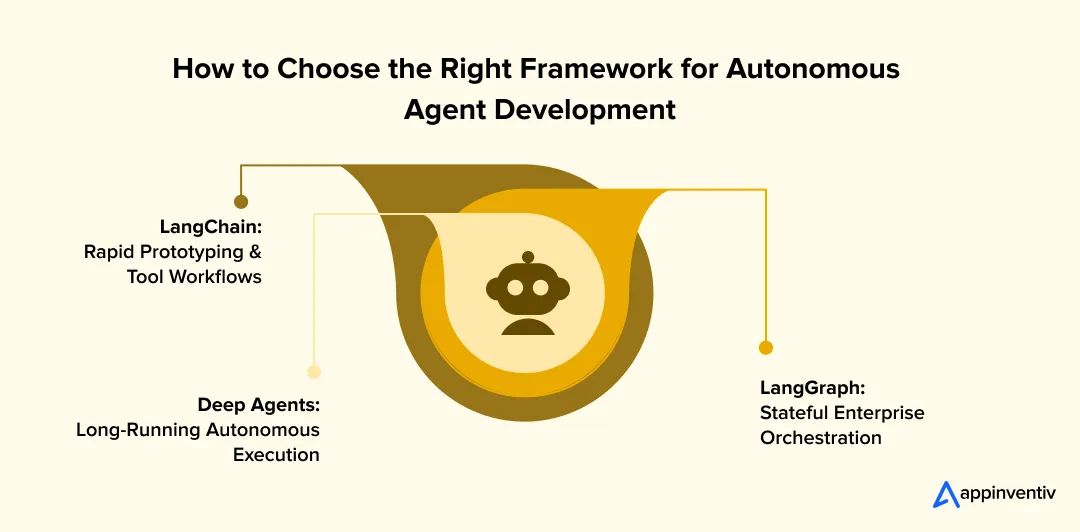
How to Choose the Right Framework for Autonomous Agent Development
Selecting the right autonomous AI agent framework shapes how agents behave in production. Some frameworks work well for lightweight workflows and rapid prototyping. Others handle long-running execution, branching logic, and persistent state management more effectively.
How LangChain Accelerates Rapid Agent Prototyping
Teams that build AI agents with LangChain benefit from reusable chains, tool abstractions, retrieval pipelines, and integrations across LLM providers and enterprise systems.
Engineering teams often use LangChain for:
- Proof-of-concept agents
- Internal copilots
- Retrieval workflows
- API-connected automation
Its modular structure supports rapid iteration during development.
LangChain does have limits in large orchestration environments. Complex workflows with retries, branching execution, or persistent runtime state often require additional orchestration layers.
LangChain’s Python ecosystem and pre-built agent components reduce setup complexity for engineering teams. Developers can quickly connect LLMs, retrieval pipelines, APIs, and orchestration layers without building execution infrastructure from scratch.
How LangGraph Supports Complex Stateful Workflow Orchestration
LangGraph handles workflows that require persistent execution state and non-linear routing.
It supports:
- Graph-based execution
- Checkpointing
- Resumability
- Conditional branching
- Interrupt handling
This becomes important in enterprise systems where workflows span multiple approvals, APIs, and long-running tasks.
A compliance workflow may pause for review, recover from failures, and continue execution hours later without losing state. LangGraph manages these transitions using stateful execution graphs rather than linear chains.
LangGraph vs LangChain Agents
LangChain works well for modular agent development and rapid workflow prototyping. LangGraph handles stateful execution, branching workflows, and long-running orchestration with stronger runtime control.
| Capability | LangChain | LangGraph |
|---|---|---|
| Workflow Style | Linear chains and tool execution | Graph-based orchestration |
| State Management | Limited persistent state | Persistent state handling |
| Execution Flow | Sequential | Branching and non-linear |
| Checkpoint Recovery | Minimal | Built-in checkpointing |
| Human Interrupts | Limited | Native interrupt handling |
| Best Fit | Copilots and lightweight agents | Enterprise orchestration systems |
| Runtime Control | Moderate | High |
How Deep Agents Handle Long-Running Autonomous Execution
Deep Agents focus on workflows that require recursive planning and adaptive reasoning across extended execution cycles.
These systems support:
- Long-horizon task execution
- Recursive reasoning loops
- Adaptive planning
- Execution harnesses for non-deterministic workflows
They work well for research-heavy tasks, enterprise analysis systems, and multi-step orchestration environments where workflows evolve during runtime.
Framework Comparison Table
Each framework solves a different orchestration problem. The right choice depends on workflow complexity, state management requirements, and runtime control needs.
| Framework | Best Use Case | Workflow Complexity | State Management | Enterprise Readiness | Ideal Teams |
|---|---|---|---|---|---|
| LangChain | Rapid prototyping and standard agent workflows | Moderate | Limited | Medium | AI engineering teams building copilots and API-driven agents |
| LangGraph | Stateful and non-linear enterprise workflows | High | Advanced | High | Enterprise orchestration and platform teams |
| Deep Agents | Long-running autonomous execution systems | Very High | Advanced | High | Teams building adaptive and research-heavy agent systems |
Legacy Systems Are Slowing AI Adoption
Connect fragmented enterprise platforms through secure LangChain orchestration and multi-agent workflow execution architectures.
How Enterprises Are Deploying LangChain Agents Across Real-World Workflows
LangChain autonomous agents have moved AI agents in enterprise deployments far beyond basic chatbot interfaces. Most organizations now use LangChain and LangGraph to automate operational workflows that span multiple systems, approvals, and decision layers.
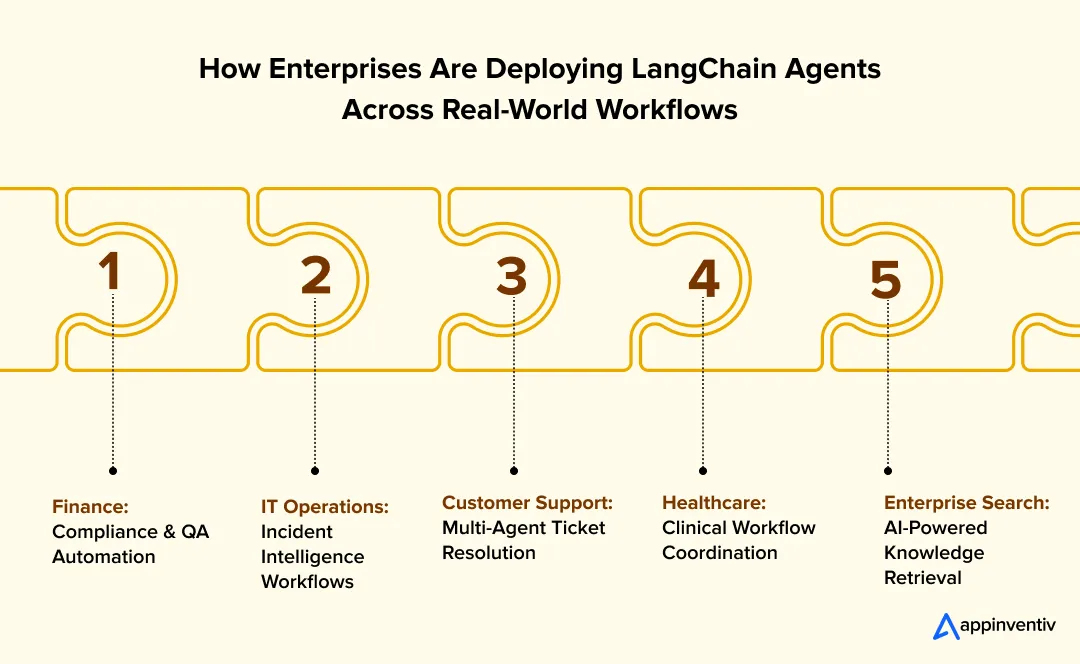
Finance Teams Are Automating QA Verification and Compliance Reviews
Prosper Marketplace deployed LangGraph to automate customer call QA verification workflows across its financial services operations. The previous process required employees to move across multiple applications manually and verify customer interactions one call at a time.
The company rebuilt this workflow using:
- LangGraph checkpoints
- Interrupt handling
- Human review loops.
The system now reviews 100% of customer calls instead of small monthly samples. Verification costs dropped from tens of dollars per review to cents per review, a pattern explored further in our breakdown of AI agent development costs.
IT Operations Teams Are Replacing Dashboard-Heavy Incident Workflows
PagerDuty built an incident intelligence agent using LangGraph to help teams retrieve operational data through Slack and Microsoft Teams instead of navigating dashboards manually.
The workflow uses:
- Memory-aware orchestration
- Fallback handling
- Retrieval pipelines
- Graph-based execution nodes
Engineering teams, product managers, and executives can now query incident trends, service health metrics, and resolution data directly through conversational workflows.
Customer Support Systems Are Shifting Toward Multi-Agent Orchestration
Cisco deployed LangChain and LangGraph across customer support environments, handling mass-scale incident workflows. The company connected multiple agentic systems through centralized tracing and modular orchestration layers.
LangGraph allowed Cisco to:
- Split large workflows into modular sub-agents
- Standardize agent communication
- Improve observability across multi-agent execution chains
This reduced operational complexity across customer-facing support systems.
Healthcare Organizations Are Building Stateful Clinical Intelligence Workflows
Vizient deployed LangGraph and LangSmith to support healthcare analytics workflows across academic medical centers and hospital systems.
The platform unified fragmented healthcare datasets and improved:
- Multi-agent orchestration
- Token management
- Continuous evaluation
- Runtime visibility
The organization also shifted from reactive debugging to continuous workflow testing and evaluation.
Enterprise Search and Internal Knowledge Systems Are Becoming Agentic
Rakuten built internal AI platforms powered by LangGraph to support more than 70 business units across Japan.
Teams use these systems for:
- Market analysis
- Internal knowledge retrieval
- Customer support
- Low-code agent creation
The company standardized evaluation, debugging, and deployment workflows through LangSmith and LangGraph orchestration layers.
Similar enterprise deployments are already delivering measurable operational gains. Suzano reduced internal enterprise query time by 95% after deploying AI agents connected to SAP Materials workflows and BigQuery environments.
Also Read: How to Build an AI Voice Agent
Benefits of Building Autonomous Workflows with LangChain Agents
Enterprise teams that build AI agents with LangChain are shifting toward autonomous workflows for one reason. Traditional automation breaks down once workflows become unpredictable. AI agents handle changing context, branching decisions, and multi-system execution more effectively.
How Autonomous Agents Reduce Operational Bottlenecks
Autonomous agents remove repetitive coordination work across departments. Teams spend less time routing tickets, validating records, or manually transferring data between systems.
How Stateful Orchestration Improves Workflow Reliability
LangGraph improves execution reliability through persistent state handling and checkpoint recovery. A workflow can pause, retry failed actions, and resume execution without restarting the entire process. This becomes important in procurement, finance, and compliance operations, where workflows often span several systems.
How AI Agents Accelerate Enterprise Decision Cycles
Enterprise AI workflow automation delivers faster record retrieval, policy validation, document summarization, and approval triggers within seconds. This reduces delays across support operations, internal reviews, and escalation pipelines.
How Autonomous Systems Improve Cross-Platform Process Execution
Enterprise AI agents for business automation help organizations operating across fragmented software environments. Autonomous agents coordinate execution across:
- ERP platforms
- CRM systems
- Vector databases
- Internal APIs
- Document repositories
This reduces workflow fragmentation and manual reconciliation work.
How Long-Running Agents Reduce Manual Intervention Across Teams
Long-running agents continue workflows across approvals, retries, and delayed responses without constant supervision.
How Enterprise AI Agents Scale 24/7 Operational Execution
AI agents process workflows continuously across regions, departments, and time zones without increasing operational headcount. Research from Google Cloud shows 88% of early AI agent adopters already report positive ROI from production deployments.
Also Read: 20+ AI Agent Business Ideas for 2026 and Beyond
How Enterprises Overcome Common Challenges in Autonomous LangChain Workflows
LangChain autonomous agents introduce new operational challenges once workflows move into production. Most enterprise deployments struggle with reliability, state handling, governance, and integration complexity during early rollout phases.
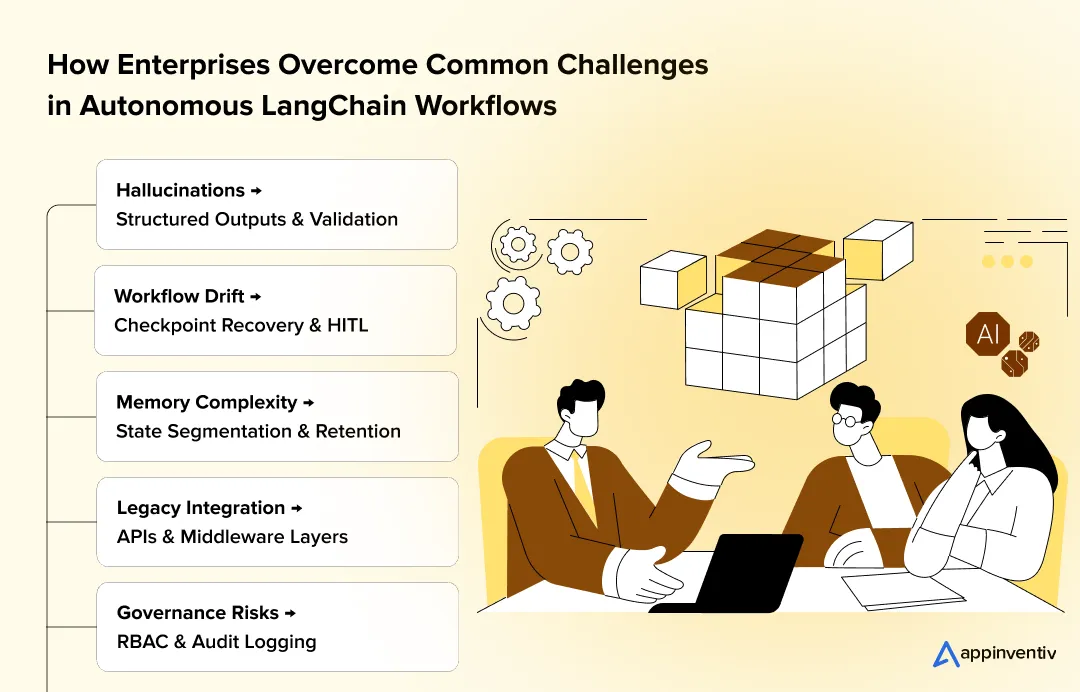
How Enterprises Reduce Hallucinations and Tool Invocation Failures
Hallucinations become more dangerous once agents interact with live systems.
Enterprises reduce these failures through:
- structured outputs,
- schema validation,
- restricted tool permissions,
- retrieval grounding,
- and evaluator agents.
Many teams also add fallback logic for failed API calls and invalid tool responses.
How Teams Manage Workflow Drift in Long-Running Agents
Long-running agents often drift from their original execution path over time.
Enterprises reduce workflow drift through:
- checkpoint recovery
- bounded execution depth
- runtime state validation
- human escalation checkpoints
- controlled tool access
LangGraph state persistence helps workflows recover without restarting entire execution chains.
How Organizations Handle State Explosion and Memory Complexity
Large workflows generate large state objects across tools, prompts, retrieval layers, and execution history.
This increases:
- Memory overhead
- Retrieval latency
- Orchestration complexity
Most enterprises separate:
- Active runtime state
- Historical memory
- Semantic retrieval stores
Retention limits and memory pruning policies also reduce unnecessary state growth.
How Enterprises Integrate Autonomous Agents with Legacy Systems
Legacy infrastructure creates integration friction across many enterprises. Research shows 46% of organizations still struggle with integration across existing enterprise systems during AI agent deployments.
Older ERP systems, internal APIs, and fragmented databases often lack standardized interfaces for modern orchestration pipelines.
Teams usually solve this through:
- Middleware layers
- API gateways
- Event-driven architectures
- Retrieval pipelines connected to legacy data stores
How Governance and Compliance Shape Enterprise AI Deployments
Governance now shapes enterprise AI adoption as much as model quality.
Most enterprises apply:
- RBAC controls
- Audit logging
- Policy validation
- Encryption standards
- Approval workflows across autonomous systems
Regulated industries often require full traceability of execution across prompts, tools, memory access, and workflow decisions.
Also Read: How to Hire an AI Agent Development Company
How LangChain Supports Customization and Flexible Agent Development
Custom LangChain agent development rarely follows fixed execution paths; teams often need agents that adapt to internal processes, approval chains, security policies, and evolving operational requirements.
Modular Agent Architectures Simplify Customization
Custom LangChain agent development benefits from modular execution through composable hooks, middleware layers, and reusable orchestration components. Teams can modify core logic without rebuilding entire workflows from scratch.
Also Read: Agentic Coding vs. Vibe Coding: Key Differences Explained
Human-in-the-Loop Systems Improve Workflow Control
Many enterprises add human-in-the-loop approval stages for workflows involving sensitive data, financial actions, or compliance validation. LangGraph interrupt handling supports these approval checkpoints during runtime execution.
Flexible Integrations Across Enterprise Systems
LangChain integrates with APIs, vector databases, ERP systems, CRM platforms, and internal tooling through standardized connectors and middleware layers. This reduces integration overhead across fragmented enterprise environments.
Support for Long Conversations and Stateful Execution
Persistent memory systems help agents maintain context across long conversations, delayed approvals, and multi-step workflows without losing execution state.
Enterprise Workflows Are Becoming Agentic
Organizations are embedding AI agents directly into operational systems instead of relying on isolated chatbot interfaces.
How Autonomous Agent Architectures Will Evolve Beyond 2026
Enterprise teams that build LangChain agents for autonomous workflows are operating amid rapidly evolving AI trends. Most companies no longer want isolated chat agents that answer questions and stop there.
The focus is shifting toward execution systems that can coordinate tasks, retrieve data, trigger workflows, and recover from failures across business environments.
- Companies will deploy groups of agents instead of single-agent systems. One agent will plan work, another will retrieve data, and another will review outputs before execution.
- MCP standards will simplify communication between agents, APIs, databases, and enterprise software platforms.
- Runtime orchestration layers will manage retries, permissions, memory state, and workflow routing automatically.
- Workflows will react to live business events such as fraud alerts, ticket escalations, infrastructure failures, and ERP updates.
- Checkpoint systems will restore workflows after interruptions instead of restarting entire execution chains from the beginning.
- Human reviewers will remain part of high-risk workflows involving finance, legal reviews, healthcare actions, and compliance operations.
- Enterprise software platforms will embed agents directly into operational systems instead of exposing them only through chat interfaces. Google Cloud research shows that 52% of enterprises already have AI agents running in production environments today.
- Logging, tracing, approval history, and runtime monitoring will become standard requirements across enterprise agent deployments.
Also Read: How Agentic AI in SaaS is Transforming Business Operations
How Appinventiv Builds Enterprise Autonomous Agent Systems at Scale
As a leading AI agent development company, Appinventiv builds autonomous AI systems for enterprise environments that go beyond prompt engineering.
Enterprise adoption is accelerating quickly, with 81% of organizations planning more complex AI agent deployments across multi-step workflows and cross-functional operations.
Large organizations need orchestration control, governance layers, observability, integration depth, and production-grade execution reliability across workflows.
Appinventiv builds enterprise AI agent systems using frameworks such as:
- LangChain
- LangGraph
- Deep Agents
- MCP-ready orchestration stacks
- Retrieval-Augmented Generation pipelines
- Multi-agent execution architectures
Our teams work across:
- Finance
- Healthcare
- Enterprise operations
- Procurement
- Compliance
- Customer support ecosystems
| Enterprise AI Capability | Appinventiv Delivery Scale |
|---|---|
| Autonomous AI Agents Deployed | 100+ |
| Data Scientists & AI Engineers | 200+ |
| Custom AI Models Trained and Deployed | 150+ |
| Industries Served | 35+ |
| Manual Process Reduction | Up to 50% |
| Agent Task Accuracy | 90%+ |
| Enterprise Scalability Improvement | 2x |
We help enterprises build:
- Stateful orchestration systems
- Human-in-the-loop workflows
- Observability pipelines
- Governance-ready agent architectures
- Secure multi-system AI execution environments
Our engineering teams focus on production deployment realities such as:
- Workflow reliability
- Checkpoint recovery
- Runtime monitoring
- Auditability
- Enterprise-scale integration across legacy and modern systems
Let’s connect and accelerate your LangChain agents development before fragmented AI workflows slow your operations.
FAQs
Q. What are LangChain agents?
A. LangChain agents development produces AI systems that can reason through tasks, call external tools, retrieve information, and execute actions across workflows. Unlike static chat interfaces, they maintain execution context and interact with APIs, databases, enterprise platforms, and orchestration layers during runtime.
Q. How to build AI agents with LangChain
A. Building LangChain agents starts with selecting an LLM, defining workflow objectives, connecting external tools, and implementing orchestration logic. Most enterprise deployments also include memory systems, retrieval pipelines, observability layers, checkpoint recovery, and governance controls for production reliability and controlled execution across workflows.
Q. How do you build autonomous AI workflows using LangChain?
A. To build autonomous AI workflows, teams need more than prompt chaining; LangChain and LangGraph orchestration, tool integrations, memory persistence, and checkpoint handling are all required. Production systems also use evaluation pipelines, runtime monitoring, and human approval layers for reliable long-running execution across enterprise environments.
Q. What is the difference between LangChain agents and traditional AI chatbots?
A. Traditional chatbots usually follow fixed conversational flows and stateless interactions. LangChain agents can reason through tasks, retrieve data, call tools, maintain memory, and execute actions across workflows. They function more like orchestration systems connected to enterprise infrastructure instead of standalone chat interfaces.
Q. Which LLMs are best for LangChain agent development?
A. GPT-4.1, Claude, Gemini, and open source AI agent framework options, such as Llama 3, are widely used for LangChain agents. The best model depends on reasoning quality, latency requirements, hosting preferences, compliance needs, and workflow complexity. Many enterprises now combine several models through routing and orchestration layers.
Q. How can LangChain agents integrate with enterprise tools and APIs?
A. LangChain agents integrate with enterprise systems through APIs, SDKs, vector databases, retrieval pipelines, and function-calling frameworks. They can connect with ERP systems, CRM platforms, ticketing tools, internal databases, and observability systems to automate workflows and coordinate actions across business operations.
Q. What are the key components of a LangChain autonomous agent architecture?
A. A complete LangChain agent architecture usually includes an LLM reasoning layer, orchestration engine, memory system, retrieval pipeline, tool execution layer, vector database, observability stack, and governance controls. Enterprise deployments also add checkpoint recovery, runtime monitoring, RBAC policies, and human approval workflows.