Key takeaways:
- Compliance is now a core business priority, influencing revenue, market access, and customer trust.
- Enterprises must navigate multiple overlapping regulations across industries and regions.
- Unified compliance controls help reduce duplicated work, complexity, and overall costs.
- Continuous monitoring and risk assessments help identify compliance gaps before they become costly issues.
- Automation streamlines evidence collection, control monitoring, and cross-framework compliance management.
- Building compliance into the architecture from day one reduces the cost of retrofitting controls later.
A data breach cost enterprises $4.44 million on average in 2025. In the US, that number climbed to $10.22 million, an all-time high, according to IBM’s latest Cost of a Data Breach Report. Healthcare took the biggest hit at $7.42 million per incident, and not just from remediation. Regulatory penalties, litigation, and mandatory breach notifications add up fast once a breach is public.
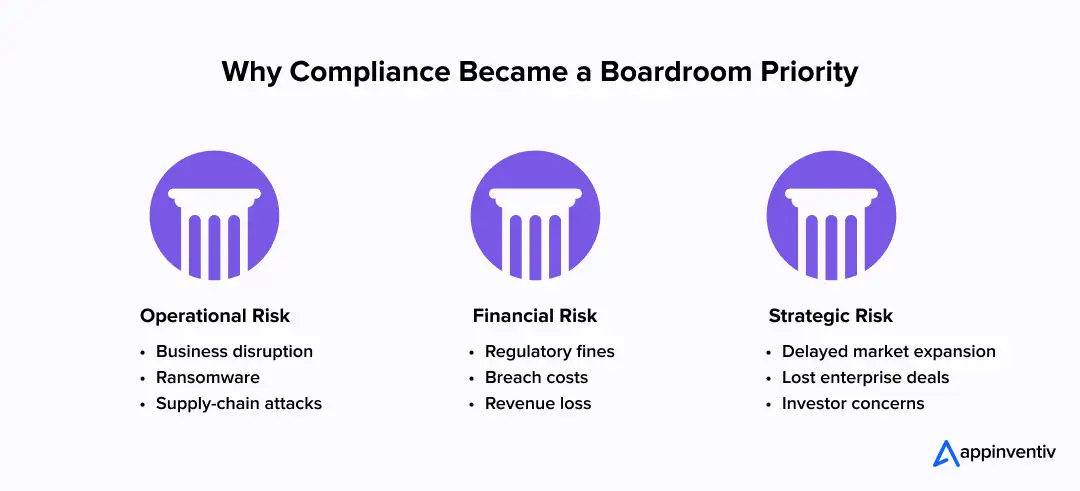
That’s the real reason cybersecurity has landed on board agendas instead of staying an IT line item. It’s tied to revenue now, to which markets a company can even sell into, to how investors price risk during due diligence. And the compliance picture itself has gotten more crowded.
An enterprise selling across the US, UK, EU, and GCC isn’t dealing with one regulation anymore. It’s GDPR and HIPAA alongside newer additions like the EU AI Act, DORA, and NIS2, each with its own scope, its own reporting clock, and its own penalty math.
So what does cybersecurity regulatory compliance actually require in practice? Which cybersecurity compliance regulations matter most right now? And how does an enterprise implement all of this without grinding product development to a halt? That’s what this guide walks through.
Automated Compliance Cuts Costs by Up to 68%
Manual, spreadsheet-driven compliance is slower and pricier. See where automation could tighten your program before your next audit.
What Does Compliance Actually Means In Cybersecurity?
This means meeting the legal, regulatory, and industry-defined security standards that govern how a company collects, stores, processes, and protects data. It’s a narrower thing than “good security practices” in one important respect: compliance in cybersecurity has to be provable. A company can run a genuinely tight security operation and still fail an audit if it can’t produce the paperwork, access logs, documented risk assessments, incident response records, vendor attestations, showing those practices actually meet a specific regulatory bar.
In practice, cybersecurity compliance requirements tend to fall into four buckets:
- Data protection mandates governing how personal or sensitive data gets handled (GDPR, HIPAA, CCPA)
- Industry-specific standards tied to a particular sector, like payments or defense (PCI DSS, CMMC)
- Security management frameworks that certify an organization’s overall posture (ISO 27001, SOC 2, NIST CSF)
- Operational resilience and AI governance rules that are newer but increasingly apply enterprise-wide (DORA, NIS2, EU AI Act)
Together, these four buckets make up the core compliance frameworks most enterprises are expected to align with, whether that alignment is mandatory or driven by customer contracts.
Government cybersecurity compliance sits in a category of its own here. Federal agencies and contractors work against NIST 800-53 and CMMC specifically, frameworks built for public-sector risk tolerance rather than commercial flexibility, which is why a vendor selling into both government and enterprise markets often ends up running two parallel control sets.
For a broader view beyond just NIST and CMMC, see IT compliance regulations for industries in the US.
Elements of Cybersecurity Compliance
Whatever regulation is in play, mature compliance programs tend to be built on the same handful of elements of cybersecurity compliance:
| Element | What It Covers |
|---|---|
| Risk assessment | Identifying and prioritizing data assets, threats, and vulnerabilities |
| Data governance | Classification, retention, encryption, and access control policies |
| Technical controls | Firewalls, MFA, endpoint detection, encryption at rest and in transit |
| Policies and documentation | Written security policies, incident response plans, acceptable use policies |
| Employee training | Security awareness, phishing simulation, role-based training |
| Third-party risk management | Vendor security assessments, contractual security clauses |
| Continuous monitoring | Logging, SIEM tools, vulnerability scanning, penetration testing |
| Audit and reporting | Internal audits, external assessments, regulator or customer-facing attestations |
Here’s the thing enterprises often miss early on: treat these elements as separate boxes to check per regulation, and costs balloon. Treat them as one connected system instead, where a control like encryption or access management satisfies GDPR, HIPAA, and SOC 2 at the same time, and the whole program gets cheaper to run over time.
This connected-system approach is also where cybersecurity governance risk and compliance, often shortened to GRC, comes in: a formal structure for how decisions, controls, and accountability flow across the organization rather than sitting in silos per regulation. Enterprises building this out from scratch often start with a GRC implementation framework that maps ownership before adding tooling.
Why This Matters for Enterprises in 2026
The business problem: Enterprises are pushing into new markets, adopting AI at scale, and leaning on bigger vendor ecosystems than they used to. All three multiply the number of regulations that apply at once.
Take a US healthcare SaaS company selling into the EU. It’s not just HIPAA anymore. Add GDPR, add SOC 2, and if any part of the product uses AI for clinical decision support, add the EU AI Act to the list too.
Why It Matters
Non-compliance isn’t a hypothetical risk sitting in a slide deck somewhere. GDPR enforcement has produced over €7.1 billion in cumulative fines since 2018, with roughly €1.2 billion of that landing in 2025 alone.
HIPAA’s 2026 inflation-adjusted penalties now reach up to $2.13 million per violation category, per year, and a single breach often trips more than one category at once.
NIS2 enforcement went live in Germany in December 2025, and it didn’t just tighten existing rules, it widened the net from roughly 4,500 regulated entities to an estimated 29,500, with fines up to €10 million or 2% of global turnover.
DORA entered its first real supervisory enforcement cycle in 2026. And the EU AI Act’s high-risk provisions become enforceable on August 2, 2026, carrying fines up to €35 million or 7% of global turnover.
The fines are only part of the cost, though. There’s the slower stuff too: longer breach detection and containment windows (241 days was the 2025 global average), lost enterprise deals from customers who won’t sign without a SOC 2 or ISO 27001 attestation in hand, and under NIS2 and DORA specifically, personal liability for executives and board members if gross negligence is found.
The business case for compliance: Enterprises that bake cybersecurity regulatory compliance into the development lifecycle, rather than scrambling to retrofit it before an audit, tend to close enterprise sales faster and spend less when something does go wrong. Organizations with mature security automation saved an average of $1.9 million per breach in IBM’s 2025 report. That’s not a small difference, and it’s exactly the kind of outcome a dedicated cybersecurity compliance company is built to help enterprises reach faster than they could alone.
Critical Cybersecurity Compliance Regulations Enterprises Must Know in 2026
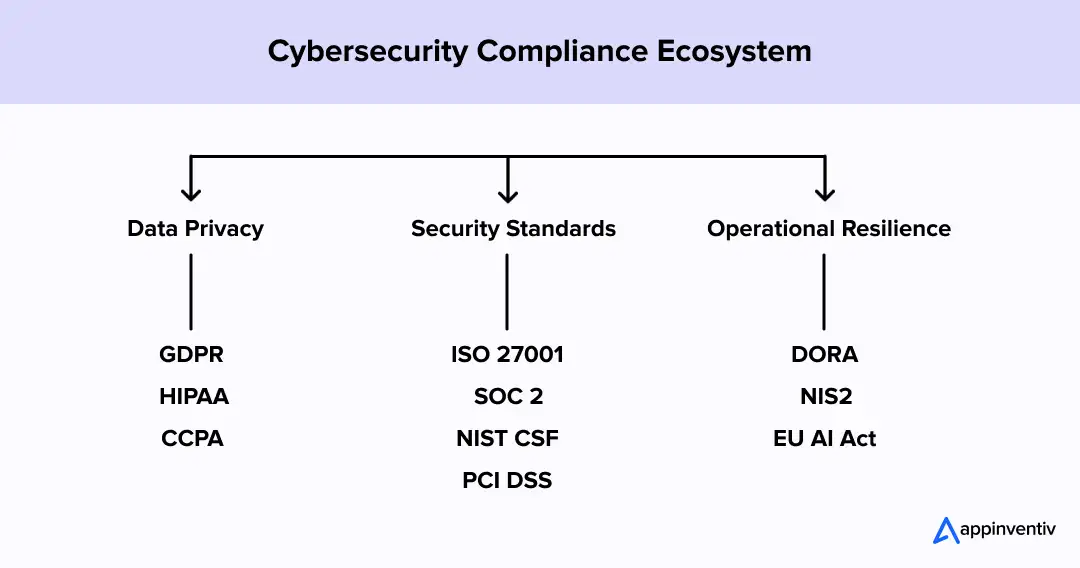
Not every regulation on this list applies to your business. But most enterprises operating across more than one market are dealing with at least three or four of these compliance standards at once, often without realizing how much they overlap. Here’s what each one actually demands, and what it costs when a company gets it wrong.
GDPR: The EU’s Data Protection Baseline
GDPR applies to any organization processing personal data belonging to people in the EU, regardless of where the company itself is headquartered.
What it requires:
- A lawful basis before processing any personal data
- Enforceable individual rights, including access, correction, and deletion
- Breach notification to regulators within 72 hours of discovery
- Documented records of processing activities and data protection impact assessments where applicable
Penalties follow a two-tier structure: lower-tier violations, like inadequate documentation, can reach up to €10 million or 2% of global turnover, while core violations, like unlawful processing or ignoring data subject rights, climb to €20 million or 4%, whichever is higher.
That two-tier structure is exactly why enterprises increasingly invest in GDPR compliance software development rather than tracking obligations manually.
HIPAA: US Healthcare’s Compliance Backbone
HIPAA covers healthcare providers, insurers, and any business associate that handles protected health information (PHI).
What it requires:
- Administrative safeguards, including risk assessments and workforce training
- Physical safeguards around facilities and devices that store or access PHI
- Technical safeguards like encryption, access controls, and audit logging
- Breach notification to affected individuals and regulators within defined timelines
Penalties are tiered by culpability, from unknowing violations to willful neglect, and a single breach often trips more than one tier at once since privacy, security, and notification failures are penalized as separate categories. Enterprises building patient-facing products from scratch increasingly design to develop a HIPAA-compliant app from day one rather than retrofitting safeguards later.
PCI DSS: Payment Data’s Hard Line
PCI DSS applies to any entity that stores, processes, or transmits cardholder data.
What it requires:
- Multi-factor authentication across the entire cardholder data environment
- Strong encryption for cardholder data at rest and in transit
- Continuous vulnerability and risk monitoring rather than annual point-in-time checks
- Regular validation through a Report on Compliance or Self-Assessment Questionnaire, depending on transaction volume
There’s no regulatory fine in the traditional sense. Instead, non-compliance is enforced through card networks and acquiring banks, and can result in transaction fees, higher processing costs, or losing the ability to process card payments altogether. That’s why most fintech teams now develop a PCI-compliant fintech app from the architecture stage instead of bolting on controls before launch.
ISO 27001: Voluntary in Name Only
ISO 27001 certification is technically optional, but most enterprise buyers now require it contractually before they’ll sign, so “voluntary” is doing a lot of work in that sentence.
What it requires:
- A documented Information Security Management System (ISMS)
- A formal risk assessment and risk treatment plan
- Defined controls mapped to the standard’s control set
- Ongoing internal audits and management review, plus periodic external surveillance audits to maintain certification
There’s no statutory fine for falling short. The real cost is losing the certification itself, and with it, the enterprise contracts that required it in the first place.
SOC 2: The Standard Enterprise Buyers Ask For
SOC 2 applies mainly to SaaS and technology vendors that handle customer data, and it’s the document most often requested during enterprise procurement.
What it requires:
- Controls mapped to one or more Trust Services Criteria: security, availability, processing integrity, confidentiality, and privacy
- A Type I report showing controls are designed appropriately, or a Type II report showing they operated effectively over an observation period
- Ongoing evidence collection to support annual re-assessment
Like ISO 27001, there’s no government penalty attached. The consequence is commercial: without it, many enterprise buyers won’t even move a vendor forward in procurement.
NIST CSF / 800-53: The Federal Framework Everyone Else Borrows
NIST frameworks govern US federal agencies and contractors directly, and get adopted voluntarily by many other organizations because they’re comprehensive and well documented. This is where government compliance for cybersecurity most directly shapes commercial practice, since private vendors selling into the public sector inherit these same control expectations.
What it requires:
- Controls organized around six core functions: govern, identify, protect, detect, respond, and recover
- Risk-based prioritization rather than a uniform checklist applied regardless of context
- Continuous monitoring and periodic reassessment as the threat landscape changes
For federal suppliers, non-compliance can mean losing the contract outright. Organizations pursuing CMMC certification should also note that its requirements are built directly on NIST 800-171, so gaps in one framework tend to surface as gaps in the other.
EU AI Act: The Newest Layer, and the Most Expensive
The EU AI Act applies to providers and deployers of AI systems used in, or affecting, the EU market.
What it requires:
- Risk classification of AI systems, with stricter obligations for systems designated “high-risk”
- Documentation and transparency requirements around how a system works and what data trains it
- Human oversight mechanisms for high-risk systems
- An internal inventory of AI systems in use, kept current as new tools are adopted
Penalties here are the steepest on this list, reaching up to €35 million or 7% of global annual turnover for the most serious violations, with obligations phasing in over a multi-year timeline rather than all at once.
For a closer look at how these obligations are rolling out, see our breakdown of AI regulation and compliance in Europe.
DORA: Financial Sector Resilience, Fast Clock Included
DORA applies to UK/EU financial entities and the critical ICT third-party providers they rely on.
What it requires:
- A formal ICT risk management framework
- A register of contractual arrangements with third-party ICT providers
- Regular digital operational resilience testing
- Incident classification and reporting on a notably tight timeline for major incidents
Penalties aren’t issued by a single central regulator. They’re determined by national competent authorities, and when DORA obligations overlap with other frameworks a financial entity is also subject to, total exposure can add up quickly.
NIS2: The Directive That Just Widened Its Net
NIS2 applies to essential and important entities across a wide range of sectors, including energy, health, transport, and digital infrastructure.
What it requires:
- Formal risk management measures covering the organization’s networks and information systems
- Supply chain security requirements extending to key suppliers and service providers
- Incident reporting within a defined, tight timeline
- Direct accountability for management bodies, not just security teams
Penalties can reach up to €10 million or 2% of global annual turnover, and unlike some earlier frameworks, NIS2 explicitly extends liability to executives and board members in cases of serious negligence.
One Conflict Worth Planning Around
DORA and NIS2 don’t use the same incident-reporting clock, and financial entities that fall under both need a single process built around the tighter of the two timelines, rather than two separate workflows that risk contradicting each other under pressure. This is exactly the kind of overlap that a formal cybersecurity governance risk and compliance structure is meant to catch before it becomes an audit finding.
Nine Regulations, One Compliance Program
Trying to map GDPR, HIPAA, PCI DSS, and the rest against your business one framework at a time gets expensive fast. Let’s build a single program that covers what actually applies to you.
Nine Regulations, One Compliance Program
Mapping each framework separately gets expensive fast. Let’s build one program that covers what applies to you.

Industry-Wise Cybersecurity Compliance and Cyberthreats
Compliance requirements don’t apply evenly across sectors, and neither do the threats each sector actually faces. Matching the two side by side shows why some industries carry a heavier compliance load than others.
Manufacturing
Manufacturing relies heavily on operational technology (OT) and legacy industrial systems that are often harder to patch and monitor than standard IT infrastructure, making the sector a common target for ransomware. There’s no single dedicated federal cybersecurity law for manufacturing; obligations typically come through customer contracts, ISO 27001, and NIST CSF adoption rather than one binding statute.
- Primary risk area: Ransomware targeting legacy OT and industrial control systems
- Compliance framework: ISO 27001, NIST CSF, contractual security requirements from OEM customers
Healthcare
Healthcare sits at the intersection of high regulatory obligation and high attacker interest, since patient data is valuable and healthcare organizations often run a mix of modern and legacy systems that are difficult to secure uniformly.
- Primary risk area: Ransomware and data exfiltration targeting electronic health records
- Compliance framework: HIPAA, and increasingly SOC 2 or ISO 27001 for health tech vendors
Financial Services
Financial services carries one of the densest regulatory stacks of any sector, layering FFIEC IT guidance, SOC 2, the Gramm-Leach-Bliley Act, and, for EU-regulated entities, DORA. The sector remains a high-value target given the direct financial upside for attackers.
- Primary risk area: Ransomware and account takeover targeting financial infrastructure
- Compliance framework: FFIEC IT Handbook, SOC 2, GLBA, DORA (EU entities)
Energy
Energy is heavily regulated on paper through NERC CIP and FERC CIP standards, but the sector often runs on aging infrastructure where fundamentals like patching and configuration management lag behind the regulatory requirements.
- Primary risk area: Ransomware and attacks targeting industrial control systems
- Compliance framework: NERC CIP, FERC CIP Standards
Retail and Consumer Businesses
Retail isn’t federally regulated as a sector, but any business handling cardholder data falls under PCI DSS regardless of industry, and consumer-facing businesses increasingly also answer to GDPR, CCPA, and a growing list of state-level privacy laws.
- Primary risk area: Payment card data theft and phishing-driven account compromise
- Compliance framework: PCI DSS, GDPR, CCPA and state privacy laws
Government and Defense Contractors
Government and defense contractors face the most prescriptive compliance stack of any sector. FISMA, NIST 800-53, DFARS, and CMMC all apply, with CMMC specifically requiring third-party assessment of security posture before a contractor can bid on defense work.
- Primary risk area: Nation-state actors and supply chain compromise
- Compliance framework: FISMA, NIST 800-53, DFARS, CMMC
How to Implement Cybersecurity Compliance: A Step-by-Step Framework
The problem: Most enterprises approach compliance reactively. A big customer asks for a SOC 2 report, or a new market requires GDPR alignment, and the response is a scramble to meet that one specific ask. Do this enough times across enough regulations and you end up with duplicated work, inconsistent controls across business units, and compliance debt that resurfaces every time a new regulation lands.
The fix: Treat compliance in cybersecurity as reusable infrastructure instead of a series of one-off projects. Here’s what that looks like in practice, broken into five phases.
Phase 1: Scope and Gap Assessment
Start by figuring out which regulations actually apply, based on where you operate, what industry you’re in, and what kind of data you handle. Then map your current controls against each applicable framework to see where the gaps sit.
This phase should leave you with:
- A clear list of every regulation in scope, by business unit and product line
- A prioritized gap list, ranked by regulatory risk and how hard each gap is to close
- A rough sense of where quick wins exist versus where real engineering effort is needed
Phase 2: Risk Assessment and Data Mapping
This is the highest-leverage phase in the entire process, and it’s the one enterprises most often try to skip. You need to know where sensitive data actually lives, how it moves between systems, and who has access to it.
Doing this properly tends to surface things nobody expected going in:
- Shadow IT tools nobody formally approved
- Third-party vendors with more access than they should have
- Data retention practices that quietly stopped matching policy years ago
Almost every regulation on the earlier list depends on this groundwork being solid. Skip it, and every phase after this one inherits the blind spots.
Phase 3: Technical and Policy Control Implementation
This is where the gaps identified in Phase 1 actually get closed. On the technical side, that usually means encryption, MFA, network segmentation, and proper logging. On the policy side, it means the documentation regulators and auditors expect to see: incident response plans, data retention schedules, vendor security requirements.
Enterprises building or modernizing digital products at this stage get the most value from a partner offering cybersecurity compliance solutions that embed these controls directly into the software development lifecycle, rather than bolting them on after the product is already built.
Phase 4: Testing and Validation
Once controls are in place, they need to be tested, not assumed to work. This phase covers internal audits, vulnerability assessment and penetration testing, and tabletop incident response exercises that walk through what actually happens if something goes wrong.
For frameworks that require third-party certification, ISO 27001 and SOC 2 being the two most common, this is also where you bring in an accredited external auditor to run the audit itself.
Phase 5: Continuous Monitoring and Maintenance
Compliance isn’t a state you reach and then leave alone. Regulations change, PCI DSS updates, penalty structures get adjusted, new frameworks like the AI Act phase in obligations over time. And enterprise environments change constantly too: new vendors, new features, new markets, each one potentially reopening a gap that was closed months ago.
What keeps a program current instead of decaying between audits:
- Continuous control monitoring rather than point-in-time checks
- Quarterly access reviews
- Annual risk reassessments, at minimum
- A standing process for evaluating new regulations as they’re announced, not after they take effect
Common Challenges in Cybersecurity Compliance
Every enterprise trying to build a real compliance program hits the same handful of walls. What separates the ones that get past them isn’t better tools, usually. It’s seeing the challenge of cybersecurity compliance coming before it becomes an audit finding.
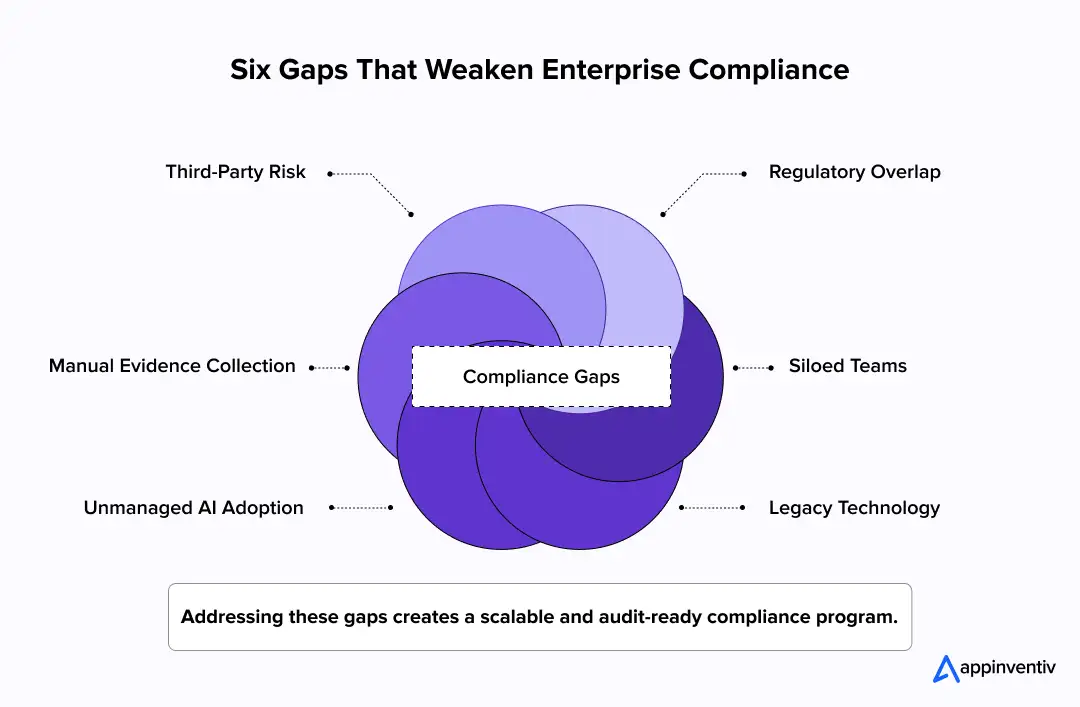
Regulatory Overlap and Conflicting Deadlines
Different frameworks don’t talk to each other, and their clocks don’t match. DORA wants a major incident reported within 4 hours. NIS2 gives you 24. GDPR sits at 72. Try to run three separate processes for three separate timelines, and you’ll end up with three teams duplicating the same triage work under three different levels of panic.
The simpler move is to build one incident response process around the strictest deadline you’re actually subject to, then let it cover the rest by default. Reporting early to a regulator with a looser window is a non-event. Missing a tighter one is a conversation you don’t want to have.
Fragmented Ownership
Compliance usually gets split across legal, IT, and security, and each group quietly assumes the other two have it covered. Nobody’s being dishonest here, it’s just that “compliance” isn’t anyone’s actual job title until an audit forces the question and everyone realizes no one owns the whole picture.
What works better is naming one accountable owner, whether that’s a compliance lead or a cross-functional committee, but only if that person or group actually has authority to make decisions. Give someone the title without the authority and you’ve just added another meeting to the calendar, not fixed anything.
For enterprises without a natural internal owner yet, it’s often faster to hire a cybersecurity consultant to run point during the build-out phase, then hand off to an internal lead once the program is established.
Third-Party and Vendor Risk
You can lock down every system you own and still get burned by a vendor who has access to your data and doesn’t take security nearly as seriously as you do. This is why supply chain risk has become such a headache, it sits mostly outside your direct control.
The way around it is doing vendor risk assessments before onboarding rather than after something breaks, writing security clauses into contracts that actually get enforced instead of just filed away, and checking in on vendor access periodically rather than treating procurement as a one-and-done review.
Most of this falls under a broader IT risk management program rather than a standalone vendor checklist.
Legacy System Limitations
A lot of core business systems were built before modern authentication, encryption, or monitoring standards existed, and you can’t always rip them out just because compliance would prefer you did. They’re often running things the business genuinely depends on.
The realistic path is modernizing in order of risk, not all at once. Start with whatever system touches your most sensitive data or your highest-exposure regulation, and treat everything else as a longer runway instead of a five-alarm emergency.
Manual, Duplicated Audit Work
When each framework gets tracked on its own spreadsheet by its own team, evidence collection turns into the same scramble every single audit cycle. The same access control screenshot gets pulled five separate times for five separate frameworks because nobody built a shared system to begin with. This is the second major challenge that enterprises run into once they’re managing more than one or two regulations at a time.
Map a control once and let it apply everywhere it’s relevant. One properly documented MFA rollout can satisfy GDPR, SOC 2, ISO 27001, and NIST at the same time. Automation tools make this easier at scale, but honestly, even a shared internal spreadsheet mapping controls to requirements gets most teams 80% of the way there.
Shadow AI and Ungoverned Tool Adoption
Teams are picking up AI tools faster than most security functions can track them, and it’s common for a tool to be in daily use for weeks before anyone in security even knows it exists. That gap is only going to matter more once the EU AI Act’s enforcement window opens.
Put an AI usage policy in place now. Keep an approved-tool list, enforce it, and build the inventory before, not after. Waiting until enforcement starts to figure out what AI you’re even running is the same mistake as waiting for a breach to write your first incident response plan.
Enterprises without an internal AI governance function often bring in AI governance consulting to get the inventory and policy work done before the deadline, not after.
Cost, Timeline, and Build vs. Buy
Ask ten CFOs what compliance should cost and you’ll get ten different answers, and honestly, all ten could be right. For most mid-to-large enterprises, a full program covering gap assessment, control implementation, and audit prep lands somewhere between $40,000 and $400,000. Where you fall in that range comes down to a handful of factors worth walking through.
What Compliance Actually Costs
A smaller SaaS company going after a single SOC 2 report sits near the bottom of that range. An enterprise managing GDPR, DORA, NIS2, and the AI Act at the same time, across several business units, ends up much closer to the top. A few things tend to drive that gap:
- How many frameworks are actually in scope. Each one brings its own gap assessment and audit prep, though shared controls do bring down the cost of each additional framework once the first one is built out.
- Legacy system debt, which is usually the biggest single cost and the one finance teams underestimate most often. Getting older systems up to speed on MFA, encryption, or continuous monitoring rarely fits inside the original budget.
- Audit and certification fees, billed separately from everything else. An accredited auditor for ISO 27001 or SOC 2 isn’t part of your internal gap-closing spend, that’s its own line item.
- The costs nobody puts in the RFP. Engineering hours pulled off product work, training time, and the ongoing effort of keeping controls running after they’re first built, not just the one-time cost of building them.
How Long It Actually Takes
Timelines shift depending on the framework, but a few numbers hold fairly steady across most enterprises.
- SOC 2 Type I takes about 2 to 4 months if the controls underneath are already in decent shape. It’s a snapshot, proof that controls are designed properly at one point in time, nothing more.
- SOC 2 Type II stretches that out to 6 to 9 months, since auditors need to watch those controls actually work over a 3 to 6 month window rather than take your word for it.
- ISO 27001 generally runs 6 to 12 months, gap assessment through certification.
- GDPR, HIPAA, and PCI DSS are harder to put a clean number on because they’re not certifications you finish once, they’re standing obligations. Getting aligned from a cold start usually takes 4 to 8 months, and then it’s ongoing from there.
Here’s the part that trips people up: internal roadmaps can slip. Regulatory deadlines can’t. NIS2 enforcement is already live in parts of the EU, and the AI Act’s high-risk provisions kick in come August 2026 whether or not your organization is actually ready.
Build vs. Buy
If you’ve got strong legal and security teams already, plenty of this can be run in-house, and long-term, ownership of ongoing compliance probably should sit internally either way, especially once the right compliance management software and processes are established.
Where that gets harder is with newer territory, DORA’s third-party register requirements, the AI Act’s risk classification rules, things that are recent enough that most companies simply haven’t built up deep expertise yet.
What tends to work in practice is a split:
- Keep in-house: governance, policy ownership, day-to-day monitoring, the internal relationships that no outside consultant can really replicate.
- Bring in outside help for: the initial gap assessment, the technical build-out, and audit prep, spots where a cybersecurity compliance consulting partner who’s done this before saves real time and meaningfully improves your odds of passing the first audit.
Go all-in on outsourcing and it gets expensive fast, and your team never actually learns the terrain for next time. Go all-in on building it yourselves from zero, especially in an area where internal talent is still thin, and the missed deadlines and failed first attempts usually end up costing more than the consulting fees would have.
How to Automate Cybersecurity Compliance Audits
Spreadsheets work fine until you’re managing two frameworks. Past that, manual tracking starts falling apart, and most enterprises find that out the hard way, usually right before a compliance audit deadline when someone’s hunting for a screenshot from six months ago. Automation fixes the parts of compliance that don’t actually need a human making judgment calls, and leaves the parts that do.
This is the core idea behind compliance automation software development: purpose-built tooling instead of a patchwork of spreadsheets.
Continuous Control Monitoring
Instead of checking whether MFA is enforced or encryption is configured correctly once a year, monitoring tools check constantly, flagging drift the moment a control falls out of line rather than months later when an auditor happens to notice. That gap between “something broke” and “someone found out” is exactly where a lot of avoidable risk sits.
Automated Evidence Collection
Auditors want proof, not promises: access logs, configuration snapshots, change records. Pulling that together by hand every audit cycle eats weeks of someone’s time, usually someone who has better things to do. Automated evidence collection captures it as it happens, so by the time an audit rolls around, most of the paperwork is already sitting there waiting.
Cross-Framework Mapping
This is where automation earns its keep. A well-built platform maps a single control, MFA enforcement, to its corresponding requirement across GDPR, SOC 2, ISO 27001, and NIST all at once. Build it once, and it counts everywhere it’s relevant across the cybersecurity compliance frameworks that apply, instead of documenting the same control five separate times for five separate audits.
None of this replaces judgment. Risk decisions, policy calls, how to interpret a gray-area requirement, that’s still a human job, and probably always will be. What automation does is take the repetitive, error-prone parts off someone’s plate so the people who understand the regulations can spend their time on the parts that actually need thinking, not data entry.
65% Say Automation Is the Most Effective Way to Cut Compliance Costs
Manual audit prep doesn’t scale past two frameworks. See what automation could take off your team’s plate.
Best Practices Checklist for Enterprise Cybersecurity Compliance
A few habits separate the enterprises that stay ahead of their compliance standards from the ones perpetually catching up before an audit.
- Keep one current inventory of which regulations apply to which business unit, product, and data type, not five different spreadsheets owned by five different teams
- Name a single accountable owner for each applicable framework, someone with actual authority, not just a title
- Build controls once and map them across frameworks instead of duplicating the same work for every regulation
- Calibrate incident response timelines to the strictest deadline you’re subject to, and let it cover the rest
- Formalize vendor risk assessments before onboarding, not after something already went wrong
- Build an AI system inventory and usage policy ahead of the AI Act’s August 2026 enforcement date, not after
- Run access reviews quarterly and full risk reassessments at least once a year, don’t wait for the next audit to check either
- Document everything. Auditors and regulators evaluate evidence, not good intentions
- Design security and compliance into the product from the architecture stage, retrofitting it later almost always costs more
Benefits of Cyber Security Compliance for Enterprises
Compliance isn’t just about staying out of trouble with regulators. Done right, it pays for itself in ways that show up well beyond the security team.
- Deals close faster. SOC 2 and ISO 27001 documentation sitting ready to go beats scrambling the moment procurement asks for it.
- Incidents cost less. A team that’s rehearsed its response plan closes the gap between finding a problem and containing it faster than one improvising in the moment.
- Market access, not a nice-to-have. For enterprises selling into the EU, GDPR and DORA alignment is the price of admission, not extra credit.
- Due diligence goes smoother. Investors and acquirers dig into security posture more than they used to, and documentation ready in advance keeps deal timelines intact.
- Less exposure for leadership. Under frameworks like NIS2 that hold executives personally accountable, a documented governance program is one of the better defenses if questions about negligence come up. It’s also the clearest sign of a mature cybersecurity risk management function rather than a reactive one.
Taken together, these are the benefits of cyber security compliance that turn a regulatory obligation into a genuine competitive advantage, rather than a cost center enterprises tolerate because they have to.
How Appinventiv Helps Enterprises Build Compliance by Design
Appinventiv has delivered 2,000+ strategy and transformation projects for enterprises across healthcare, BFSI, and government industries where a compliance gap isn’t a hypothetical risk, it’s a line item on someone’s balance sheet. That volume of work across regulated sectors is what shapes how we approach compliance: not as a checklist bolted on before launch, but as part of the architecture decisions made on day one.
Enterprises evaluating cybersecurity compliance services often need more than a one-time audit partner, and this is where our cybersecurity compliance consulting services come in, giving them a team that’s already navigated the specific regulatory terrain their industry sits in, GDPR for a fintech expanding into the EU, HIPAA for a healthcare platform handling PHI, or DORA for a financial services firm managing third-party ICT risk.
That prior exposure tends to be the difference between a first audit that passes and one that surfaces gaps nobody saw coming.
Clients working with Appinventiv on strategy and consulting engagements have seen average revenue growth of 30%, a number that reflects something worth stating plainly: compliance done right isn’t purely defensive spending.
As a full-spectrum partner among cyber security solution providers, Appinventiv covers the entire lifecycle, initial risk and gap assessment, technical control implementation, audit preparation, and continuous monitoring, rather than a one-time engagement that leaves the client managing everything alone once the report is filed.
Regulations keep shifting, NIS2 enforcement expanding, the AI Act phasing in, DORA entering its first real supervisory cycle, and enterprises need a partner who stays engaged past the initial build, not one who disappears after the certificate is issued. That’s the model Appinventiv works from as a cybersecurity compliance company built for long-term partnership, not a single deliverable, and it’s why enterprises across regulated industries turn to our cybersecurity services for programs that hold up under real regulatory scrutiny.
Ready to build compliance into your architecture instead of bolting it on later? Talk to our experts.
FAQs
Q. Why is cybersecurity compliance important?
A. It reduces the financial and legal exposure of a data breach, keeps a business eligible to operate in regulated markets like the EU, and increasingly determines whether enterprise buyers will even sign a contract, since SOC 2 and ISO 27001 attestations are now standard procurement requirements.
Q. How to automate cybersecurity compliance audits?
A. Automation works across three layers: continuous control monitoring that checks technical controls in real time instead of once a year, automated evidence collection that captures logs and access records as they happen, and cross-framework mapping that ties a single control, like MFA, to its corresponding requirement across multiple regulations at once. Together, these cut audit prep from weeks to days.
Q. What are the types of compliance?
A. Cybersecurity compliance generally falls into four types: data protection mandates (GDPR, HIPAA, CCPA), industry-specific standards (PCI DSS, CMMC), security management frameworks (ISO 27001, SOC 2, NIST CSF), and operational resilience or AI governance regulations (DORA, NIS2, EU AI Act).
Q. What are the essential steps for achieving data privacy regulation adherence?
A. Start by mapping where personal data lives and how it moves across systems, then run a gap assessment against the specific regulation in scope, implement the required technical and administrative controls, document policies and consent mechanisms, and set up a breach notification process that meets that regulation’s specific reporting timeline.
Q. How to select a cybersecurity auditing firm for industry standards?
A. Look for verifiable experience with the specific frameworks and industry you operate in, ask for references from similar clients, confirm the firm is accredited for the certification you need, such as an accredited ISO 27001 certification body, and check whether they offer ongoing advisory support rather than a one-time audit and exit.