Reading Time: 7 minutes
Most B2C marketers will tell you they personalize. Ask them what that means, and you’ll hear: “We segment by purchase history” or “We send different emails to different cohorts.” But that’s not personalization. That’s sorting.
Real personalization, the kind that actually moves retention and lifetime value, requires a fundamentally different way of thinking about customers. And increasingly, it requires AI, not as a shortcut, but as the engine that makes true 1:1 engagement economically possible.
We spoke to two practitioners who have done this work in the trenches: Kerim Agalar, a veteran in lifecycle and retention marketing with experience across brands like Uniti Group, RingCentral, and Banana Republic, and Jennifer Finn, Director of Product Engagement at Wealthsimple (a Canadian financial services platform with over 3 million clients), and asked them to break down what the shift actually looks like, and why most companies are getting it wrong.
Here’s what they had to say.
Most Brands Are Still Reacting, Not Personalizing
The most common mistake teams make when adopting AI for personalization is assuming it can do the heavy lifting from day one. AI amplifies what already exists. Feed it a weak strategy or messy data, and it produces confident-sounding errors at scale.
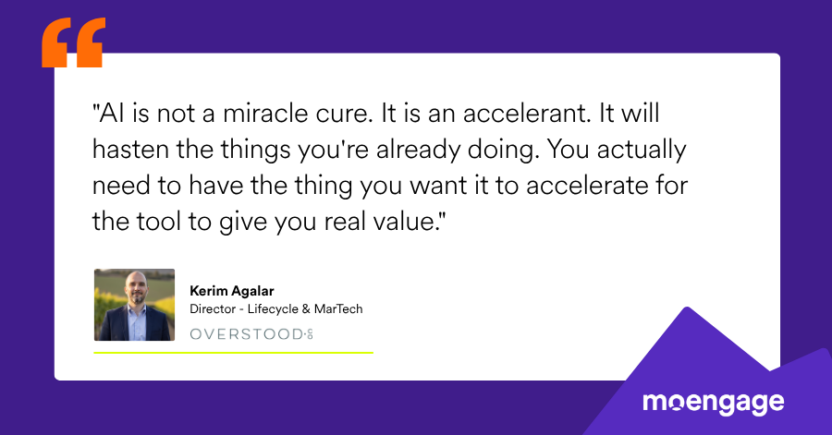
Kerim argues that AI isn’t a starting point; it’s a multiplier, and you need something worth multiplying first.
He maps the marketing journey as three distinct stages: reactive, proactive, and predictive. Reactive marketing labels customers based on one purchase. Proactive marketing involves identifying friction points and addressing customer churn risk. Predictive marketing leverages machine learning to identify engagement patterns and predict customer behavior.
Based on this framework, brands should first focus on building a relationship with their customers and understanding them better. Only once they have substantial behavioral data should they start experimenting with machine learning and AI.
Jennifer has lived this at Wealthsimple through the evolution of their “Next Best Action” model. The initial model, which Jen calls “V1,” operated on familiar logic and was reactive: ‘customers with similar profiles to you took this action, so you probably should too.’ It worked initially, but it had a ceiling. For example, a 30-year-old with $50,000 invested got the same treatment as every other 30-year-old with $50,000 invested, regardless of their goals, risk tolerance, or financial situation.
On the other hand, the new model (V2) uses secure LLM connections that draw from a client’s complete financial picture, anticipating what a specific individual actually needs next. This is a powerful shift. But according to Jennifer, getting there required a fundamental mindset shift across the team, away from the need for certainty before acting.
“The leap around AI is moving from ‘we need to get this perfect before we launch’ to ‘we need to launch so we can learn from our clients’ feedback and understand what perfect looks like.’ Operationally, you need to resist the temptation to boil the ocean.” — Jennifer Finn, Director of Product Engagement, Wealthsimple
Where AI Actually Changes the Economics
The case for AI in personalization is not that it replaces good judgment. It is that it removes the bandwidth constraints that keep most teams stuck at surface-level segmentation. Most teams simply do not have the capacity to go deeper, at the scale their audience deserves, so they stick with broad segments and generic messages, and wonder why engagement is flat. AI changes that equation, but only if you’ve built the right foundations first.
Jennifer’s team at Wealthsimple uses AI to test dozens of personalized message variations simultaneously, optimizing for actual product adoption and downstream engagement.
“What used to be ‘this segment gets message A, this segment gets message B’ has become these thousand individuals each getting messages tailored to their financial situation, communication preferences, and behavior. What excites me most is the learning velocity; every optimization surfaces insights about what resonates, which value props land, and which CTAs drive action. This is actually really powerful feedback to feed into our learning models, product, and broader content strategy.” — Jennifer Finn, Director of Product Engagement, Wealthsimple
Kerim had a similar experience at one of his previous companies, where he used an AI-powered language personalization tool for an abandoned cart campaign.
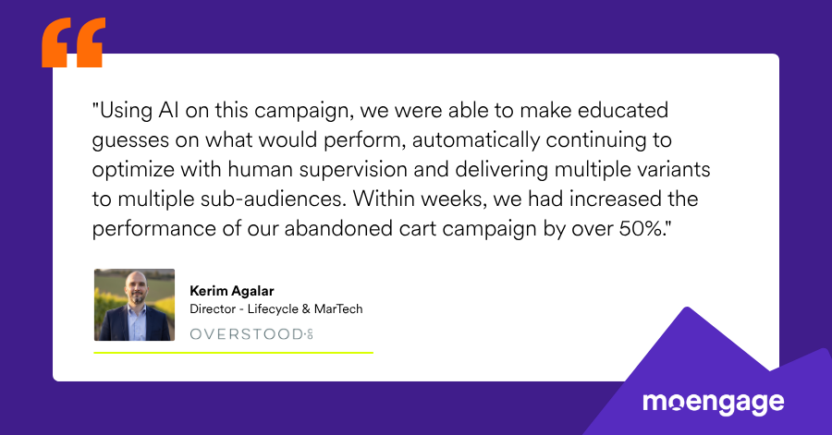
The results in both cases stemmed from the foundations already being in place: clean data, a specific problem to solve, clear success metrics, and humans actively reviewing what the model was doing. AI accelerated what was already working.
The Silent Churn Nobody is Measuring
Even with better segmentation and smarter messaging, there is a growing pattern that most retention dashboards are not built to catch. Many customers aren’t unsubscribing. They are not churning. They are just going quiet.
Kerim calls this the “apathy segment,” i.e., subscribers who receive every message but interact with none of them. He blames messaging frequency as the main driver. Brands increase send volume because short-term numbers justify it, while customers begin tuning out as they realize it’s easier than unsubscribing. The customer relationship has not ended; it has just quietly stopped functioning.
Most brands wait until someone has been inactive for a year or two before triggering reactivation campaigns. By then, Kerim argues, the window has largely closed. He suggests starting as early as 7 to 90 days, before indifference becomes the default.
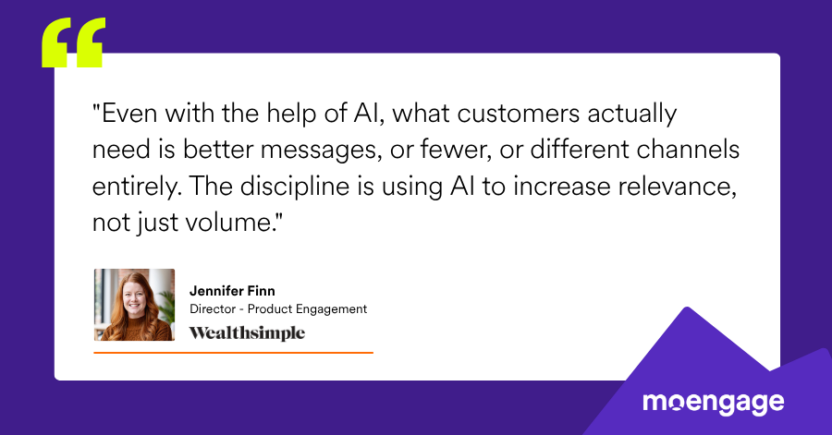
At Wealthsimple, Jennifer’s team has caps on monthly marketing communication across channels. Every message needs to justify its place. AI’s role here is not to scale send frequency but to make each touchpoint smarter, identifying what a disengaged customer actually needs to hear, when, and through which channel.
The Line Between Helpful and Intrusive is Thin
The same AI capabilities that enable smarter personalization also make it easier to overstep. And when that happens at scale, the damage to customer trust is significant.
Jennifer recalls receiving a buy-now-pay-later email from a brand flagging an expensive abandoned cart item and asking if she was having financial trouble.
“The intent might have been helpful, but making assumptions about someone’s financial situation based on incomplete data can feel borderline offensive to the customer. We’re in an era where a ton of customer data is available, but marketers need to use it in a mindful and trustworthy way.” — Jennifer Finn, Director of Product Engagement, Wealthsimple
Kerim points to browsing-abandonment campaigns as another area where this line gets crossed. Done poorly, the message signals to the customer that the brand has been watching their every move. Done well, it positions the brand as helping the customer complete their purchase. The difference, he argues, comes down to orientation: is the personalization built around the customer’s intent, or the brand’s conversion goal?
“I’ve received a lot of browse campaigns that said, ‘I know you are looking at this. Now go buy it.’ That really puts me on the defensive. If the vibe is ‘I’m watching you,’ you’re bringing your customer back to the early 2000s of Best Buy, where somebody was waiting behind every corner to pounce on you and try to sell you something. There’s a way to make your browse campaign much smarter by focusing on the outcome rather than conversion-driving.” — Kerim Agalar, Director – Lifecycle & MarTech, Overstood
At Wealthsimple, this principle plays out in practice. When a large deposit appears in a client’s account, the team surfaces educational content on tax-efficient investing options rather than making assumptions about their financial situation. This addresses the client’s likely need without making them feel watched.
Jennifer’s litmus test for any AI-driven outreach is whether she would feel comfortable explaining to a client exactly how their data was used to trigger that communication. Any hesitation is a red flag.
The Marketer’s Job Isn’t Going Away; It’s Changing
As AI handles more execution, the marketer’s role shifts towards a different kind of accountability, one that requires human judgment precisely because AI cannot provide it.
Kerim argues there are two things marketers must never hand off: the “story” and the “math.” The story matters because brand is the one thing a competitor cannot simply copy. Without a coherent brand identity, products become commodities. The emotional connection a brand builds with its customers is what makes LTV durable over time. The math matters because AI is correlative, not causal. It finds patterns, not meaning. Someone needs to monitor the model and catch where it is optimizing for the wrong thing.
“We need humans watching the math, making sure AI isn’t correlating data in ways that worsen the experience. And we need humans guiding the story. Without a brand, all our products are commoditized. The only thing that can’t be copied in the long term is the emotion you evoke in your customers.” — Kerim Agalar, Director – Lifecycle & MarTech, Overstood
Jennifer draws the line specifically at the decisions that involve trade-offs between short-term performance and long-term trust. Those calls, she argues, require human values, not pattern recognition.
“What AI should never autonomously decide is probably the ethical boundaries of what we communicate and what trade-offs we make between short-term gains and long-term trust.” — Jennifer Finn, Director of Product Engagement, Wealthsimple
The Real Competitive Advantage Isn’t AI. It is Discipline.
The marketers getting personalization right are not the ones who bought a new AI platform and pointed it at their existing segments. They identified a specific problem, ran a contained experiment, watched the results closely, and adjusted. That discipline (not the technology) is what separates them.
AI can help brands overcome the bandwidth constraints that keep most teams stuck at surface-level segmentation. It can test dozens of variations simultaneously, catch disengagement before it hardens into churn, and make each touchpoint smarter without scaling send volume. But it needs a foundation to work from: clean data, a clear objective, and humans who know when the output has gone off course.
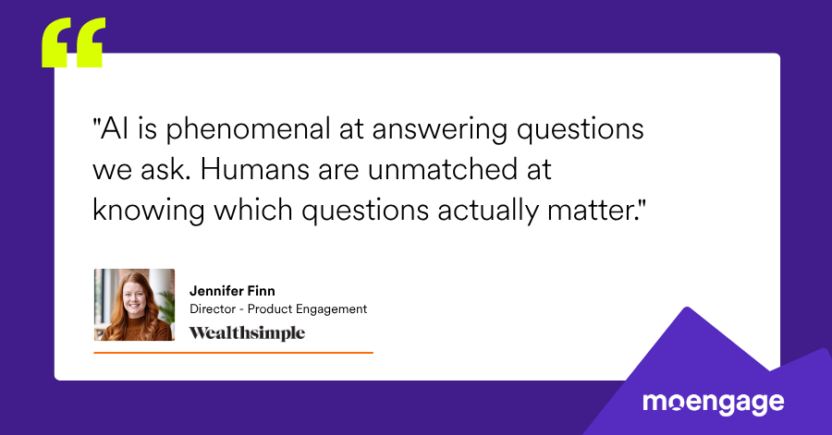
What it cannot do is decide which questions are worth asking in the first place.
The post AI-Powered Personalization: Lessons from the Trenches appeared first on MoEngage.