[ad_1]
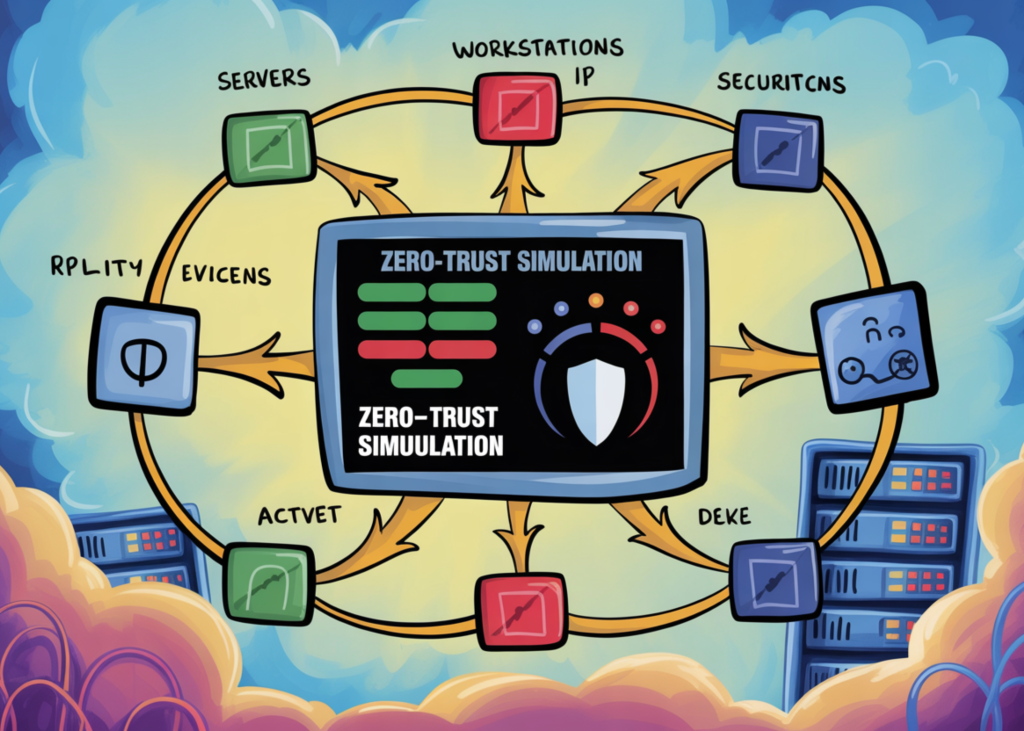
In this tutorial, we build a realistic Zero-Trust network simulation by modeling a micro-segmented environment as a directed graph and forcing every request to earn access through continuous verification. We implement a dynamic policy engine that blends ABAC-style permissions with device posture, MFA, path reachability, zone sensitivity, and live risk signals such as anomaly and data-volume indicators. We then operationalize the model through a Flask API and run mixed traffic, including insider-lateral movement and exfiltration attempts, to show how trust scoring, adaptive controls, and automated quarantines block malicious flows in real time.
!pip -q install networkx flask


import math
import json
import time
import random
import hashlib
from dataclasses import dataclass, field
from typing import Dict, Any, List, Tuple, Optional


import networkx as nx
from flask import Flask, request, jsonify


import matplotlib.pyplot as plt


def _sigmoid(x: float) -> float:
   return 1.0 / (1.0 + math.exp(-x))


def _clamp(x: float, lo: float = 0.0, hi: float = 1.0) -> float:
   return max(lo, min(hi, x))


def _now_ts() -> float:
   return time.time()


def _stable_hash(s: str) -> int:
   h = hashlib.sha256(s.encode("utf-8")).hexdigest()
   return int(h[:10], 16)


def _rand_choice_weighted(items: List[Any], weights: List[float]) -> Any:
   return random.choices(items, weights=weights, k=1)[0]


def _pretty(obj: Any) -> str:
   return json.dumps(obj, indent=2, sort_keys=False)
We set up the environment by installing the required libraries and importing all dependencies needed for graph modeling, risk scoring, and API handling. We define utility functions for trust normalization, hashing, timestamping, and weighted sampling to support deterministic simulations. We prepare helper functions that simplify logging and structured output formatting throughout the tutorial.
ZONES = ["public", "dmz", "app", "data", "admin"]
SENSITIVITY = {"public": 0.15, "dmz": 0.35, "app": 0.6, "data": 0.85, "admin": 0.95}


ASSETS = {
   "public": ["cdn", "landing", "status"],
   "dmz": ["api_gateway", "waf", "vpn"],
   "app": ["orders_svc", "billing_svc", "ml_inference", "inventory_svc"],
   "data": ["customer_db", "ledger_db", "feature_store"],
   "admin": ["iam", "siem", "backup_vault"]
}


ACTIONS = ["read", "write", "deploy", "admin", "exfiltrate"]


ROLES = ["customer", "employee", "analyst", "engineer", "admin", "secops"]


DEVICE_TYPES = ["managed_laptop", "managed_server", "byod_phone", "unknown_iot"]
NETWORK_CONTEXT = ["corp_lan", "corp_vpn", "public_wifi", "tor_exit"]


@dataclass
class RequestContext:
   user: str
   role: str
   device_id: str
   device_type: str
   device_posture: float
   mfa: bool
   source: str
   src_node: str
   dst_node: str
   action: str
   time_bucket: str
   geo_risk: float
   behavior_anomaly: float
   data_volume: float
   reason: str = ""


@dataclass
class Decision:
   allowed: bool
   trust_score: float
   rule_hits: List[str] = field(default_factory=list)
   controls: Dict[str, Any] = field(default_factory=dict)
   explanation: str = ""
   ts: float = field(default_factory=_now_ts)


@dataclass
class PrincipalState:
   user: str
   role: str
   base_risk: float
   last_seen_ts: float
   rolling_denies: int = 0
   rolling_allows: int = 0
   quarantined: bool = False
   compromise_score: float = 0.0


@dataclass
class DeviceState:
   device_id: str
   device_type: str
   owner: str
   posture: float
   attested: bool
   quarantined: bool = False


@dataclass
class FlowRecord:
   ts: float
   ctx: Dict[str, Any]
   decision: Dict[str, Any]
We define the core domain schema including zones, assets, roles, device types, and contextual signals that shape our Zero-Trust environment. We formalize request, decision, principal, device, and flow record structures using dataclasses to maintain clarity and state integrity. We establish the foundational data model that enables continuous trust evaluation across identities, devices, and network paths.
def build_microsegmented_graph(seed: int = 7) -> nx.DiGraph:
   random.seed(seed)
   G = nx.DiGraph()


   for z in ZONES:
       G.add_node(f"zone:{z}", kind="zone", zone=z, sensitivity=SENSITIVITY[z])


   for z, assets in ASSETS.items():
       for a in assets:
           node = f"{z}:{a}"
           G.add_node(node, kind="asset", zone=z, sensitivity=SENSITIVITY[z] + random.uniform(-0.05, 0.05))
           G.add_edge(f"zone:{z}", node, kind="contains")


   allowed_paths = [
       ("public", "dmz"),
       ("dmz", "app"),
       ("app", "data"),
       ("admin", "app"),
       ("admin", "data"),
       ("admin", "dmz"),
       ("dmz", "admin")
   ]


   for src_z, dst_z in allowed_paths:
       G.add_edge(f"zone:{src_z}", f"zone:{dst_z}", kind="zone_route", base_allowed=True)


   for src_z, dst_z in allowed_paths:
       for src_a in ASSETS[src_z]:
           for dst_a in ASSETS[dst_z]:
               if random.random() < 0.45:
                   G.add_edge(f"{src_z}:{src_a}", f"{dst_z}:{dst_a}", kind="service_call", base_allowed=True)


   for z in ZONES:
       for a in ASSETS[z]:
           if random.random() < 0.35:
               G.add_edge(f"{z}:{a}", f"{z}:{a}", kind="self", base_allowed=True)


   return G


def draw_graph(G: nx.DiGraph, title: str = "Zero-Trust Microsegmented Network Graph") -> None:
   plt.figure(figsize=(14, 9))
   pos = nx.spring_layout(G, seed=42, k=0.35)
   kinds = nx.get_node_attributes(G, "kind")
   node_colors = []
   for n in G.nodes():
       if kinds.get(n) == "zone":
           node_colors.append(0.85)
       else:
           node_colors.append(G.nodes[n].get("sensitivity", 0.5))
   nx.draw_networkx_nodes(G, pos, node_size=350, node_color=node_colors)
   nx.draw_networkx_edges(G, pos, arrows=True, alpha=0.25)
   nx.draw_networkx_labels(G, pos, font_size=8)
   plt.title(title)
   plt.axis("off")
   plt.show()
We construct a micro-segmented directed network graph where zones and assets are explicitly modeled with sensitivity attributes. We programmatically generate inter-zone and service-level communication paths to simulate realistic enterprise traffic patterns. We visualize the network topology to clearly observe segmentation boundaries and potential lateral movement routes.
class ZeroTrustPolicyEngine:
   def __init__(self, G: nx.DiGraph):
       self.G = G
       self.principals: Dict[str, PrincipalState] = {}
       self.devices: Dict[str, DeviceState] = {}
       self.flow_log: List[FlowRecord] = []
       self.blocked_edges: set = set()
       self.policy_version = "ztpe-v1.3"


       self.role_perms = {
           "customer": {"public": {"read"}, "dmz": {"read"}},
           "employee": {"public": {"read"}, "dmz": {"read"}, "app": {"read", "write"}},
           "analyst": {"public": {"read"}, "dmz": {"read"}, "app": {"read"}, "data": {"read"}},
           "engineer": {"public": {"read"}, "dmz": {"read"}, "app": {"read", "write", "deploy"}, "data": {"read"}},
           "admin": {"public": {"read"}, "dmz": {"read", "write"}, "app": {"read", "write", "deploy", "admin"}, "data": {"read", "write", "admin"}, "admin": {"read", "write", "admin"}},
           "secops": {"public": {"read"}, "dmz": {"read", "write"}, "app": {"read", "admin"}, "data": {"read", "admin"}, "admin": {"read", "admin"}},
       }


       self.w = {
           "role_fit": 1.4,
           "device_posture": 1.8,
           "mfa": 1.0,
           "network_context": 1.2,
           "time": 0.6,
           "geo_risk": 1.2,
           "behavior_anomaly": 2.2,
           "data_volume": 1.4,
           "principal_base_risk": 1.3,
           "principal_compromise": 2.0,
           "asset_sensitivity": 1.6,
           "path_validity": 1.5,
           "quarantine": 4.0,
       }


       self.thresholds = {
           "allow": 0.72,
           "step_up": 0.62,
           "rate_limit": 0.55,
           "deny": 0.0
       }


   def register_principal(self, user: str, role: str, base_risk: float) -> None:
       self.principals[user] = PrincipalState(
           user=user,
           role=role,
           base_risk=_clamp(base_risk),
           last_seen_ts=_now_ts()
       )


   def register_device(self, device_id: str, device_type: str, owner: str, posture: float, attested: bool) -> None:
       self.devices[device_id] = DeviceState(
           device_id=device_id,
           device_type=device_type,
           owner=owner,
           posture=_clamp(posture),
           attested=bool(attested)
       )


   def _asset_zone_and_sensitivity(self, node: str) -> Tuple[str, float]:
       if node.startswith("zone:"):
           z = node.split(":", 1)[1]
           return z, SENSITIVITY.get(z, 0.5)
       z = self.G.nodes[node].get("zone", "public")
       sens = float(self.G.nodes[node].get("sensitivity", SENSITIVITY.get(z, 0.5)))
       return z, _clamp(sens)


   def _base_abac_check(self, role: str, dst_zone: str, action: str) -> bool:
       return action in self.role_perms.get(role, {}).get(dst_zone, set())


   def _path_is_valid(self, src: str, dst: str) -> bool:
       if (src, dst) in self.blocked_edges:
           return False
       try:
           return nx.has_path(self.G, src, dst)
       except nx.NetworkXError:
           return False


   def _network_context_risk(self, source: str) -> float:
       table = {"corp_lan": 0.1, "corp_vpn": 0.25, "public_wifi": 0.65, "tor_exit": 0.9}
       return table.get(source, 0.6)


   def _time_risk(self, time_bucket: str) -> float:
       return 0.15 if time_bucket == "business_hours" else 0.55


   def _compute_trust_score(self, ctx: RequestContext) -> Tuple[float, List[str], Dict[str, Any]]:
       rule_hits = []
       controls: Dict[str, Any] = {}


       principal = self.principals.get(ctx.user)
       device = self.devices.get(ctx.device_id)


       if principal is None:
           rule_hits.append("unknown_principal")
           principal = PrincipalState(ctx.user, ctx.role, base_risk=0.85, last_seen_ts=_now_ts())


       if device is None:
           rule_hits.append("unknown_device")
           device = DeviceState(ctx.device_id, ctx.device_type, owner=ctx.user, posture=0.25, attested=False)


       src_zone, src_sens = self._asset_zone_and_sensitivity(ctx.src_node)
       dst_zone, dst_sens = self._asset_zone_and_sensitivity(ctx.dst_node)


       abac_ok = self._base_abac_check(ctx.role, dst_zone, ctx.action)
       if not abac_ok:
           rule_hits.append("abac_denied")


       path_ok = self._path_is_valid(ctx.src_node, ctx.dst_node)
       if not path_ok:
           rule_hits.append("invalid_path_or_blocked")


       if principal.quarantined or device.quarantined:
           rule_hits.append("quarantined")
           controls["auto_response"] = "deny_quarantine"


       if ctx.action == "exfiltrate":
           rule_hits.append("exfil_attempt")


       if dst_zone in ["admin", "data"] and not ctx.mfa:
           rule_hits.append("mfa_required_for_sensitive_zone")
           controls["step_up_mfa"] = True


       if device.owner != ctx.user:
           rule_hits.append("device_owner_mismatch")


       net_r = self._network_context_risk(ctx.source)
       t_r = self._time_risk(ctx.time_bucket)


       role_fit = 1.0 if abac_ok else 0.0
       posture = _clamp(device.posture if device.attested else device.posture * 0.75)
       mfa = 1.0 if ctx.mfa else 0.0
       path_valid = 1.0 if path_ok else 0.0
       sens = _clamp(dst_sens)


       principal_risk = _clamp(principal.base_risk)
       compromise = _clamp(principal.compromise_score)
       anomaly = _clamp(ctx.behavior_anomaly)
       geo = _clamp(ctx.geo_risk)
       data_vol = _clamp(ctx.data_volume)


       quarantine_penalty = 1.0 if (principal.quarantined or device.quarantined) else 0.0
       owner_mismatch_penalty = 1.0 if (device.owner != ctx.user) else 0.0
       exfil_penalty = 1.0 if (ctx.action == "exfiltrate") else 0.0


       z = 0.0
       z += self.w["role_fit"] * (role_fit - 0.5)
       z += self.w["device_posture"] * (posture - 0.5)
       z += self.w["mfa"] * (mfa - 0.5)
       z += self.w["path_validity"] * (path_valid - 0.5)


       z -= self.w["asset_sensitivity"] * (sens - 0.35)


       z -= self.w["network_context"] * (net_r - 0.25)
       z -= self.w["time"] * (t_r - 0.15)
       z -= self.w["geo_risk"] * (geo - 0.2)


       z -= self.w["behavior_anomaly"] * (anomaly - 0.1)
       z -= self.w["data_volume"] * (data_vol - 0.15)


       z -= self.w["principal_base_risk"] * (principal_risk - 0.2)
       z -= self.w["principal_compromise"] * (compromise - 0.0)


       z -= 2.0 * owner_mismatch_penalty
       z -= 2.5 * exfil_penalty
       z -= self.w["quarantine"] * quarantine_penalty


       trust = _sigmoid(z)


       if trust < self.thresholds["rate_limit"]:
           controls["rate_limit"] = True
       if trust < self.thresholds["step_up"]:
           controls["step_up"] = bool(controls.get("step_up_mfa", False) or dst_zone in ["admin", "data"])
       if trust < self.thresholds["allow"]:
           controls["continuous_auth"] = True


       if "abac_denied" in rule_hits or "invalid_path_or_blocked" in rule_hits or "exfil_attempt" in rule_hits:
           controls["risk_signal"] = "policy_violation"


       if anomaly > 0.75 and sens > 0.75:
           controls["auto_response"] = "quarantine_candidate"


       return _clamp(trust), rule_hits, controls


   def evaluate(self, ctx: RequestContext) -> Decision:
       trust, rule_hits, controls = self._compute_trust_score(ctx)
       allowed = trust >= self.thresholds["allow"]


       if controls.get("step_up"):
           if not ctx.mfa:
               allowed = False
               rule_hits.append("step_up_failed_no_mfa")
           else:
               allowed = allowed or (trust >= self.thresholds["step_up"])


       if controls.get("rate_limit") and trust < 0.5:
           allowed = False
           rule_hits.append("rate_limited_denied")


       explanation = self._explain(ctx, trust, allowed, rule_hits, controls)
       dec = Decision(allowed=allowed, trust_score=trust, rule_hits=rule_hits, controls=controls, explanation=explanation)


       self._post_decision_updates(ctx, dec)


       self.flow_log.append(
           FlowRecord(
               ts=dec.ts,
               ctx=ctx.__dict__.copy(),
               decision={
                   "allowed": dec.allowed,
                   "trust_score": dec.trust_score,
                   "rule_hits": dec.rule_hits,
                   "controls": dec.controls,
                   "explanation": dec.explanation
               }
           )
       )
       return dec


   def _explain(self, ctx: RequestContext, trust: float, allowed: bool, hits: List[str], controls: Dict[str, Any]) -> str:
       src_z, _ = self._asset_zone_and_sensitivity(ctx.src_node)
       dst_z, dst_s = self._asset_zone_and_sensitivity(ctx.dst_node)
       bits = []
       bits.append(f"Decision={'ALLOW' if allowed else 'DENY'} | trust={trust:.3f} | {ctx.user}({ctx.role}) {ctx.action} {ctx.src_node}->{ctx.dst_node}")
       bits.append(f"Context: source={ctx.source}, time={ctx.time_bucket}, geo_risk={ctx.geo_risk:.2f}, anomaly={ctx.behavior_anomaly:.2f}, data_vol={ctx.data_volume:.2f}")
       bits.append(f"Zones: {src_z} -> {dst_z} (dst_sensitivity={dst_s:.2f}) | MFA={'yes' if ctx.mfa else 'no'} | posture={ctx.device_posture:.2f}")
       if hits:
           bits.append(f"Rule hits: {', '.join(hits)}")
       if controls:
           bits.append(f"Controls: {controls}")
       return " | ".join(bits)


   def _post_decision_updates(self, ctx: RequestContext, dec: Decision) -> None:
       p = self.principals.get(ctx.user)
       d = self.devices.get(ctx.device_id)


       if p is None:
           self.register_principal(ctx.user, ctx.role, base_risk=0.65)
           p = self.principals[ctx.user]
       if d is None:
           self.register_device(ctx.device_id, ctx.device_type, ctx.user, ctx.device_posture, attested=(ctx.device_type.startswith("managed")))
           d = self.devices[ctx.device_id]


       p.last_seen_ts = dec.ts


       if dec.allowed:
           p.rolling_allows += 1
           p.rolling_denies = max(0, p.rolling_denies - 1)
           p.compromise_score = _clamp(p.compromise_score - 0.02)
       else:
           p.rolling_denies += 1
           p.compromise_score = _clamp(p.compromise_score + 0.06 + 0.10 * (1.0 if "exfil_attempt" in dec.rule_hits else 0.0))


       if dec.controls.get("auto_response") == "quarantine_candidate" or p.rolling_denies >= 4 or p.compromise_score > 0.78:
           p.quarantined = True
           if d:
               d.quarantined = True


       if ("invalid_path_or_blocked" in dec.rule_hits) or ("exfil_attempt" in dec.rule_hits) or ("abac_denied" in dec.rule_hits):
           self.blocked_edges.add((ctx.src_node, ctx.dst_node))


   def stats(self) -> Dict[str, Any]:
       total = len(self.flow_log)
       allows = sum(1 for r in self.flow_log if r.decision["allowed"])
       denies = total - allows
       top_denies = {}
       for r in self.flow_log:
           if not r.decision["allowed"]:
               for h in r.decision["rule_hits"]:
                   top_denies[h] = top_denies.get(h, 0) + 1
       principals = {
           u: {
               "role": p.role,
               "base_risk": round(p.base_risk, 3),
               "compromise_score": round(p.compromise_score, 3),
               "rolling_denies": p.rolling_denies,
               "rolling_allows": p.rolling_allows,
               "quarantined": p.quarantined
           }
           for u, p in self.principals.items()
       }
       devices = {
           did: {
               "owner": d.owner,
               "type": d.device_type,
               "posture": round(d.posture, 3),
               "attested": d.attested,
               "quarantined": d.quarantined
           }
           for did, d in self.devices.items()
       }
       return {
           "policy_version": self.policy_version,
           "flows_total": total,
           "flows_allow": allows,
           "flows_deny": denies,
           "deny_reasons_top": dict(sorted(top_denies.items(), key=lambda kv: kv[1], reverse=True)[:10]),
           "blocked_edges_count": len(self.blocked_edges),
           "principals": principals,
           "devices": devices
       }
We implement the dynamic Zero-Trust Policy Engine that evaluates every request using ABAC, contextual risk signals, behavioral anomaly scores, and path validation. We compute a continuous trust score through a weighted risk model and trigger adaptive controls such as step-up authentication, rate limiting, and quarantine. We update the principal and device state after each decision to simulate continuous verification and evolving risk posture.
def make_world(engine: ZeroTrustPolicyEngine, seed: int = 13) -> Dict[str, Any]:
   random.seed(seed)


   users = [
       ("alice", "employee", 0.18),
       ("bob", "engineer", 0.22),
       ("cathy", "analyst", 0.25),
       ("dan", "admin", 0.15),
       ("eve", "secops", 0.10),
       ("mallory", "employee", 0.55)
   ]
   for u, r, br in users:
       engine.register_principal(u, r, br)


   devices = [
       ("dev-alice-lt", "managed_laptop", "alice", 0.82, True),
       ("dev-bob-lt", "managed_laptop", "bob", 0.77, True),
       ("dev-cathy-lt", "managed_laptop", "cathy", 0.74, True),
       ("dev-dan-lt", "managed_laptop", "dan", 0.88, True),
       ("dev-eve-lt", "managed_laptop", "eve", 0.90, True),
       ("dev-mallory-byod", "byod_phone", "mallory", 0.42, False),
       ("unknown-iot-7", "unknown_iot", "unknown", 0.20, False),
   ]
   for did, dt, owner, posture, attested in devices:
       engine.register_device(did, dt, owner, posture, attested)


   all_assets = [n for n in engine.G.nodes() if engine.G.nodes[n].get("kind") == "asset"]
   by_zone = {z: [a for a in all_assets if engine.G.nodes[a].get("zone") == z] for z in ZONES}


   return {"users": users, "devices": devices, "assets": all_assets, "by_zone": by_zone}


def gen_request(engine: ZeroTrustPolicyEngine, world: Dict[str, Any], kind: str = "normal", seed_salt: str = "") -> RequestContext:
   rnd = random.Random(_stable_hash(kind + seed_salt + str(_now_ts())[:6]))


   users = world["users"]
   by_zone = world["by_zone"]


   def pick_user(role_bias: Optional[str] = None) -> Tuple[str, str]:
       if role_bias:
           filtered = [u for u in users if u[1] == role_bias]
           if filtered:
               u, r, _ = rnd.choice(filtered)
               return u, r
       u, r, _ = rnd.choice(users)
       return u, r


   def user_device(u: str) -> Tuple[str, str, float]:
       candidates = [d for d in engine.devices.values() if d.owner == u]
       if candidates:
           d = rnd.choice(candidates)
       else:
           d = rnd.choice(list(engine.devices.values()))
       return d.device_id, d.device_type, d.posture


   def time_bucket():
       return "business_hours" if rnd.random() < 0.75 else "after_hours"


   source = _rand_choice_weighted(NETWORK_CONTEXT, [0.45, 0.25, 0.22, 0.08])
   geo_risk = _clamp(rnd.uniform(0.05, 0.35) + (0.25 if source in ["public_wifi", "tor_exit"] else 0.0))
   behavior_anomaly = _clamp(rnd.uniform(0.02, 0.25))
   data_volume = _clamp(rnd.uniform(0.02, 0.25))


   if kind == "normal":
       u, r = pick_user()
       did, dt, posture = user_device(u)


       src_zone = _rand_choice_weighted(["public", "dmz", "app"], [0.15, 0.55, 0.30])
       dst_zone = _rand_choice_weighted(["dmz", "app", "data"], [0.35, 0.45, 0.20])
       action = _rand_choice_weighted(ACTIONS, [0.55, 0.28, 0.07, 0.08, 0.02])


       src = rnd.choice(by_zone[src_zone])
       dst = rnd.choice(by_zone[dst_zone])


       mfa = True if dst_zone in ["data", "admin"] else (rnd.random() < 0.55)


       return RequestContext(
           user=u, role=r,
           device_id=did, device_type=dt, device_posture=posture,
           mfa=mfa, source=source,
           src_node=src, dst_node=dst,
           action=action,
           time_bucket=time_bucket(),
           geo_risk=geo_risk,
           behavior_anomaly=behavior_anomaly,
           data_volume=data_volume,
           reason="routine_access"
       )


   if kind == "malicious_flow":
       u, r = ("unknown_actor", "customer")
       did, dt, posture = ("unknown-dev", "unknown_iot", 0.18)


       source = _rand_choice_weighted(["tor_exit", "public_wifi"], [0.65, 0.35])
       geo_risk = _clamp(rnd.uniform(0.6, 0.95))
       behavior_anomaly = _clamp(rnd.uniform(0.75, 0.98))
       data_volume = _clamp(rnd.uniform(0.75, 0.98))


       src = rnd.choice(by_zone["public"] + by_zone["dmz"])
       dst = rnd.choice(by_zone["data"] + by_zone["admin"])
       action = _rand_choice_weighted(["write", "admin", "exfiltrate"], [0.25, 0.25, 0.50])
       mfa = False


       return RequestContext(
           user=u, role=r,
           device_id=did, device_type=dt, device_posture=posture,
           mfa=mfa, source=source,
           src_node=src, dst_node=dst,
           action=action,
           time_bucket="after_hours",
           geo_risk=geo_risk,
           behavior_anomaly=behavior_anomaly,
           data_volume=data_volume,
           reason="external_malicious_attempt"
       )


   if kind == "insider_threat":
       u, r = ("mallory", "employee")
       did, dt, posture = user_device(u)


       source = _rand_choice_weighted(["corp_vpn", "public_wifi"], [0.55, 0.45])
       geo_risk = _clamp(rnd.uniform(0.25, 0.65))
       behavior_anomaly = _clamp(rnd.uniform(0.55, 0.95))
       data_volume = _clamp(rnd.uniform(0.55, 0.95))


       src = rnd.choice(by_zone["app"] + by_zone["dmz"])
       dst = rnd.choice(by_zone["data"] + by_zone["admin"])
       action = _rand_choice_weighted(["read", "write", "exfiltrate", "admin"], [0.18, 0.22, 0.45, 0.15])


       mfa = rnd.random() < 0.25


       return RequestContext(
           user=u, role=r,
           device_id=did, device_type=dt, device_posture=posture,
           mfa=mfa, source=source,
           src_node=src, dst_node=dst,
           action=action,
           time_bucket="after_hours",
           geo_risk=geo_risk,
           behavior_anomaly=behavior_anomaly,
           data_volume=data_volume,
           reason="insider_lateral_and_exfil"
       )


   raise ValueError(f"Unknown kind={kind}")


def run_simulation(engine: ZeroTrustPolicyEngine, world: Dict[str, Any], steps: int = 60, seed: int = 99) -> Dict[str, Any]:
   random.seed(seed)
   results = {"allowed": 0, "denied": 0, "samples": []}


   for i in range(steps):
       if i in [12, 13, 14, 28, 29]:
           ctx = gen_request(engine, world, kind="malicious_flow", seed_salt=str(i))
       elif i in [18, 19, 20, 34, 35, 36, 50, 51]:
           ctx = gen_request(engine, world, kind="insider_threat", seed_salt=str(i))
       else:
           ctx = gen_request(engine, world, kind="normal", seed_salt=str(i))


       dec = engine.evaluate(ctx)
       if dec.allowed:
           results["allowed"] += 1
       else:
           results["denied"] += 1


       if i < 10 or (not dec.allowed and len(results["samples"]) < 18):
           results["samples"].append({"ctx": ctx.__dict__, "decision": dec.__dict__})


   return results
We generate realistic traffic scenarios, including normal business activity, malicious external flows, and insider lateral-movement attempts. We simulate contextual variables, including geo-risk, anomaly scores, and data volume, to stress-test the policy engine. We run multi-step simulations to observe how trust scores shift and how the engine progressively blocks risky behavior.
def make_app(engine: ZeroTrustPolicyEngine, world: Dict[str, Any]) -> Flask:
   app = Flask(__name__)


   @app.get("/health")
   def health():
       return jsonify({"ok": True, "policy_version": engine.policy_version})


   @app.get("/graph")
   def graph():
       nodes = [{"id": n, **engine.G.nodes[n]} for n in engine.G.nodes()]
       edges = [{"src": u, "dst": v, **engine.G.edges[u, v]} for u, v in engine.G.edges()]
       return jsonify({"nodes": nodes, "edges": edges, "blocked_edges": list(map(list, engine.blocked_edges))})


   @app.post("/request")
   def evaluate_request():
       payload = request.get_json(force=True)
       ctx = RequestContext(**payload)
       dec = engine.evaluate(ctx)
       return jsonify({"allowed": dec.allowed, "trust_score": dec.trust_score, "rule_hits": dec.rule_hits, "controls": dec.controls, "explanation": dec.explanation})


   @app.post("/simulate")
   def simulate():
       payload = request.get_json(force=True) if request.data else {}
       steps = int(payload.get("steps", 50))
       res = run_simulation(engine, world, steps=steps, seed=int(payload.get("seed", 123)))
       return jsonify({"steps": steps, "allowed": res["allowed"], "denied": res["denied"], "stats": engine.stats()})


   @app.get("/stats")
   def stats():
       return jsonify(engine.stats())


   return app


G = build_microsegmented_graph(seed=7)
engine = ZeroTrustPolicyEngine(G)
world = make_world(engine, seed=13)


draw_graph(G, title="Zero-Trust Microsegmented Network (Zones + Assets + Directed Flows)")


app = make_app(engine, world)
client = app.test_client()


print("== Health ==")
print(client.get("/health").json)


print("\n== Run simulation (mixture: normal + malicious flows + insider threat) ==")
sim_out = client.post("/simulate", json={"steps": 70, "seed": 2026}).json
print(_pretty({"allowed": sim_out["allowed"], "denied": sim_out["denied"], "blocked_edges_count": sim_out["stats"]["blocked_edges_count"]}))


print("\n== Top deny reasons ==")
print(_pretty(sim_out["stats"]["deny_reasons_top"]))


print("\n== Principal risk snapshot (watch mallory) ==")
principals = sim_out["stats"]["principals"]
focus = {k: principals[k] for k in sorted(principals.keys()) if k in ["alice","bob","cathy","dan","eve","mallory","unknown_actor"]}
print(_pretty(focus))


print("\n== Example: send a direct insider exfil request via the policy API ==")
insider_ctx = gen_request(engine, world, kind="insider_threat", seed_salt="manual-1")
insider_ctx.action = "exfiltrate"
insider_ctx.mfa = False
insider_ctx.behavior_anomaly = 0.92
insider_ctx.data_volume = 0.88
insider_ctx.geo_risk = 0.62


resp = client.post("/request", json=insider_ctx.__dict__).json
print(_pretty(resp))


print("\n== Example: a legitimate admin read with MFA from corp_lan ==")
admin_ctx = RequestContext(
   user="dan", role="admin",
   device_id="dev-dan-lt", device_type="managed_laptop", device_posture=engine.devices["dev-dan-lt"].posture,
   mfa=True, source="corp_lan",
   src_node=random.choice(world["by_zone"]["admin"]),
   dst_node=random.choice(world["by_zone"]["data"]),
   action="read",
   time_bucket="business_hours",
   geo_risk=0.08,
   behavior_anomaly=0.06,
   data_volume=0.10,
   reason="admin_operational_access"
)
resp2 = client.post("/request", json=admin_ctx.__dict__).json
print(_pretty(resp2))


print("\n== Final stats ==")
final_stats = client.get("/stats").json
print(_pretty({
   "flows_total": final_stats["flows_total"],
   "flows_allow": final_stats["flows_allow"],
   "flows_deny": final_stats["flows_deny"],
   "blocked_edges_count": final_stats["blocked_edges_count"],
   "deny_reasons_top": final_stats["deny_reasons_top"]
}))


scores = [r.decision["trust_score"] for r in engine.flow_log]
plt.figure(figsize=(9, 4))
plt.hist(scores, bins=18)
plt.title("Trust Score Distribution Across Simulated Flows")
plt.xlabel("trust_score")
plt.ylabel("count")
plt.show()


denied = [r for r in engine.flow_log if not r.decision["allowed"]]
print("\n== Recent denied explanations (last 6) ==")
for r in denied[-6:]:
   print("-", r.decision["explanation"])
We expose the policy engine through a Flask API and interact with it using a test client to keep the notebook self-contained. We run simulations, inspect trust distributions, analyze denial reasons, and observe quarantine and edge-blocking behavior. We conclude by visualizing trust score patterns and examining denied explanations to validate the Zero-Trust enforcement logic in action.
In conclusion, we demonstrated how Zero Trust becomes a measurable, programmable system when identity, device state, network context, and behavior signals are evaluated together for every interaction. We saw the policy engine deny or step up risky requests, rate-limit low-trust activity, and dynamically block abusive edges to prevent repeated lateral movement and data theft. By combining graph-based segmentation with an evolving trust score and automated responses, we ended with a repeatable framework that we can extend with richer telemetry, better anomaly models, and environment-specific policies while keeping the core “never trust, always verify” loop intact.
Check out the Full Codes with Notebook. Also, feel free to follow us on Twitter and don’t forget to join our 150k+ ML SubReddit and Subscribe to our Newsletter. Wait! are you on telegram? now you can join us on telegram as well.
Need to partner with us for promoting your GitHub Repo OR Hugging Face Page OR Product Release OR Webinar etc.? Connect with us
The post How to Build a Dynamic Zero-Trust Network Simulation with Graph-Based Micro-Segmentation, Adaptive Policy Engine, and Insider Threat Detection appeared first on MarkTechPost.
[ad_2]
Source_link