[ad_1]
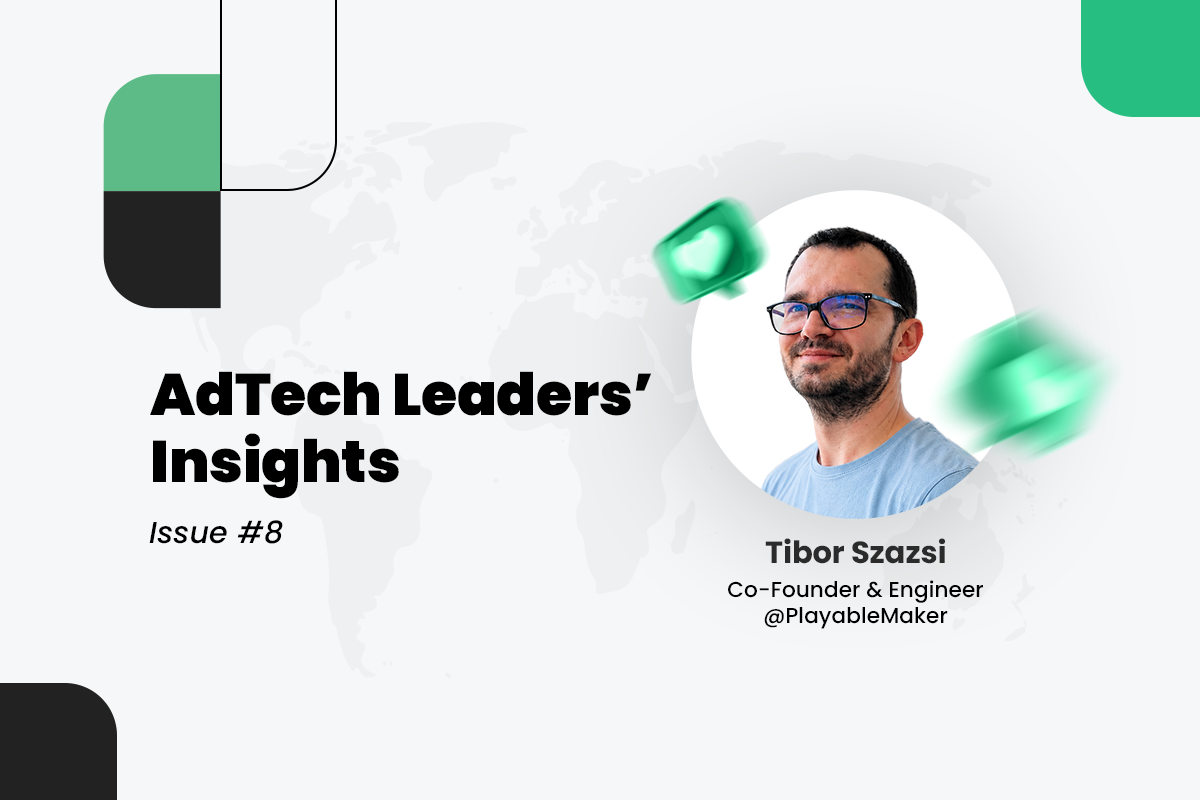
Playable ads have become increasingly hard to ignore (especially on platforms like AppLovin) but many studios are still figuring out how to make them work at scale. We spoke with Tibor Szaszi of PlayableMaker about some of the questions UA teams wrestle with most: how often to refresh creatives, how closely a playable should mirror the actual game, and whether smaller teams can realistically compete on volume without an unlimited production budget.
AppSamurai: Studios told you directly they came to playable ads because they had no other way to compete on AppLovin. What does a studio’s performance typically look like before and after making that switch? What metrics actually move?
Tibor Szaszi: Being a creative tool, not UA or optimization tool, we do not typically discuss metrics. Instead user usually comes with an idea and question –
“what others are creating?” But one thing those customers have in common is that they have a game/app that they grew to a certain level and want to scale a lot. For that they usually want to go applovin and applovin means using playables. Thus often talking to us, because price per playable, investment vs outcome, that’s what they are referencing as a decision factor with playables. They often don’t want to start investing thousands into custom playables, but want to try what is possible within their budgets. But if something gets mentioned it’s the usual trio of suspects – CTR, CPI, ROAS.
AppSamurai: From the volume of playables built on your platform, are there specific mechanics or design patterns you see consistently outperforming others, and do those patterns differ meaningfully by genre?
Tibor Szaszi: The most commonly used game mechanic is the puzzle mechanic and memory games. We have multiple variations of templates with puzzle game mechanics. However, many playable ads are still created from video ads, where we do not recognize game mechanics in video. Talking about template categories, End cards are the most used/favorite. Next in the lines are the match 3, merge 2, quiz, and Interactive options mechanics.
AppSamurai: UA managers often debate how faithful a playable ad should be to the actual game. Should a playable ad accurately represent the core loop, or is it better to build something that just converts well even if it attracts players who might churn?
Tibor Szaszi: I think the theme and mood of the playable ad should at least be related to the game. Sometimes it is difficult to recreate the exact game mechanics, but you can still show elements from the actual game. It is important to use the same assets.
For example, if you have a battle game, you can create a playable ad with a warrior selection screen, using the warriors from your actual game. If you have a racing game, you can still create a playable ad featuring a car tuning scene, showing the garage, the cars, and so on.
It is always about A/B testing. You need to find the right type of playable ad that converts.
AppSamurai: You’ve pointed out that the studios winning on AppLovin and Mintegral aren’t winning because they have better ideas, they’re winning because they test more of them. How does a smaller UA team close that gap without an unlimited production budget?
Tibor Szaszi: You never know which creative will be the winning one until you test them. Smaller teams can still create a large number of playable ads, they just need to find a tool that allows them to do so. Speed and cost are crucial.
In PlayableMaker, they can create 80 playable ads for €129 per month, or unlimited playable ads for €599 per month.
We recommend testing multiple variations of the same playable ad. One can end with winning the game, another with losing, or simply an unfinished ending where the game continues in the actual game.
Different playable ads can also be created by changing the game assets used, but we recommend using the assets from the actual game.
Unfortunately, we still see some studios creating only one or two playable ads.
AppSamurai: Creative fatigue is compressing fast, some data points to under 10 days before a creative loses steam on high-velocity platforms. How should UA managers be thinking about their playable refresh rhythm, and what’s a realistic weekly output target for a studio that wants to stay competitive?
Tibor Szaszi: Playable fatigue windows really have collapsed; on the fastest channels you often get 7–10 solid days before performance slides. From a PlayableMaker perspective, UA teams need to think in terms of a rhythm, not one‑off productions: a small set of modular, evergreen templates per title, and a weekly habit of refreshing hooks, angles, and difficulty rather than rebuilding from scratch each time. They create a working template, where every week different things can be modified – number of clicks, colors, CTAs, swapping game mechanics, images etc.
In practical terms, for a studio that wants to stay competitive on high‑velocity platforms, we’d call a realistic target something like 2–3 new playable concepts and 6–10 variants per week per priority title. The only way to make that sustainable is having a toolchain where cloning, reskinning, and exporting across networks is a matter of minutes, so your team’s energy goes into ideas and testing, not file prep and engineering.
AppSamurai: You built a free MRAID validator because playables breaking on upload is one of the most common and frustrating problems in the workflow. Beyond validation, what are the two or three technical mistakes you see UA teams make most often that silently kill their playable ad performance before a campaign even starts?
Tibor Szaszi: The MRAID validation tool was built because some ad networks have rejected our playable ads, and it was the easiest way to test our creatives and discuss issues with their support. These types of rejections should be now eliminated by design. Our playable ads are prepared to meet the technical criteria of each ad network—for example, the game should start muted until the first user interaction, launch immediately without additional loading time, fit the screen size, and be ready for both portrait and landscape modes, etc.
After a playable ad passes the technical checks, ad networks perform manual testing. This process can sometimes take longer, as they focus on the content itself. This is where issues can occur. Sometimes there is inappropriate content, sometimes a misplaced text or image. In other cases, the CTA button is not visible enough or does not have a pressed state.
I recommend testing the creative before uploading it. Some ad networks offer dedicated testing tools for playable ads, where users can test the entire creative before submission. I strongly recommend using them, as many issues can be identified and fixed in advance.
[ad_2]
Source_link