Reading Time: 7 minutes
TL;DR
- Fintech, wealth management, and neobank brands can personalize engagement across every market without moving sensitive financial data out of Databricks.
- MoEngage, an agentic customer engagement platform, connects natively to Databricks and activates governed data like KYC, balances, risk scores, transaction history and more attributes via zero-copy Warehouse Segments, with no exports, no duplicated PII, no per-market pipelines.
- Merlin AI provisions an AI agent for every customer instead of static segments, deciding the next message, channel, and send time in real time based on live signals like portfolio drift and funding status.
- Powers the full fintech lifecycle such as onboarding, cross-sell, referrals, reactivation, retention, investor education, and compliance/transactional messaging all from one governed connection across every regulatory market.
- This results in real-time, 1:1 personalized engagement at global scale, without increasing cross-border compliance risk.
A digital wealth manager, neobank, or payments app doesn’t have one customer data problem, it has one for every market it operates in. KYC records, transaction ledgers, risk and propensity scores, support history, and app behavior all live in different systems, often duplicated per country to satisfy local data-residency rules. For a fintech brand serving customers across five or ten markets, that’s not hundreds of millions of data points to stitch together, it’s the same stitching problem, repeated once per regulatory regime.
Even a brand that solves this and produces a unified, governed customer view doesn’t automatically get value from it. A risk score sitting in a model has no commercial impact until it decides which product, channel, and moment reaches the right customer, and in financial services, that decision has to clear compliance before it can clear ROI.
This matters more now because the pressure on fintech brands is no longer just “personalize the experience.” It’s “prove personalization pays for itself while every part of your product is commoditizing.”. Deloitte’s 2026 outlook goes further for wealth management specifically: as deposits, payments, and account fees compress toward zero differentiation, personalization is becoming the new performance metric, not a CX add-on.
Personalization Has to Earn Trust Before It Earns Revenue
Retail brands that get a recommendation wrong lose a click. Fintech brands that get a recommendation wrong by sending an unlicensed product offer into the wrong jurisdiction, or nudging a customer with data that shouldn’t have crossed a border will create regulatory exposure. That’s the real reason fintech personalization has lagged other industries. It isn’t a data or AI capability gap, it’s a governance gap. Marketing teams are asked to move fast on customer moments while InfoSec and legal are asked to guarantee that PII, balances, and identity documents never move somewhere they shouldn’t.
The brands solving this aren’t choosing between speed and governance. They’re separating where data lives from how it gets activated, which is exactly why critical customer engagement moments are lost. Databricks and MoEngage help make data governance and marketing activation seamlessly through their native integration.
Databricks Decides What’s True and Compliant. MoEngage Decides the Next Move.
Databricks stays the governed system of record for KYC status, account balances, portfolio composition, churn and propensity models, transaction history and manages a unified and access-controlled per Unity Catalog policy, per market, per regulation. MoEngage is the agentic engagement layer on top of it. Through Warehouse Segments, MoEngage queries approved, PII masked attributes directly from Databricks through zero-copy sharing and no per-market export pipeline. MoEngage’s Merlin AI uses that context to decide the next best product, channel, and send time for each customer.
The result: a fintech brand doesn’t need a separate martech stack, ETL tool, export process, or compliance review per country. One governed connection powers every market the brand operates in.
From Static Segments to an Agent for Every Investor
Most fintech engagement still runs on a handful of manually built segments “HNI clients,” “dormant IPs,” “referral-eligible”, refreshed on whatever cadence the data team can manage, and tested one variable at a time. That’s marketing built for the average customer in a segment, not the customer in front of you.
MoEngage’s Merlin AI agents work differently. Instead of a marketer building a segment and hoping it holds, an agent is provisioned for every customer, continuously reading the same governed Databricks attributes like risk tier, portfolio drift, funding status, referral activity and deciding the next message, channel, and moment for that one investor, not the segment average.
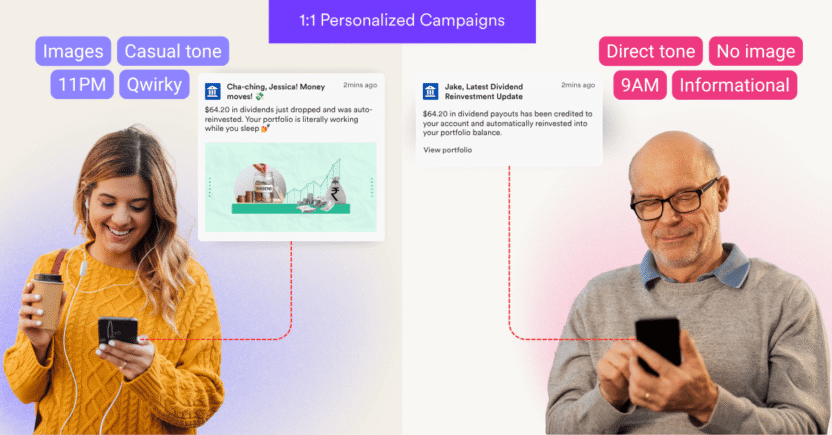
By truly personalizing engagement down to the individual level, the platform ensures content adapts dynamically to demographic and behavioral nuances—so a Gen Z user relaxing on their phone at 11 PM receives a playful, upbeat notification reading, “No cap, your savings just leveled up!  You unlocked $20 cashback—go treat yourself!”, whereas a retired customer checking their updates at 9 AM gets a clear, direct summary stating, “Monthly Account Update: $20 in cashback rewards has been successfully credited to your balance.” Agents test thousands of messages and offer variants in parallel, learning what moves a specific customer rather than what moves a persona, and improving with every interaction.
For a regulated fintech brand, an agent making that call is only as trustworthy as the data and rules it’s reading from. That’s exactly why Databricks staying in the governed system of record isn’t a constraint on agentic marketing. It’s what makes it possible to run truly 1:1, real-time marketing without a compliance review before every send. This is the positioning both companies are building toward together: activating Databricks intelligence to deliver truly 1:1 agentic marketing, in real time, for every customer, in every market.
Multiply Engagement ROI Without Multiplying Regulatory Risk
A propensity score used once in a quarterly compliance report has limited commercial value. The same score used continuously to decide who gets an onboarding nudge, a rebalancing alert, or a referral invite can influence every customer touchpoint, in every market, without a new data-sharing agreement each time.
That compounds in three ways:
- More markets activated on one connection. The same governed pipeline that powers a UAE campaign powers Singapore, Malaysia, Hong Kong, and Thailand without a new export process or vendor review per region.
- Faster time to compliant value. Marketing teams launch on approved, current data instead of waiting on a data team to prepare a fresh export for every campaign.
- Continuous, auditable learning. Engagement outcomes flow back into Databricks, so risk and compliance teams get the same audit trail marketing gets for optimization.
Where This Shows Up Across the Fintech Lifecycle
- Onboarding & Activation: A newly approved account gets welcomed with messaging that matches its actual risk profile and time horizon, not a generic product summary, because the data reflects what’s true right now, not what was true at last export.
- Cross-Sell & Upsell: A single-product investor gets nudged toward a hedge fund, private-markets allocation, or new ETF structure based on a live propensity score, not a stale segment built weeks earlier.
- Referral & Word-of-Mouth: High-value, high-intent cohorts get isolated precisely enough to run referral programs (and sync them to paid social for look-alike targeting) without ever exporting account-level data to do it.
- Reactivation & Win-Back: A paused recurring-deposit plan or a dormant corporate account triggers a win-back flow the same day the pause is detected, not at the next quarterly review.
- Retention & Recurring-Investment Nudges: Portfolio drift past a set threshold triggers a rebalancing nudge in near real time, reinforcing the confidence that keeps dollar-cost-averaging customers investing.
- Educational & Thought Leadership: Market commentary and investor-education content route by declared risk appetite and portfolio composition instead of blasting the same newsletter to the entire base.
- Events & Webinars: Webinar invites (with partners like index providers or asset managers) go only to customers who currently qualify an accredited-investor status checked against live data, not a list built months ago.
- Promotions, Festive & Loyalty: Region-specific offers and loyalty tie-ins reflect current point balances and market, so a customer in one country never sees an offer that only applies in another.
- Transactional & Compliance: Offboarding notices and investor-status deadlines always match the customer’s actual, current status in the system of record because there’s no export lag between what compliance knows and what the customer is told.
Connect Onboarding, Investing, and Support Across Markets
Consider a premium client who onboarded in the UAE, refers to a friend who signs up in Malaysia, and browses a new alternative-investment product in the app while responding well to push. Databricks unifies that client’s KYC status, transaction history, referral activity, and product browsing across every market they’ve touched. MoEngage decides whether the next action is a referral reward confirmation, a product nudge, or a rebalancing alert and coordinates it across push, email, in-app cards, and paid-social sync, in the right language, from the right regional sender, without ever needing the underlying account data to leave its market of origin.
This is the boundary that’s disappearing: not just between digital and offline, but between one regulatory market and the next. A global fintech brand increasingly needs to treat its five or ten markets as one customer base with different compliance rules, not five or ten separate marketing operations.
Scale Personalization With Governance Built In
None of this works if faster activation comes at the cost of regulatory trust. Through zero-copy sharing via Delta Sharing, engagement outcomes flow back to Databricks for reporting and model refinement without creating another data store to secure. Databricks governs exactly which attributes marketers can see and never PII data account numbers, net worth, or tax identifiers per market, per role, per regulation. Retailers can move fast because a bad recommendation costs a click, fintech brands need the same speed with a much higher bar, and that bar is what this architecture is built to clear.
Closing the Gap Between Data Investment and Fintech Growth
Fintech brands have already invested in the data and models needed to personalize. The gap left to close isn’t more data, it’s turning governed intelligence into millions of compliant, 1:1 decisions across every market, channel, and regulatory regime a brand operates in. Databricks provides the trusted, governed foundation. MoEngage turns that foundation into an agent for every customer, deciding the next best action, in real time, wherever that customer happens to be banking, investing, or paying. Together, they give global fintech leaders a path from data investment to compliant, cross-border, truly one to one growth.
The post How Databricks and MoEngage Help Fintech Brands Scale 1:1 Customer Engagement without Cross-Border Compliance Issues appeared first on MoEngage.