[ad_1]
Reading Time: 5 minutes
Personalization Has a Ceiling. It’s Made of Human Bandwidth.
For as long as brands have invested in customer engagement, the goal has stayed the same: show up at the right moment, with the right message, for every individual. And for just as long, the same constraint has stood in the way. Doing that at scale is genuinely hard.
For years, one of the biggest bottlenecks was simply producing enough relevant content. Generative AI has largely dissolved that constraint. Marketers can now create variants, campaigns, and creative faster than ever. The barrier to creative output has come down significantly.
But producing more messages was never the same as getting the right message to the right person. That exposes the problem underneath the problem, the one that has stubbornly remained unsolved: Decisioning. Who do you talk to? What do you communicate? When, and on which channel? For each individual, every day.
The industry has tried to answer this in waves.
First came segmented campaigns. You discovered an audience and crafted a message that was the best average for that population, but not optimal for any single person in it. Then came journeys. We stopped thinking in one-off sends and started thinking in flows: triggers, branches, wait steps, lifecycle orchestration. It was a real improvement. Messages could now respond to behavior. But a journey is still a set of rules a human drew in advance. Someone has to imagine every path, build every branch, and maintain it as the world changes. Personalization improved. The decisions were still authored by people and applied to groups.
As programs grew, so did everything around them. More segments to maintain, more journeys to build, more tests to run, more people needed to manage it all. Personalization hits a ceiling, and that ceiling is made of human bandwidth.
That’s the constraint this acquisition is meant to address.
MoEngage Acquires Aampe, Creating a Unified Platform for Agentic Marketing and Decisioning
Aampe is an Agentic AI infrastructure company built on a specific architectural idea: deploy a dedicated, autonomous AI agent for every individual end-user. Marketers define the content, goals, and guardrails; agents handle the decisions, composing the right message for each person and learning from every outcome. Aampe has deployed millions of these individual agents across its customers, processing over 200 billion decisions a week.
The acquisition completes MoEngage’s vision of an Agentic Customer Engagement Platform. MoEngage’s Merlin AI agents let marketers build content, launch campaigns, design journeys, and surface insights with far greater efficiency – capabilities brands like Soundcloud, Swiggy, and Loblaws already use, while the recent launch of Merlin AI Custom Agents takes this further by owning entire marketing workflows end-to-end rather than assisting with isolated tasks.
It’s the best of both worlds. Marketers get agents to scale their operations while simultaneously getting agents that drive true 1:1 decisioning for their customers. Scale, without sacrificing human relevance.
With the acquisition, Aampe’s founding team – Paul Meinshausen, Schaun Wheeler, and Sami Abboud will join MoEngage to lead Agentic Decisioning. Aampe’s existing customers will continue to be served without disruption and will benefit from the additional engineering, data science, and customer support resources that come with being part of MoEngage.
What “Agentic Decisioning” Actually Means
Almost every vendor in customer engagement now claims AI-driven personalization. But most “AI decisioning” stops at surface tactics – next-best channel, optimal send time, or solving for a single use case. Those matter, but they’re the starting point, not the destination.
Aampe’s architecture is unique – it’s one agent per user, not one model per segment. Each agent builds a persistent model of that individual, their rhythm, content preferences, and what actually moves them to act, and updates it through every interaction.
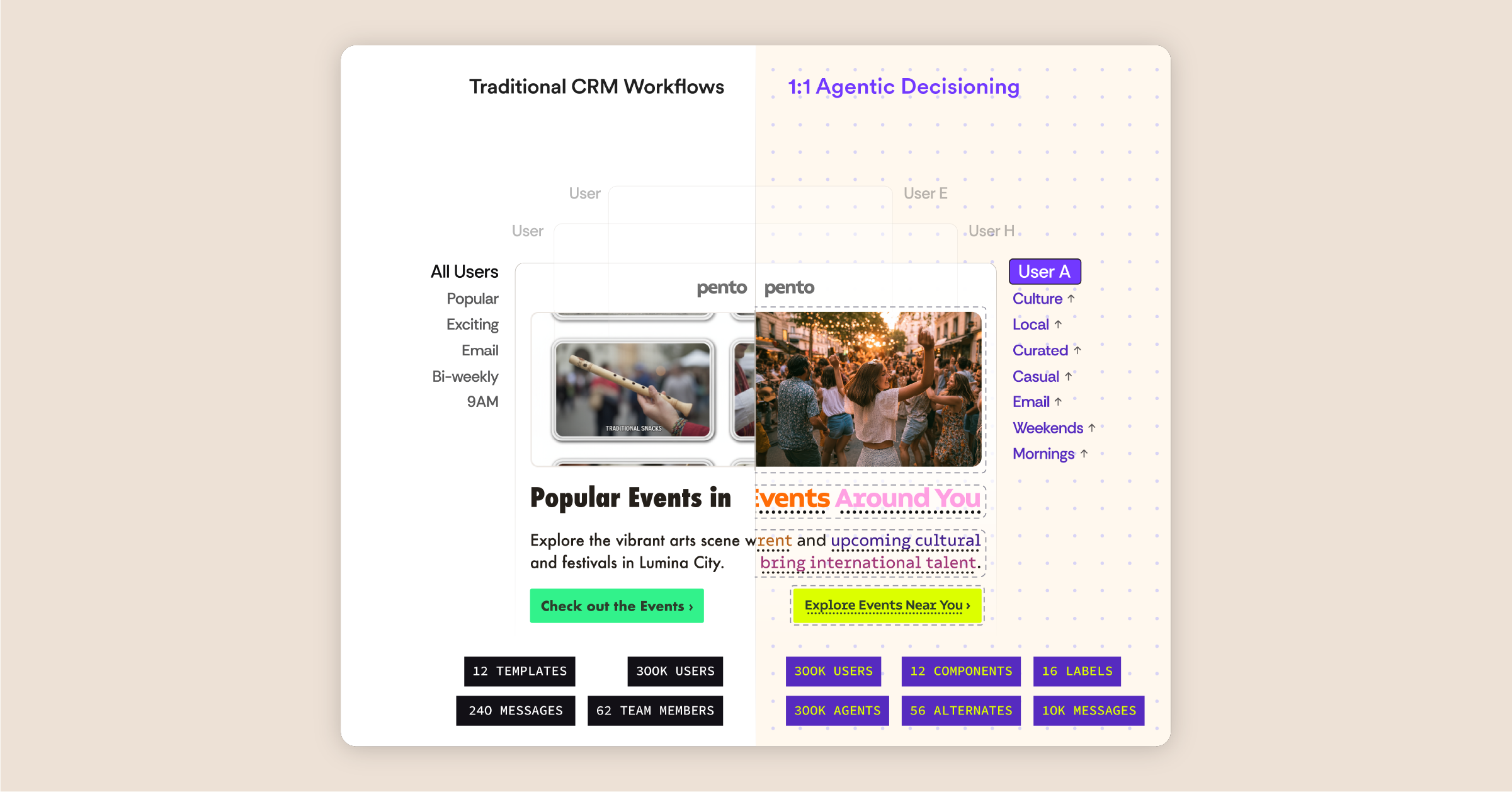
Here’s what that looks like in practice. If a brand has ten million users, Aampe deploys ten million agents – each one maintaining its own understanding of that specific person and updating it through every interaction. A few things make this work:
- Reinforcement learning at the individual level. Each agent uses Thompson Sampling and multi-armed bandits to continuously optimize content, timing, frequency, and channel – all at once for a single user.
- Causal, not correlational, learning. Agents distinguish “this happened because I sent a message” from “this happened after I sent a message,” so they learn what actually drives action.
- Semantic learning that compounds. Agents learn at the level of meanings – tones, themes, value framings – not just specific messages. New campaigns inherit everything the agents have already learned, so nothing cold-starts.
- Network intelligence. Agents share learnings across the platform while staying autonomous per user, which keeps even brand-new users from starting cold.
Customers Are Already Seeing What This Looks Like Together
Swiggy, India’s leading food delivery platform, has been using both MoEngage and Aampe in its engagement stack. Niranjan Sane, their AVP of Growth, described what it looks like from their side:
Personalization at scale isn’t a nice-to-have; it’s how we build loyalty with millions of users every day. MoEngage has been a core part of that infrastructure, and Aampe has shown us how we can deliver highly relevant messages to our customers by working through thousands of options and tailoring them toward their specific preferences.
Taxfix, a European tax platform, ran Aampe side-by-side with a rule-based CRM system they’d been iterating on for 4 years. Their Chief Growth Officer, Alex Beresford, shared the outcome directly:
Aampe beat it by 50%, delivered a 40% revenue uplift versus a global holdout, and was breakeven in thirty days. When I compared the fully loaded cost of running Aampe against what we spend on advertising to drive the same returning-customer behavior, Aampe was 120 to 150 times more efficient.
Grab, Southeast Asia’s leading super app, serves over 52 million monthly transacting users across eight markets, coordinating communications across mobility, food delivery, and digital banking within a single app. Their Head of Product Comms, Matias Singers, described what compounding decisioning looks like at that scale:
The real unlock with Aampe wasn’t just the personalization, it was the compounding. When we learn that a user responds to convenience as a value proposition, that learning carries forward into every future product launch, every new feature, every campaign. We’re not starting from zero every time. That changes the entire economics of how a team like ours operates at our scale.
How Brands Can Get Started: Start Anywhere
We designed this for one outcome – making Agentic Decisioning accessible to every brand, regardless of where they are in their journey. We call it Start Anywhere.
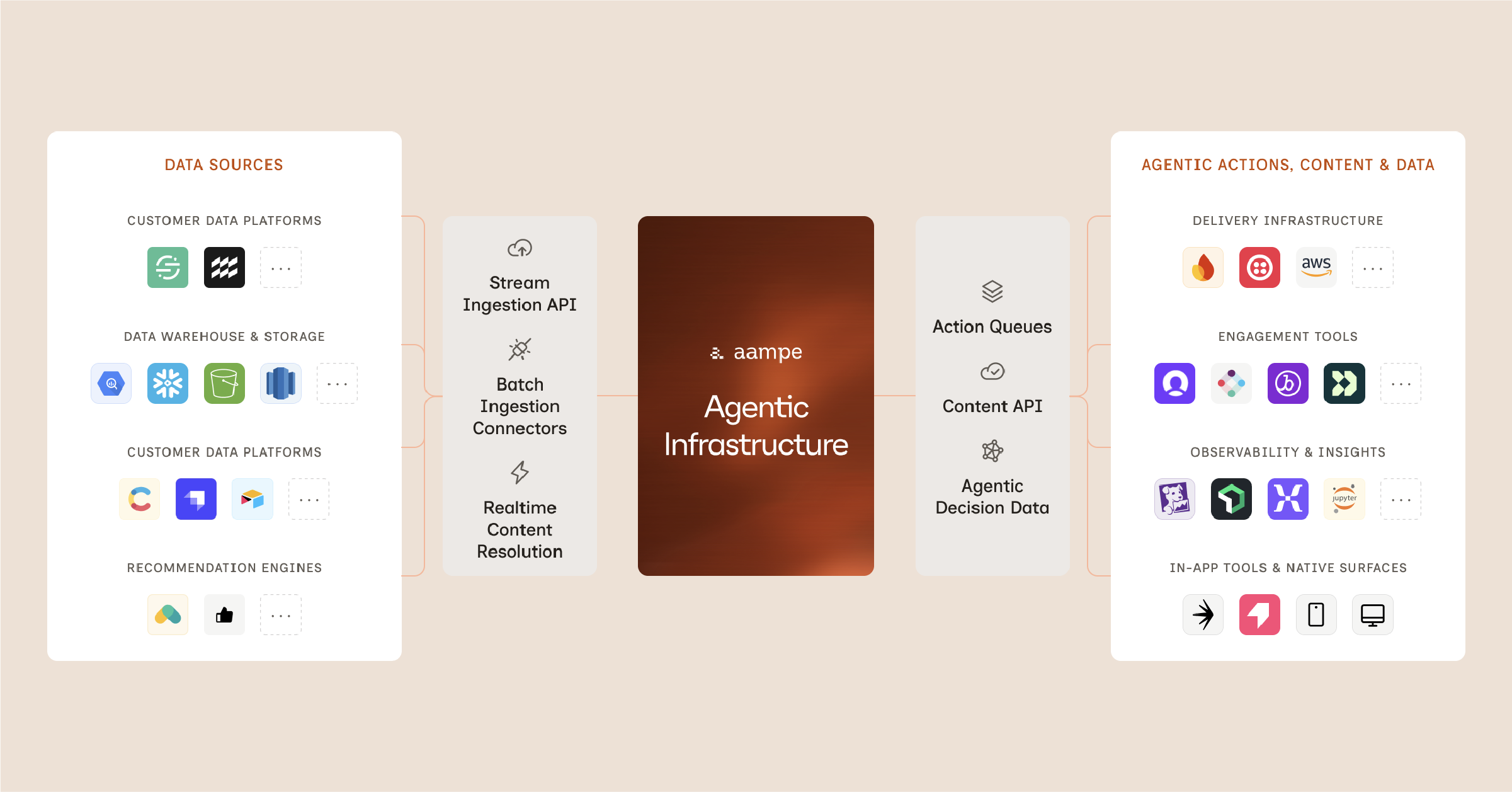
- Already on a different customer engagement platform? You can plug Aampe’s per-user agents directly into your existing stack today and start leveraging individual-level decisioning right away – no rip-and-replace.
- Already a MoEngage customer? Aampe will be available natively, expanding what you can do without switching a thing.
Wherever you are, you can begin where you stand.
What’s Next?
Bringing MoEngage and Aampe together also unites both companies’ AI labs under a single focus: building the next generation of agentic marketing. For Aampe’s research team, that means access to production-scale context and signal across MoEngage’s global customer base – the depth needed to accelerate what’s already working. For the industry, it means cutting-edge, scalable decisioning becomes the default, not the exception.
Want to see agentic decisioning in action? Whether you’re already on MoEngage, running on another platform, or just starting to explore agentic AI, we’d love to show you what this looks like for your brand. Get in touch with our team to start anywhere.
The post MoEngage Acquires Aampe to Build the Agentic CEP, Powered by 1:1 Agentic Decisioning appeared first on MoEngage.
[ad_2]
Source_link