Loyalty Program Benefits: What the Data Shows in 2026
In 2026, the average loyalty program returns 5.3x on investment, up from 5.2x in 2025 and 4.8x two years before that. That steady climb is the clearest argument yet for what loyalty program benefits actually deliver, and it comes from the largest dataset Antavo has ever fielded. Whether you’re new to loyalty or building a case for leadership, here’s what the data shows. Antavo’s 2026 Global Customer Loyalty Report surveyed 10,000 consumers and nearly 3,000 marketers across 19 industries, and the results are worth understanding in full before your next budget conversation.

The Investment Case for Loyalty Program Benefits
The headline number is 5.3x average ROI in 2026. That’s not a one-year snapshot, it’s the third year running of a climb: 4.8x, then 5.2x, then 5.3x. A single strong year could be luck. Three years of consistent upward movement is a trend.
Among the 87% of program owners who actually measure ROI, 93% report it’s positive. That figure matters more with the caveat attached than without it: it’s not “9 in 10 loyalty programs work,” it’s “9 in 10 programs work among those who are tracking closely enough to know.” The gap between measuring and not measuring is itself a signal worth sitting with.

The budget data adds a second layer. Brands that already run a loyalty program allocate 51.5% of their marketing budget to CRM and loyalty. Brands still planning to launch one allocate 42.5%, a 21.2-point gap. The ROI number answers “does it work.” The budget gap answers a different, more urgent question: “is everyone already ahead of you.” Read together, they say the same thing from two directions, this isn’t a bet anymore, it’s table stakes the rest of the market is already funding at a materially higher rate.

Customer Appetite Is Rising
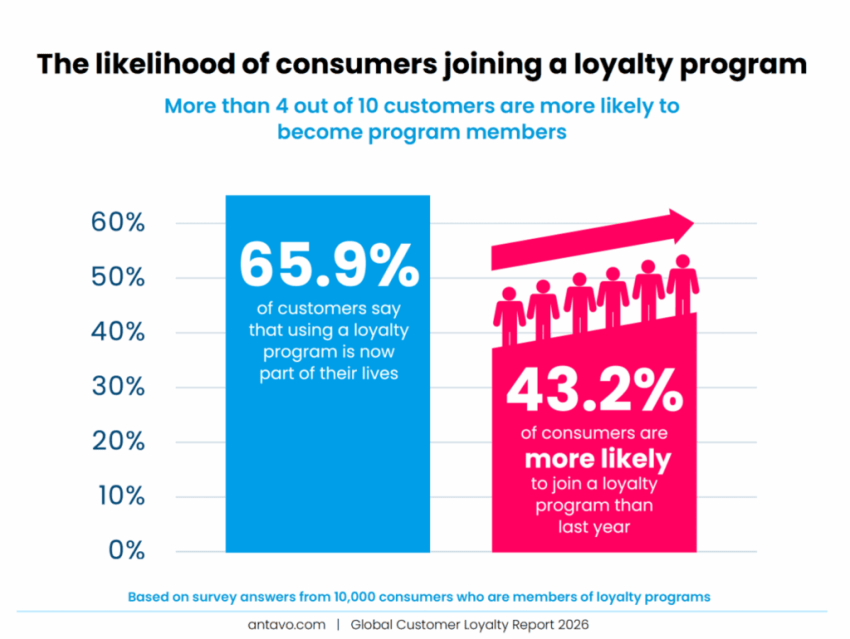
The demand side backs up the investment case. 43.2% of consumers say they’re more likely to join a loyalty program now than they were a year ago, and 65.9% say using a loyalty program is simply part of their lives at this point, not a novelty, a habit.
What’s driving that willingness is worth a closer look, because it isn’t gamification or flashy features. The top reasons consumers join are money-saving benefits (70.8%), free products or shipping (46.3%), and personalized offers or rewards (41.6%). Demand for loyalty programs is rising, and it’s still driven by plain financial value rather than novelty. That’s a useful data point to have on hand if “customers want more gamification” comes up as an assumption later in planning, the data says customers want value first, engagement mechanics second.
Where Loyalty Program Benefits Still Fall Short
None of this is a straight line up. Program owner satisfaction jumped from 69.2% in 2025 to 83.0% in 2026, a large one-year swing. But that number gets more complicated the closer you look at it.
There’s a perception gap behind the satisfaction jump. 82.6% of marketers believe their program makes customers feel valued. Only 56.2% of customers agree. That’s roughly a 26-point gap between how marketers rate their own program and how the people in it actually experience it.

The sharper risk sits underneath that gap. 74% of members disengage within two months of joining but keep their membership active. Only 3.4% actually cancel. Cancellation isn’t the risk here, disengagement is. The membership is sticky. The engagement isn’t. A program can look healthy by enrollment and retention numbers while quietly losing the behavior change it was built to drive. Antavo’s Loyalty Perception Gap piece goes deeper into why this gap forms and what closes it.
Key takeaways
- 5.3x average ROI, up from 4.8x two years ago. Loyalty investment has a three-year track record now, not just a single strong quarter, use the trend line, not the single number, when making the case internally.
- 43.2% more likely to join, driven by plain financial value. Demand is real, but it’s earned through savings and personalization, not novelty, prioritize value clarity over gimmicks in acquisition messaging.
- 83.0% satisfaction sits on top of a 26-point perception gap. Don’t let a good satisfaction number stand in for actually checking whether members feel valued, the two aren’t the same metric.
Frequently Asked Questions for Loyalty Program Benefits
Do loyalty programs actually deliver ROI?
Yes. Antavo’s GCLR 2026 data puts average ROI at 5.3x, up from 5.2x in 2025 and 4.8x in 2024, a three-year upward trend rather than a single-year outlier.
Are customers still interested in loyalty programs in 2026?
Interest is rising. 43.2% of consumers say they’re more likely to join a program now than a year ago, and 65.9% consider using loyalty programs a normal part of their routine.
What’s the biggest challenge loyalty programs face right now?
Disengagement, not cancellation. 74% of members go quiet within two months of joining while staying technically enrolled, and only 3.4% formally cancel, meaning most loyalty risk is invisible in standard churn metrics.
The Bottom Line
The ROI is real, the demand is real, and the gap between how programs perform and how members experience them is real too. None of those three facts cancels out the others. The data makes the investment case for loyalty program benefits, but only if the disengagement problem gets addressed directly rather than smoothed over.
Antavo is the AI loyalty and incentives platform that brings together loyalty, promotions, and agentic AI to turn customers into regulars: the customers who come back on their own, buy more often, and bring others with them. For more than a decade, Antavo has powered identity-led loyalty strategies for brands including SKIMS, Paul Smith, KFC, Flying Tiger Copenhagen, and Hyatt’s Inclusive Collection. Marketers build, change, and launch programs and promotions themselves, without waiting on engineering.
If you’re tired of paying to win the same customers twice, book a call with our experts and see how Antavo turns them into regulars.