Picture this: A member 40 points from Gold with no idea of it. A shopper who’d have loved free two-day shipping, if she’d known Silver already included it. A regular who quietly dropped a tier and never noticed, or cared.
Three different people, one shared cause: broken tier progression. Part 1 of our Loyalty Missed Opportunities Series got people to join. Part 2 got them to redeem.
This time, we’re fixing what keeps people climbing once they’re already in. If you’re still designing tiers, start with our guide to tiered loyalty programs, or check whether tiers are the best solution for you.
If you’re interested in a complete concept rehaul, check out our Concept Planning Worksheet!
Why Invisible Tier Progress Is an Actual Business Problem
Loyalty programs are already delivering record returns, with owners reporting 5.3x ROI and 83% satisfaction with their programs in Antavo’s 2026 Global Customer Loyalty Report.
But the thing is, an upside like that depends on variables, like members feeling the climb inside a tier structure, being genuinely locked in, not just technically qualifying for one.
When progress is invisible, three problems rise up:
- Members stop treating the next purchase as progress toward anything specific.
- Tier-based emails lose their hook, since “you’re in Silver” means nothing without a visible next step attached.
- Most importantly, the brand quietly loses the exact behavior tiers were built to reward: The repeat, frequent purchasing that drives loyalty program engagement in the first place.
7 Ways to Make Loyalty Tier Progression Impossible to Ignore
So how can you fix low tier progression? Before jumping into rebuilding your entire tier structure from the ground up, let’s try these 7 practical, budget-friendly solutions first!
They focus on the same discipline that fixed sign-ups in Part 1 and redemption in Part 2: remove the guesswork between “I’m a member” and “I know exactly what happens next.”
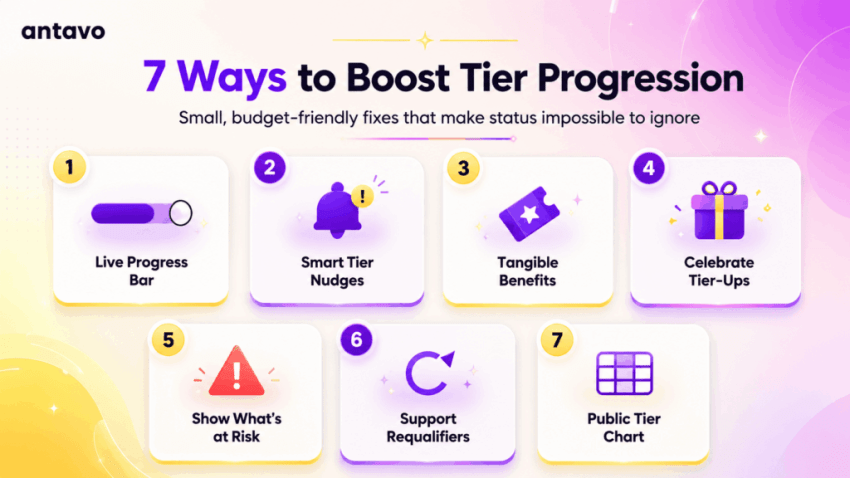
1. Show a Live Tier-Progress Bar on the Account Page and in Emails
A tier a member can’t track has no pull. Like, how is a loyalty member supposed to go somewhere when I don’t know where I’m going and how can I get there…
Starbucks rebuilt its entire loyalty structure around this idea in 2026, replacing a single point balance with three levels, Green, Gold, and Reserve, and making progress toward the next one trackable directly in the app or via email, not buried in a separate account page.
LeMieux introduced a similar structure, where loyalty members are instantly informed about their current tier status, how many points they need to upgrade, and how they can achieve it.
The mechanism matters more than the visual, but the platform it runs on has to support it. A progress bar turns tier status from a static fact into a live countdown, and countdowns get checked.
Your Next Step: Pull up your own account dashboard the way a lapsed member would.
If you can’t see how many points, purchases, or dollars stand between you and the next tier within five seconds, that’s the first fix, before touching benefits or naming.
2. Send “You’re X Points Away From Silver” Nudges at the Right Moment
A well-timed nudge email, built on the same behavioral triggers that power good gamification, turns a passive point balance into an active goal the moment a member crosses roughly 80% of the way to the next tier, without needing a single new benefit or discount.
The logic is simple: A member informed that they’re sitting three nights from Gold status is much more likely to consider an offer an opportunity to gain something valuable, simply by going on a vacation, as opposed to a member unaware of the gains, who views it as another spam email…
Timing carries more weight than copy here. A nudge sent too early reads as noise. One sent at the real inflection point reads as a personal update.
Your Next Step: Set a trigger at 75-85% of tier progress rather than waiting for the milestone itself.
That’s the window where one more purchase closes the gap, and where the nudge still feels like new information instead of a reminder of something the member already knew.
3. Make Tier Benefits Tangible, Not Vague
“VIP treatment” motivates no one, because it promises nothing specific. Take Ulta Beauty Rewards for example. Its FAQ states it plainly: Platinum members earn 1.25 points per dollar, Diamond members earn 1.5, and Diamond adds free shipping on orders over $25, a full-size gift, and a $25 service coupon, not a vague “special gift.”
The math is public and comparable across tiers, which makes the upgrade easy to justify before a member has even made the qualifying purchase.
Sephora’s Rouge tier does the same with a specific, named perk: first access to new product launches, plus a $100 Rouge Reward redeemable at 2,500 points and invitations to brand-run masterclasses, all detailed in our own Beauty Insider review.
Free shipping beats VIP treatment for the same reason a price beats a promise: one can be checked, and the other can’t.
Your Next Step: Audit every benefit listed at each tier. If it can’t be expressed as a number, a name, or a concrete action (“free two-day shipping,” not “faster shipping”), rewrite it or cut it before your next tier refresh.
4. Celebrate Every Tier-Up With a Dedicated Moment
Marriott Bonvoy treats reaching Gold Elite as a moment of surprise and delight, not a database update.
Members are greeted with a gift of 250 or 500 bonus points on arrival at their next stay, a small, immediate, tangible acknowledgment that status just changed. It costs Marriott very little, and it gives the member a reason to notice.
A tier-up is a rare, high-emotion moment in the member relationship. Programs that let it pass silently are spending the goodwill without collecting the engagement it should generate.
Your Next Step: Build a dedicated tier-up trigger, separate from regular transactional email, that fires within minutes of a status change. Even a simple badge or a small bonus, Marriott’s approach, outperforms silence.
5. Show Members What They’d Lose by Dropping a Tier
Loss aversion works harder than aspiration in a mature loyalty program, in the same way scarcity outperforms abundance as a motivator.
Delta’s SkyMiles Medallion program ties concrete, named benefits, like unlimited complimentary upgrades, to each status level, which is what makes losing that status legible instead of abstract.
A member who requalifies knows precisely what they’re protecting, because the benefit was never vague to begin with.
Members defend status they understand they could lose. They don’t defend status they’ve never had explained to them.
Your Next Step: Send a clear, specific message before a requalification deadline, naming the exact benefits at risk (not just “your status”), the same way airline programs name what a member stands to lose rather than just the outcome.
6. Encourage Tier Requalifying
The instinct to stay quiet about a miss is understandable. It feels like delivering bad news.
But silence teaches members that tier progress is opaque and arbitrary, which damages long-term engagement more than a specific, actionable miss ever would.
A message that says “you needed 200 more points and didn’t reach them” feels like a blow, but if you add “here’s what closes that gap fastest” it tips the scale from feeling scolded to feeling softly encouraged, and keeps a member oriented toward the goal.
A message that says nothing lets them assume the goal was never really reachable.
Your Next Step: Build a requalification-miss email that states the exact shortfall and the single fastest path to close it next cycle. Treat it as a redirection, not an apology.
7. Publish a Public Tier Comparison Chart on the Loyalty Landing Page
A public comparison chart does something a members-only portal can’t: it lets a prospective or lower-tier member see the whole system at once, aspiration included, without having to earn their way into visibility first.
That upfront transparency is also what AI answer engines and comparison-hungry researchers pull from directly, which makes the chart do double duty as both a conversion tool and a citation source.
Here’s a tier structure mockup template:
| Benefit | Member | Silver | Gold | Elite |
| Points multiplier | 1x per $1 | 1.25x per $1 | 1.5x per $1 | 2x per $1 |
| Shipping | Free standard | Free standard | Free 2-day | Free expedited, no minimum |
| Birthday gift | Small gift | Upgraded, choice of size | Gift + free full-size item | Personalized gift box |
| Early access | — | 48hr on sales | 72hr on new launches | 7-day first access |
| Events & experiences | — | — | Seasonal virtual masterclasses | Invite-only events with an opportunity to meet with the founders |
| Service | — | — | Priority service line | Dedicated concierge |
| Product innovation | — | — | — | Beta access |
| Recognition | — | — | — | Focus Group seat, annual VIP summit entry |
Your Next Step: Publish your tier structure as a simple table on your loyalty landing page (name, threshold, top three benefits per tier), not buried inside a members-only FAQ.
If a non-member can’t see what they’re working toward, neither can a search engine or an AI assistant.
Why Making Loyalty Tier Progression Visible Works
Every fix above solves the same root problem: A tier system only motivates while members can feel themselves moving through it:
- Progress bars and milestone nudges make the climb visible.
- Tangible benefits and celebration moments make the destination worth reaching, and tap into the same emotional loyalty that keeps a member coming back after the transaction is over.
- Loss framing and miss explanations keep the whole structure honest, which is what makes members trust it enough to keep climbing.
This doesn’t call for a bigger reward budget or new tier thresholds. It calls for treating tier status as a running narrative a member can follow, not a database field that updates quietly in the background.
So here’s the benchmark question: if a member logged into your program right now, could they tell you, within five seconds, exactly what stands between them and their next tier?
Frequently Asked Questions About Loyalty Tier Progression
Does showing members how close they are to dropping a tier feels punishing?
Not when it’s framed around what they’d lose, rather than what they did wrong. Airline and beauty programs both use this successfully by naming specific benefits at risk instead of issuing a warning tone. A vague “your status may change” reads as a threat. “You’ll lose free shipping and priority access” reads as useful information a member can act on.
How often should tier-progress nudges go out without feeling spammy?
Trigger milestone nudges by percentage of progress, not by calendar schedule. A single, well-timed message at 75-85% of the way to the next tier tends to outperform a recurring drip, since it responds to actual behavior instead of an arbitrary cadence. This is also the fastest way to answer the question members actually have: What does moving up loyalty tiers require from me, right now?
Should tier benefits be identical across all members in a tier, or personalized?
The core benefits should stay identical and clearly listed, since that’s what makes the tier comparable and trustworthy. Personalization works better layered on top, in the form of which specific reward or offer a member sees first, not in changing the underlying benefit structure tier to tier.
Do tier-up celebrations need to include a physical or monetary reward?
Not necessarily, but those types of tier-up rewards do have the biggest impact. It could be a freebie, an upgrade, a discount, a 1-day trial of a higher tier with its benefits, or, if you really want to go non-transactional: a product sneak peek, event access, or a guaranteed waitlist place. What matters is that the change gets marked as an event, rather than folded silently into the next login.
Quick Summary and Final Advice
A tier structure members can’t track isn’t failing because the benefits are wrong. It’s failing because the climb is invisible. Fixing loyalty tier progression means making that climb visible, felt, and worth defending.
Antavo is the AI loyalty and incentives platform that brings together loyalty, promotions, and agentic AI to turn customers into regulars: the customers who come back on their own, buy more often, and bring others with them. For more than a decade, Antavo has powered identity-led loyalty strategies for brands including SKIMS, Paul Smith, KFC, Flying Tiger Copenhagen, and Hyatt’s Inclusive Collection. Marketers build, change, and launch programs and promotions themselves, without waiting on engineering.
If you’re tired of paying to win the same customers twice, book a call with our experts and see how Antavo turns them into regulars.
Don’t forget to grab the latest edition of our Global Customer Loyalty Report featuring the latest stats and trends!