Summary
- Conversational commerce can combine AI-assisted product discovery, support, and guided handoff or transaction workflows in configured channels such as WhatsApp, depending on integration, market, and business model.
- A practical evaluation rubric should assess data and identity readiness, catalog and recommendation quality, AI assistance, channel configuration, governance, escalation, orchestration, and analytics.
- A platform built around unified profiles and configured data integrations can support more connected personalization than disconnected tools used separately for each experience.
- B2B and B2C teams may prioritize different workflows, customer contexts, and operating models, so each pilot needs an appropriate rollout plan.
- Start with one pilot channel, a defined workflow, required data, escalation path, and measurement approach before expanding.
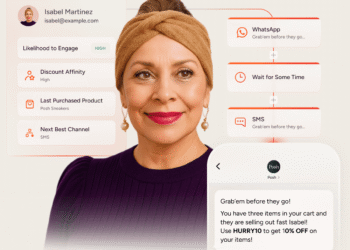
Conversational commerce companies provide tools that help customers browse, ask questions, and receive assistance through messaging experiences. Depending on the channel, integrations, and business model, those experiences can guide discovery, support a handoff, or advance a transaction workflow. That distinction matters because most vendor conversations still get framed around WhatsApp adoption numbers instead of what a platform can actually do once a shopper starts typing.
This guide is for marketing and ecommerce leaders: chief marketing officers, VP-level ecommerce owners, and marketing operations teams evaluating messaging and customer data platform vendors for 2026 budgets. You’ll get a practical scoring rubric for separating a true artificial intelligence (AI)-native conversational commerce platform from a bolt-on chatbot, a look at how unified data platforms compare with point-solution messaging tools, and separate playbooks for B2B and B2C teams. A quoting workflow and a cart-recovery message have almost nothing in common, and the rest of this guide treats them that way.
What actually counts as a conversational commerce platform in 2026
A conversational commerce platform can use AI assistance to support product discovery, customer questions, and post-purchase journeys across configured channels. The experience should be evaluated for how it uses approved customer, product, and knowledge-base data; how it handles escalation; and whether any handoff or transaction workflow is supported for the relevant channel and implementation.
Chatbot and live-chat tools vary widely in their capabilities, data integrations, and handoff design. Buyers should test how each option handles complex questions, customer context, product information, and escalation to a human team.
An AI-assisted platform should be evaluated on whether configured data, governance, and journeys enable useful customer experiences across the channels a team operates. That is the distinction worth testing before evaluating any vendor, rather than assuming conversational commerce is only a feature inside a messaging tool.
The capabilities that separate real platforms from point solutions
Evaluate every vendor on the workflows its configured AI assistance can support, not simply on the number of channels shown in a pricing sheet. Test how product discovery, recovery, service, knowledge retrieval, and human handoff work for the specific channel, data integration, and business process your team will operate.
AI agent quality: discovery, recovery, and support in one thread
Ask vendors to demonstrate a realistic conversation, not only a demo script. Can the experience use configured customer context, product catalogs, recommendations, and knowledge-base content to support discovery, recovery, service, and a clear human handoff when needed?
For an example of AI-driven product discovery and personalization in practice, see the ECCO customer story.
Channel breadth and native data integration
Channel count matters less than whether configured channels can use consistent customer and product context. Ask how WhatsApp and other enabled channels use unified profiles built from user attributes, events, and product data, and how Customer Data Management supports personalization across those experiences.
How the major vendors stack up in 2026
A useful evaluation distinction is whether the platform connects customer, behavioral, and product data to personalization across channels or relies on separate tools for each experience. Ask vendors to show how segmentation, recommendations, journey orchestration, analytics, and AI assistance work together in the workflows your team needs.
An AI-agent-led approach should be assessed alongside its data and identity foundation. Customer Data Management can unify user attributes, events, and product data to power personalization across configured channels, subject to the integrations and workflows a team has implemented.
The practical question is whether recommendations, customer context, and journey logic are available consistently when a customer needs assistance. For an example of messaging and personalization from a single omnichannel platform, see the Slazenger customer story.
Where agentic AI shopping assistants pull further ahead is in handling ambiguity. A templated recommendation widget can suggest “customers also bought,” but it can’t handle a customer who says “I need something for a wedding in July, budget under $200, and I hate florals.”
A strong shopping-assistance experience can use a configured catalog, recommendations, and knowledge-base content to help a customer narrow choices, while providing an escalation path for questions that need human support. Within Insider One’s Platform, Agent One is designed for customer support and shopping assistance, while Insider One AI supports campaign creation, content generation, audience building, analysis, and marketing workflows.
B2B and B2C conversational commerce need different playbooks
B2C and B2B conversational commerce can serve different customer journeys, and teams should adapt the workflow to the buying context. The two segments may need different entry points, operating goals, and definitions of what a validated pilot looks like.
The B2C playbook: discovery and recovery at scale
B2C conversational commerce can support high-volume journeys such as cart recovery, browse-abandonment follow-up, and product discovery. The measurement plan should define the customer journey, intended business outcome, service and escalation experience, and data needed to assess the pilot responsibly.
For an example of an AI-powered conversational flow for high-volume customer support, see the Avis customer story.
The B2B playbook: quoting and account-based journeys
B2B journeys often involve multiple stakeholders and sales-assisted steps rather than a direct purchase in a single message. Conversational commerce in B2B can support qualification, knowledge retrieval, quoting and reorder workflows, account-service questions, and routing a buying committee to the right sales contact.
Set expectations around the stage of the buying journey the experience is intended to advance, the information it needs, and the handoff to sales or service. Evaluate a B2B pilot against its qualification, knowledge, routing, and workflow goals rather than applying a B2C purchase-completion assumption.
A practical rollout plan for getting started in 2026
Pick one channel and one clearly defined pilot outcome before you touch a second channel. A phased rollout lets teams validate data and identity, product catalog setup, channel configuration, escalation design, and measurement before broadening the experience.
A workable sequence looks like this:
- Choose a single pilot channel based on where customers already engage, including WhatsApp where it is configured and appropriate for the market and workflow.
- Define the pilot workflow, intended outcome, measurement approach, ownership, governance, and criteria for reviewing the customer experience.
- Validate data and identity readiness by connecting the pilot to the user attributes, events, and product data needed to support the configured experience.
- Confirm catalog ingestion, recommendation quality, channel configuration, knowledge-base content, and an escalation path before broadening the journey.
- Expand deliberately by testing orchestration and analytics across additional configured channels after the initial operating model and customer experience are validated.
This sequence gives teams a practical way to validate their setup before extending it across more journeys. Insider One’s onboarding path covers settings, website integration, user-data planning and validation, channel setup, product catalog setup, and product-discovery configuration, which can support a phased Conversational CX rollout.
Conclusion
For teams evaluating a growth platform, Insider One differentiates by bringing unified profiles, data integrations, cross-channel personalization, product recommendations, analytics, and AI assistance together for the journeys a team needs. Buyers can evaluate how Agent One, Insider One AI, catalog and recommendation capabilities, and phased onboarding fit their B2C or B2B workflow. Start with one accountable pilot, validate the data and operating model, and then expand deliberately.
To evaluate how Customer Data Management, Insider One AI, and Agent One can support your use case, book a personalized demo to review your goals, data requirements, channel setup, and implementation constraints with the Insider One team.
Frequently Asked Questions
Conversational commerce uses messaging experiences to help customers discover products, get support, and move through a buying or service journey. Depending on the configured channel, integrations, and business model, the experience can provide guided discovery, assistance, a handoff, or a supported transaction workflow.
A basic chatbot may focus on predefined questions and simple routing. Conversational commerce software should be evaluated for its configured access to customer context, product catalogs, recommendations, knowledge-base content, channel setup, and human handoff—not assumed to support every transaction workflow in every channel.
B2C can support discovery and cart-recovery journeys, while B2B can support quoting, reorder workflows, knowledge retrieval, and routing account-based buying committees to the right contact. The appropriate workflow depends on the buying journey, required information, configured channel, and sales or service handoff design.
Buyers should prioritize platforms that can apply unified customer and product data, shared personalization logic, and clear governance across the channels they have configured. They should also assess how the platform supports recommendations, journey orchestration, analytics, AI assistance, and human handoff for their highest-value use cases.
Score vendors on data and identity readiness, catalog and recommendation quality, AI assistance, cross-channel personalization, journey orchestration, analytics, channel configuration, and human-handoff design. Ask for a realistic demonstration using the workflows, data requirements, and escalation scenarios your team expects to operate.
Pick one pilot channel where your customers already engage, define the workflow, required data, escalation path, and measurement approach, and connect it to unified customer data before expanding. Expand to additional channels after the first setup, operating model, and customer experience have been validated.