[ad_1]
For the last few months we’ve been in hiring season at Buffer, iterating on our process as we go. We’ve tried quite a few new things, and I’d love to tell you about one that’s been particularly impactful: sharing a detailed Q&A doc with candidates before their first interview.
It’s a role-specific document we send when we invite someone to a first interview. We started doing this in engineering, and have since adopted it for most of our open roles. The feedback from candidates has been really positive, and it’s made our conversations better the whole way through. It takes some upfront work, but it’s been worth it. Here’s how it works, and why we do it.
How this works
Our hiring usually starts the same way – a candidate applies through a short form with a few questions, and if it looks like a good fit, we invite them to a first interview. These days, that invitation comes with a link to the role’s Q&A doc and a gentle ask to read through it before we talk.
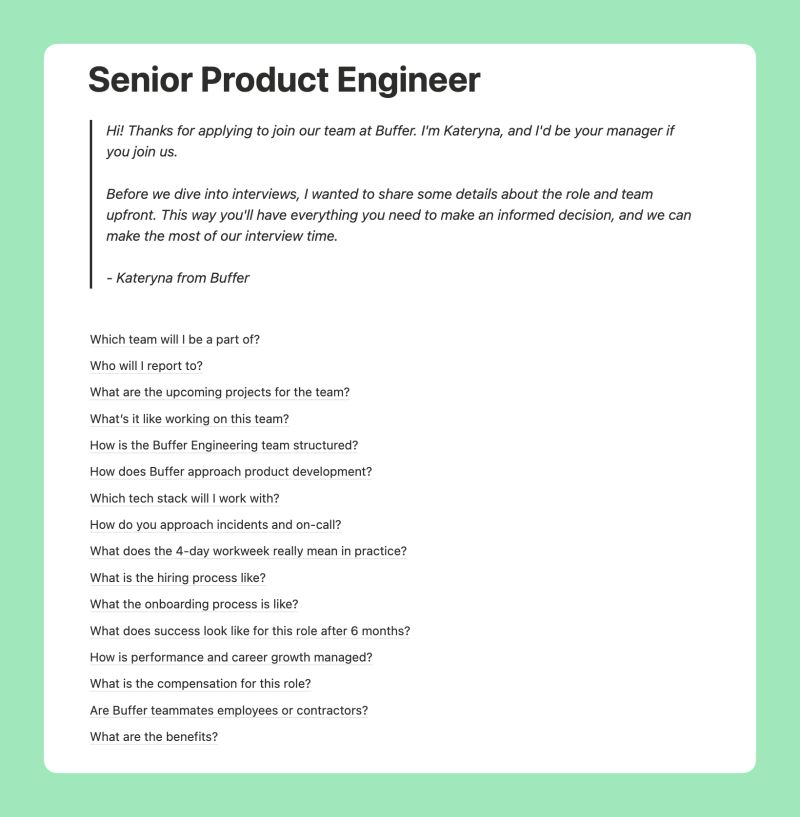
The doc is specific to each role and covers what people most want to know about the job and the team: who they’d be working with and reporting to, what the team is focused on, what our process looks like, what the 4-day week actually means day to day, how career growth and performance work, compensation, benefits, and more.
Here’s what it looks like:
How I put it together
I usually start by reflecting on the role and the questions:
- What do candidates usually ask me in those early calls?
- What might they be wondering but not say out loud?
- What’s genuinely specific about this role or team that’s worth going into depth on?
Then I write the answers (though “write” isn’t quite the right word – I usually dictate them 😉) as if I were explaining things to a candidate sitting across from me, and shape that into the doc afterwards. It keeps the tone conversational, and it saves me time.
It’s also a team effort. I invite people from the team to add their own parts, a few words about who they are and what they work on, so the candidate hears more than just my voice.
We get creative with it, too. For one role, we included a short video snippet from an all-hands where PM walked through team strategy.
And then I try to keep it updated – we transcribe our interviews, so when a candidate asks a good question that isn’t covered yet, I can go back to the transcript, see how I answered in the moment, and fold that in. The doc grows out of real conversations over time.
Why this matters
Applying for a job is hard, and it can feel like looking into a black box. You learn about a company in scattered pieces, across interviews and whatever is public, and it’s hard to put the whole picture together.
Buffer is a very transparent company, so for us it’s almost the opposite problem: there’s a lot of information out there, and it can be hard to know what matters most for a specific role.
Putting the basics in candidates’ hands ahead of the interviews does two things:
- It helps candidates. They can take everything in at their own pace, decide whether the role is actually right for them, and show up to the first conversation already oriented and prepared. This is the part we hear the most gratitude for.
- It helps us. When the basics are already covered, the questions people ask go deeper – about a specific project, a decision we made, or what’s hard for the team right now. We get a truer read on each other than we would if we spent every interview covering the same ground. It saves time, but more than that, it makes the conversations better.
The format
If you’d find it useful, here’s a Notion template you can copy and make your own: Q&A Doc Template. It’s just the bare structure – adapt it however fits your team. Ours has changed quite a bit since we started this practice. If you want to look at a filled-out example, here is one for one of our past roles.
A few things I’d recommend if you’re thinking of trying it:
- Start with one role – we find that a specific doc is more useful than a generic template, and we find that candidates appreciate it most if they can find specific details about the team and projects they’re going to be working on if they join.
- Write the questions before the answers – this helps to think holistically and avoid looking at the blank page for too long.
- Lean on your interviews. If you record or transcribe them, a lot of your best answers already exist, and you can just collect them.
- Let it stay a little unfinished – naturally, not everything is figured out. It’s okay to say that we’re still figuring this out.
This is a small thing, but it’s added up for us. Hiring asks a lot of people, and putting some care into what they get back has been worth it, both because it feels good and because the conversations that follow are better for it.
[ad_2]
Source_link