Have you ever pondered the question of what puts “unity” into “community”? Well, a customer can finish a streak alone, but they can’t have a club alone. That’s the whole difference between community loyalty programs and the engagement mechanics they get mistaken for: a badge or a leaderboard can wear either label, depending on one fact, whether the other people on it are real to the customer or just decoration.
If you’d like to get a helping hand in building the concept for your loyalty program, make sure to download our worksheet:
The Six Pillars of Customer Connection
A durable customer relationship isn’t built from a single lever. It splits into six distinct dimensions: three relational and three mechanical. The relational three, recognition, exclusivity, and community, are usually where the brand buyer’s attention lands first, felt as identity and belonging. The mechanical three, personalization, engagement, and utility, are where the operations buyer tends to start, felt as mechanics and value exchange. They’re the same six dimensions either way, just a different door in.
Key takeaways
- Recognition, “you see me.” The customer is known wherever they show up, greeted by name and tier, with status carrying across channels and milestones acknowledged.
- Exclusivity, “you give me first access.” The customer gets access others don’t, through early drops, members-only products, and priority.
- Community, “you belong with us.” The customer belongs, both with the brand and with other customers, through clubs, events, and shared challenges.
- Personalization, “you know me.” Relevance is built from the customer’s own data, in the form of tailored offers, content, and journeys.
- Engagement, “you make this fun.” Play and interaction build habit, through gamification, streaks, missions, and surprise moments.
- Utility, “you reward me meaningfully.” The customer gets tangible value they actually want, in the form of points worth redeeming, useful perks, and partner offers.
No brand builds all six equally, and that’s by design rather than a gap to close. The point isn’t to check every box. It’s knowing which ones a program is built on deliberately, and which ones are happening by accident.
Community, or “You Belong With Us”
Community means the customer belongs, both to the brand and to other customers, through clubs, events, shared challenges, and user-generated content. It’s the third pillar in this series for a reason: recognition identifies the customer, exclusivity gives them status, and community is where that status stops being held alone and starts being shared. It’s the first pillar that can’t happen to a customer in isolation.
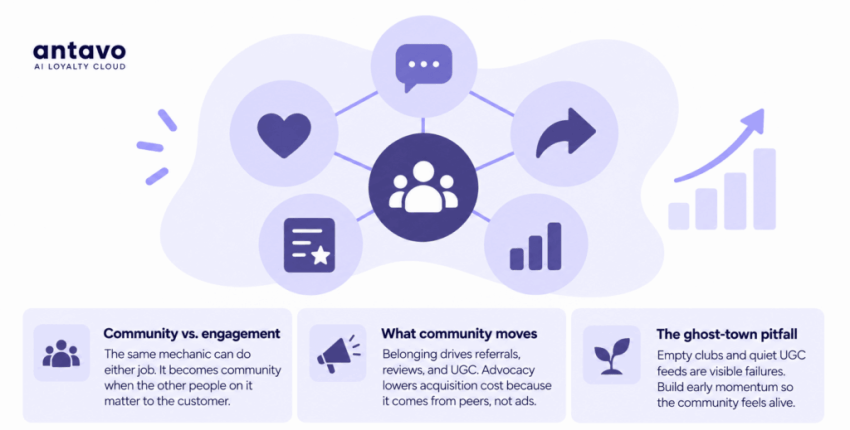
Community and engagement can wear the same mechanic as a different label. The test that separates them: community requires other people to be real, engagement doesn’t.
Community Through Sociology and Consumer Research
The need to belong isn’t a marketing insight. Baumeister and Leary’s belongingness hypothesis, published in 1995, argued that belonging is a fundamental human motivation, on par with safety and physical needs, not a preference some customers happen to have. Community loyalty programs aren’t inventing that need, they’re aiming an existing one at a brand.
The consumer-specific version comes from Muniz and O’Guinn’s brand community research, published in 2001, the paper that coined the term “brand community.” Their finding was that brand communities exhibit the same three markers as traditional ones, shared consciousness, rituals and traditions, and moral responsibility to other members.
Community in Customer Retention and Marketing
Community vs. Engagement
The distinction holds up under a harder question: isn’t a leaderboard just gamification with a social skin on it? Not necessarily. A leaderboard is community if the other names on it matter to the customer, and engagement if they don’t. The mechanic can be identical on a spec sheet; what makes it one pillar or the other is whether the customer is playing against themselves or with other people.
What Community Moves Commercially
Recognition and exclusivity change how a customer feels about a brand. Community changes what a customer does on its behalf, in front of other people. Members who feel part of something talk about it unprompted, and referrals and UGC lower acquisition cost in a way no discount can, since the recommendation comes from a peer, not an ad. Also, this advocacy only compounds when it’s embedded in a broader loyalty structure, not run standalone.
The Ghost-Town Pitfall
When it comes to using community-driven features, you missing to build a critical mass is the biggest cause for concern. Think of a club with three members, or a UGC feed nobody posts to. Ending up with an empty community space is a visible issue, and a ghost town on display can scare away potential new customers. That’s why gaining early momentum is absolutely pivotal. So make sure you give a good reason for customers to become part of a community.
Community in Loyalty Programs
In practice, community shows up through a specific set of mechanics: clubs for collective earning and spending, friend referrals, Instagram contests for UGC, incentivized reviews, as well as leveraging a common passion, like running, and building a community around it. Adidas is an excellent example of how to make running the beating heart of a like-minded community. It works because it’s tied to a shared identity, movement and an active lifestyle, that members already have in common.
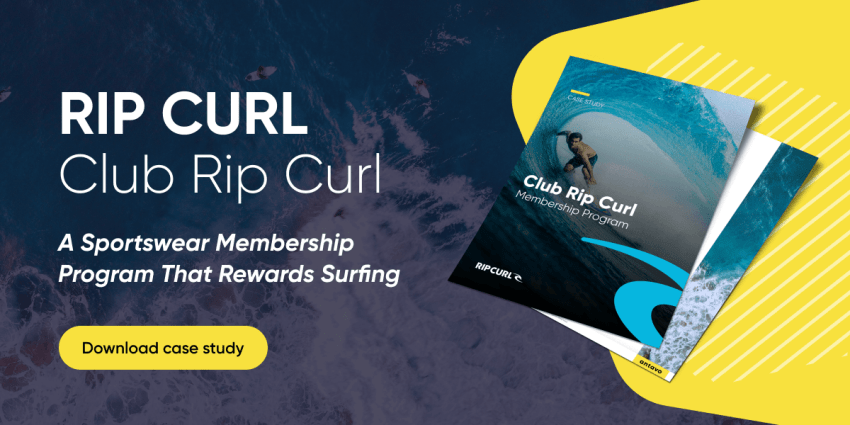
The award-winning Club Rip Curl is what community looks like at full mass, built around an activity shared by the whole surfing community, which is appropriately rewarded by the brand’s loyalty program.
Frequently Asked Questions for Community Loyalty Programs
How many members does a community need before it stops feeling empty?
There’s no universal number; it depends more on visible activity than headcount. A few hundred members with regular posts reads as alive. A few thousand with no visible activity still reads as a ghost town.
How do you measure whether a community is working, versus just active?
Look past raw activity counts toward whether members engage with each other, not just the brand. Comments between members and organic reactions to UGC are stronger signals than page views, which measure attention rather than belonging.
Can a smaller or newer brand build real community, or does it need scale first?
Scale helps, but isn’t a precondition. For example, Scandic Friends builds community around a sense of belonging rather than sheer size, by giving members a reason to interact with each other.
Closing Thoughts
Community is the pillar where loyalty stops being a private feeling and becomes visible to other people: a referral, a review, a post other members react to. That visibility is what makes it powerful, and unforgiving to get wrong. Next in this series: personalization, and what it means for a brand to know a customer well enough to act on it.
Antavo is the AI loyalty and incentives platform that brings together loyalty, promotions, and agentic AI to turn customers into regulars: the customers who come back on their own, buy more often, and bring others with them. For more than a decade, Antavo has powered identity-led loyalty strategies for brands including SKIMS, Paul Smith, KFC, Flying Tiger Copenhagen, and Hyatt’s Inclusive Collection. Marketers build, change, and launch programs and promotions themselves, without waiting on engineering.
If you’re tired of paying to win the same customers twice, book a call with our experts and see how Antavo turns them into regulars.