In the first three installments of our Loyalty Missed Opportunities Series, we covered getting customers to join, getting them to redeem what they earn, and making tier progression feel real. Stack those three fixes on top of each other, and you get a program that actually works: members joining, spending points, climbing tiers.
And then, the moment you step outside the loyalty-branded newsletter, none of it exists:
- The win-back email has no idea the recipient is two purchases from Gold.
- The support agent answering a call about a late delivery can’t see that the person on the line is a top-tier member.
- The store associate at the register has never heard of the member promotion the customer is trying to redeem.
On paper, the program is healthy. In practice, the rest of the business is still treating that same customer like a stranger.
If you’re wondering how to get loyalty program communication out of its silo, here are 5 fixes, and not one of them requires ripping out your tech stack.
Ready to see how others avoid siloed loyalty communication? Check out our in-depth case study on Paul Smith’s Collectors Club with a specific section on how the Klaviyo integration works.

Why Siloed Loyalty Communication Is an Actual Business Problem
Think about it: the what, when, where, and how of your communication is what really sets the tone for your loyalty members about the program. Here are 4 explicit reasons why you should definitely care about how it lands.
You give away margin you didn’t need to give away
A customer three points from a reward tier is one of the warmest audiences on your list. Send them a generic sitewide discount instead, and best case, you’ve handed out a redundant deal. Worst case, you’ve undercut a full-price purchase that was already coming.
You send messages that contradict each other
A tier-exclusive offer landing the same week as a public sitewide sale tells your best customers their status doesn’t actually mean much. That’s not a missed opportunity; that’s active damage to the thing you spent a year building.
5 Fixes to Get Loyalty Communication Out of Its Silo
None of these require a new platform or a quarter-long project. Most of them are a segment condition, a shared rule, or a line item on a form you already use.
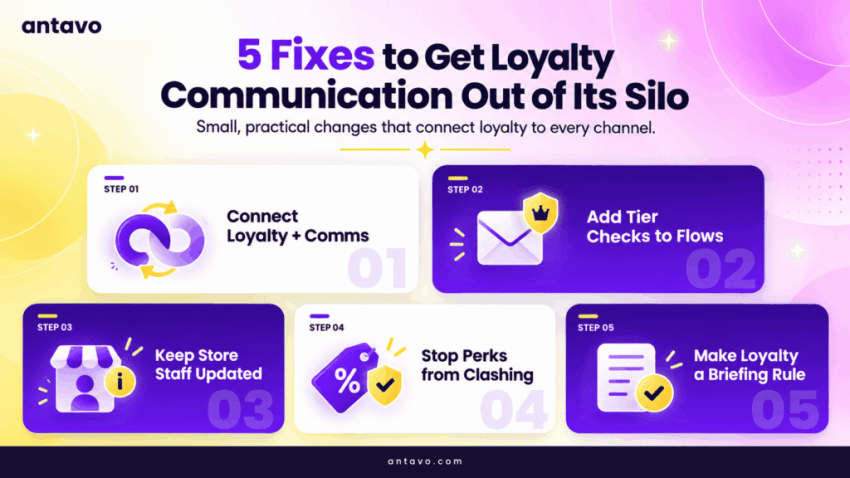
1. Connect Your Loyalty Platform Directly to Your Comms Platform
This is the one fix that makes all the others possible, so it goes first. If your loyalty platform and your email/SMS platform only talk to each other through a nightly export, everything downstream (flows, segments, personalization) is working with yesterday’s data at best.
A direct integration changes what’s possible, not just what’s convenient. Take Antavo’s integration with Klaviyo, which powers Paul Smith’s Collectors Club:
- The moment a member opts in, a welcome flow fires automatically, and from there, loyalty events become the trigger for the emails themselves.
- A tier-up sends a congratulations flow.
- A tier-down sends a win-back flow.
- Getting close to the next tier triggers a nudge, timed to when the purchase is actually within reach.
The business case here isn’t complicated:
- Campaigns launch off real loyalty events instead of waiting in a developer queue,
- Targeting reflects what a customer is doing right now instead of what they bought six months ago,
- Because every send traces back to a specific loyalty trigger, you can finally see which loyalty moments drive revenue and which ones don’t.
Your Next Step: Check whether your loyalty platform and your primary comms platform have a native, real-time integration, or whether someone is still exporting a CSV.
If you want the fuller picture of what else should be flowing between your loyalty platform and the rest of your stack, we cover that separately here.
2. Put Loyalty Status Into the Flows You Already Run
You don’t need a separate “loyalty lifecycle program.” You just need your existing automated emails to check one thing before they send: is this person a loyalty member, and if so, what’s their status? Here’s what that looks like in practice.
Say a customer hasn’t bought anything in 60 days
So your win-back flow is about to email them a 15% discount to lure them back.
If that customer is actually a Gold-tier member with a 20% discount sitting unused in their account, sending the 15% offer is a downgrade dressed up as an incentive.
A single tier check before the email sends would catch this: either skip the discount for that customer, or point them to the better reward they already have.
Take browse abandonment
Someone looks at a product, doesn’t buy, and normally gets a “still thinking about it? Here’s 10% off” nudge the next day.
If that same person is two purchases away from unlocking a new tier, a more useful nudge is telling them so, not undercutting the reward they’re about to earn with a discount that has nothing to do with it.
Your Next Step: Pick your highest-volume flow (win-back or browse abandonment are usually the biggest offenders) and add a single loyalty-tier check to it this week.
Don’t rebuild the flow, just add the condition. (If you want the full rundown of which loyalty email types are worth sending in the first place, we’ve mapped those out separately.)
3. Keep In-Store Staff as Up to Date as Your Newsletter
It’s easy to treat email and SMS as the whole battlefield and forget the channel that’s arguably more persuasive than either: a conversation with a staff member.
A customer mentioning their tier at checkout, asking about a promotion they saw, or trying to redeem a reward, and getting a generic response, does more damage in thirty seconds than a badly timed email does in a week.
It happens because loyalty updates get built for digital channels and never make it to the floor. A new campaign goes live in the app before anyone’s told the store team it exists. The customer ends up better informed about their own loyalty status than the person serving them.
Fixing this requires treating in-store staff as a true part of your omnichannel communication that gets the same update, at the same time, as everything else you ship.
Your Next Step: Before your next loyalty campaign or promotion goes live, check whether store staff received the same information customers did, and check it before the send goes out, not after the first confused customer complains.
If there’s no existing habit for this, add a short internal recap- what’s live, what’s excluded, where it applies- to whatever channel your stores already use to get daily updates.
4. Make Sure Your Loyalty Perks and Your Sales Never Clash
Here’s a situation you’ve probably seen before: your loyalty program offers Gold members a 20% discount as a reward for reaching that tier.
Then, marketing launches a sitewide sale with the same 20% off, open to absolutely everyone. Suddenly, the “exclusive” perk your best customers worked to earn isn’t exclusive at all, and they notice.
That’s the kind of mixed signal that quietly undoes all the work of building a tier system in the first place.
The fix doesn’t need new software or a calendar overhaul, just one simple rule everyone agrees to follow: Before any sitewide sale goes out, check it against your tier perks, and leave out anyone whose existing reward is the same as or better than the sale.
Your Next Step: Look at your next planned sitewide promotion. Compare it to what your top tiers already get. If there’s overlap, exclude those members from that send before it goes out.
5. Add Loyalty Status as a Required Line in Every Campaign Brief
The first four fixes will slip within a quarter if nobody has to ask this next question.
Add one mandatory field to whatever campaign brief template your team already uses: “How does this campaign treat loyalty tier: include, exclude, or customize?”
It doesn’t need a long answer. It needs to be unavoidable, so loyalty stops being the thing everyone forgets to check and becomes the thing nobody can ship a campaign without answering.
Your Next Step: Open your team’s current brief template and add the field today. The point isn’t a perfect policy; it’s making the question impossible to skip.
Why Getting Loyalty Out of Its Silo Works
Every fix above solves the same root problem: loyalty status is data the rest of the business is entitled to use, and right now it mostly isn’t:
- Connecting the platforms gets the data moving in real time.
- Branching existing flows and briefs gets it in front of the customer without new campaigns.
- Shared calendar rules stop the brand from contradicting itself.
None of it requires a bigger team or a new tool budget. It requires treating loyalty as an input, not an island.
So here’s the benchmark question: If a top-tier member called support, walked into a store, and got a win-back email, all in the same week, would any of those three know they’re a member?
Customer journey mapping is how you find out where those moments live in the first place.
Frequently Asked Questions About Loyalty Communication Silos
How do I know if my loyalty program has a communication silo problem?
Run a quick check: pick one of your top-tier members and trace what they’d experience across three channels this week: a support call, an email, and (if you have physical locations) a store visit. If any of those three would treat them like a brand-new customer instead of a recognized member, that’s the silo. Most programs fail this test in at least one channel without realizing it, simply because nobody’s ever tested it end to end.
What’s the difference between “loyalty communication” and just good lifecycle marketing?
There shouldn’t be one. The silo happens when loyalty status gets treated as its own channel instead of as one more input into the lifecycle flows already running. Fixing it isn’t about building more loyalty-specific campaigns; it’s about making sure the campaigns you already run take tier and points into account.
Is this the same as personalization?
Related, but narrower. Personalization usually means inferring what a customer wants from behavior. This is about acknowledging what you already definitively know- tier, points, redemption history- and making sure that fact travels with the customer across channels instead of staying locked in the loyalty platform.
Which of these fixes should we do first?
Connecting your loyalty platform directly to your comms platform, if that link doesn’t already exist. Every other fix on this list (branching flows, briefing support and store staff, setting calendar rules) assumes loyalty data is reaching those teams and systems in real time. Without that connection, the rest are working off stale information.
Quick Summary and Final Advice
A loyalty program that only speaks through its own newsletter is only doing a fraction of its job. The fixes here don’t ask for a bigger budget or a new platform; they ask for loyalty status to travel with the customer into the flows, teams, and channels that already exist.
The real takeaway: enrollment, redemption, and tier progression prove the program works. Whether that status shows up everywhere else is what proves the rest of the business is paying attention to it too.
Antavo is the AI loyalty and incentives platform that brings together loyalty, promotions, and agentic AI to turn customers into regulars: the customers who come back on their own, buy more often, and bring others with them. For more than a decade, Antavo has powered identity-led loyalty strategies for brands including SKIMS, Paul Smith, KFC, Flying Tiger Copenhagen, and Hyatt’s Inclusive Collection. Marketers build, change, and launch programs and promotions themselves, without waiting on engineering.
If you’re tired of paying to win the same customers twice, book a call with our experts and see how Antavo turns them into regulars.
Make sure to download our in-depth Paul Smith case study, with a specific section addressing loyalty program communication.