[ad_1]
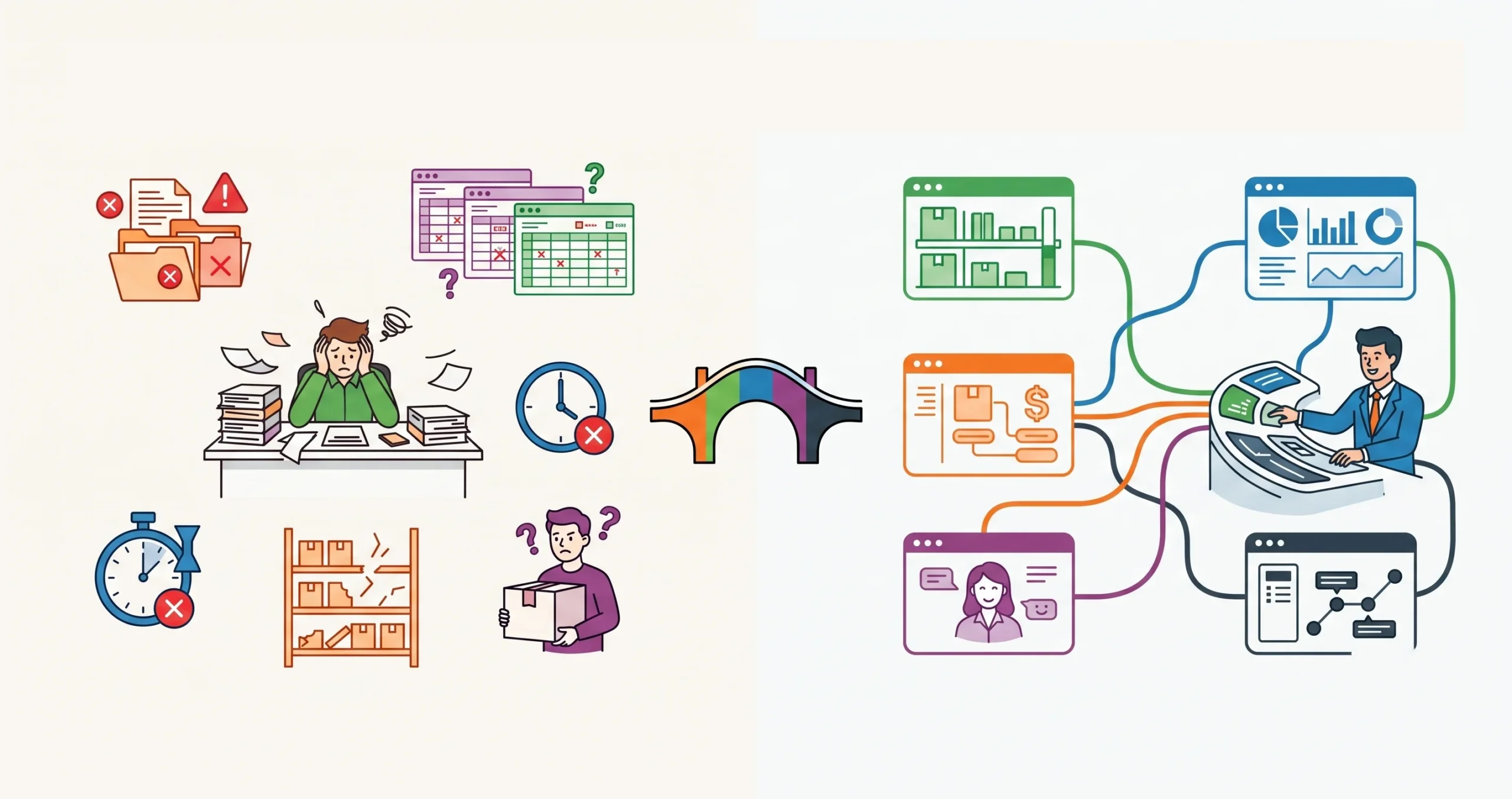
Automation is the basic need of this generation and time. If your team is still typing the same customer details into five different tools, or you wait days just to get a simple report, you already know something’s not working. Most businesses hit this wall at some point. That’s usually when people start looking at Odoo ERP automation.
Here are the clearest signs your business has outgrown manual work and how Odoo fixes each one.
What Is Odoo ERP Automation?
Simply put, Odoo is one system that runs your whole business, sales, inventory, accounts, HR, and support instead of using separate tools that don’t talk to each other.
When someone makes a sale, stock updates on its own. When stock moves, accounts update too. No one has to copy anything from one place to another. That’s really the whole point of ERP automation.
Sign 1: Your Team Wastes Time on Manual Data Entry
Think about how many times the same customer detail gets typed in, once by sales, again by accounts, maybe a third time by support. It’s not just tiring, it costs real money. Every extra entry is a chance for a typo or a missed detail.
Odoo keeps everything in one shared place. Type it once, and every team can see it instantly. Orders update stock on their own, and invoices get created automatically once a sale goes through.
Sign 2: Teams Are Working in Silos
Does sales have no clue what’s actually in stock? Does finance only find out about a big order after it’s already shipped? When teams can’t see each other’s information, mistakes happen and customers feel it.
With Odoo, everyone works off the same live data. Sales can check stock instantly. Finance can see payments the moment they come in. Less confusion, fewer emails going back and forth just to confirm basic facts.
Sign 3: Inventory Keeps Giving You Headaches
Running out of your best-selling item while sitting on a pile of something nobody wants is a common, costly problem. Add in wrong stock counts, and you’ve got trouble.
Odoo shows you real stock numbers across every location, all the time. You get alerts when stock is low, automatic reorder rules, and barcode scanning, so you always know what you really have.
Sign 4: Reports Take Forever and Are Already Old by the Time They’re Ready
If building a monthly report means pulling numbers from five places and putting them together in Excel, that’s a problem. By the time it’s done, the numbers have probably already changed.
Odoo gives you live dashboards for sales, finance, and stock. You see how the business is doing right now, not weeks later.
Sign 5: Customer Follow-Ups Keep Slipping Through
Every missed follow-up is a customer walking away. If your team is relying on memory to remember who to call back, leads will get lost.
Odoo’s CRM handles this for you. Leads get assigned automatically, reminders show up when it’s time to follow up, and you can see exactly where every customer stands. Nothing gets forgotten.
Sign 6: Orders Take Too Long to Process
Customers expect quick delivery today. If your process still involves manual approvals, checking stock by hand, and creating invoices one by one, you’re falling behind.
With Odoo, placing an order sets everything else in motion, stock checks, invoices, shipping, without anyone having to do it manually.
Sign 7: Accounting Is Getting Harder to Keep Up With
More transactions usually means more mess, late invoices, reconciliation errors, unclear cash flow. These are all signs your finance team is buried in manual work.
Odoo automates invoicing, tracks payments as they arrive, and handles bank reconciliation without anyone matching numbers by hand. Your finance team gets time back for actual planning instead of data entry.
Sign 8: Growth Is Creating More Problems Than It Solves
Growth should feel good. But if every new customer or product means more chaos and more overwhelmed staff, your systems aren’t built to keep up.
This is where Odoo really helps. You can start small, just sales and inventory, and add more, HR, manufacturing, projects, as you grow. No need to switch platforms every time the business expands.
Sign 9: You Don’t Know How the Business Is Doing Right Now
Making decisions based on last month’s numbers is like driving while looking in the rearview mirror. If you can’t answer “how are we doing today” without digging through spreadsheets, that’s a problem.
Odoo gives you live dashboards for sales, revenue, stock, and team performance, so you catch problems early instead of after they’ve already cost you money.
Sign 10: You’re Paying for Too Many Separate Tools
Different software for CRM, accounting, inventory, HR, and support might work at first, but the costs add up. Multiple subscriptions, data that doesn’t match up, and a new tool to learn every time someone joins the team.
Odoo replaces all of that with one system. One login, one set of numbers everyone trusts, and one bill instead of five.
A Quick Self-Check
Ask yourself honestly:
- Is your team stuck doing the same data entry over and over?
- Do departments struggle to see what other teams are doing?
- Is your inventory more guesswork than fact?
- Are customer follow-ups slipping through?
- Does it take too long to know how the business is really doing?
If you answered yes to two or more of these, it’s a good sign your business is ready for Odoo ERP automation.
Conclusion
Growing a business shouldn’t mean drowning in spreadsheets or chasing down information that should already be right in front of you. Those are the clearest signs your current systems just can’t keep up anymore.
Odoo brings sales, inventory, accounting, and customer support into one place, so your team spends less time on repetitive tasks and more time actually growing the business. This is exactly why more companies are turning to Odoo software development in Bangalore to set up systems that actually fit the way they work. A good team offering Odoo ERP software development in Bangalore can get you up and running with the right modules from day one, so you don’t waste time or money on a setup that doesn’t scale with you.
If even a few of these signs sound familiar, it’s worth exploring what Odoo ERP automation could do for your business.
[ad_2]
Source_link