[ad_1]
Reading Time: 19 minutes
Klaviyo alternatives might be on your radar if you’ve outgrown email‑only campaigns or want to engage customers across more touchpoints.
Okay, you might be happy with Klaviyo’s Shopify integration and Ecommerce‑focused workflows. But you’re not alone if you wish you also had a robust Shopify customer engagement platform with:
- Unified analytics without relying on multiple tools
- Dedicated customer support built for larger teams
- Fair pricing based on actually active profiles
In this guide, we’ve shortlisted the best Klaviyo alternatives that go beyond Klaviyo’s core strengths.
Whether you’re a Shopify marketing team aiming to orchestrate omnichannel customer journeys from one interface, or a multi‑brand enterprise needing flexible integrations and scalability, this list gives you the facts you need to build your shortlist and pick the platform that fits your brand now and in the future. Let’s dive in!
Klaviyo Alternatives at a Glance: TL;DR Comparison Table
| Platform | Best For | Channels | G2 Rating | Pricing Starts At | Ideal For (Shopify/Ecommerce Fit) |
| MoEngage | Omnichannel customer engagement | Email, SMS/RCS, on-site messages, Google/Meta ad sync, mobile push, web push, in-app, WhatsApp & more | 4.5/5 | Custom (Growth + Enterprise tiers, MTU-based) | Mid-market to enterprise Shopify brands running multi-channel retention and lifecycle programs |
| Constant Contact | Easy mobile email design | Email, SMS (US only), social media | 4.1/5 | ~$340/month (30K contacts) | Small Shopify startups focused on simple email and SMS launches |
| Mailchimp | Email automation | Email, SMS (US/UK), MMS (US only) | 4.3/5 | $8.86/month (500 contacts) | Brands wanting solid email automation without complexity |
| Twilio SendGrid | Developer-friendly email tools | Email, SMS, WhatsApp, MMS (via API) | 4.0/5 | $19.95/month (100K emails) | Shopify brands with technical teams needing API-driven email control |
| HubSpot | Connecting marketing and sales data | Email, SMS, social media, push (via OneSignal), WhatsApp | 4.5/5 | $890/month (2K contacts) | Teams that want marketing automation tightly integrated with CRM |
| OneSignal | Push notification automation | Push, email, SMS, RCS, in-app | 4.7/5 | Free tier available; Growth from $9/month | Brands heavily dependent on push notifications across mobile and web |
| Braze | Enterprise ease of use | Email, SMS, RCS, WhatsApp, web, LINE, mobile apps | 4.5/5 | Custom enterprise pricing | Enterprises needing intuitive UI paired with advanced orchestration |

What are the Best Klaviyo Alternatives for Customer Engagement?
If you’ve used or considered Klaviyo before, you already know its strengths and where it can feel limiting. This list of alternatives to Klaviyo highlights customer engagement tools that solve those gaps.
Some offer more native channels than Klaviyo does. Others make real-time segmentation, personalization, and cross‑channel analytics easier to manage.
Whether your focus is Ecommerce, retail, or another consumer brand, you’ll find options here to improve how you reach and convert customers. For Shopify marketing teams, it’s also a chance to see which platforms integrate seamlessly with store events while expanding beyond email and SMS.
Let’s explore the top picks and what each does best.
1. Best for Omnichannel Customer Engagement and Analytics: MoEngage
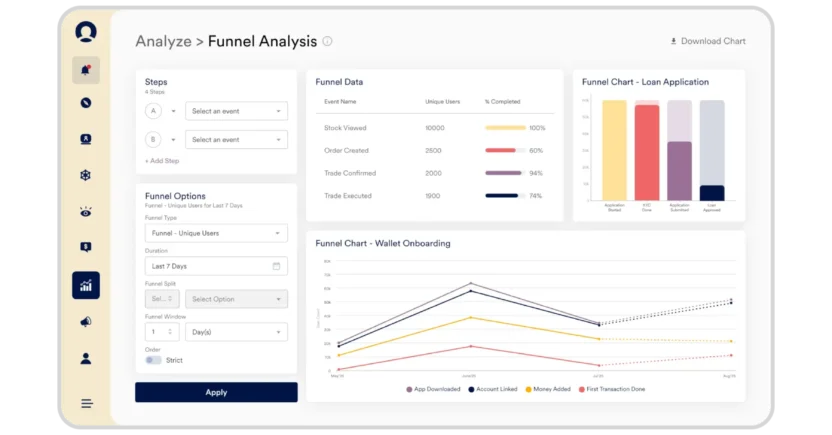
MoEngage is an insights-led AI-native customer engagement platform built for consumer brands that need to do more than send basic emails. That’s why MoEngage stands out among the best Klaviyo alternatives for Shopify and Ecommerce brands.
Where Klaviyo grew up as an email-first tool for entrepreneurs and small businesses, and later added SMS, MoEngage was designed from the ground up to orchestrate personalized customer journeys across every touchpoint customer are on — email, SMS, mobile push, in-app, web push, on-site messaging, WhatsApp, and RCS — from a single connected workflow.
For Shopify stores running multi-channel retention programs, mobile apps, or global messaging audiences, that breadth of native channel coverage changes what’s operationally possible.
The platform’s Merlin AI engine powers send-time optimization, channel routing, churn prediction, journey testing, and campaign decisioning, most of which are included on standard plans rather than gated behind paid add-ons.
Pricing: Fair, usage-based pricing tied to Monthly Tracked Users (MTUs). You pay only for profiles that are actually active, that is, customers who engage with your emails, SMS, push notifications, or other campaigns. If a contact hasn’t engaged in six months or a year, they don’t add to your bill. This keeps costs predictable as you scale, no matter how large your contact database grows, and ensures your pricing reflects real engagement, not just your contact list size. That said, MoEngage offers two pricing plans — Growth and Enterprise.
G2 Rating: 4.5/5
Channels: SMS, RCS, email, mobile and web push, WhatsApp, in-app and on-site messages, web personalization, Google Ads Audience, and Facebook Audience.
Standout Feature: AI Campaign Decisioning agent that clearly defines your campaign objectives and operational restrictions (like budgets) to deliver hyper-personalized experiences to every customer.
Best Fit: Mid-market and enterprise Shopify stores running omnichannel programs that need unified cross-channel analytics and predictable MTU-based pricing for truly active users.
Link to a Platform Tour:
Where MoEngage is Different from Klaviyo:
We sourced all of this information directly from Klaviyo’s website, with references, and it is accurate as of April 2026:
A) Native Omnichannel Support Without Add‑Ons
Klaviyo’s main native channels are email and SMS, with push notifications, WhatsApp, and other channels requiring additional configuration or third‑party integration.
MoEngage includes native support for email, SMS, on-site messages, WhatsApp, RCS, push notifications, in‑app messaging, and web push, accessible from the same campaign builder. That means Shopify stores can launch and coordinate messages without extra connectors or manual setups.
Why it matters: Shopify marketing teams can manage omnichannel programs from a single interface, reducing operational complexity and ensuring channel messages are aligned.
B) Unified Cross-Channel Analytics
Klaviyo’s reporting is strong for email and SMS revenue attribution, but the picture fragments when you move beyond those two channels. Push, in-app, and WhatsApp performance doesn’t appear in a unified view, and advanced analytics capabilities, including CLV dashboards, product analytics, and RFM (Recency, Frequency, and Monetary value) analysis, require paid add-ons that can significantly increase total cost as your team’s needs grow.
MoEngage includes a unified cross-channel dashboard covering Shopify store behavior, app activity, email, push, WhatsApp, and web in a single view. Funnel analytics across all channels, retention cohorts, predictive churn analytics, and custom shareable dashboards are included without a separate paid tier. Attribution is also configurable — your team can choose view-through, click-through, or in-session attribution depending on how you actually measure campaign impact.
Why it matters: Marketing teams get a complete engagement picture from a single dashboard, enabling Shopify brands to optimize campaigns holistically and justify spend across touchpoints.
C) Dedicated Customer Success Team
Klaviyo’s support model is designed for smaller Ecommerce brands, with most accounts managed through shared support channels. Larger teams with complex multi‑channel programs often need more strategic guidance, but dedicated account management isn’t standard.
MoEngage offers enterprise‑grade customer success for Shopify brands, including proactive onboarding, regional support teams, dedicated Customer Success Managers (CSMs), Engagement Managers, Quarterly Business Reviews, and access to a Customer Advisory Board. This ensures teams get strategic help and execution guidance quickly, without waiting in long ticket queues.
Why it matters: Shopify brands scaling across multiple channels get a partner genuinely invested in their success. The results? Less time‑to‑value, less costly downtime, and faster execution of growth strategies.
These are just some of the differences between MoEngage vs. Klaviyo. Now, let’s move on to the other Klaviyo competitors for Shopify.
2. Best for Easy Mobile Email Design: Constant Contact
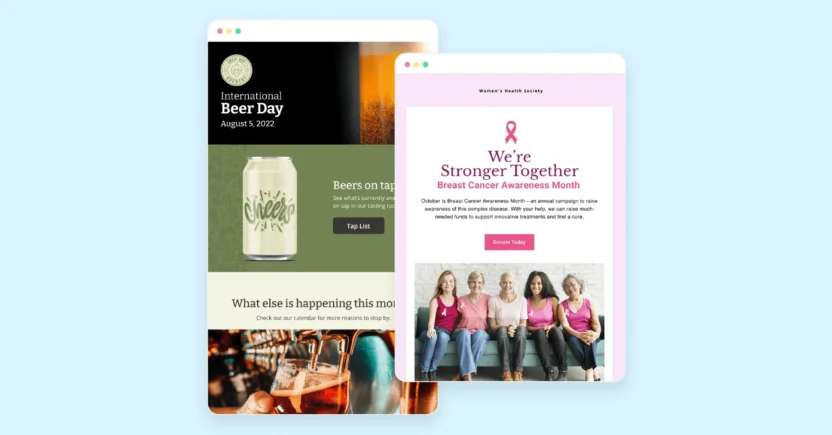
Constant Contact is one of the best alternatives to Klaviyo for email marketing, especially for small startups that want to get started quickly without technical hurdles. It offers simple tools for managing campaigns across email, SMS, and social media in one place.
Strengths: The email templates are mobile-friendly and simple to customize. Constant Contact’s “Text-to-join” feature lets customers subscribe to your email and SMS updates by texting your brand.
Limitations: The SMS tools are basic and don’t allow you to use pre-approved contact lists. Email automation is limited as well, compared to platforms like MoEngage. The interface can sometimes be slow to load, too.
Pricing: Prices are based on the contact list size. For example, for 30k-35k contacts, monthly costs range from $340 to $485. For 45k-50k contacts, the range is $430 to $575. SMS marketing is always a paid add-on.
G2 Rating: 4.1/5
Channels: Email, SMS (US only), and social media
Best Fit: Small startups prioritizing quick, mobile-friendly email campaigns.
3. Best for Email Automation: Intuit Mailchimp
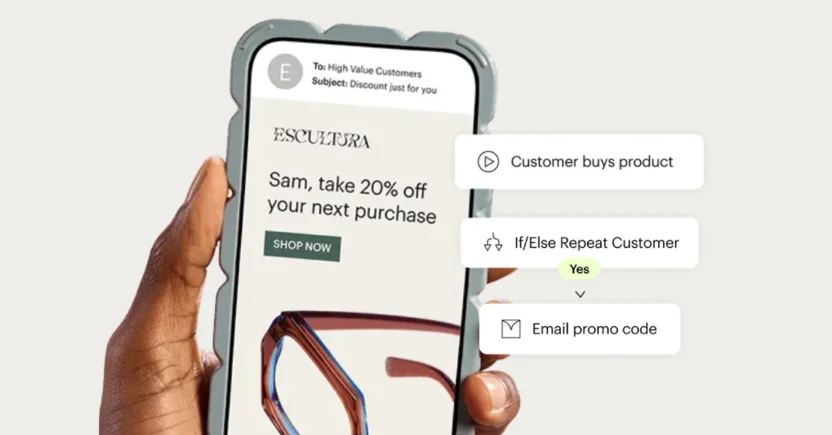
As one of the email marketing alternatives to Klaviyo, Mailchimp makes it straightforward to create, personalize, and automate email campaigns. Its drag-and-drop editor and segmentation tools help deliver targeted messages at the right time.
Strengths: Strong automation features with over 50 behavioral triggers. Easy email scheduling and reporting tools offer quick insights.
Limitations: Some email templates are rigid without HTML knowledge. Some downtime has occurred during busy periods, and the interface could be updated for a better user experience.
Pricing: Four tiers. The free plan lets you send 500 emails/day or 1K/month to up to 500 contacts. But after 30 days, email support disappears, and you lose features like A/B testing. Paid plans start at $8.86/month for 500 contacts, scaling to $972.25/month for 200K contacts. SMS is available (US and UK only) as a paid add-on.
G2 Rating: 4.3/5
Channels: Email, SMS (US/UK paid plans), and MMS (US only, Standard/Premium)
Best Fit: Brands looking for strong email automation and basic personalization without complexity.
4. Best for Developer-Friendly Email Tools: Twilio SendGrid
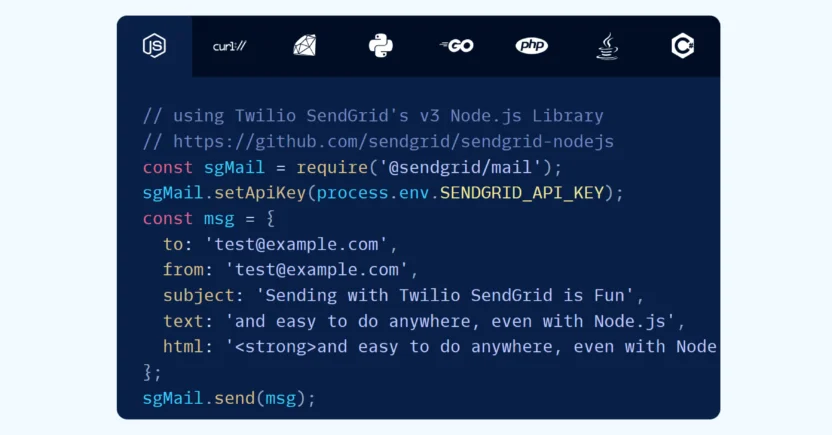
Twilio SendGrid offers reliable email delivery and simple APIs that integrate easily with existing systems. No wonder it’s one of the top Klaviyo competitors and alternatives. It’s designed for teams with technical knowledge who want full control over their email workflows.
Strengths: Consistent email deliverability, clear API setup process, and features like automatic link shortening with branded URLs.
Limitations: Lacks detailed onboarding resources for non-technical B2C marketing teams. Meant for teams with developer support.
Pricing: SendGrid offers a two-month free trial (100 emails/day), then Essentials starts at $19.95/month for 100K emails/month. The Pro plan with dedicated IPs and SSO starts at $89.95/month for 2.5M emails/month.
G2 Rating: 4.0/5
Channels: Email, SMS, WhatsApp, and MMS via APIs
Best Fit: Brands with technical teams wanting flexible, API-driven email capabilities.
5. Best for Connecting Marketing and Sales Data: HubSpot Marketing Hub
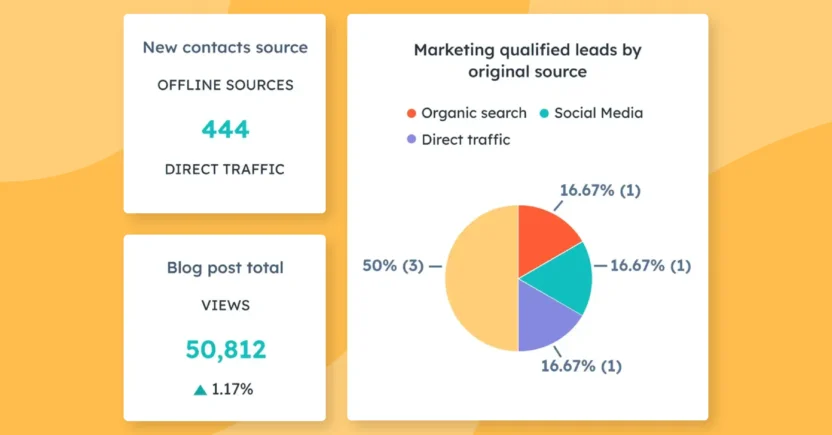
HubSpot Marketing Hub integrates directly with the HubSpot CRM, enabling marketing and sales teams to work from the same customer data. This supports personalized campaigns and performance tracking, making HubSpot one of the best Klaviyo alternatives.
Strengths: Enables marketing-sales alignment, offers scalable personalization, and supports multiple channels, including WhatsApp (via integrations).
Limitations: The onboarding process can be complex and costly. Managing multiple datasets within one platform may also be challenging for smaller teams.
Pricing: Starts at $890/month for 2K contacts, 3 users, and 5K campaigns, plus a $3,000 onboarding fee. Enterprise pricing starts at $3.6K/month for 10K contacts and 5 users, plus a $7,000 onboarding fee.
G2 Rating: 4.5/5
Channels: Email, SMS, social media, push notifications (via OneSignal integration), and WhatsApp
Best Fit: Teams requiring a marketing automation platform that’s fully integrated with CRM data.
6. Best for Push Notification Automation: OneSignal
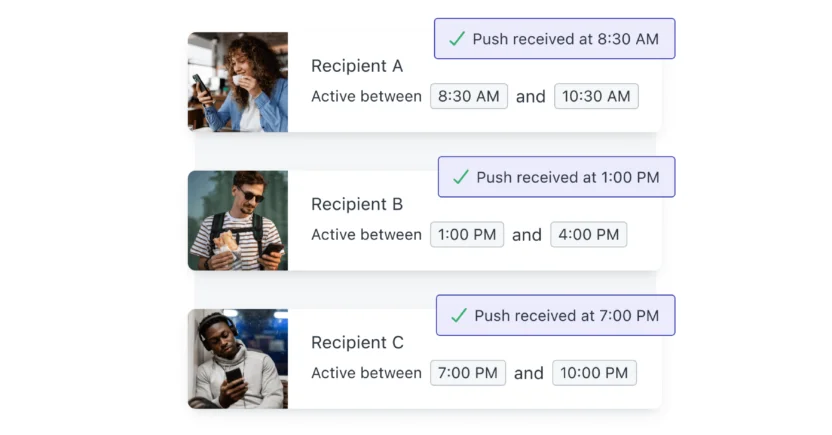
OneSignal offers quick setup for push notifications, with clear documentation and SDKs that enable targeted messaging for mobile and web users.
Strengths: OneSignal’s advanced automation and real-time push analytics make it one of the closest alternatives to Klaviyo for push notifications. Its smooth integration with iOS and Android apps is another reason why it excels in automating push campaigns.
Limitations: OneSignal’s email and SMS analytics are basic, and deliverability in these channels could be improved. Which is why you should also keep an eye on the best alternatives to OneSignal.
Pricing: OneSignal’s free plan includes unlimited push notifications and 10K emails/month. Growth plan starts at $9/month for up to 20K emails. Custom pricing unlocks extended reporting and dedicated support.
G2 Rating: 4.7/5
Channels: Push notifications, email, SMS, RCS, and in-app messaging
Best Fit: Brands that rely heavily on push notifications for customer engagement.
7. Best for Easy Navigation: Braze
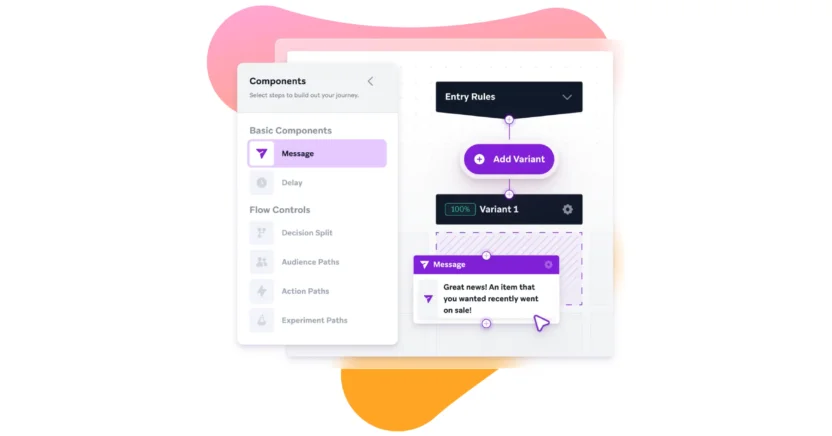
Braze combines unified customer data with real-time segmentation and campaign orchestration. What makes Braze one of the best Klaviyo alternatives is that its interface is straightforward, thanks to drag-and-drop tools and structured onboarding.
Strengths: Intuitive navigation, detailed documentation, and BrazeAI for automated customer engagement strategy optimization.
Limitations: Setting up integrations with existing systems can be complex. Initial setup usually needs technical support. In fact, if you’re already using Braze, now’s the perfect moment to check out the closest Braze alternatives.
Pricing: Braze’s custom enterprise pricing includes advanced features, dedicated support, and broad integrations.
G2 Rating: 4.5/5
Channels: Email, mobile apps, SMS, RCS, web, LINE, mobile apps, and WhatsApp.
Best Fit: Enterprises seeking both ease of use and advanced campaign capabilities.
Other Potential Alternatives to Klaviyo
1. Iterable
Iterable is well‑known for covering the full spectrum of cross‑channel campaigns, from creation to optimization, across email, SMS, push, and more. Its segmentation flexibility is a major plus, and it integrates with over 100 apps, making it adaptable to a variety of Martech stacks.
For Shopify brands, that level of segmentation means you can target very specific customer behaviors and transaction patterns.
Where it falls short: Reporting depth is limited without connecting to a third‑party BI or your data warehouse. If you want a complete, in‑platform view of the customer journey from first touch to purchase and repeat orders, you may need extra tools. Some teams have also noticed slower performance when building complex multi‑step automations, which can drag down campaign turnaround time.
If you’re looking for Iterable alternatives, you’ll probably be aiming for a CEP that combines strong segmentation with faster orchestration and more unified analytics out of the box.
2. Salesforce Marketing Cloud
Salesforce Marketing Cloud is a familiar choice for large enterprises that need data‑driven customer engagement and advanced CRM integration.
Where it falls short: As a legacy platform, onboarding it with modern Ecommerce stacks like Shopify often takes significant technical effort. The platform’s rigidity, high maintenance costs, and complex navigation can slow teams down — not ideal when you’re running weekly product drops or flash sales.
For many marketing teams, the need for faster setup, less admin overhead, and smoother integration with newer systems makes them choose from among alternatives to Salesforce Marketing Cloud.
3. Oracle Responsys
Oracle Responsys offers multilingual campaign capabilities, so you can manage variations for different languages within the same campaign. It’s helpful for brands selling in multiple countries or regions.
Where it falls short for modern Ecommerce: Omnichannel coverage is incomplete. It focuses on email, push, and SMS, but doesn’t natively support increasingly important channels like WhatsApp or RCS — both of which are seeing rising adoption in customer engagement for retail. Workflow speed can also take a hit if you have to set up many campaigns in quick succession, especially during peak sales seasons.
Brands that switch from Responsys often look for alternatives to Oracle Responsys that match its localization strengths, but add more native channels and smoother campaign execution.
6 Key Criteria to Consider When Choosing a Klaviyo Competitor
You shouldn’t have to keep switching customer engagement platforms every couple of years or so. Because when replacing Klaviyo or any other existing platform, you’re changing the foundation of your customer engagement workflows.
Your choice should align with your team’s capabilities, channel needs, and growth plans, while making migration and training as painless as possible. With that, let’s look at 6 core criteria that matter most when evaluating Klaviyo alternatives and competitors, so you can shortlist vendors that will genuinely work for your brand and satisfy your internal buying committees.
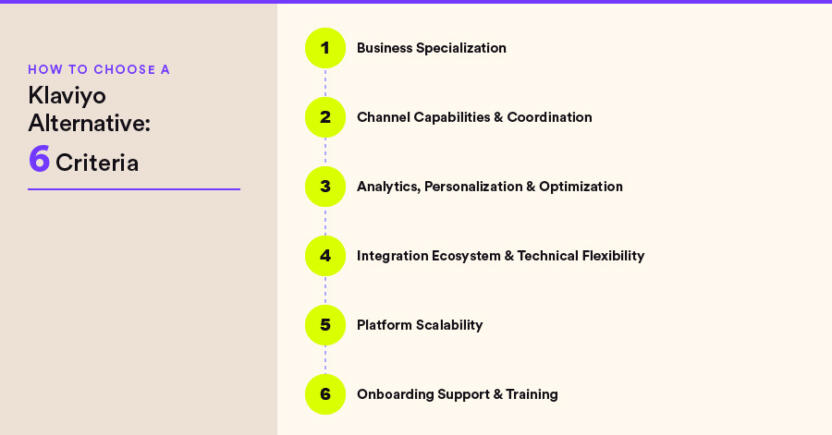
1. Business Specialization
Where a platform focuses its development and positioning will determine how well it supports your specific needs.
Klaviyo’s Ecommerce-first approach works well for B2C stores with mostly email/SMS workflows. But if you need strong push notifications, deep personalization, or engagement beyond ecommerce, you might find more suitable options elsewhere.
Some CEPs, like Constant Contact, are built around small business use cases like easy setup, basic automations, and straightforward email design, making them ideal for startups or smaller Shopify merchants. Others, like Braze and MoEngage, are enterprise-grade and designed for complex omnichannel engagement across industries like retail, fintech, and media.
Questions to ask yourself about this when looking for a Klaviyo alternative:
- Does the platform have reference customers or proven results in Ecommerce specifically?
- Does it also work well in other industries if you diversify your business later?
- Are its templates and onboarding examples tailored to Shopify workflows?
- Does the vendor’s roadmap include features your business will require in the next 12-24 months?
- How receptive is the vendor to incorporating customer feedback into product updates?
2. Channel Capabilities and Coordination
A platform’s value isn’t just in how many channels it supports, but also in how well those channels work together.
For instance, Constant Contact offers email, SMS (US only), and social media, but its SMS features are limited. Mailchimp combines email with SMS and MMS in select regions, but is still email-first. If you need push notification automation, OneSignal excels in that area, but lags in email/SMS analytics. And if you need truly omnichannel engagement, MoEngage is the perfect fit, with native support for over 10 channels.
Questions to ask yourself about this when looking for a Klaviyo alternative:
- Will the platform support the channels you use today and those you plan to add later?
- Does it orchestrate messages across channels to avoid duplicate or conflicting communications?
- Can it handle emerging channels like RCS or in-app messaging?
- Does it include fatigue management to prevent over-messaging customers?
- How strong is its channel deliverability compared to its competitors?
3. Analytics, Personalization, and Optimization
Strong analytics and personalization features set advanced CEPs apart from basic tools.
Klaviyo offers robust reporting and segmentation for Ecommerce, but some alternatives provide broader or deeper capabilities. Braze includes AI-driven optimization for engagement strategies, while MoEngage is known for predictive analytics and insightful segmentation built from behavioral data.
Mailchimp’s behavioral triggers are extensive, enabling targeted email campaigns, but it lacks flexibility in visual customization. Constant Contact’s analytics are functional but less advanced, making it suitable for simpler campaigns.
Questions to ask yourself about this when looking for a Klaviyo alternative:
- Does the platform offer AI-based campaign optimization?
- Can it segment customers automatically based on real-time behavior?
- Does it support A/B testing across multiple channels?
- Is funnel attribution tracked from the first touchpoint to conversion?
- Can you build and adjust segments without relying on a data team?
4. Integration Ecosystem and Technical Flexibility
Your chosen customer engagement platform must integrate smoothly with your Shopify store, CRM, analytics tools, and any other core systems.
Twilio SendGrid stands out for its developer-friendly APIs, making integrations straightforward for technical teams. HubSpot connects natively with its CRM and can link to many third-party tools. Both Braze and MoEngage offer broad integration ecosystems that support data warehouses, CDPs, and analytics platforms.
Constant Contact’s integrations are more limited, and OneSignal is strong in mobile SDKs, but less focused on deep Ecommerce integrations.
Questions to ask yourself about this when looking for a Klaviyo alternative:
- Does the vendor provide native Shopify integration and real-time sync?
- Does it connect directly to your CRM, CDP, and analytics tools?
- How flexible is its data model for accepting custom attributes and events?
- Does it offer well-documented APIs for building custom connections?
- How responsive is the vendor’s integration support team?
5. Platform Scalability
Scalability is about whether the platform can keep pace with your campaign load, audience size, and operational complexity without impacting deliverability or speed.
Klaviyo scales well in Ecommerce contexts with large email/SMS lists, no doubt. Klaviyo enterprise alternatives like MoEngage and Braze offer enterprise-level scalability and stable performance for high-volume traffic across multiple channels. HubSpot, too, can handle large datasets and multiple teams, though you must budget for steep pricing as the scale increases.
Questions to ask yourself about this when looking for a Klaviyo alternative:
- Can the platform handle your future contact volume without slowing down?
- How does deliverability change as message volume increases?
- Do customer segmentation and personalization remain real-time at a larger scale?
- Can it support multiple teams and users without degraded performance?
6. Onboarding Support and Training
Even the most feature-rich platform isn’t useful if your team can’t adopt it effectively.
HubSpot offers structured onboarding (at a cost), Braze provides detailed documentation and guided setup, and MoEngage includes personalized onboarding for enterprises. Constant Contact’s simplicity reduces training needs, but automation depth is limited. OneSignal’s SDKs benefit technical teams, but are less tailored for marketers.
Questions to ask yourself about this when looking for a Klaviyo alternative:
- Does the vendor offer role-specific training for marketing, ops, and data teams?
- Is there ongoing post-launch support?
- Are there self-service resources like documentation and video tutorials?
- Will your team need additional technical support during customer onboarding?
Top 3 Klaviyo Alternatives Feature Comparison
Not every Klaviyo alternative is built for the same kind of brand. To help your team cut through the noise, we’ve compared Klaviyo head-to-head with three of the best Klaviyo alternatives for Ecommerce use cases: MoEngage, Constant Contact, and Mailchimp.
We chose these three because they cover the most common buyer profiles — brands that have outgrown Klaviyo’s channel limitations, teams starting out and prioritizing simplicity, and brands that are focused primarily on email automation.
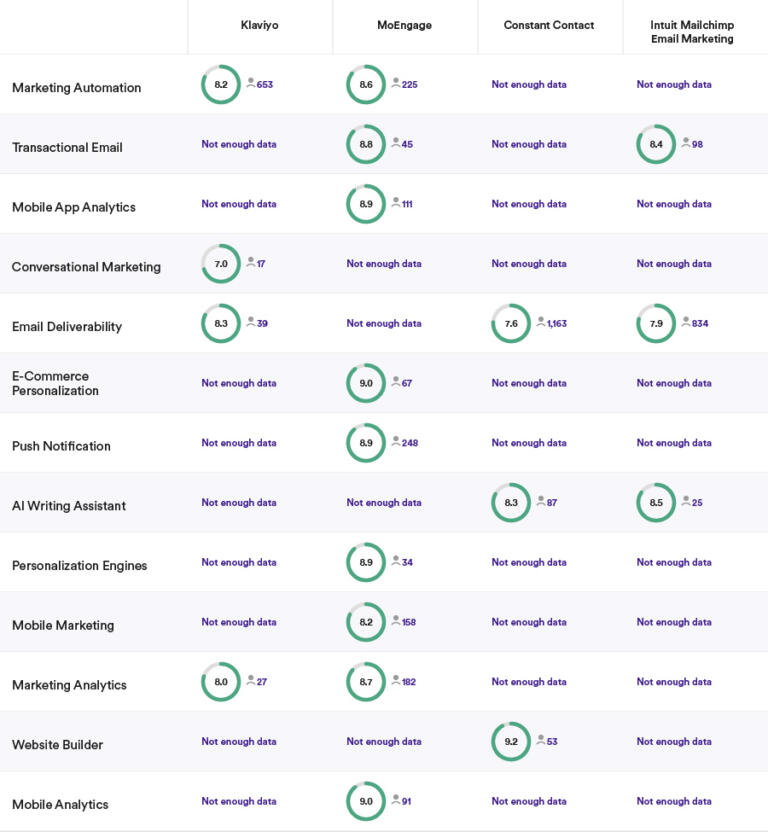
Next, let’s compare these top Klaviyo alternatives side-by-side on the criteria that matter most to Ecommerce and Shopify marketing teams.
| Criteria | Klaviyo | MoEngage | Constant Contact | Mailchimp |
| G2 Rating | 4.6/5 | 4.5/5 | 4.1/5 | 4.3/5 |
| Native Channels | Email, SMS; push & WhatsApp require extra configuration | Email, SMS, RCS, on-site messages, mobile & web push, in-app messages, web personalization, Google Ads Audience & Facebook Audience, WhatsApp & more | Email, SMS (US only), social media | Email, SMS (US/UK), MMS (US only) |
| Shopify Integration | Native integration; triggers from orders, carts, product views | Native Shopify integration with cross-channel journey triggering | Basic integration | Basic integration |
| AI Capabilities | K:AI suite: content generation, Marketing Agent, Next Best Product, Customer Agent | Merlin AI: copywriter, designer, segment assist, churn prediction, campaign + offer decisioning agents | Basic email content suggestions | Content optimizer, subject line helper |
| Cross-Channel Analytics | Strong for email/SMS revenue | Unified dashboard across all channels; Shopify + app + web in one view | Basic email reporting | Standard email/campaign reporting |
| Best For | Brands focused on email + SMS with strong out-of-box Ecommerce flows | Shopify brands running multi-channel programs needing omnichannel orchestration, AI, and unified analytics | Small startups launching fast with simple email and SMS | Brands needing solid email automation without operational complexity |
5 Migration Strategies When Switching To a Klaviyo Alternative
Switching from Klaviyo or another customer engagement platform to a Klaviyo competitor may feel straightforward, especially if you’ve only been running email and SMS campaigns. But in reality, migrations often fail when teams skip critical planning steps.
You might discover too late that the new platform can’t replicate existing automations. Or lose historical email/SMS campaign data. Or rush timelines without proper testing. The list can be endless!
The key is to approach migration as a structured project, with clear milestones, defined responsibilities, and vendor involvement where needed.
Here are proven customer engagement platform migration strategies to ensure your move to a Klaviyo alternative is smooth and successful.
1. Build a Detailed Migration Plan
List exactly what you’re migrating, and in what order. This should cover:
- Subscriber data (properties, attributes, tags)
- Behavioral events and triggers used in campaigns
- Segmentation logic and filtering rules
- Currently active email/SMS campaigns and automation series
- Integration points with Shopify, payment systems, and analytics tools
- Templates, naming conventions, and branding elements
Document your current setup in Klaviyo or other existing CEP and map it to your desired state in the new platform.
For example, if you’re switching to MoEngage for its AI-powered journey optimization, decide whether those capabilities will be active from day one or phased in later. If you’re moving to HubSpot Marketing Hub for CRM alignment, plan how to migrate and merge existing customer profiles to avoid duplicates.
Next, break the migration into logical phases, such as:
- Phase 1: Data export from Klaviyo and cleanup
- Phase 2: Import into the new CEP
- Phase 3: Workflow recreation
- Phase 4: Integration testing
- Phase 5: Parallel running before full switch
Each phase should have success criteria before proceeding. Include buffer time for troubleshooting, as delays are common during data imports and integration checks.
2. Assemble a Cross-Functional Migration Team
Migrating from Klaviyo or any other CEP impacts data integrity, compliance, and operations.
Your migration team should include:
- Marketing to ensure campaigns and customer journeys function correctly
- Technical/Engineering to handle API integrations, Shopify sync, SDK usage (if applicable)
- Product/Operations to prioritize new features and manage workflow changes
- Data/Analytics to verify tracking accuracy and reporting continuity
- Compliance/Security to ensure customer data handling aligns with regulations
Appoint a single migration lead — someone with enough authority to enforce timelines and approvals — who will also be the primary contact for the vendor’s onboarding/support team.
If you choose platforms like Braze or MoEngage that offer managed migration services, leverage their expertise. For example, MoEngage has migrated hundreds of campaigns in a matter of weeks, with improvements in customer engagement metrics driven by both technical readiness and coordinated change management.
3. Audit and Improve Documentation
Before choosing a Klaviyo alternative, assess the quality of its technical and onboarding documentation:
- Are APIs and integration guides accurate and up-to-date?
- Are there clear instructions for Shopify integration?
- Are there examples for building templates, triggers, and workflows?
For developer-heavy teams, platforms like Twilio SendGrid or Braze with comprehensive API docs will speed up migration.
For less technical teams, platforms with strong no-code configuration and visual guides (like Constant Contact or HubSpot) reduce reliance on engineering resources during setup.
Internally, create your own migration reference that covers:
- Campaign logic and workflow diagrams
- Data architecture
- Naming conventions and segmentation patterns
This will become invaluable for future platform changes or onboarding new staff.
4. Test Workflows Under Real Conditions
Stopping your existing CEP, such as Klaviyo, before validating your new platform can cause significant downtime, especially for transactional and high-value campaigns like abandoned cart flows.
That’s why it’s better to start testing as early as possible:
- Use a staging or sandbox environment if available
- Validate that all integrations work as intended
- Check message rendering across channels (email, SMS, and push, if applicable)
- Confirm automation triggers fire correctly
Platforms like MoEngage, for instance, provide real-time campaign previews and parallel-run migration support, making it easier to see exactly how messages will appear before going live.
Keep Klaviyo running until you’re confident every workflow in the new platform works under production-like conditions. This ensures you have a fallback if issues arise before or during go-live.
5. Secure Comprehensive Onboarding and Post-Migration Support
The first 30-60 days after switching are critical for adoption and optimization. Customer engagement software varies widely in its onboarding approach.
HubSpot, for example, charges for structured onboarding, but offers in-depth, guided sessions. MoEngage includes professional services and ongoing optimization reviews. On the other hand, Constant Contact relies on simplicity, reducing training needs, but limiting advanced automation early.
Some of the onboarding and support terms you should negotiate before signing include:
- Response time SLAs during migration and post-launch
- Scheduled check-ins for performance reviews
- Role-specific training for marketing, data, and ops teams
At the end of the day, ongoing vendor support can drive tangible benefits. For example, MoEngage’s strategic onboarding helped an agency client save $18,000 annually, while improving campaign results through weekly sessions and optimization planning.
Top 5 FAQs Answered About Klaviyo Alternatives
1. What are the best Klaviyo alternatives for Shopify brands?
If you run marketing for a Shopify store and want to replace Klaviyo, look for platforms that combine strong Ecommerce integrations with broader channel coverage and real-time personalization. Based on this guide, these Klaviyo alternatives are particularly well-suited to Shopify brands:
- MoEngage: Native Shopify integration with triggers across email, SMS, push, WhatsApp, RCS, in‑app, web push, and on‑site messages. Real-time segmentation lets you follow up instantly after store events, such as cart abandonment or product views.
- Constant Contact: Shopify-friendly email marketing with easy, mobile‑responsive templates. Great for smaller brands launching campaigns fast.
- Mailchimp: Easily integrates with Shopify and offers straightforward email automation, behavioral triggers, and reporting tools. Ideal for brands that need capable automation without the complexity of a larger omnichannel platform.
When shortlisting these vendors, test each with your actual Shopify store data to see how easily they handle campaign triggers, segmentation, and reporting tied to Ecommerce-specific behaviors.
2. Why do Shopify stores look for Klaviyo alternatives?
For many Shopify merchants, Klaviyo remains a strong email and SMS platform, but they start exploring alternatives when they need:
- Broader native channel support (push, WhatsApp, in-app, on‑site messaging) without third-party connectors
- Unified cross-channel analytics included without paid add-ons
- Real-time segmentation that updates instantly for campaigns across all channels
- Predictive capabilities and AI optimization are available at lower tiers or without audience minimums
Alternatives to Klaviyo, like MoEngage and Braze, appeal to Shopify stores running omnichannel campaigns, while others like HubSpot Marketing Hub serve teams that want marketing-sales alignment via CRM.
3. Which Klaviyo alternative is best for advanced customer segmentation across multiple channels?
Two strong contenders here are MoEngage and Iterable.
MoEngage offers RFM auto-bucketing, affinity segmentation, and real-time event-triggered evaluation, all included without requiring a paid-tier upgrade. It lets Shopify stores instantly target customers after key actions (e.g., cart abandonment) across mobile, web, email, and messaging channels. It also supports direct querying of warehouse data, eliminating delays in data movement.
Iterable is known for its flexible, multi-channel segmentation, which combines customer events, preferences, and engagement data from email, push, SMS, in-app, and web campaigns into a single audience definition. With robust API connections, brands can feed in behavioral data from Shopify and other systems to drive personalized journeys across channels.
4. What’s the best way to choose a Klaviyo alternative for your Shopify store?
Start with these decision criteria:
- Channels you need now and in 12-24 months
- Segmentation depth and whether it works across all channels
- Analytics scope: is it revenue-first (like Klaviyo) or fully cross-channel unified (like MoEngage)?
- Integration ecosystem, especially the depth of Shopify data sync and support for your CRM/CDP
- Scalability in both features and pricing
- Migration and onboarding support to minimize disruption
5. How long will migration take if I switch to a Klaviyo alternative?
It depends on:
- How many channels you’ll need to configure in the new platform
- The complexity of your data, i.e., the number of lists, segments, automation flows, and integrations
- Vendor migration support and whether they can accelerate setup
Modern CEPs like MoEngage and Braze have faster migration processes than legacy platforms like Salesforce Marketing Cloud. For example, some MoEngage customers, like the Drop app, have reported launching in as little as 7-10 days, including channel configuration and initial campaigns — because the vendor handles parallel setup while your existing CEP is still running, reducing downtime risk.

Choosing the Right Klaviyo Alternative for Your Shopify Store
Finding the right customer engagement platform from among the best Klaviyo alternatives is more about matching a tool to your specific customer engagement strategy, channel mix, and growth roadmap. Whichever platform you consider, the most effective next step is to:
- Validate your requirements using the evaluation criteria in this guide.
- See the platform in action with your own Shopify data and use cases.
Of course, Klaviyo is a strong choice if your focus is primarily on email/SMS-first Ecommerce automation and you’re satisfied with adding other channels later through integrations.
But if your plans include tighter cross‑channel orchestration, real‑time segmentation across multiple channels, and unified analytics without paying for multiple add‑ons, platforms with native omnichannel capabilities, such as MoEngage, deserve to be on your shortlist.
In fact, you can schedule a personalized MoEngage demo to see exactly how it handles the workflows, channels, and analytics that matter to your Shopify store, and whether it’s the right fit for your marketing roadmap.
The post Top 7 Klaviyo Alternatives to Engage Your Shopify Customers appeared first on MoEngage.
[ad_2]
Source_link