
[ad_1]
Key takeaways:
- RegTech software development cost in the UK spans £40,000 to £400,000+, with regulatory scope and legacy integration depth driving the cost.
- High-performance systems deliver a 30% to 50% reduction in manual workloads, protecting enterprises from severe FCA penalties.
- Advanced AI features generally represent around 25–40% of the total project investment due to the specialised engineering and compliance requirements involved.
- Integrating modular machine learning and real-time transaction monitoring accounts for 25% to 40% of custom engineering allocations.
Regulatory compliance has become one of the largest operational expenses for UK financial institutions. According to research by TheCityUK and PwC UK, the financial services sector now spends more than £33.9 billion annually on regulatory compliance, accounting for over 13% of firms’ average operating costs.
As regulatory expectations continue to evolve, from FCA Consumer Duty and anti-money laundering (AML) requirements to AI governance and digital operational resilience, traditional compliance approaches built on manual processes and disconnected legacy systems are becoming increasingly costly and difficult to scale.
This growing pressure is prompting banks, insurers, lenders, payment providers, wealth management firms, and FinTech companies to invest in custom RegTech software that automates compliance workflows, accelerates KYC and AML processes, strengthens fraud detection, and simplifies regulatory reporting. However, before embarking on a digital compliance initiative, one question inevitably arises: How much does RegTech software development cost in the UK in 2026?
The short answer: regtech software pricing in the UK typically ranges from £40,000 for a modular compliance MVP to £400,000 or more for a full enterprise compliance ecosystem.
However, the exact answer extends far beyond project complexity alone. Regulatory scope, AI capabilities, integrations, cybersecurity requirements, cloud infrastructure, and long-term scalability all shape the total investment.
In this blog, we’ll break down the estimated cost of developing RegTech software in the UK, the key factors that affect pricing, hidden expenses to budget for, and practical strategies to maximise ROI, helping you make an informed technology investment that supports both compliance and business growth.
Turn Compliance Costs into Competitive Advantage
With UK financial firms spending over £33.9 billion annually on compliance, investing in the right RegTech platform can significantly reduce manual effort and long-term operational costs.

How to Estimate RegTech Software Development Costs in 2026?
The easiest way to estimate the RegTech software development cost in the UK is by multiplying the total project effort by the hourly development rate.
| Estimated RegTech Development Cost = Total Development Hours × Hourly Development Rate + Third-Party & Infrastructure Costs |
|---|
Example:
- Total development effort: 2,000 hours
- Average UK development rate: £60/hour
- Third-party APIs & cloud setup: £20,000
Estimated Cost = (2,000 × £60) + £20,000 = £140,000
This formula provides a reliable starting point for early-stage budgeting before detailed project scoping.
How Much Does RegTech Software Development Cost in the UK? (2026 Benchmarks)
The cost of developing regulatory technology depends heavily on the scope of the project, the complexity of the data systems involved, and the specific regulatory workflows being automated. A simple system designed to automate a single process requires fewer resources than a real-time, cross-border transactional analysis platform.
RegTech Software Development Cost Breakdown by Project Complexity
The table below outlines typical budget requirements and delivery timelines for custom regulatory platforms in the UK market:
| Platform Type | Estimated Cost (GBP) | Timeline |
|---|---|---|
| Compliance Dashboard MVP | £40,000–£100,000 | 3–5 months |
| AML/KYC Automation Platform | £100,000–£200,000 | 5–8 months |
| Regulatory Reporting Platform | £200,000–£250,000 | 6–10 months |
| AI-powered RegTech Platform | £250,000–£300,000+ | 8–14 months |
| Enterprise Compliance Ecosystem | £300,000–£400,000+ | 12–18 months |
RegTech Software Development Cost Breakdown by SDLC
Allocating capital across the lifecycle of an enterprise software project requires a clear understanding of where resources are most needed. In regulatory technology projects, early-stage planning and architectural design are critical to long-term success.
| Phase | Key Actions | % Budget | Estimated Cost Range (GBP) |
|---|---|---|---|
| Discovery & Compliance Assessment | Mapping FCA requirements, analyzing gaps, and evaluating regulatory workflows. | 8% | £3,200–£32,000 |
| Product Strategy | Defining product roadmaps, determining compliance MVP scope, and setting ROI metrics. | 6% | £2,400–£24,000 |
| UX/UI Design | Designing high-density user dashboards, mapping exception workflows, and testing low-fatigue layouts. | 7% | £2,800–£28,000 |
| System Architecture | Structuring microservices, modeling databases, and planning rules engines. | 10% | £4,000–£40,000 |
| Backend Development | Engineering business logic, implementing processing pipelines, and building ledger trails. | 24% | £9,600–£96,000 |
| Frontend Development | Coding interactive interfaces, building data query panels, and deploying charts. | 14% | £5,600–£56,000 |
| AI & Machine Learning Development | Training anomaly models, tuning text processing, and building explainability layers. | 12% | £4,800–£48,000 |
| API & Data Integrations | Connecting KYC hooks, building legacy bridges, and securing messaging queues. | 10% | £4,000–£40,000 |
| Security Engineering & Compliance | Configuring data encryption, establishing role-based access control, and hardening keys. | 5% | £2,000–£20,000 |
| Testing, Quality Assurance & Audit | Executing continuous integration suites, performance profiling, and generating code audit logs. | 4% | £1,600–£16,000 |
Investing time and resources in discovery workshops and regulatory assessments helps prevent costly changes later in the project. Defining data flows, isolation policies, and reporting frameworks early on ensures that engineering teams can work efficiently without needing to redesign core systems during production.
What Are the Key Factors Affecting RegTech Software Development Cost in UK Enterprises?
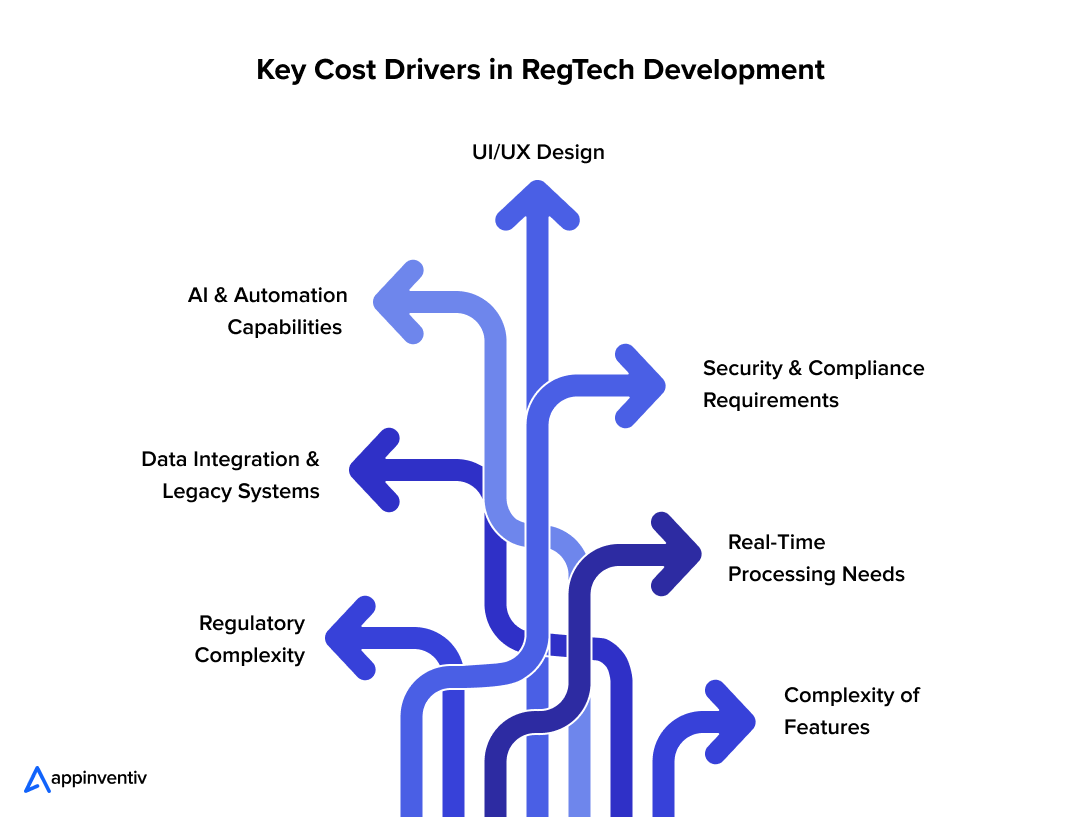
Identifying specific cost drivers enables procurement and technology teams to control expenses, manage technical debt, and prevent scope creep during the development process.
Regulatory Complexity
The scope of the regulations a platform must handle directly influences the cost to build regtech software in the UK. Managing localized rules, like specific FCA reporting formats, is a straightforward engineering task. However, building platforms that can handle multiple jurisdictions, manage cross-border data constraints, and automatically update in response to changing rules increases development time and costs.
Data Integration & Legacy Systems
Most UK financial enterprises operate on core legacy platforms. Building secure, reliable API bridges between older transactional databases and new regulatory platforms requires specialized engineering. Managing unstructured data, ensuring consistency across systems, and building reliable data pipelines can add significant complexity and cost to a project.
AI & Automation Capabilities
Integrating artificial intelligence into UK regulatory platforms requires specialized resources. Developing machine learning models for natural language processing, automated document verification, or predictive risk scoring increases the required investment. Costs depend on the complexity of the data pipelines, model training requirements, and the need for explainable AI frameworks that satisfy regulatory auditors.
UI/UX Design
Compliance officers and auditors interact with these platforms daily, often under time pressure during reporting windows. Interface design that reduces manual review time has a direct cost offset, which is why UX investment on regtech tends to be higher than on comparable internal tools.
Security & Compliance Requirements
Encryption standards, role-based access control, and data privacy requirements aligned with UK GDPR expectations add engineering overhead that generic software categories do not carry. ISO 27001 and SOC 2 alignment during build, rather than retrofitted after launch, is materially more affordable over the platform’s lifetime.
Real-Time Processing Needs
Transaction monitoring and fraud detection that must operate in real time, rather than in nightly batch cycles, require different infrastructure choices, including event streaming architecture and low-latency data pipelines. This raises both development and hosting cost.
Complexity of Features
The total number of functional components within a platform changes the required investment. A system that includes automated identity check features, transaction monitoring rules, and automated report generation requires more engineering hours than a single-purpose compliance tool. Every additional feature increases the scope of development, testing, and long-term maintenance costs.
Feature-Wise Cost Breakdown
| Feature | Estimated Cost (GBP) |
|---|---|
| KYC/KYB Verification | £30k–£100k |
| AML Transaction Monitoring | £50k–£200k |
| Risk Scoring Engine | £40k–£150k |
| Regulatory Reporting Automation | £25k–£120k |
| AI and ML Fraud Detection | £80k–£300k |
| Dashboard & Analytics | £20k–£80k |
AI modules, particularly fraud detection and risk scoring, typically account for 25 to 40% of total project cost on platforms where they are included. This is consistent with what we see across custom RegTech platform pricing UK engagements, where model training, validation, and explainability documentation extend both timeline and budget well beyond the core software build.
Planning a RegTech Platform Development?
Get a tailored cost estimate, architecture recommendation, and delivery roadmap from our compliance technology experts.

How RegTech Software Costs Vary Across the Financial Sector?
Compliance requirements vary significantly across different parts of the UK financial services industry. These differences impact structural architecture choices and overall budgets:
| Sector | Relative Cost Driver | Estimated Development Cost (GBP) |
|---|---|---|
| Retail Banking | High-volume transaction monitoring, enterprise AML/KYC workflows, regulatory reporting | £250,000 – £400,000 |
| Digital Banks | API-first architecture, real-time compliance, faster regulatory change cycles | £200,000 – £380,000 |
| FinTech | Sandbox-stage compliance, rapid scalability, embedded KYC/AML and fraud prevention | £80,000 – £250,000 |
| Wealth Management | Consumer Duty compliance, suitability assessments, portfolio risk and reporting | £150,000 – £320,000 |
| Insurance | Claims fraud detection, underwriting compliance, Solvency II reporting | £180,000 – £350,000 |
| Lending | Affordability checks, credit risk integration, automated decisioning, FCA compliance | £100,000 – £280,000 |
| Payments | Real-time fraud screening, sanctions checks, cross-border payment compliance | £150,000 – £350,000 |
| Investment Firms | Market abuse surveillance, MiFID II reporting, trade monitoring, audit trails | £220,000 – £400,000 |
| Credit Unions | Lower transaction volumes, core AML/KYC automation, budget-conscious implementation | £40,000 – £120,000 |
Compliance priorities differ enough across these sectors that a platform built for retail banking AML scope rarely transfers cleanly to insurance claims fraud or investment surveillance without material rework. Sector-specific regulatory mapping during discovery is what keeps a bespoke RegTech software cost in the UK proportionate to actual risk exposure rather than inflated by generic feature parity.
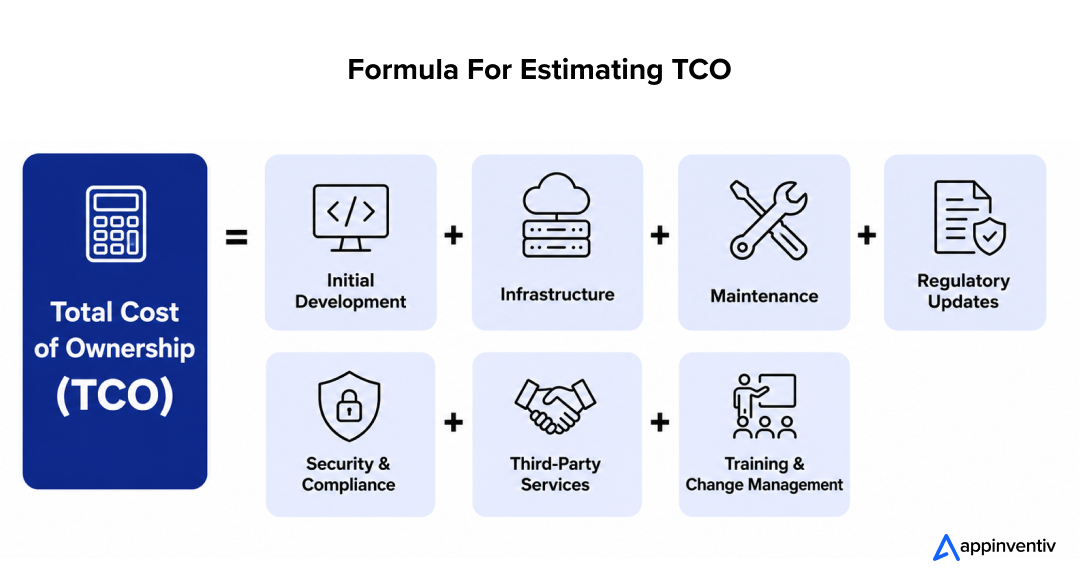
How to Estimate the Total Cost of Ownership (TCO) of a RegTech Platform
Many organisations focus on the upfront development budget when planning a RegTech initiative. However, a well-planned TCO assessment helps compliance leaders and technology teams avoid budget overruns while ensuring the platform remains scalable, secure, and adaptable for years to come.
Key Components of RegTech TCO
| Cost Component | Typical Share of Total Cost | What’s Included |
|---|---|---|
| Initial Development | 35–45% | Discovery, UI/UX, development, testing, deployment |
| Cloud Infrastructure | 15–20% | Hosting, storage, networking, backup, disaster recovery |
| Maintenance & Support | 15–20% | Bug fixes, performance optimisation, feature enhancements |
| Regulatory Updates | 10–15% | FCA rule changes, AML/KYC updates, reporting modifications |
| Cybersecurity & Compliance | 5–10% | Penetration testing, audits, vulnerability management, certifications |
| Third-Party Services | 5–10% | Identity verification, sanctions screening, credit bureaus, payment APIs |
| User Training & Change Management | 3–5% | Staff onboarding, documentation, compliance training |
Example
Suppose a UK digital lender invests £200,000 in developing a custom RegTech platform. Over the next five years, additional operational expenses could include:
- Cloud infrastructure: £60,000
- Maintenance and support: £80,000
- Regulatory updates: £40,000
- Security audits and compliance testing: £25,000
- Third-party API subscriptions: £30,000
- User training and adoption: £15,000
Estimated Five-Year TCO: £450,000
While this may appear significantly higher than the initial build cost, the platform can simultaneously reduce manual compliance effort, minimise regulatory risks, accelerate customer onboarding, and eliminate licensing fees associated with multiple disconnected tools.
That’s why enterprises should evaluate RegTech investments based on long-term business value rather than development cost alone.
What Are the Hidden RegTech Development Costs UK Businesses Should Budget For
Initial build quotes rarely capture the full cost of ownership. Most cost overruns on regtech platforms happen after the MVP ships, not during the build itself, driven by regulatory updates that arrive faster than internal budgeting cycles anticipate. Budgeting for post-launch obligations at the outset avoids the funding gaps that stall compliance platforms mid-lifecycle.
- Regulatory updates and ongoing compliance changes — FCA handbook amendments and new reporting formats mean rolling code changes, not a one-off maintenance ticket.
- Third-party API costs — identity verification, sanctions screening and PEP checks usually run on per-query licences that scale with transaction volume, so costs creep as the business grows.
- Data storage and cloud infrastructure — AWS or Azure hosting for compliance data with seven-year-plus retention requirements adds up faster than most initial estimates assume.
- Security audits and penetration testing — these aren’t a launch-day formality. ISO 27001 and SOC 2 status depend on doing them again and again.
- Post-launch support and upgrades — dedicated engineering capacity to respond to regulatory change without disrupting a live reporting cycle.
Build a rolling compliance-change budget into year one rather than treating it as contingency, and most of these overruns simply don’t happen.
Build vs Buy vs Hybrid: What’s More Cost-Efficient?
This single decision shapes the total cost of ownership more than any individual feature choice. Get it wrong and you’re either locked into years of workaround engineering around a rigid SaaS tool, or you’ve overbuilt for a problem a lighter-touch tool could’ve solved.
| Approach | Cost Profile | Trade-off |
|---|---|---|
| Build (Custom RegTech) | High upfront cost | Long-term flexibility, full control over compliance logic |
| Buy (SaaS RegTech tools) | Lower initial cost | Limited customisation, vendor lock-in on regulatory logic |
| Hybrid Approach | Moderate upfront cost | Best fit for enterprises with legacy systems and partial off-the-shelf coverage |
Large UK enterprises with heavy legacy infrastructure tend to gravitate toward hybrid models: custom integration and reporting logic layered over selected SaaS components, rather than ripping out every system at once. It protects the existing investment while still closing the specific regulatory gaps generic tools can’t reach. When boards weigh the cost to build regtech software in the UK against the sheer disruption of a full platform replacement, hybrid is often the more defensible path.
What Is the ROI of Investing in RegTech Software?
When evaluating the cost of regulatory software, it is helpful to look beyond initial capital expenditure and consider the long-term operational improvements it can deliver.
- Compliance operating costs typically drop 30 to 50% once manual reconciliation and reporting are automated
- Regulatory reporting cycles speed up, cutting the risk of late or inaccurate submissions
- Fraud losses fall as real-time monitoring replaces periodic, after-the-fact review
- Audit readiness improves, with full data lineage available on demand instead of reconstructed by hand during an examination
PwC and TheCityUK’s November 2025 research on UK compliance costs puts it plainly: regulatory compliance now eats up more than 13% of annual operating costs at the UK’s largest financial services firms, a number that’s climbed for five years running.
Against that trajectory, the real board-level question isn’t whether regtech software pricing in the UK feels expensive. It’s whether the cost of standing still is higher, and rising faster.
The market is voting with its wallet too. IMARC Group puts the UK RegTech sector at roughly $617.5 million in 2025, with a projected 17.05% CAGR ($2,651.3 million) through 2034, driven largely by AI and cloud-based compliance adoption.
How to Reduce RegTech Development Costs Without Compromising Compliance
Applying practical cost-reduction strategies helps teams deliver robust, compliant software within budget, preventing common project delays.
- Start with a compliance MVP development covering the highest-risk obligation first, rather than building full scope before you’ve even launched
- Use modular architecture so new compliance requirements extend the platform instead of forcing a rebuild
- Lean on pre-built APIs for identity verification and sanctions screening rather than custom-building commodity checks from scratch
- Prioritise high-risk areas like AML and fraud detection ahead of lower-risk reporting automation
- Work with a regtech development partner who’s already solved the common legacy integration headaches, so you’re not paying to relearn lessons someone else already learned.
CTA
Future-Proof Your Compliance Strategy
Understand the cost and ROI of building a RegTech platform designed for evolving UK regulations and long-term growth.
What Are the Common Mistakes that Increase RegTech Development Costs?
The most costly mistakes in custom regulatory technology development stem from poor early-stage planning and architectural choices:
- Neglecting Comprehensive Discovery: Skipping detailed regulatory mapping workshops before writing code forces expensive database restructuring later in the development cycle.
- Over-Engineering Custom Models: Attempting to build proprietary identity verification tools or global sanction lists from scratch, rather than integrating proven, secure third-party APIs, inflates upfront capital requirements.
- Ignoring Legacy Data Formats: Underestimating the technical difficulty of building secure data bridges to older, unstructured legacy core banking software leads to severe delivery delays and budget overruns.
- Failing to Automate System Auditing: Creating manual workarounds for tracking data lineage increases long-term compliance engineering costs and heightens the risk of severe regulatory penalties.
Questions to Ask Before Hiring a RegTech Software Development Company in the UK?
Vendor selection deserves the same scrutiny as the platform itself. So much of the total cost gets locked in during the first few weeks of an engagement, often before anyone’s noticed. Here are some critical questions you must ask to your potential vendor before making a hiring decision.
- Have you built FCA-compliant financial platforms before, and can you show outcomes, not just a delivery timeline?
- What’s your direct experience with AML/KYC automation at UK enterprise scale?
- How do you handle regulatory updates after launch? Is that part of a support contract, or billed separately as it comes up?
- Can your architecture support AI-driven compliance as expectations around algorithmic accountability keep evolving?
- What security standards do you follow, and are they independently certified, not just self-attested?
- How do you handle cloud security and disaster recovery for data with long statutory retention periods?
- Can you integrate with our existing banking and compliance systems, or does everything need replacing?
- How do you validate compliance requirements during discovery, and who actually signs off before build begins?
Why Choose Appinventiv for RegTech Software Development?
Managing the initial cost to build regtech software in the UK is only part of the equation. The engineering partner you select directly determines whether your budget delivers a resilient platform your compliance teams trust, or an unstable system requiring continuous maintenance patches.
Technology leaders must look beyond basic software delivery. Building a production-ready compliance engine requires real machine learning depth, cross-system integration experience, and a proven track record navigating the Financial Conduct Authority (FCA) regulatory frameworks.
At Appinventiv UK, we act as a trusted custom fintech software development company in the UK for enterprises operating within complex, highly regulated data environments. We design, deploy, and support scalable software architectures tailored to modern financial realities.
Our delivery model provides immediate benefits by embedding FCA-ready architecture directly into your infrastructure, ensuring your platform adapts seamlessly to rules like the Consumer Duty mandates without requiring costly core database overhauls. We combine this structural agility with practical AI expertise, embedding explainable machine learning models that automate high-volume AML transaction monitoring and predictive risk scoring, resulting in an average 30% to 50% reduction in manual tracking workloads.
Our regional footprint includes over 3,000 digital assets successfully deployed across the UK and Europe, supported by a network of 5+ innovation hubs in London, Berlin & Amsterdam to guarantee close, secure collaboration with your internal technology teams.
For institutions limited by older applications, our teams specialize in legacy modernization, building secure, low-latency API bridges that unlock siloed transaction data without disrupting daily operations. Every line of code is backed by strict ISO certifications, specifically ISO 27001, ISO 9001, and SOC 2 benchmarks, to guarantee a 99.5% security compliance SLA across your entire data pipeline.
Our team of 1600+ tech experts brings deep, practical experience building compliant financial software for high-growth enterprises. We have engineered secure transactional engines and complex backend infrastructures for pioneering fintech products, including:
- Mudra: A highly engaging, AI-driven personal budgeting platform designed for millennials, launched seamlessly across 12 countries to automate expense tracking and real-time behavioral insights.
- Edfundo: An innovative financial literacy and smart money-management ecosystem built with a modular microservices architecture, ensuring secure data isolation and rapid cross-border scaling.
We work closely with your team to design modular, secure architectures tailored to your specific compliance goals. Our structured discovery processes help clarify project requirements early, helping you manage long-term costs and deliver scalable, audit-ready platforms built for the modern financial landscape in the UK.
Contact Appinventiv in the UK today to receive a detailed cost estimate for your RegTech platform based on your compliance requirements.
A Quick Snapshot: What Enterprise Buyers Should Remember
| Metric | Typical Estimate |
|---|---|
| Average Project Cost | £40k–£400k+ |
| Development Timeline | 3–18 months |
| Maintenance | 15–25% annually |
| AI Features Increase Cost | 20–35% |
| Biggest Cost Driver | Legacy integrations |
| Highest ROI Module | AML Automation |
FAQs
Q. How much does RegTech software development cost in the UK in 2026?
A. The typical enterprise regtech software development cost in the UK ranges from £40,000 for a modular compliance MVP to over £400,000 for a multi-layered enterprise platform. Total budgets depend on the complexity of the data infrastructure, integration requirements, and the scope of the regulatory workflows being automated.
Q. What factors affect the cost of RegTech software development in the UK?
A. The primary factors affecting regtech software development cost in UK include the complexity of the underlying regulations, the age and structure of existing legacy systems, the need for real-time data processing, and the inclusion of advanced features like AI-driven fraud detection. Security requirements and the depth of data isolation protocols also influence the final budget.
Q. How long does it take to develop RegTech software in the UK?
A. An MVP usually takes 3 to 6 months, a scalable platform 6 to 12 months, and an enterprise-grade deployment 12 to 18 months, depending on regulatory scope and legacy integration depth.
Q. How does AI impact RegTech costs?
A. AI modules such as fraud detection and risk scoring typically account for 25 to 40% of total project cost, mostly because of the model training, governance and explainability work needed to satisfy the FCA.
Q. How do you build a future-ready RegTech platform that adapts to regulatory changes?
A. We build RegTech platforms using a modular microservices architecture and an independent business rules engine. This allows compliance teams to update transaction monitoring thresholds and reporting formats via a secure user interface without modifying the core system codebase.
Q. When Should You Invest in Custom RegTech Software?
A. A custom RegTech solution becomes a strategic investment when:
- Your business operates across multiple regulatory frameworks, such as FCA, AML, MiFID II, PSD2/PSD3, Consumer Duty, or UK GDPR.
- Manual compliance processes are slowing operations, increasing audit preparation time, or creating unnecessary operational overhead.
- Your existing compliance tools don’t integrate with core banking systems, CRMs, ERPs, payment gateways, or other enterprise applications.
- You need AI-powered capabilities like automated transaction monitoring, fraud detection, regulatory reporting, or intelligent risk scoring.
- Your organisation is scaling rapidly, requiring a platform that can accommodate increasing transaction volumes, users, and evolving regulatory requirements.
- Data security, governance, and audit readiness are business-critical, requiring enterprise-grade architecture and complete control over compliance workflows.
For organisations facing one or more of these challenges, investing in custom RegTech software is a must.
[ad_2]
Source_link