Key Takeaways
- Define the business risk before choosing a security title or engagement model.
- Match the role to the environment, whether the priority is cloud, application, compliance, incident response, or network defense.
- Evaluate cybersecurity professionals through relevant scenarios, practical tasks, evidence, and references.
- Compare permanent, consulting, managed, and hybrid models against the coverage the business actually needs.
- Reliable data, system integration, employee adoption, security, and human oversight determine whether automation succeeds.
- Restaurants should pilot new systems against clear performance baselines before scaling them across multiple locations.
A company rarely starts looking for security help because everything is running smoothly. Usually, something has changed.
A large customer may have sent a security questionnaire that nobody can complete with confidence. An internal audit may have found accounts belonging to former employees. The cloud environment may have doubled in size while access rules remained largely untouched. Sometimes the trigger is more serious: unusual login activity, exposed customer data, ransomware, or an application vulnerability already visible from the internet.
The first response is often, “We need to hire a cybersecurity expert.” That sounds reasonable. It is also where many hiring mistakes begin.
Cybersecurity covers several very different jobs. The person who tests an application for exploitable flaws may not be the person to prepare a compliance program. A strong incident responder may have limited experience securing software before release. Someone who has spent years protecting corporate networks may not be ready to govern identities across a cloud-native product.
So, before searching for a cybersecurity expert for hire, the business needs to answer a more basic question: what problem will they own?
That answer affects everything that follows. It shapes the role, seniority, interview questions, commercial model, and first 90 days. It also helps the company avoid paying for a highly qualified specialist whose experience does not match the work.
The stakes are not limited to recruitment costs. IBM reports that the global average cost of a data breach has reached $4.99 million. Yet the financial figure tells only part of the story. A security failure can interrupt operations, delay contracts, pull engineers away from product work, and force leadership to make public decisions before all the facts are known.
Hiring well will not remove cyber risk. Nothing will. It will, however, give the business someone capable of identifying the risks that matter, challenging weak assumptions, and getting the right teams to act before a manageable problem becomes a crisis.
Your Biggest Cybersecurity Risk May Still Be Invisible
Identify the exposures that deserve action before an incident, audit, or customer review exposes them.
Why Hiring a Cybersecurity Expert Is Harder Than It Appears
The title “cybersecurity expert” is almost too broad to be useful.
Consider two businesses advertising the same position. The first is a healthcare software company preparing for an enterprise compliance review. It needs someone who understands patient data, application architecture, evidence collection, third-party risk, and secure development. The second is a manufacturer dealing with outdated plant systems, remote vendor access, and production equipment that cannot be patched during normal working hours.
Both need cybersecurity expertise. They do not need the same person.
This is why generic job descriptions attract confusing candidate pools. A vacancy asking for experience in SIEM, penetration testing, cloud security, governance, privacy, DevSecOps, incident response, and employee training does not describe a versatile professional. More often, it describes several vacancies combined into one.
NIST’s NICE Framework identifies 52 cybersecurity work roles across seven categories. A business does not need to recruit against the entire framework. The number simply shows how much variation sits behind the word “cybersecurity.”
The market makes the problem harder. The World Economic Forum found that only 14% of organizations felt confident they had the security talent they needed. Capable candidates can afford to question a poorly defined role. They want to know what authority they will have, whether the budget is realistic, how leadership manages cybersecurity risks, and who will act on their recommendations.
There is a practical reason for those questions. A security expert can identify a serious weakness, but may not own the system that needs fixing. Engineering may control the release schedule. IT may manage access. Finance may approve the required tool. Legal may decide how much risk the company can accept. Without executive support, the expert becomes responsible for outcomes they cannot influence.
Interviews create another difficulty.
Cybersecurity has a large technical vocabulary, and confident candidates can use it well. They may discuss zero trust, attack paths, threat intelligence, security orchestration, identity governance, and regulatory frameworks. None of that shows how they will respond when information is incomplete and the business wants a quick answer.
A more revealing question is simple: “A product team wants to launch on Friday, but testing has found a serious access-control flaw. What do you do?”
There is no perfect one-line response. A strong candidate will ask what data is exposed, how easy the flaw is to exploit, whether the affected function can be disabled, what contractual commitments exist, and who has authority to accept the remaining risk. The questions reveal judgment. A rehearsed definition does not.
The same principle applies to certifications. CISSP, CISM, OSCP, CCSP, GIAC, ISO 27001, and cloud credentials can support a candidate’s case. They show study and, in some instances, tested practical ability. They should not replace evidence of work completed in an environment similar to yours.
If the company wants to hire cybersecurity expert support successfully, it must define the result before comparing candidates. “Improve our security posture” is not a result. “Identify our exposed customer-data systems, correct critical access gaps, and run an incident exercise within 90 days” is specific enough to assess.
Once the outcome is clear, the right kind of expertise becomes much easier to recognize.
Challenges Your Business Faces Without Cybersecurity Experts
A business without dedicated security expertise does not operate without security work. The work simply moves elsewhere.
IT handles employee access. Developers fix vulnerabilities when they have time. Legal interprets notification requirements. Compliance collects evidence before audits. Procurement sends vendor questionnaires to whoever appears closest to the subject.
This arrangement can function for years, particularly in a smaller company. Problems appear when the business grows faster than its informal controls.
The Business Impact of Operating Without Cybersecurity Expertise
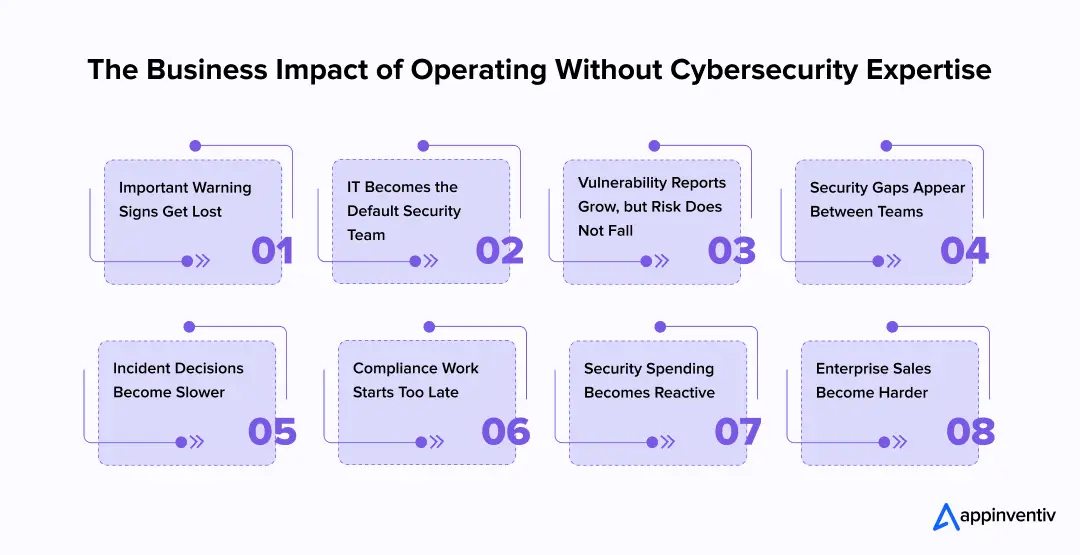
Important Warning Signs Get Lost
Security products produce alerts every day. Many are harmless. Some are not.
Suppose an employee logs in from an unfamiliar location. On its own, the event may not justify action. If the same account then downloads a large volume of data, creates a new access token, and changes a forwarding rule, the sequence deserves immediate attention.
Tools can record those actions. Someone still needs to connect them.
Without experienced review, each event may be closed separately or left in a queue. The company may only recognize the incident after a customer reports fraudulent activity or an employee loses access to a system.
IT Becomes the Default Security Team
Most IT departments already have a visible job: keep people working.
They manage devices, accounts, infrastructure, remote access, software issues, and service interruptions. Security adds another set of responsibilities, but those tasks often come without more time or staff.
Routine support has immediate users waiting for help. A vulnerability review does not. Neither does an access audit or recovery exercise. The less visible work is easy to postpone, even when the team understands its importance.
This is not an effort problem. It is a capacity problem.
Vulnerability Reports Grow, but Risk Does Not Fall
Scanning a system is quick. Deciding what to fix is not.
A report may contain hundreds of findings ranked by technical severity. The ranking does not know whether the affected server holds customer data, sits behind another control, supports a critical business process, or will take three months to replace.
Someone has to add that context.
Without it, teams often correct the easiest findings first because closing tickets shows progress. A more dangerous weakness may remain open because the fix crosses several departments. Temporary exceptions stay active. The next assessment discovers many of the same issues.
Security Gaps Appear Between Teams
Modern attacks move across boundaries.
A stolen password may provide access to a cloud account. That account may have an unnecessary permission. The permission may expose a database used by an internal application. An API may then offer a route to extract the information without triggering a simple network rule.
Identity, cloud, data, application, and network teams can each follow their own procedures while the full attack route remains open.
This is where specialist experience matters. Network security experts can assess segmentation and traffic exposure. Application specialists understand authentication flows and business logic. Cloud experts can trace permissions that are difficult to see from a traditional infrastructure review.
The business does not always need all three. It does need someone capable of recognizing when one discipline is not enough.
Incident Decisions Become Slower
A security incident creates questions that cannot wait for the next meeting.
Should the company disable a suspicious administrator account immediately? Can a server be isolated without stopping customer transactions? Has data actually left the environment? Does the event trigger a contractual or legal notification? What can leadership tell customers without speculating?
If nobody owns these decisions, the response becomes a series of hurried conversations. Teams may take conflicting actions. Useful evidence can be lost. Communications may begin before the investigation has established reliable facts.
An experienced security lead brings order to that process. They set the response sequence, involve the right people, and separate what is known from what is still being investigated.
Compliance Work Starts Too Late
A written policy does not prove that a control works.
An organization may have an access-review policy but no reliable record of completed reviews. Backups may run every night, yet nobody has tested whether a critical system can be restored. Supplier assessments may exist for new vendors while older, higher-risk relationships remain untouched.
These gaps often surface during an audit or customer review, when the deadline is already fixed.
The business then shifts employees away from their regular work to collect screenshots, reconstruct approvals, and correct controls under pressure. A delayed certification can also hold up a contract or planned market entry.
[Also Read: Cybersecurity Compliance Requirements Every Enterprise Needs]
Security Spending Becomes Reactive
Without clear ownership, security budgets tend to follow the latest incident or sales demonstration.
A phishing event leads to a new email product. An audit leads to another reporting platform. A cloud concern results in a tool that overlaps with one the company already owns. The technology stack grows, but basic questions remain unanswered.
Which important assets are not monitored? Who reviews privileged access? When was recovery last tested? Are developers fixing the vulnerabilities that matter most?
A capable expert may recommend a new product. They may also conclude that the business needs to configure an existing tool properly, remove old access, or give teams enough time to complete overdue work.
That judgment is the real advantage of hiring cybersecurity experts. The company starts spending against known exposure rather than fear.
Enterprise Sales Become Harder
Security now affects revenue directly, particularly in B2B markets.
Large customers want evidence before sharing data or connecting systems. They ask how access is controlled, where information is stored, how incidents are handled, and whether subcontractors follow equivalent safeguards.
Poorly owned security work turns every questionnaire into a new project. Sales sends questions to IT. IT forwards some to legal. Engineering answers the application items. Nobody wants to approve the final response.
A dedicated expert can maintain evidence, challenge promises the company cannot support, and provide buyers with answers that reflect actual controls. That does not only improve security. It shortens commercial friction.
The absence of expertise is therefore felt well beyond the security team. It appears in delayed remediation, tired IT staff, difficult audits, slower sales, confused incident response, and technology spending that never quite resolves the underlying problem.
Once those costs become visible, the hiring decision becomes easier to justify. The harder decision comes next: choosing the precise capability the business needs.
Steps to Hire a Cybersecurity Expert for Your Business
Understanding the need is only the beginning. The following steps explain how to hire a cybersecurity expert without relying on impressive titles, long certification lists, or generic interview questions.
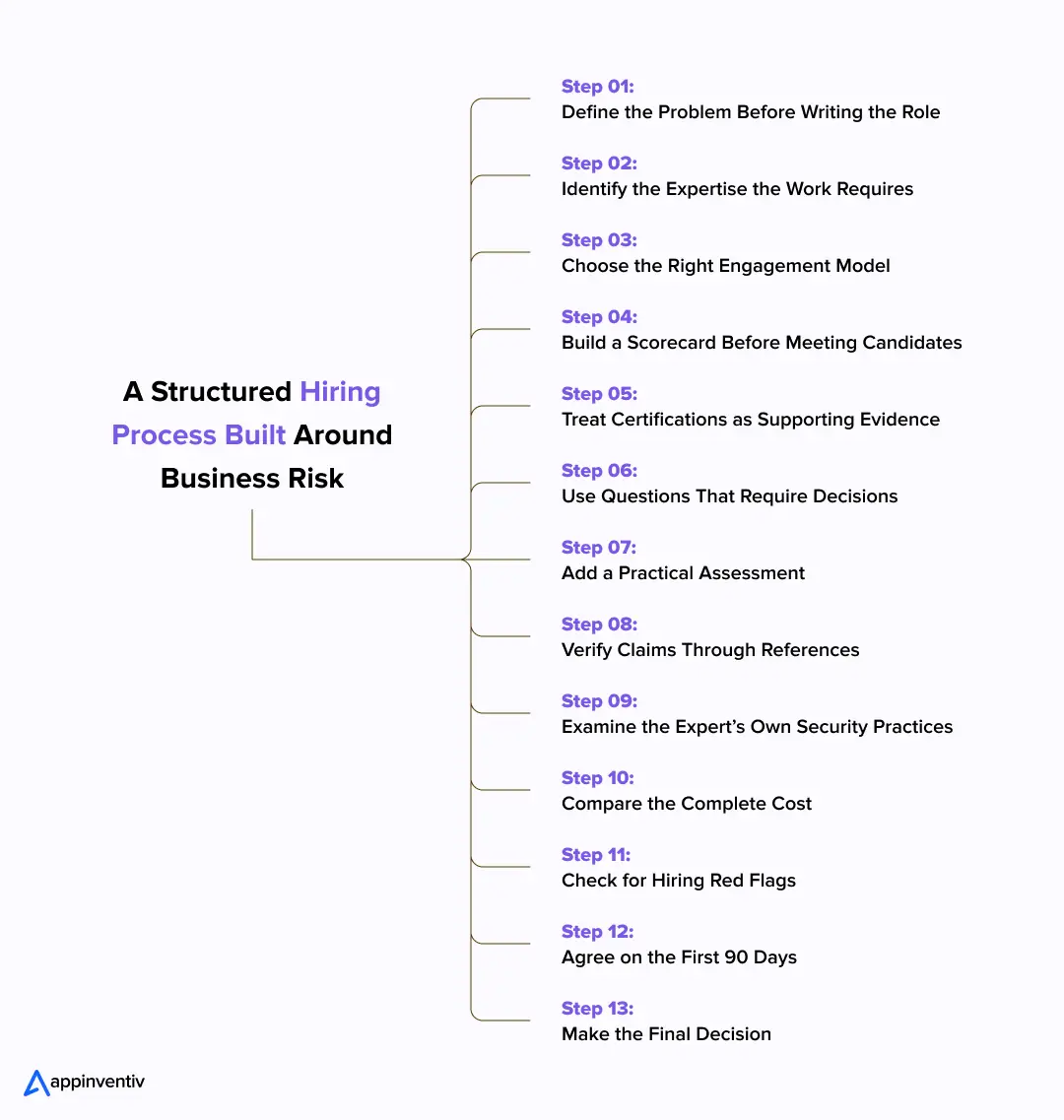
Step 1: Define the Problem Before Writing the Role
Begin with the event or pressure that created the requirement.
Maybe the company is entering a regulated market. Perhaps enterprise customers now expect formal security evidence. The business may be migrating critical systems to the cloud or releasing an application that will process sensitive data. An audit may have exposed recurring weaknesses that nobody currently owns.
Write down the situation in plain language.
Do not begin with “We need to hire a cybersecurity expert.” That sentence gives recruiters and candidates very little direction. Describe what the person or the hired team must change instead.
A stronger brief could read:
Within the first 90 days, identify the systems handling customer data, review privileged access, prioritize critical vulnerabilities, and run an incident-response exercise with the relevant business teams.
That description gives the candidates something concrete to discuss. It also tells the business what evidence to seek.
Common hiring triggers include:
- A security incident, ransomware event, or suspected account compromise
- An upcoming ISO 27001, SOC 2, PCI DSS, HIPAA, GDPR, or DORA requirement
- A major cloud migration or infrastructure modernization program
- A new mobile application, digital platform, API, or AI system
- Repeated vulnerabilities that remain unresolved
- Enterprise customers requesting security documentation
- Rapid expansion into new products, regions, or regulated industries
- Internal IT teams that no longer have enough security capacity
Once the problem is documented, decide whether it is temporary or continuing. An architecture review may require a consultant. Daily risk ownership may justify a permanent employee. Continuous monitoring will require more than one person.
Step 2: Identify the Expertise the Work Requires
The word “cybersecurity” is not specific enough for shortlisting.
A company securing a consumer application may need someone experienced in code review, API testing, authentication, session management, and secure development. An organization facing a ransomware incident needs investigation, containment, forensics, and recovery skills. A regulated business preparing for an audit may need governance and evidence-management experience.
Use the business requirement to identify the role:
| Business requirement | Relevant expertise | What the person should produce |
|---|---|---|
| Create a security strategy | CISO, virtual CISO, or security program lead | Prioritized roadmap, governance structure, budget plan, and executive reporting |
| Secure cloud infrastructure | Cloud security architect or engineer | Configuration review, identity controls, workload protection, and remediation plan |
| Protect enterprise networks | Network security experts | Segmentation, secure remote access, traffic visibility, and network threat controls |
| Secure software and APIs | Application or product security engineer | Threat models, code review, security testing, and developer guidance |
| Test exploitable weaknesses | Penetration tester or red team specialist | Verified attack paths, business impact, evidence, and retesting |
| Monitor active threats | SOC analyst, detection engineer, or MDR provider | Alert investigation, escalation, containment, and incident records |
| Prepare for audits | GRC or privacy specialist | Control mapping, evidence readiness, policy updates, and exception tracking |
| Respond to an active incident | Incident-response and forensics specialist | Containment, investigation, recovery guidance, and evidence handling |
| Protect connected operations | OT or ICS security specialist | Asset visibility, safe segmentation, vendor-access controls, and resilience planning |
A growing business may need a cybersecurity firm that can establish priorities and bring in specialists as risks change. A mature security function may require deep support in a specific area, while a hybrid environment may need expertise across several domains.
The scope should determine the team structure. Requirements such as 24/7 monitoring, penetration testing, cloud security, audit management, application security, employee awareness, and incident response demand coordinated specialists rather than a single resource. The right cybersecurity firm should provide this breadth under clear ownership and one operating model.
Step 3: Choose the Right Engagement Model
Not every security requirement needs a permanent hire.
The right model depends on how frequently the work occurs, how quickly the company needs help, and how much business context the expert will need.
Full-Time Employee
A full-time employee can provide consistent ownership and develop a close understanding of the business. They can work directly with engineering, IT, legal, finance, and leadership while helping security become part of daily decision-making.
The challenge is coverage. One employee cannot monitor threats around the clock, manage compliance, test applications, secure cloud infrastructure, and lead incident response with equal depth. Businesses may still need external specialists, additional tools, training, and backup support.
This model works best when the company needs an internal security owner who can coordinate with a broader cybersecurity team.
Fractional or Virtual CISO
A fractional or virtual CISO gives businesses access to senior security leadership without adding a full-time executive position. The engagement may cover security strategy, governance, compliance oversight, customer reviews, and board reporting.
However, a virtual CISO usually provides direction rather than continuous execution. Limited monthly hours cannot support daily monitoring, technical testing, vulnerability remediation, and incident management.
Businesses choosing this model will often need a dedicated delivery team to implement the roadmap and manage ongoing security operations.
Independent Consultant
An independent consultant can be effective for a narrowly defined requirement with a clear end date. This may include an architecture review, penetration test, compliance assessment, cloud-security review, or incident investigation.
The model becomes difficult when the requirement grows or moves across different security domains. Knowledge may remain concentrated with one person, and availability can become a concern during urgent incidents or after the engagement ends.
A consultant is therefore better suited to specialist assignments than complete security ownership. Businesses with continuing requirements may need a team that can provide consistent coverage and a structured handover.
Dedicated Cybersecurity Team
A dedicated cybersecurity team is the stronger option when the business needs continuous coverage or expertise across several security areas. Instead of relying on one generalist, the organization gains access to professionals across monitoring, cloud security, application testing, compliance, vulnerability management, and incident response.
The team can scale as priorities change, provide backup when individual members are unavailable, and retain knowledge through shared documentation and operating processes. It can also work alongside internal IT and engineering teams without requiring the business to recruit every specialist separately.
Businesses should still examine the proposed team, experience, service levels, escalation process, and data-handling practices. When properly structured, a dedicated team provides broader expertise, stronger continuity, and clearer accountability than relying on a single security resource.
Step 4: Build a Scorecard Before Meeting Candidates
Interviewers often remember confidence, recognizable employers, and personal chemistry. Those factors can overpower evidence if the company has not agreed on assessment criteria first.
Create a scorecard around the work.
Technical Relevance
When considering to hire a cybersecurity expert, look for experience close to your environment.
Someone who has spent years protecting office networks may not automatically be ready for a cloud-native SaaS platform. Network security experts should not be treated as default application-security candidates. The underlying risks, tools, and working relationships differ.
Ask what the candidate personally designed, investigated, tested, or fixed. “Supported a SOC 2 project” says little. “Mapped controls, corrected access-review gaps, organized evidence, and reduced audit findings” is much easier to examine.
Risk Judgment
Good candidates do not mark every issue as urgent.
Give the person five findings and a limited budget. Ask which issue should be handled first and why. The best response may begin with questions about exposure, data sensitivity, existing controls, operational impact, and recovery options.
Judgment matters because technical severity does not always equal business priority.
Commercial Understanding
Security decisions affect releases, revenue, operations, contracts, and customer experience.
A candidate should understand those effects without using them to justify weak controls. If the technically ideal solution is not practical, ask for a safer alternative and a clear explanation of the remaining risk.
Communication
Ask the candidate to explain the same vulnerability to two audiences.
The engineer needs enough detail to fix it. The CEO needs to understand the exposure, options, cost, and decision required. The explanation should change, but the underlying facts should not.
Execution
Finding a weakness is not the same as reducing risk.
Ask for an example in which the candidate stayed involved after the report. Did they assign ownership, help choose a fix, deal with resistance, retest the control, and escalate what remained open?
A security assessment that nobody acts upon has limited value.
Integrity
Cybersecurity professionals may receive access to credentials, source code, network diagrams, customer records, executive communications, and incident evidence.
Verify employment history, references, contractual obligations, and potential conflicts. Be cautious of anyone who proposes testing live systems without written authorization, an agreed scope, and a recovery plan.
Stop Hiring Security by Job Title
Build cybersecurity capability around your actual attack surface, regulatory pressure, and operating model.
Step 5: Treat Certifications as Supporting Evidence
Certifications help confirm that a provider has invested in recognized security knowledge. They can support the initial shortlist, but they should be assessed across the proposed team rather than concentrated in one senior profile who may have limited involvement after the contract begins.
Relevant credentials may include:
- CISSP for broad security knowledge and experience
- CISM for security leadership and governance
- CCSP for cloud security
- OSCP for practical offensive-security testing
- GIAC certifications for specialist technical areas
- ISO 27001 credentials for information-security management
- AWS, Azure, and Google Cloud security certifications
- Vendor-specific qualifications for products used by the company
The credentials should match the work.
A team handling penetration testing should include professionals with practical offensive-security experience. Cloud-security assignments need people familiar with the cloud platforms in use. Governance credentials matter for compliance work, but they do not prove that the same team can investigate a compromised endpoint or review application logic.
Ask the firm to identify the people assigned to the engagement, their certifications, and the work each person will own. This prevents a provider from presenting highly qualified leaders during the sales process and assigning less experienced resources after onboarding.
Case studies should also reflect the capability of the wider team. Ask how responsibilities were divided, which specialists became involved, how conflicting findings were resolved, and whether the same team remained through remediation and retesting.
Step 6: Use Questions That Reveal How the Team Works
Prepared capability decks tell you what a provider offers. Realistic scenarios show how its people work together when a decision crosses security disciplines.
Ask the proposed delivery team to respond, not only the account manager.
Strategy and Prioritization
- You enter an organization with no reliable asset inventory. How would the team divide the first month of work?
- Five serious vulnerabilities are open, but the budget covers only two fixes. Who would assess them, and how would the team agree on priority?
- When would you recommend accepting a security risk rather than correcting it immediately?
- What would your first quarterly security review show the board?
- How would you handle disagreement between technical specialists and the security lead?
Incident Response
- A privileged account logs in from an unusual location at 2 a.m. Which team members respond during the first hour?
- How would you contain a compromised server without damaging useful evidence?
- Who would coordinate technical investigation, legal input, operational recovery, and executive updates?
- At what point would the team recommend customer communication?
- How is coverage maintained if the primary incident lead is unavailable?
Application and Cloud Security
- A product team wants to release with an unresolved access-control flaw. How would your security and engineering specialists respond?
- How would the team review access across employees, administrators, service accounts, APIs, and third parties?
- Which security checks would you place inside the development lifecycle?
- How would cloud, application, and identity specialists assess an environment inherited through an acquisition?
- Who supports developers after vulnerabilities are reported?
Leadership and Accountability
- Tell us about a security recommendation a client rejected.
- Describe a decision your team got wrong and what changed afterward.
- How would you explain a serious control failure to the board?
- What happens when the client accepts a risk your specialists consider too high?
- Who remains accountable when work passes between different specialists?
Do not score the provider on terminology or presentation quality. Listen for clear responsibilities, practical handoffs, escalation discipline, and evidence that cybersecurity professionals can work as one team rather than several disconnected resources.
Step 7: Use a Team-Based Practical Assessment
A practical assessment can show whether the proposed team applies its expertise coherently. Keep the task limited, fictional, and relevant to the planned engagement. It should test the provider’s approach without becoming unpaid consulting.
Suitable exercises include:
- Reviewing a short architecture diagram and identifying connected risks
- Prioritizing a sample vulnerability report
- Writing an executive update from a fictional incident timeline
- Preparing a 90-day security plan for a sample company
- Reviewing an access-control design
- Conducting a limited test inside an isolated environment
- Explaining how findings would move from assessment to remediation and retesting
Ask the provider to show which specialist would handle each part. For example, an application-security engineer may identify a broken authorization flow, while a cloud specialist checks whether the same weakness exposes storage or service accounts. The security lead should then connect both findings to business impact.
Pay attention to the handoffs. A strong team should not produce separate answers that leave the client to reconcile them. Its recommendations should show one view of the risk, one order of priority, and clear ownership for the next action.
Never ask a provider to probe a live production system during selection. The exercise should assess judgment and teamwork, not create unnecessary exposure.
Step 8: Verify the Firm’s Experience Through Evidence
Security engagements are confidential, so providers cannot share every report, incident record, or client environment they have handled. That does not mean their claims should remain untested.
Ask for references connected to the work you are buying. A general recommendation may say that the firm was professional. A useful reference explains how the team responded during an incident, handled difficult remediation, or worked with internal engineering and leadership groups.
Questions for former clients may include:
- What scope did the provider actually own?
- Which specialists took part in the engagement?
- Did the proposed senior team remain involved after onboarding?
- How did the team behave during a serious incident or deadline?
- Were its recommendations practical?
- Did it support implementation and retesting?
- How well did it work with technical and non-technical stakeholders?
- Was the documentation usable after the engagement?
- How did the provider handle mistakes or disagreements?
- Would the client trust the same team with privileged access again?
Request case studies that resemble your environment in terms of industry, architecture, regulations, or security maturity. The client name matters less than the similarity of the problem and the detail of the result.
Also examine continuity. A dedicated team should not depend entirely on one relationship manager or security lead. Ask how knowledge is shared internally, how absences are covered, and what happens if a key specialist leaves during the engagement.
A firm with shared documentation and backup resources offers stronger continuity than a provider whose knowledge sits with one individual.
Step 9: Examine the Provider’s Own Security Practices
A dedicated cybersecurity team may receive access to some of the most sensitive material in the business.
This can include:
- Network and cloud architecture
- Source code
- Credentials and temporary access tokens
- Vulnerability reports
- Security logs
- Customer records
- Employee information
- Incident evidence
- Compliance documentation
- Details of unresolved control gaps
The provider’s devices, accounts, file storage, collaboration tools, development environments, and subcontractors therefore become part of your risk.
Ask how client data will be encrypted, accessed, retained, transferred, and deleted. Check whether customer environments are separated. Understand how the provider approves privileged access and how quickly that access is removed when a team member changes roles or leaves.
The review should also cover:
- Multi-factor authentication for provider accounts
- Endpoint protection on devices used for client work
- Background checks where legally permitted
- Secure storage for reports and evidence
- Logging of privileged activity
- Restrictions on copying client data
- Subcontractor access
- Internal incident-response procedures
- Notification timelines if the provider experiences a breach
- Secure deletion at the end of the contract
The contract should address confidentiality, breach notification, data location, liability, intellectual property, access revocation, subcontracting, and post-engagement support.
A firm hired to examine your security should be prepared to answer detailed questions about its own. Technical capability does not compensate for weak internal controls.
Step 10: Compare the Complete Cost
Before you hire cybersecurity expert resources, look beyond the quoted salary, hourly rate, or monthly fee.
A low-priced engagement may cover only assessment and reporting. The client then has to interpret findings, coordinate several internal teams, locate specialists for remediation, and pay again for retesting. The initial quote is lower, but the total effort is not.
Compare proposals across:
- Exact systems and assets included
- Security disciplines covered
- Testing depth and exclusions
- Seniority of the delivery team
- Availability of specialist resources
- Hours of monitoring or support
- Response and escalation times
- Tool and licence charges
- Internal effort required
- Remediation guidance
- Implementation support
- Retesting
- Executive reporting
- Travel and after-hours fees
- Contract length and exit terms
- Documentation and knowledge transfer
- Coverage during staff absence or attrition
Ask each bidder to state its assumptions.
Two penetration-testing proposals may carry the same label while covering very different work. One may include applications, APIs, manual business-logic testing, cloud configuration, developer support, and retesting. Another may rely mainly on automated scanning and end when the report is issued.
Dedicated-team pricing may appear higher than the cost of one consultant. The comparison changes when the business accounts for specialist access, continuity, incident coverage, shared documentation, and reduced dependence on internal employees.
The most useful question is not, “Which option has the lowest rate?” It is, “Which option leaves the fewest important responsibilities uncovered?”
Step 11: Check for Provider and Team Red Flags
Pause the selection process when a provider:
- Guarantees that the business will never experience a breach
- Recommends products before reviewing the environment
- Presents senior specialists who will not join the delivery team
- Cannot identify who will own each part of the engagement
- Treats compliance as proof of security
- Uses fear without offering a practical response
- Refuses to define scope, exclusions, or escalation paths
- Avoids discussing mistakes
- Proposes intrusive testing without written permission
- Stops at reporting and excludes remediation support
- Cannot explain how client information will be protected
- Claims deep expertise across every discipline without naming specialists
- Relies heavily on one person with no backup
- Uses subcontractors without disclosing their role
- Cannot explain how knowledge will be transferred
- Offers 24/7 coverage without showing the staffing model behind it
Watch how the proposed team responds to detailed questions. Strong providers acknowledge limits and explain when another specialist should become involved. Weak ones rely on broad claims and polished slides.
Confidence helps during an incident. Certainty without evidence does not.
Step 12: Agree on the First 90 Days
A dedicated cybersecurity team should not spend the first quarter producing generic policies and long reports that internal teams struggle to use.
The initial period should establish working relationships, identify material exposure, deal with anything immediately dangerous, and create routines that can continue after the first assessment.
First 30 Days: Understand the Environment
During the first month, the team should learn how the business operates before proposing large changes.
Priorities may include:
- Meeting the owners of critical systems and processes
- Identifying sensitive data and essential services
- Reviewing recent incidents, audits, customer concerns, and unresolved findings
- Mapping privileged access and external exposure
- Understanding important third parties
- Reviewing current security tools and monitoring gaps
- Confirming escalation contacts
- Identifying responsibilities across the provider and internal teams
- Acting on weaknesses that are already being exploited
Different specialists may review different areas, but the findings should come together in one risk view. The client should not receive separate lists from cloud, application, network, and compliance teams with no agreed order of priority.
Days 31 to 60: Set Priorities and Begin Remediation
The second month should turn discovery into action.
The team may:
- Build a risk-ranked remediation plan
- Test backups and recovery procedures
- Review logging, identity, endpoint, application, and cloud coverage
- Assign internal and external owners
- Agree on reporting metrics
- Run an incident tabletop exercise
- Begin correcting the highest-risk issues
- Support engineering and IT teams during remediation
- Record risks that cannot be resolved immediately
- Establish escalation routes for delayed actions
This period shows whether the provider can move from diagnosis to execution. A capable team stays close enough to answer questions, adjust recommendations, and verify that proposed fixes work within the business environment.
Days 61 to 90: Establish Repeatable Security Work
By the third month, the business should have more than a completed assessment.
The team should help:
- Add security checks to development and change processes
- Establish regular access reviews
- Create a vulnerability-remediation rhythm
- Track temporary exceptions and expiry dates
- Retest completed fixes
- Improve monitoring and incident handoffs
- Standardize evidence collection
- Present remaining exposure and budget requirements to leadership
- Document responsibilities across internal and external teams
- Confirm which specialist capabilities remain necessary
Do not measure the quarter by the number of policies written, alerts closed, or reports delivered.
Look for material exposure removed, critical assets covered, recovery tested, responsibilities clarified, and repeated weaknesses beginning to decline. The business should also know who to contact when a new cloud, application, network, or compliance issue appears.
Step 13: Make the Final Decision
Use one scoring model for every shortlisted firm.
The weights may change according to the engagement. Technical depth should carry more weight for an application-security or penetration-testing program. Governance, communication, and sector experience may matter more for a compliance-led transformation.
A wider cybersecurity requirement should also place weight on team coverage and continuity.
| Evaluation area | Suggested weight |
|---|---|
| Relevant technical capability across the team | 20% |
| Experience with comparable business risks | 15% |
| Risk judgment and prioritization | 15% |
| Team structure and specialist coverage | 15% |
| Execution and previous results | 15% |
| Communication and stakeholder management | 10% |
| Continuity, security practices, and references | 10% |
Require a short written reason for every score. This prevents a strong sales presentation or one impressive specialist from outweighing weaknesses in delivery coverage.
Before signing the contract, confirm:
- The named delivery team
- Roles and responsibilities
- Availability and coverage hours
- Escalation paths
- Access requirements
- Reporting cadence
- Remediation and retesting responsibilities
- Replacement and continuity terms
- Data-handling requirements
- Exit and knowledge-transfer arrangements
The selected cybersecurity advisory and consulting services should be able to operate as an extension of the business without taking risk authority away from internal leadership. Internal owners still decide what the organization will accept. The dedicated team brings the breadth, capacity, and continuity needed to turn those decisions into sustained security work.
How Much Do Hiring the Cybersecurity Experts Cost?
There is no single useful price for security expertise.
An application assessment with a fixed finish line is not comparable to a permanent security leader. Neither can be compared directly with a team monitoring threats throughout the night.
Salary is only one part of the cost. Recruitment, benefits, training, tools, and specialist support also need to be included.
| Engagement model | Indicative cost | Best suited for |
|---|---|---|
| Full-time cybersecurity expert | $75,000 to $200,000+ annually | Continuing internal ownership |
| Independent consultant | $90 to $180+ per hour | Assessments, testing, investigations, and defined projects |
| Fractional or virtual CISO | $5,000 to $20,000 per month | Strategy, governance, and compliance leadership |
| Managed security provider | Monthly fee based on assets, coverage, and SLAs | Monitoring, detection, and incident support |
| Dedicated security team | Custom monthly or project pricing | Programs requiring several security disciplines |
These are budgeting markers, not quotations. A cybersecurity expert for hire during an active incident will cost more than someone reviewing controls on a planned schedule.
Specialists in digital forensics, OT security, cloud architecture, advanced penetration testing, and application security may also charge more because credible experience is scarce.
What Affects the Final Cost?
Pricing for cybersecurity expert services commonly depends on:
- Specialization and seniority
- Number of users, applications, cloud accounts, endpoints, and locations
- Regulatory requirements
- Existing security maturity
- Hours of coverage
- Response SLAs
- Engagement duration
- Tools and licences
- Remediation support
- Retesting and reporting requirements
A business with limited asset visibility and years of unresolved findings will require more initial work than one with established ownership and reliable evidence.
Compare Value, Not Only Rates
A low fee may simply mean that important work has been excluded.
Before choosing a proposal, ask:
- Which systems are covered?
- Who performs the work?
- What is excluded?
- How quickly are serious issues escalated?
- Does the price include remediation guidance?
- Will the provider retest completed fixes?
- What reporting will leadership receive?
- How much internal time is required?
- Are after-hours support and emergency work included?
- What knowledge remains with the company afterward?
Looking at the overall cybersecurity experts cost through the outcome delivered is more useful than comparing rate cards alone.
The business should know what exposure will change, how much work remains internal, and what happens after a serious finding is raised.
Once those answers are clear, it becomes easier to select a cybersecurity consultant for business requirements rather than the lowest bid.
Put the right expertise on the right risks. Build a cybersecurity team and roadmap around the systems your business cannot afford to lose.
Why Choose Appinventiv as Your Cybersecurity Partner?
One security hire can close one gap. Enterprise risk is rarely that tidy.
Applications, APIs, cloud accounts, identities, data, compliance duties, and incident response all intersect. Appinventiv brings these cybersecurity expert services into one engagement, with the team shaped around the environment rather than a fixed service bundle.
As a trusted cybersecurity services provider, we begin with the systems and business processes that cannot afford to fail. Our experts assess exposure, agree on priorities with internal owners, and separate urgent fixes from longer-term security work.
Organizations that need to hire cybersecurity consultant support can keep assessment and remediation connected. Our teams do not simply hand over a report and leave internal employees to interpret it alone.
Our capabilities cover cyber-risk assessment, application and cloud security, penetration testing, vulnerability management, security operations, virtual CISO support, DevSecOps, AI security, and compliance consulting.
With 1,600+ technology experts, 3,000+ delivered solutions, and experience across 35+ industries, Appinventiv can connect security work with the software, cloud, data, and infrastructure teams responsible for implementing it.
Each engagement begins with defined access, named owners, practical deadlines, and agreed measures of progress. The purpose is straightforward: reduce material exposure, improve incident readiness, meet compliance requirements, and leave the business better prepared to manage future security decisions.
FAQs
Q. How much does it cost to hire a cybersecurity expert?
A. The cost to hire cybersecurity consultants depends on the expert’s experience, specialization, location, and engagement model. In the US, a full-time cybersecurity professional may cost between $75,000 and $200,000+ annually. Consultants generally charge hourly or project-based fees, while virtual CISOs and managed security providers commonly work on monthly retainers.
The total investment may include:
- Salary or professional service fees
- Recruitment and onboarding costs
- Security tools and software licences
- Certifications and ongoing training
- After-hours or emergency support
- Remediation and retesting services
Businesses should compare the risks covered and outcomes delivered, not just the hourly rate.
Q. How do I hire the right cybersecurity expert for my business?
A. Start by defining the security problem that needs to be solved. A broad requirement such as “improve cybersecurity” will attract different profiles without providing a reliable way to compare them. The role should reflect your systems, risks, compliance obligations, and expected outcomes.
During the hiring process:
- Identify the required security specialization
- Review experience in similar business environments
- Use scenario-based interview questions
- Include a relevant practical assessment
- Verify previous responsibilities and results
- Check references and professional credentials
- Agree on measurable 30, 60, and 90-day goals
The right expert should connect technical findings with business priorities and provide a practical route to remediation.
Q. When should a company hire a cybersecurity expert?
A. A company should not wait for a serious breach before seeking cybersecurity expertise. The need usually becomes clear when the business handles sensitive data, adopts new technologies, enters regulated markets, or cannot manage security risks through its existing IT team.
Consider hiring an expert when:
- Security incidents or suspicious activities are increasing
- Critical vulnerabilities remain unresolved
- The company is moving systems to the cloud
- A new application, API, or AI system is being launched
- Customers request detailed security evidence
- An audit or certification deadline is approaching
- Internal IT teams lack security capacity
- The business has experienced rapid growth or acquisition
Early involvement usually costs less than emergency investigation and recovery.
Q. Should I hire an in-house cybersecurity expert or outsource cybersecurity?
A. An in-house expert is suitable when the business needs continuous ownership, detailed organizational knowledge, and daily involvement in security decisions. Outsourcing works well when the company needs faster access to multiple specialists, continuous monitoring, or support for a defined requirement.
The decision should consider:
- Frequency and duration of the security workload
- Number of specializations required
- Need for 24/7 monitoring and response
- Available recruitment and technology budget
- Regulatory and data-handling requirements
- Level of internal security ownership required
- Urgency of the current risks
Many businesses use a hybrid model in which internal leaders retain risk ownership while an external partner provides specialist and operational support.
Q. How can a cybersecurity expert reduce business risk?
A. A cybersecurity expert helps the business understand which systems, data, and processes face the greatest exposure. They prioritize risks according to their likely impact and coordinate action before a weakness develops into operational disruption, financial loss, or regulatory action.
Their work can help the business:
- Detect and contain threats sooner
- Close critical vulnerabilities
- Strengthen identity and access controls
- Protect applications, APIs, cloud systems, and data
- Prepare teams for security incidents
- Improve backup and recovery readiness
- Meet regulatory and customer requirements
- Reduce repeated findings and security failures
The value comes from improving decisions and controls, not simply adding more security tools.
Q. How do cybersecurity experts integrate into existing security teams?
A. Cybersecurity experts should work within the company’s existing architecture, policies, tools, and reporting structure. Their role is to close defined capability gaps and strengthen the internal team without creating separate security processes or unclear ownership.
A structured integration typically includes:
- Reviewing the current security environment
- Defining responsibilities and decision rights
- Aligning with existing tools and workflows
- Agreeing on reporting and escalation procedures
- Working with IT, engineering, legal, and compliance teams
- Documenting findings, controls, and response actions
- Transferring knowledge to internal employees
- Tracking performance through agreed security metrics
Clear ownership is essential. External experts may provide execution and advice, but the business should retain authority over risk acceptance and strategic decisions.