
Key takeaways:
- Smart infrastructure connects physical assets, data, technology and governance to improve public services and operational outcomes.
- Australia’s $242 billion infrastructure pipeline and a shortfall of 300,000 workers makes asset-level intelligence a delivery necessity, not an innovation extra.
- Smart infrastructure use cases demonstrate how AI, IoT, digital twins and analytics can transform infrastructure management.
- Legacy systems, poor data, cybersecurity, governance, skills and procurement remain major adoption challenges for governments.
Urbanisation, stringent climate targets and the demand for consumer-grade community services are forcing government agencies to move beyond legacy systems. Traditional physical assets can no longer operate in isolation. The Australian government’s push toward sovereign digital capabilities, including the Future Made in Australia mandate, highlights the urgent need to bridge the physical and digital divide.
To bridge this divide, organisations are progressing through a clear evolution. The journey begins with traditional infrastructure, moves to connected infrastructure, evolves into smart infrastructure and ultimately reaches intelligent infrastructure. Each stage adds a greater ability to capture, connect and use infrastructure data, moving agencies from simply managing assets to making more informed operational decisions.
Smart infrastructure for the public sector is no longer a conversation about concrete and steel. It is the convergence of physical assets, such as roads, utilities, buildings and transport networks, fitted with sensors, connectivity and data platforms that let agencies monitor condition, usage and performance in real time, and apply that data to plan, maintain and operate assets more efficiently.
Adopting these connected ecosystems is now critical because the pressure to transform is mounting. The 2025 Infrastructure Market Capacity Report outlines a $242 billion Major Public Infrastructure Pipeline across Australia, shadowed by a critical shortfall of up to 300,000 workers projected by 2027. Governments simply cannot build their way out of this constraint. They must operate existing assets with far greater intelligence.
This blog details the high-value use cases, foundational technologies and a practical implementation roadmap required to execute this operational shift effectively.
Ready to assess your infrastructure maturity?
Talk to our government technology experts to define a practical path from pilot to production.
What Is the Difference Between Traditional, Smart and Intelligent Infrastructure in the Public Sector?
The distinction between traditional, smart and intelligent infrastructure determines where agencies should invest first. Traditional assets are unmonitored and reactive. Smart assets are connected and observable. Intelligent assets analyse data and support or automate decisions. Understanding this progression helps government leaders sequence investment rather than adopting sensors or AI without a data foundation to support them.
Smart Infrastructure vs Traditional Infrastructure
| Dimension | Traditional Infrastructure | Smart Infrastructure |
|---|---|---|
| Monitoring | Manual inspection, periodic reporting | Continuous, sensor-based monitoring |
| Maintenance | Reactive, scheduled by calendar | Condition-based, triggered by data |
| Data | Siloed, paper or spreadsheet-based | Digitised, integrated across systems |
| Decision making | Experience and manual judgement | Data-informed, dashboard-supported |
| Community interface | Counter, phone, static forms | Digital services, real-time status |
Smart Infrastructure vs Intelligent Infrastructure
Smart infrastructure is connected, observable and data-enabled. It tells an agency what is happening. Intelligent infrastructure goes further: it analyses that data, predicts outcomes and supports or automates decisions, such as flagging a bridge for early inspection before a fault becomes visible.
Most public sector programmes today sit in the smart tier, with a smaller number of mature agencies, particularly in transport and health imaging, moving into intelligent territory.
The Five Layers of a Smart Infrastructure Ecosystem
A robust public sector ecosystem relies on five distinct architectural layers.
- Physical Layer: roads, bridges, buildings, utilities, transport and water networks
- Connectivity Layer: IoT devices, 5G, fibre, private networks and edge infrastructure
- Data Layer: cloud platforms, GIS, APIs and digital twins
- Intelligence Layer: AI, analytics, automation and decision support
- Governance and Security Layer: governance, security and human oversight, which touches every layer above it
Why Governments Are Investing in Smart Infrastructure?
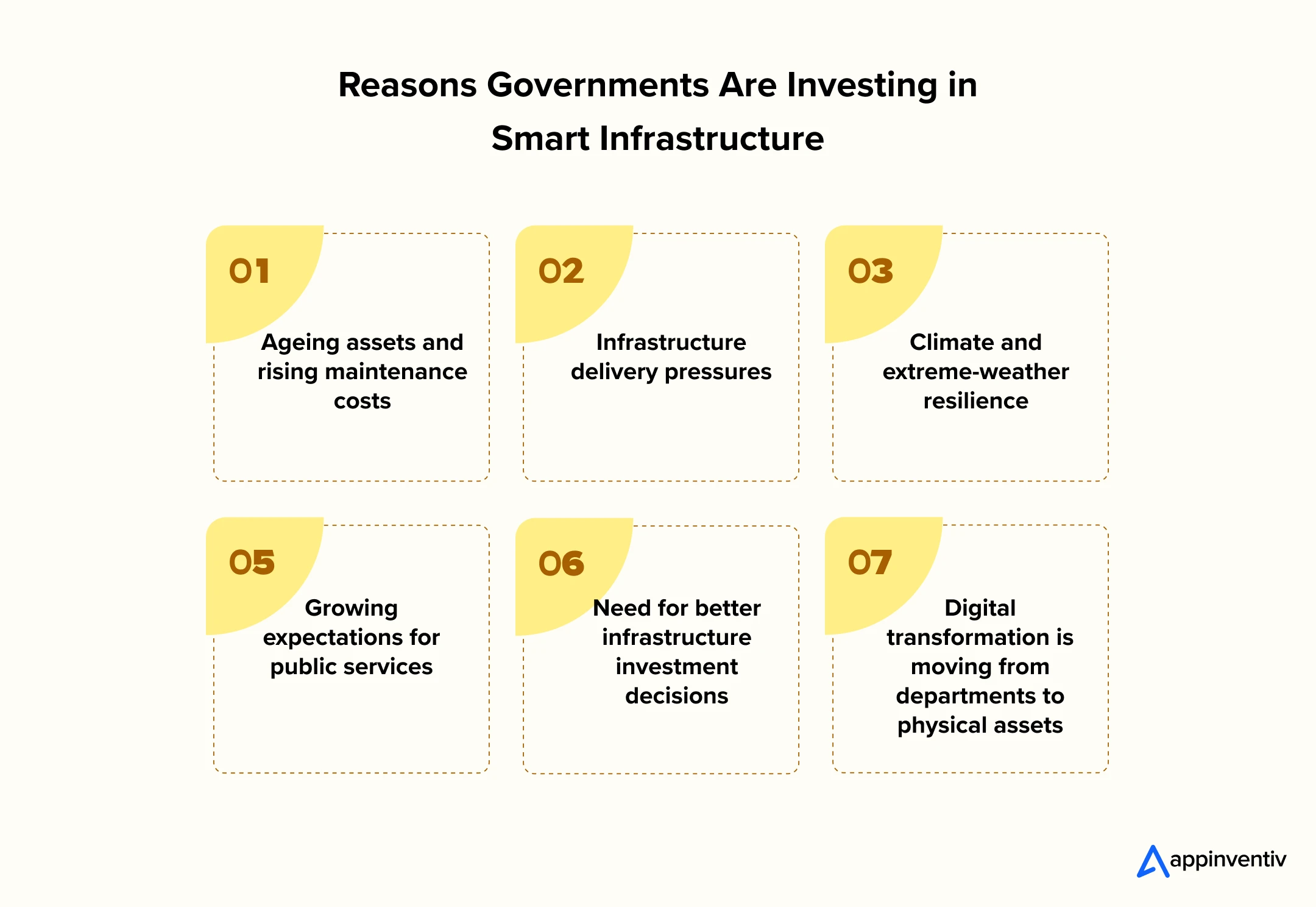
Investment in smart infrastructure is being driven by ageing assets, delivery pressure, climate exposure and rising community expectations. Agencies that connect physical assets to governed data platforms are better placed to prioritise limited capital, respond to extreme weather and shift digital transformation strategy from back-office systems to the assets themselves.
Ageing Assets and Rising Maintenance Costs
Much of Australia’s public asset base was built decades ago and is now reaching the point where reactive maintenance becomes more expensive than condition-based intervention.
Infrastructure Delivery Pressures
With a $242 billion pipeline and a workforce shortfall approaching 141,000 workers, agencies need to extract more delivery capacity from existing labour and materials rather than assuming supply will catch up.
Climate and Extreme-Weather Resilience
Flood, bushfire and heat exposure are pushing agencies toward infrastructure that can sense stress and failure risk ahead of an event, not only report on damage afterwards.
Growing Expectations for Public Services
Community who interacts daily with real-time eCommerce and logistics apps increasingly expect the same responsiveness from government transport, utilities and permitting services.
Need for Better Infrastructure Investment Decisions
Infrastructure decisions often involve long asset lives and substantial public expenditure. Better data can improve planning by showing asset condition, utilisation, demand and interdependencies.
10 High Impact Smart Infrastructure Use Cases for the Public Sector
Australian agencies already operate smart infrastructure at scale, from adaptive traffic control to AI-assisted diagnostics and statewide digital twins infrastructure. These programmes show what is achievable within current governance and budget constraints, and where the next wave of intelligent infrastructure investment is likely to concentrate over the coming years.
Smart Urban Mobility and Transport
Traffic congestion costs the economy billions annually. Melbourne leverages real-time intersection data to optimise traffic flow dynamically. Similarly, Sydney has integrated cognitive computing across its transport networks to predict delays and manage peak commuter volumes effectively.
Sustainable Resource and Waste Management
Municipalities are streamlining essential services through connectivity. Brisbane incorporates smart sensors into waste collection bins, allowing trucks to service only full bins. This targeted routing cuts fuel consumption and lowers operational costs.
Next-Generation Healthcare
Regional areas often suffer from acute specialist shortages. South Australia Medical Imaging utilises advanced tools like Harrison.ai to process radiological diagnostics in seconds. This AI-powered diagnostic infrastructure raises the standard of care and accelerates treatment pathways across the state.
Unified Community Services and Cloud Adoption
The NSW Spatial Digital Twin provides a powerful interactive collaboration tool accessible via a browser. It enables urban planners and communities to visualise infrastructure projects in real time, serving as a prime example of community -centric infrastructure.
Intelligent Project Delivery
Victoria’s Digital Build program requires state-shaping projects to be built twice (digitally and physically). Using 3D modelling, immersive reality and IoT sensors, the government mitigates design risks and improves project delivery precision before any concrete is poured.
Smart Water Grids
Regional and metropolitan water authorities deploy acoustic sensors and pressure monitors across pipeline networks to detect micro-leaks. Fixing these leaks before pipes burst conserves millions of litres of water and prevents costly urban flooding.
Predictive Energy Management
Public buildings and state-owned facilities use IoT-enabled HVAC and lighting systems that adjust based on real-time occupancy and grid demand, significantly reducing energy consumption and carbon emissions.
Public Safety and Emergency Response
Connected streetlights equipped with environmental sensors and computer vision can detect accidents, monitor crowd densities and instantly alert emergency services, improving response times in dense urban corridors.
Automated Environmental Monitoring
Coastal and forest regions deploy autonomous sensor networks to track air quality, water pollution and bushfire risks. These systems feed real-time dashboards that inform early warning systems and public health advisories.
Smart Irrigation in Public Spaces
To combat rising water costs and drought conditions, cities like Perth utilise soil moisture sensors and weather data to automate park irrigation. Water is distributed only when required, safeguarding green spaces sustainably.
Key Technologies Powering Public Sector Smart Infrastructure
Technology selection should follow the operating problem. A government agency does not need every emerging technology in its architecture. It needs the smallest technology stack that can produce reliable operational value and scale securely.
| Smart Infrastructure Technologies | Role in the Ecosystem | Typical Public-Sector Application |
|---|---|---|
| AI & Machine Learning | Detects patterns, predicts failure, supports decisions | Predictive maintenance, diagnostic imaging, demand forecasting |
| IoT & Edge Computing | Captures condition and usage data close to the asset | Traffic sensors, bin fill sensors, water and structural monitoring |
| Digital Twins & Spatial Data | Models assets and scenarios in a shared visual environment | Planning, asset lifecycle management, emergency response modelling |
| Cloud Computing (SaaS/PaaS) | Hosts data platforms and scales processing on demand | Community service portals, integrated data platforms, analytics workloads |
The architecture should also account for identity, encryption, observability, data lineage and system resilience from the beginning.
How AI Is Changing Smart Infrastructure for the Public Sector?
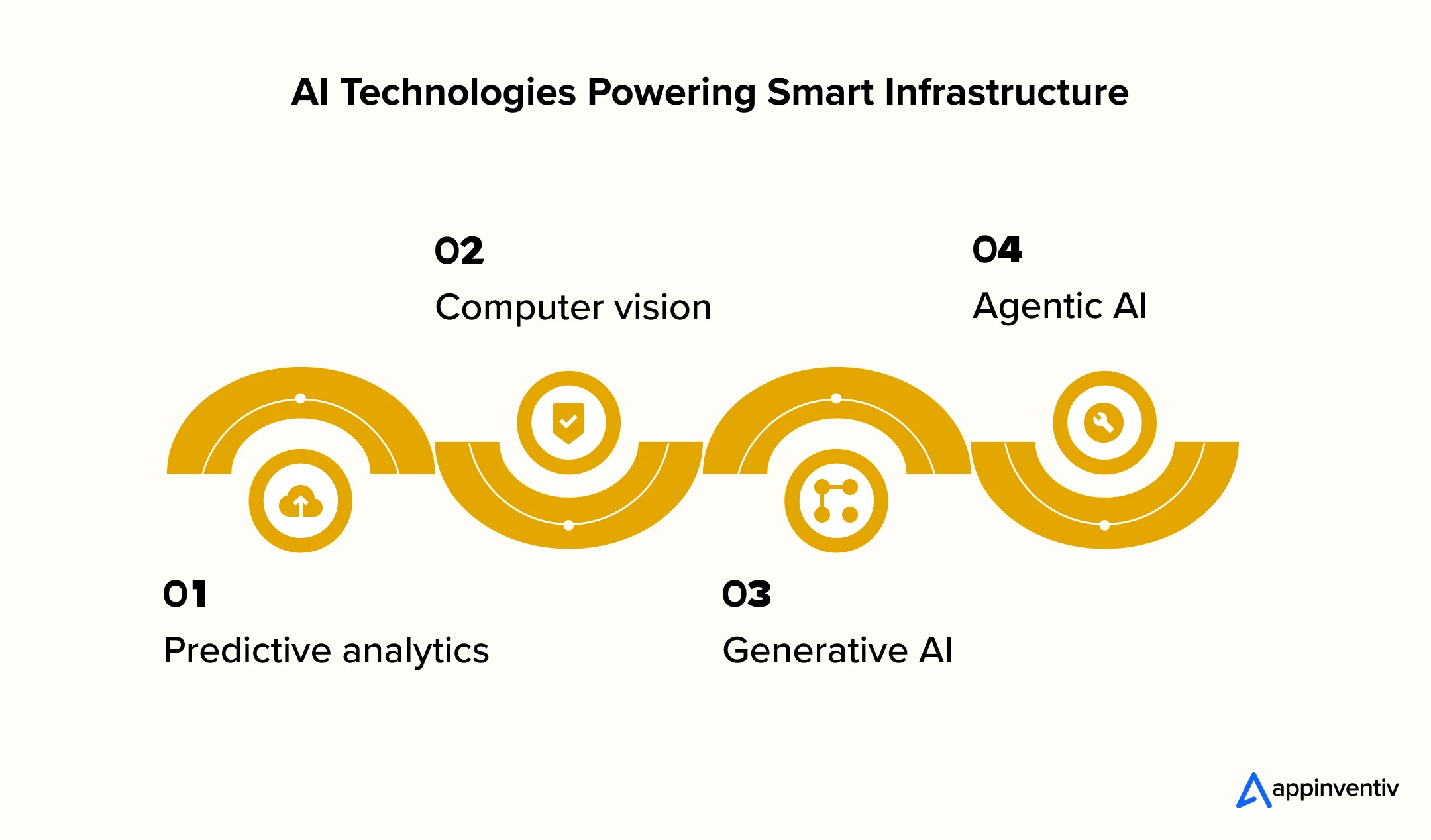
AI implementation in Australia is moving public infrastructure from observation to prediction and, in select cases, to automated response. Predictive analytics, computer vision, generative AI and increasingly agentic AI are each suited to different infrastructure problems, but every deployment should retain human oversight for decisions with material safety, cost or equity consequences.
Predictive Analytics
Predictive models flag likely asset failure or demand spikes ahead of time, letting maintenance teams intervene before a fault affects service.
Computer Vision
Computer vision reviews imagery, from pavement condition footage to diagnostic scans, at a speed and consistency manual review cannot match.
Generative AI
Generative AI use cases increasingly help to draft technical reports, summarise inspection findings and prepare briefing material, reducing administrative load on technical staff.
Agentic AI
Agentic AI is starting to appear in narrow, monitored workflows, such as triaging maintenance requests or routing sensor alerts, though most agencies are still piloting rather than scaling this layer.
The government’s responsible-use policy also requires accountable officials, transparency, strategic AI adoption, use-case accountability and impact assessment for relevant Commonwealth entities.
The Data Architecture Behind Smart Infrastructure in Government
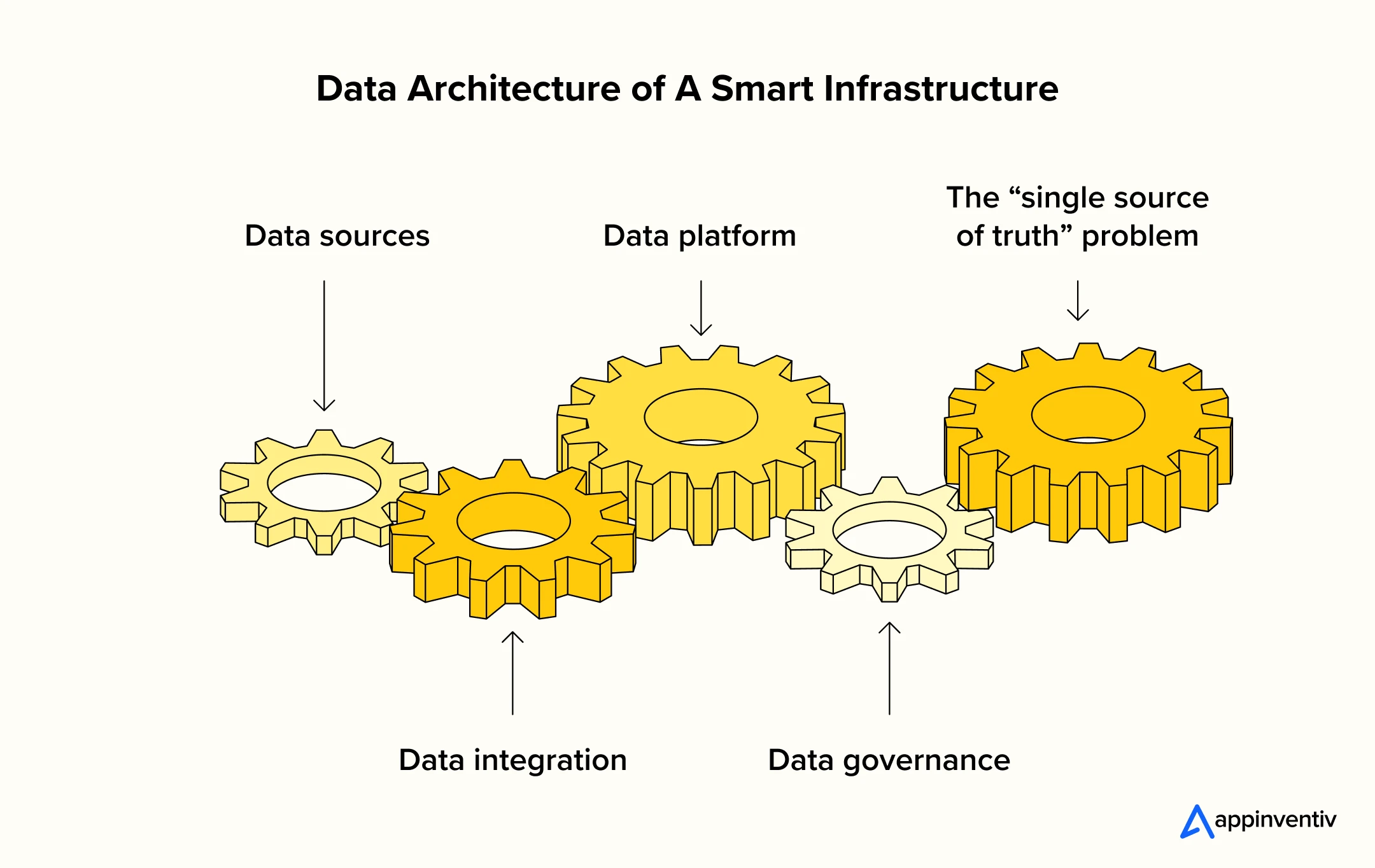
Sensors and AI models are only as useful as the data foundation beneath them. Agencies that connect data sources, integration layers and governance without building a single monolithic database avoid the fragmentation that undermines many first-generation smart infrastructure pilots.
Data Sources
Sources may include IoT devices, GIS, BIM models, enterprise applications, inspection records, mobile applications, cameras and external datasets.
Each source should have defined ownership and quality expectations.
Data Integration
APIs, event streaming and integration platforms can connect operational systems without forcing every application onto the same technology stack.
The objective is controlled interoperability, not wholesale replacement of existing systems.
Data Platform
A cloud-based data platform can provide governed storage, processing, analytics and access controls.
Architecture should distinguish operational workloads from analytical workloads and account for data residency, resilience and lifecycle requirements.
Data Governance
Governance should define who owns each dataset, who can access it, how quality is measured, how changes are recorded and how long information is retained.
For spatial infrastructure data, NSW introduced a mandatory policy framework in 2025 for agencies contributing to and using the NSW Spatial Digital Twin.
The “single source of truth” problem
Government programmes should not interpret a single source of truth as one enormous database.
A more practical model is:
Interoperable systems + shared standards + governed data + common asset identifiers
That structure allows agencies to retain fit-for-purpose systems while creating a consistent information environment.
Also Read: Enterprise Customer Data Platform Development in Australia
Key Challenges to Smart Infrastructure Implementation and Their Solutions
The hardest part is rarely connecting the first sensor. The difficulty appears when agencies attempt to integrate technology with existing systems, security obligations, procurement structures and operational teams. Each challenge therefore needs an architectural and organisational response rather than another standalone technology purchase.
| Challenge | Public-Sector Impact | Solution |
|---|---|---|
| Legacy systems and fragmented data | Slows integration, inflates project cost | Phased API-led integration rather than full replacement |
| Poor-quality infrastructure data | Undermines AI and analytics accuracy | Data cleansing and standardisation before analytics investment |
| Cybersecurity and critical infrastructure risk | Expands attack surface via connected devices | Security-by-design, network segmentation, ISO 27001-aligned controls |
| Privacy and responsible data use | Risk of non-compliant community data handling | Privacy-by-design and data minimisation built into architecture |
| AI governance and explainability | Difficult to audit automated recommendations | Documented model logic and human review checkpoints |
| Skills and workforce capability | Limited in-house data engineering and AI capacity | Blended delivery with an experienced technology partner |
| Procurement and vendor lock-in | Long-term dependency on a single supplier | Open standards, modular contracts, panel-based procurement |
How to Implement Smart Public Infrastructure in Australia: A 7-Step Process
Effective smart infrastructure programmes do not start with a device purchase. They start with a defined outcome, move through a maturity assessment and use-case prioritisation, and only then build the data foundation, pilot, integrate and scale. Skipping any of these steps is the most common reason pilots fail to reach production.
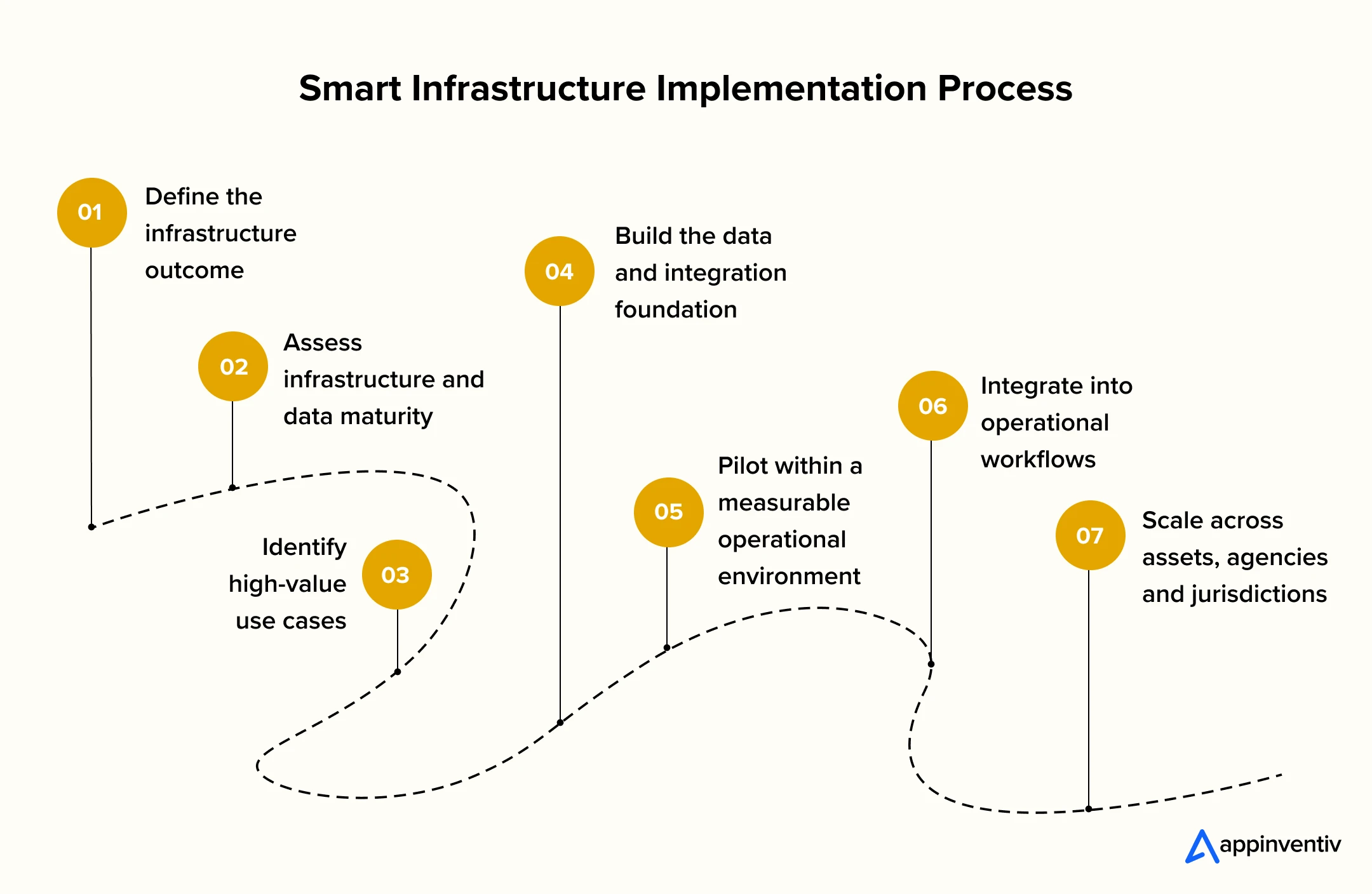
Step 1. Define the Infrastructure Outcome
Specify the operational problem first. Examples include reducing unplanned outages, improving road maintenance, increasing asset utilisation, shortening inspection cycles or improving emergency response.
Step 2. Assess Infrastructure and Data Maturity
Map assets, systems, datasets, integrations, security controls and workforce capability. The assessment should identify what is available today, what is trusted and what needs remediation.
Step 3. Identify High-value Use Cases
Prioritise smart infrastructure use cases using: Impact × Feasibility × Data readiness × Risk
| Use Case Factor | Low Priority Signal | High Priority Signal |
|---|---|---|
| Impact | Marginal cost or service improvement | Material cost, safety or service gain |
| Feasibility | Requires new infrastructure build-out | Uses existing sensors or systems |
| Data readiness | Data fragmented or absent | Data already digitised and accessible |
| Risk | High safety, privacy or political exposure | Contained, reversible, low exposure |
The best first use case is usually not the most technically ambitious. It is the one that can demonstrate measurable operational value while creating reusable capability.
Step 4. Build the Data and Integration Foundation
Establish APIs, data models, identity controls, asset identifiers, data governance and platform architecture. This is where many pilots either become scalable products or remain isolated demonstrations.
Step 5. Pilot within a Measurable Operational Environment
Choose a defined asset group, location or workflow. Set baseline metrics before deployment so the programme can demonstrate whether the intervention actually improved the outcome.
Step 6. Integrate into Operational Workflows
Move beyond dashboards. A mature solution should connect insights to maintenance systems, workforce processes, alerts, approvals and reporting. The technology becomes valuable when it changes how work gets done.
Step 7. Scale Across Assets, Agencies and Jurisdictions
Once the model is proven, standardise APIs, security controls, data models and deployment patterns. Scaling should preserve local operational requirements without creating a separate architecture for every department.
Ready to move from pilot projects to enterprise-scale infrastructure transformation?
Define a practical implementation roadmap with clear priorities, measurable outcomes and long-term governance from day one.

How to Build a Business Case for Smart Infrastructure?
The business case should make the financial and operational logic explicit. Government leaders need to understand not only smart infrastructure implementation cost, but also the cost of maintaining the platform, governing data, training users and operating the technology over the asset lifecycle.
Five questions should anchor the case:
- What infrastructure problem is being solved?
- What measurable outcome will improve?
- What data and technology are required?
- What will implementation and ongoing operation cost?
- How will value be measured and scaled?
Do not start with technology. Start with the infrastructure outcome, then determine the data, workflow and technology required to achieve it.
A practical KPI framework can then connect technology investment to measurable operational and public-sector outcomes:
| KPI | Business value | How to measure impact | What improvement signals |
|---|---|---|---|
| Maintenance cost per asset | Lower lifecycle and maintenance expenditure | Compare maintenance spend per asset before and after implementation | Lower cost per asset without compromising asset condition |
| Unplanned outage frequency | Fewer service disruptions and emergency interventions | Track failures and unplanned outages across the same asset class | Fewer unexpected failures and reactive work orders |
| Inspection time | Higher workforce productivity and faster asset assessment | Compare average inspection hours before and after digital enablement | Shorter inspection cycles with consistent or improved accuracy |
| Asset availability | Better service continuity and utilisation of public assets | Measure operational uptime against defined availability targets | Higher availability and fewer service interruptions |
| Energy / water consumption | Reduced operating expenditure and resource waste | Compare consumption against historical or baseline usage | Lower consumption without reducing service quality |
| Response time | Faster incident resolution and reduced operational impact | Measure time from detection to intervention | Faster response and shorter disruption periods |
| Project rework | Lower delivery costs and fewer construction or maintenance delays | Track rework hours, costs and incidents across projects | Reduced rework and fewer avoidable project variations |
| Service reliability | More consistent public services and improved community outcomes | Measure service interruptions, delays or failure rates | Fewer disruptions and more predictable service delivery |
| Community satisfaction | Stronger public value and confidence in services | Track satisfaction against service-level or community experience baselines | Improved satisfaction alongside measurable operational gains |
| Cost avoided through early intervention | Financial value from identifying risks before they become failures | Compare intervention costs with estimated failure, disruption or replacement costs avoided | Higher proportion of issues resolved before major failure |
How Appinventiv Helps Government Organisations Build Smart Infrastructure Solutions
Translating smart infrastructure strategy into secure, deployed reality requires a digital engineering company with experience in public sector delivery.
Appinventiv combines rigorous security compliance, advanced engineering and sovereign data expertise to help Australian government organisations modernise legacy systems, integrate AI capabilities and build resilient, community-centric digital assets at scale.
We operate as a custom software development and digital transformation services provider with 11+ years of APAC delivery experience. Our team of 1700+ tech experts has deployed 3000+ digital assets in Australia and successfully transformed 500+ legacy systems.
This execution depth is reflected in our 90% client retention rate and our recognition among APAC’s High-Growth Companies by Statista and the Financial Times for three consecutive years.
With 5+ agile delivery centres across Australia, we understand the local compliance and governance landscape intimately. We hold ISO 27001, ISO 9001 and SOC2 certifications, backed by a 99.50% security compliance SLA.
Approved on the Queensland Government ICTSS and Local Buy LGA procurement panels, we partner with agencies to architect interoperable data platforms, integrate AI and modernise legacy systems. By aligning secure technology with strategic intent, we routinely deliver up to 35% efficiency gains in Australian enterprises and government operations.
Talk to our government technology experts today to identify priority use cases, assess data and integration readiness, and define a practical path from pilot to production.
FAQs
Q. What is smart infrastructure for the public sector?
A. Smart infrastructure for the public sector connects physical assets, sensors, networks, data platforms and operational systems to improve planning, maintenance, resilience and service delivery. Its effectiveness depends on more than connectivity. Governance, cybersecurity, interoperability, data quality and human oversight must be built into the operating model.
Q. What are the main components of smart infrastructure?
A. Smart infrastructure typically comprises five components: the physical asset layer, a connectivity layer of IoT devices and networks, a data layer covering cloud platforms and digital twins, an intelligence layer of AI and analytics, and a cross-cutting governance and security layer that oversees the other four.
Q. How do digital twins support public infrastructure management?
A. Digital twins create a live, data-linked model of physical assets, letting planners test scenarios and visualise underground and above-ground infrastructure together before committing capital. Programmes such as the NSW Spatial Digital Twin and Digital Twin Victoria already apply this approach at state scale for planning and asset management.
Q. How much does it cost to develop a smart infrastructure solution?
A. Smart infrastructure development costs for government typically range from AUD 70,000 for a contained, single-asset-class pilot to AUD 700,000 or more for a multi-agency programme spanning sensor deployment, integration, a governed data platform and AI capability.
The actual figure varies, depending on asset type, sensor coverage, system integrations, data platform complexity, AI sophistication, security requirements and deployment scale, so any quoted range is a starting point for scoping rather than a fixed budget.
Q. How long does a smart infrastructure project take to implement?
A. A focused pilot covering a single asset class can typically be delivered within 3-6 months, while a multi-agency or statewide programme spanning integration, governance and scaled AI capability usually runs from 6-12+, depending on legacy system complexity and procurement timelines.
Q. How can government agencies integrate smart infrastructure with legacy systems?
A. Most agencies integrate smart infrastructure with legacy systems through API-led middleware that connects legacy asset management and finance systems to new data platforms without a full system replacement, allowing modernisation to proceed in phases while maintaining continuity of existing operational systems.
Q. How can governments secure IoT-enabled infrastructure?
A. Securing IoT-enabled infrastructure requires network segmentation, encrypted device communication, regular firmware patching and alignment with recognised frameworks such as ISO 27001, alongside ongoing monitoring for anomalous device behaviour that could indicate compromise of connected infrastructure.
Q. How can agencies measure the ROI of smart infrastructure?
A. Smart infrastructure ROI is best measured against the outcome defined at the outset, such as reduced maintenance cost, improved asset uptime, faster incident response or reduced manual inspection hours, tracked against a pre-implementation baseline over a defined measurement period rather than a single point-in-time comparison.
Q. How can government organisations start a smart infrastructure programme?
A. Agencies should start with an infrastructure and data maturity assessment, identify one or two high-value, low-risk use cases, and build the data governance foundation before scaling sensor deployment or AI investment across additional asset classes.
Q. What are the benefits of smart infrastructure?
A. Key benefits of smart infrastructure include predictive maintenance, lower operating costs, faster incident response, better resource management, data-driven investment decisions and improved community experiences.