
I use Buffer to post on LinkedIn about the tools and tech updates that power my work as a full-stack engineer. The scheduling, the queue, the publishing — all of that works great for me. But there was always this one moment in the workflow where I’d get stuck.
I’d open Buffer, navigate to the Create Space, and just…stare at a blank screen.
It’s not that I had nothing to say. But sitting there trying to figure out what to actually post (what’s trending right now? What are people in my space paying attention to this week? Which topic is even worth writing about?) I’d go in circles. There are plenty of topics. That was never the problem. The problem was picking one, finding the right angle, and getting it into a shape I wanted to publish.
So I built a web app called Buffer Ideas Extension that sits in front of Buffer’s Create Space workflow. It asks a few questions about who you are and what you’re working on, generates structured content ideas based on what’s actually trending in your space, and pushes the ones you like straight into Buffer through the API.
Here’s why I built it, and how the whole thing works.
Why I decided to build the Ideas Extension
Every idea generator I’d tried had the same problem: it didn’t know anything about me. I’d get the same generic suggestions regardless of who I am or what I do: “share a behind-the-scenes look at your process,” “post a tip your audience would find helpful.”
Prompts like this work fine as starting points, but they’re quite disconnected from what’s actually happening in my industry today. They don’t know my niche, they don’t know my audience, and they definitely don’t know what’s trending in my space right now.
I wanted a tool that knew something about me before it tried to help me. So I built it.
The concept was pretty simple: what if, before generating a single idea, the tool first asked a few questions (your industry, the topics you care about, who your audience is) and then actually used that information to perform its research every time? So the ideas it gives you are tailored to you.
Since I’m a software engineer, I leaned into that experience to build the app. For the technical folks, I used an Nx monorepo with a NestJS backend and an Angular 19 frontend as the stack. And even if you’re not technical, you can still achieve much of the same thing.
How the Buffer Ideas Extension app works, step by step
The first time you log in, the Ideas Extension asks you three questions:
- What industry are you in?
- What topics interest you within that industry?
- And who’s your target audience?
That’s it. You run through three screens, and it takes maybe 30 seconds to complete. Those answers get saved to your profile and feed every idea generation request from that point on. The model relies on context about who you are or what you care about to generate ideas.
When I did a walkthrough with Tami from Buffer’s content team, she selected Creative as her industry, photography, writing, and video as her interest areas, and early-to-mid-career professionals as her audience. Every idea the app generated came back filtered through that lens and grounded in what was actually trending in the creative space that week.
It’s really simple for the user, but there’s a lot more going on under the hood.
What happens when you hit ‘Generate’
After you’ve entered your info and hit “Generate Ideas,” the app goes out to the internet in real time and searches for trending topics related to your industry and interests from roughly the last 72 hours.
I use a single OpenAI Responses API call per request with web search enabled and a strict JSON schema on the output. The prompt asks for recent trends, and it returns five ideas at a time.
But that’s just one part of what the app delivers. I didn’t want the app to give back vague one-liners. When I’m planning a post, I need to know the angle, the hook, what points I’m going to hit, and what the call to action (CTA) is.
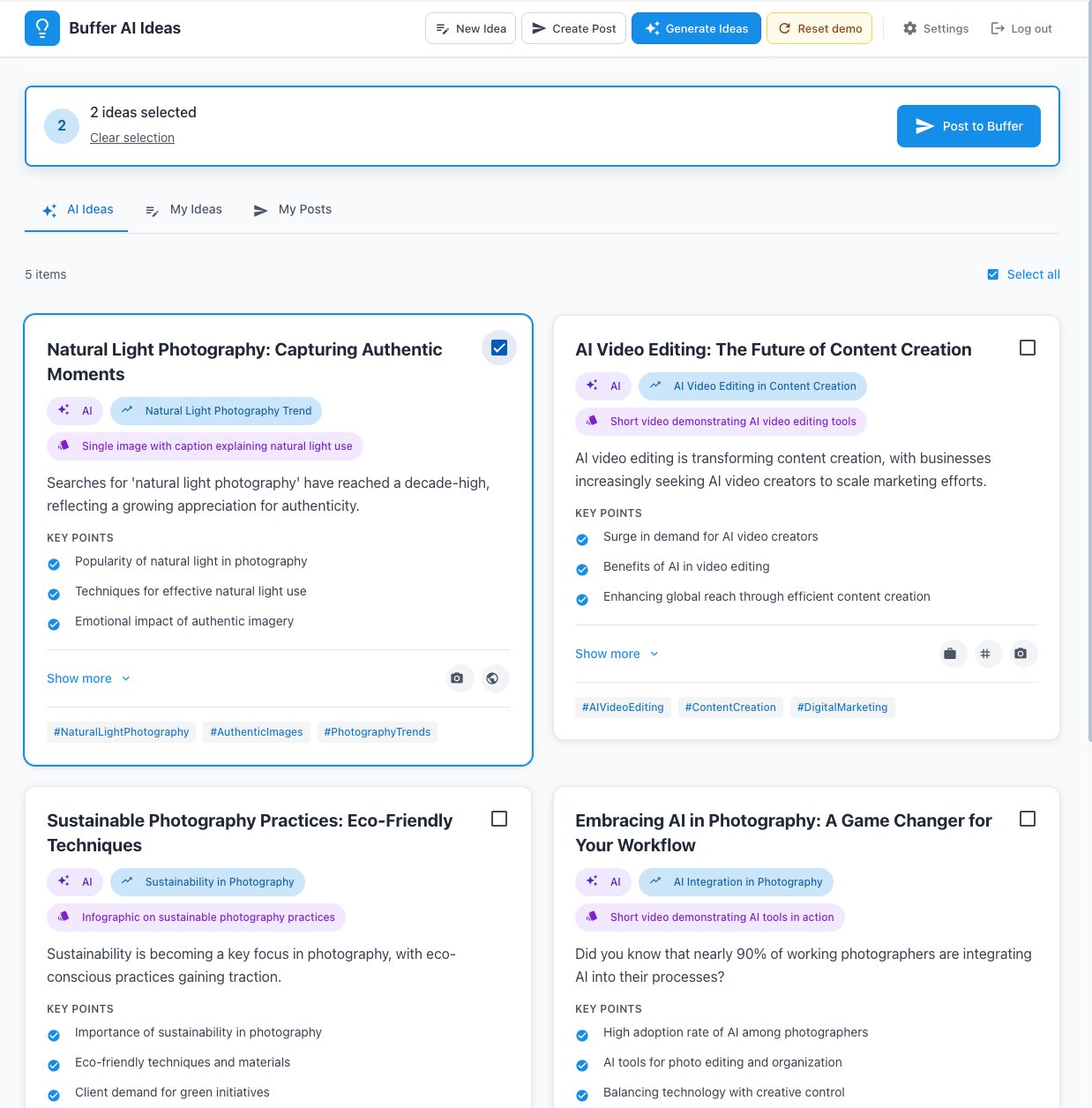
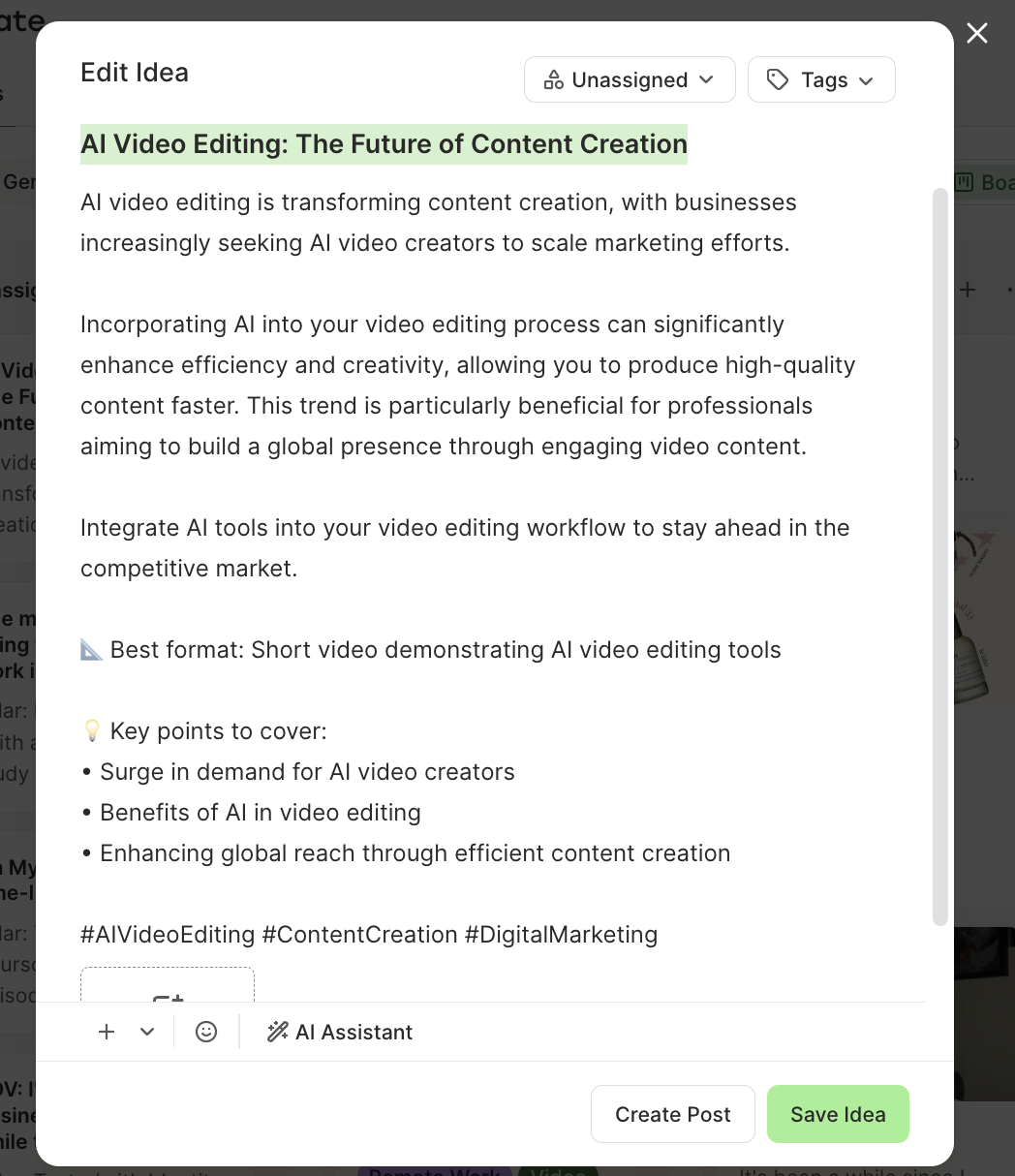
So each idea comes back as a full package with a title, hook, body outline, call to action, key talking points, suggested format, hashtags, recommended platforms, the trending topic it’s tied to, and a source URL when the search finds one. You’re getting something you could sit down and draft from right away.
I also added rich text formatting, which allows you to bold or italicize text, add bullet lists, links, and so on, using Unicode so the formatting survives on platforms like LinkedIn. I always format my LinkedIn posts with bold and bullets, and I wanted to be able to do that without leaving the app.
Pushing ideas straight into Buffer using the API
Everything up to this point, from the onboarding to the hooks and hashtags, would be useful on its own. But it would also mean I’m still copying and pasting things into Buffer manually, and the whole point was to remove friction from the workflow, not just relocate it.
So the last piece was connecting directly to Buffer through the GraphQL API.
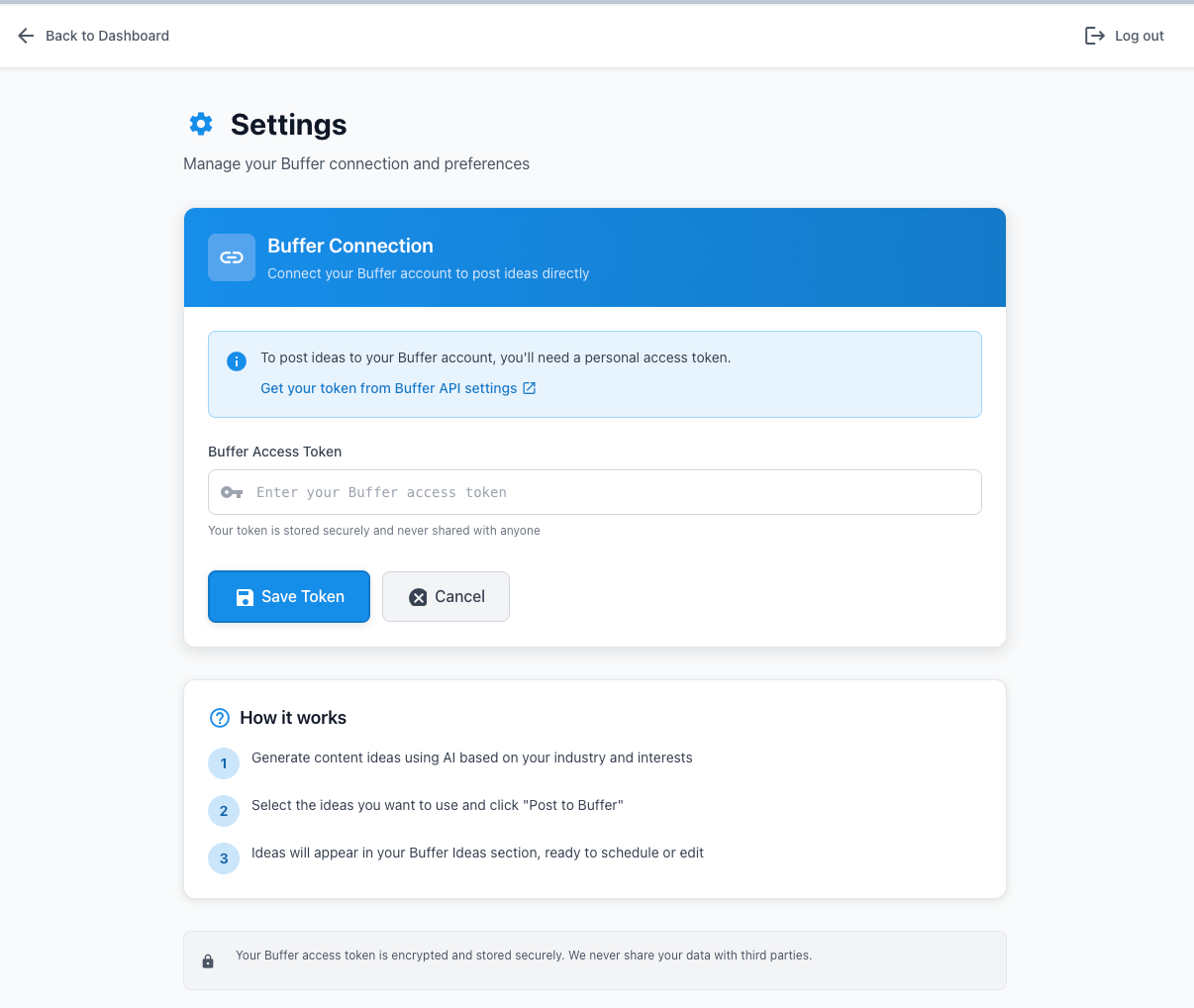
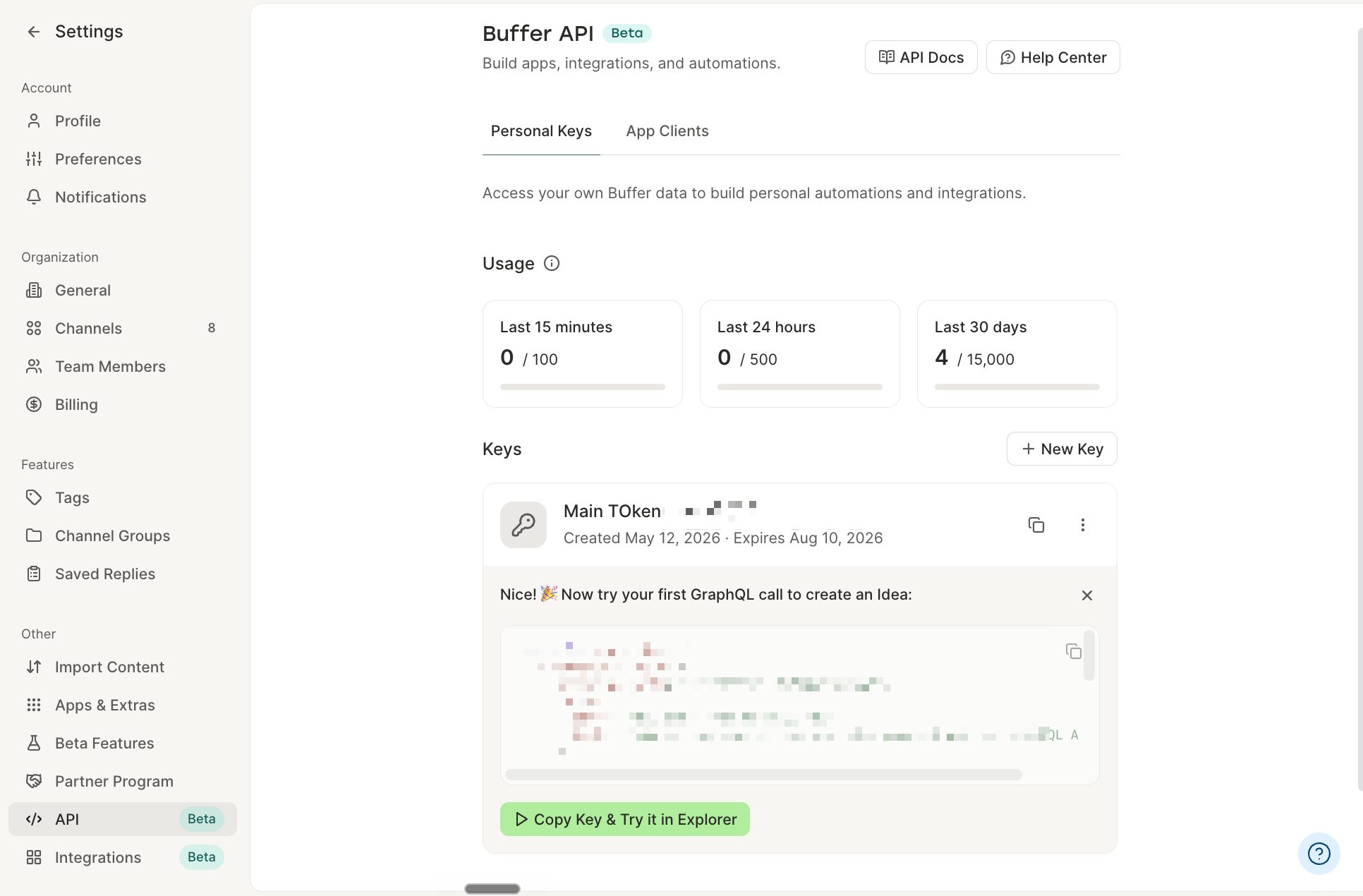
In the app’s settings, you paste your personal access token from Buffer. Once that’s connected, you can go to your dashboard, select one or more ideas, hit “Post to Buffer,” and they land in your Create Space section. The app tags which ones you’ve already pushed, so you don’t lose track.
My goal in building the Ideas Extension wasn’t to replace Buffer — just making sure I showed up to the Create Space and had something waiting for me to work with.
What has changed in my content creation process
I don’t have a neat before-and-after to show, but I can tell you what shifted in how I work.
The most obvious improvement is that I post more because there’s much less friction. My ideas are also much higher in quality and I think the web search is the reason. With search included in the same process as idea generation, the ideas tend to reference current events. And because each idea comes with a hook, talking points, a CTA, and hashtags already attached, I’m no longer starting from zero.
The smaller features also ended up mattering more than I expected. The viral hooks and hashtag suggestions sound like nice-to-haves, but in practice, they were the difference between stopping at a rough draft and having something I was willing to hit publish on.
Those little moments of “what do I open with?” and “what hashtags do I even use?” were eating more time than I realized.
And then there’s the validation that this problem resonated beyond me. The response from people at Buffer, from other builders on LinkedIn, and from getting included in the community outreach told me the gap I was trying to close was accurate.
Ready to build?
If you’re taking Buffer’s API for a spin, we’ve got resources to get you moving. Our developer docs cover the GraphQL schema, auth flow, and quick-start examples. The Buffer MCP server docs walk through plugging it into Claude or any MCP-compatible AI agent.
If you need hands-on help, our support team is around, or you can join our Discord server and chat to other people building with the API.
We’d love to hear about what you make. Find us in Discord, or @buffer on all major social channels.