Communicators need to understand what’s driving the frustration before it becomes a trust problem.
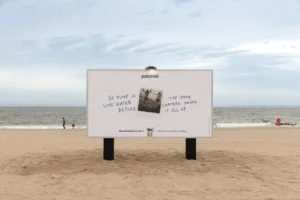
Polaroid took the AI debate onto a Coney Island beach this summer.
Rising from the sand was a giant billboard with a message aimed directly at one of the technology’s most controversial talking points: “Go jump in some water before the data centers drink it all up.”
The company followed it with lines including “You can’t bask in blue light” and “Dance like nobody is recording.” The campaign leaned into a major frustration: People are getting tired of technology taking up so much space in their lives.
“The more we lose ourselves in digital algorithms, the more we drift away from empathy and real connection,” said Patricia Varella, brand and creative director at Polaroid.
Americans are being asked to absorb AI in advertising, customer service, workplaces, schools and the infrastructure being built in their communities. For communicators, dismissing these feelings as fear of new technology would be a mistake. The complaints are increasingly specific. What is AI improving? What is it replacing? Who benefits? And how much choice do people have?
Pew Research Center found that 50% of Americans are more concerned than excited about increased AI use in daily life. Just 10% are more excited. At the same time, 73% would allow AI to assist with at least some daily activities.
People will use AI. But they’re also becoming much more selective about where they want it.
Audiences can see the shortcut
Neil Patel, co-founder of marketing agency NP Digital, said brands create problems when AI becomes an end in itself.
“AI is a bad idea when you’re using it simply because you can,” Patel said. “If it doesn’t make the customer experience better, the marketing more relevant, or your team more effective, you’re probably just adding AI for the sake of saying you use AI.”
Consumers probably won’t care if a PR team used AI to sort research, summarize a spreadsheet or remove repetitive admin work, she said. But replacing the voice or creative judgment they encounter is much more visible, and more likely to be a pain point.
“People aren’t necessarily skeptical of AI, they’re skeptical of brands using AI to replace effort, originality, and human judgment,” Patel said. “Consumers can tell when something feels mass produced.”
On campuses, job anxiety is becoming public
Former Google CEO Eric Schmidt was repeatedly booed when he discussed AI during the University of Arizona’s commencement this Spring.
But this reaction, seen on multiple campuses, isn’t a complete rejection of AI. Gallup found 57% of U.S. college students use AI for coursework at least weekly, including roughly one in five who use it daily. Yet 42% of students pursuing bachelor’s degrees have given at least a fair amount of thought to changing their major because of AI’s potential impact.
Meghan Kessler, a junior public relations major at Temple University, said she uses AI for some assignments, though she doesn’t think it should be a core tenant of PR.
She recalled seeing an AI-generated Coca-Cola ad and immediately recognized what she was watching.
“It really turned me off because there’s no human aspect to that,” she said. “What gets me is the fact that it’s so obvious.”
Her response brings up a great point for communicators: What does the audience gain from knowing or experiencing AI?
Gregg Feistman, adjunct professor at Temple University’s Klein College of Media and Communications, said he requires students to use AI for certain assignments and then reflect on their experience.
“Overwhelmingly, they don’t like it,” Feistman said. “They see jobs being threatened.”
CEOs talk about AI in terms of productivity, cost savings and efficiency. Feistman said those messages are probably intended for investors, but they reach consumers too.
“It may have been the right message for the investor audience,” he said. “It sure wasn’t the right message for anybody else.”
The trust problem gets bigger when AI leaves the screen
The reputational stakes rise considerably when AI moves from marketing to business decisions that affect entire communities.
Feistman points to growing opposition to AI data centers as an example.
“They don’t have a PR problem. They have a business problem,” he said.
Companies can explain the need for AI infrastructure, but communications cannot erase concerns about water, electricity, land development or quality of life when residents believe decisions were made without them, he said.
“Nature abhors a vacuum,” Feistman said. “People are gonna fill it in there with their own worst-case scenarios.”
His recommendation is instead to “start flooding the zone with credible information.”
Sometimes credible information includes saying the company doesn’t know yet. Being candid about uncertainty can open a dialogue about the technology instead of forcing communicators to defend certainty they can’t support, he said.
Sixty-one percent of Americans say they want more control over how AI is used in their own lives, Pew found. Just 17% are comfortable with their current level of control.
AI fatigue is changing what good marketing looks like
The biggest mistake brands can make right now is confusing efficiency with effectiveness, Patel said.
“AI can help you create 100 pieces of content instead of 10, but if none of those 100 pieces are memorable, useful, or trusted, you haven’t gained anything,” he said. “We went from ‘AI can do this’ to ‘AI is in everything’ incredibly fast. Every company launched an AI feature, every ad started mentioning AI and the internet filled up with AI-generated content. The novelty disappeared.”
Communicators need to know when using AI genuinely improves something and when it creates a new trust problem. They also need enough influence inside their organizations to ask harder questions before those decisions reach the public. What does this improve for people? What are we asking them to give up? Have we listened to the people affected? Can we explain the decision?
“Let AI analyze data, uncover patterns, personalize experiences and help your teams move faster,” Patel said. “But when trust, emotion, creativity, or your brand’s point of view matters, humans still need to be heavily involved.”
The post The AI backlash is getting louder. Brands should pay attention. appeared first on PR Daily.