📌 THE GIST
- Every business opportunity hiding right now lives inside a behavior your customers quietly changed — and no AI tool is going to surface it for you if you don’t know how to look.
- The press-on nail market hit $738 million in 2024 and is projected to surpass $1 billion by 2030 — built almost entirely on one consumer signal: people still wanting the same outcome, refusing to overpay for it.
- After reading this, you’ll have a 4-step framework to read any market shift and find the opportunity inside it — before the mainstream crowd shows up and calls it “a trend.”
Learning how to identify business opportunities is less about research and more about paying attention to your own life. The best market signals don’t come from industry reports — they come from small, almost-invisible shifts in what people choose to stop doing, start doing, or do differently because their circumstances changed. The press-on nail market is a $738 million example of exactly that.
I’ve been skipping my regular nail salon appointments lately. My nails needed a break. And wow — the money I’ve been saving is not a small number.
That’s when my social media feed started showing me press-on nail content. Not the bargain-bin drugstore strips from 2005 — actual sets that looked like what you’d walk out of a salon with. I started watching the videos. Then I started clicking the links. Then I went down a full rabbit hole, and I could not stop.
The price difference is almost insulting. A gel manicure runs $40–$120 and lasts two weeks. A quality press-on set runs $15–$35 and lasts nearly as long. Annually, women spending on salon gel manicures pay $1,248–$2,184 per year. The press-on equivalent? $390–$1,040. Same beautiful nails. Fraction of the cost. You do it yourself in 20 minutes.
The more I looked, the more I found: a massive, growing community of small business owners making custom, handmade press-on nails. Entrepreneurs building real revenue on Etsy, TikTok Shop, and their own websites. Gross margins of 40–70%. No license required. Low startup costs.
And I thought: this is exactly how opportunity works.
Why Consumer Behavior Is the Best Business Research Tool You Have
Before we go deep on the press-on nail case study, I want to be clear about something. You don’t need fancy market research software to identify business opportunities. You need to pay attention to what people are doing differently right now.
Economists have a name for what’s happening in the press-on nail space: trade-down behavior. McKinsey found that 63% of consumers don’t view premium salon services as inherently superior to alternatives, and 24% have already traded down to at-home or lower-cost options. This isn’t reluctant compromise — it’s informed choice by savvier, more price-conscious consumers.
The critical question isn’t “what are people buying?” It’s “what outcome are people trying to achieve, and how has the path they’re willing to take to get there shifted?”
In the nail category: the outcome (beautiful, maintained nails) stayed the same. The path (spending $100 at a salon every two weeks) became a point of friction. When that friction grows strong enough, a new market opens up.
This pattern repeats across industries — every single time the economy tightens, costs rise, or technology closes a convenience gap. Your job, as an entrepreneur, is to spot it early.
How to Identify Business Opportunities Using the Three-Layer Need Test
The frameworks I stumbled on while going down the nail rabbit hole are genuinely some of the most useful opportunity-identification tools I’ve seen. Let me give you the most important one.
Every product or service category has three layers of consumer need. Most businesses — especially big ones — only address the surface. The opportunity almost always lives in the deeper layers.
| Layer | What the Consumer Is Searching For | Press-On Nail Example | Where the Opportunity Lives |
|---|---|---|---|
| Surface Need | I want press-on nails | Any nail product | Mass market (saturated) |
| Functional Need | I want salon-quality nails without the cost or time | Glamnetic, Olive & June | Premium DTC brands (growing) |
| Emotional Need | I want to feel polished and in control of my appearance — on my terms | Custom handmade sets | Small entrepreneurs (wide open) |
Mass brands (Kiss, Impress, Sally Hansen) live at the surface. Premium DTC brands live at the functional layer. The enormous white space for small entrepreneurs? The emotional layer — hyper-personalized, community-connected products for people the mass market has completely ignored.
Think about the woman who recently quit gel manicures because her nails are damaged. She doesn’t want a generic press-on set. She wants something designed around nail recovery, with positioning that makes her feel smart for choosing it — not like she settled. Nobody is speaking to her directly. That’s a business.
Think about athletes whose nails need to survive workouts and sweat. Think about men who want minimalist nail care without the stigma. Think about kids’ parents who want non-toxic, adhesive-tab sets because their 8-year-old is obsessed with nail content on TikTok. All underserved. All growing.
How to Identify Business Opportunities by Reading the Trend Curve
Timing matters enormously. The same opportunity that makes you a pioneer at one stage makes you a latecomer at another. This is where most entrepreneurs get it wrong — they wait until an opportunity is obvious, then wonder why they can’t get traction in a crowded market.
Trend researchers describe four stages. You want to enter at Stage 1 or Stage 2 — before the mainstream crowd arrives.
💡 STRATEGY ALERT
Stage 1 — Weak Signal: Niche TikTok creators, Reddit threads, scattered searches. Almost no competition. Enter here and you own SEO and brand positioning before anyone else arrives.
Stage 2 — Rising: Search volume climbing, first mainstream media coverage, maybe one big brand piloting it. Still early enough to build fast.
Stage 3 — Mainstream: Mass brands enter, big-box retail picks it up, heavy competition. You can still win, but differentiation gets harder.
Stage 4 — Saturated: Price wars, little differentiation. Avoid unless you can compete purely on operations.
In press-on nails, men’s nail care and nail-health recovery are currently at Stage 1–2. Athletic press-ons and Gen Alpha designs are at Stage 2. Custom bridal sets are at Stage 3. Generic basic sets? Stage 4. Don’t build there.
Google Trends is free and underused for this kind of early signal work. Search a niche term, check the trajectory over 5 years, and look at the “related queries” — the rising ones predict where the opportunity is moving. TikTok’s Creative Center shows you what people are searching for with almost no content available. That gap between search demand and content supply? That’s your signal.
The Content Gap as a Market Signal
This is the most underused opportunity-spotting tool I know. When someone searches “press-on nails for nurses” and finds nothing tailored to healthcare workers — that’s not a content gap. That’s a product gap wearing a content mask.
The entrepreneur who builds content and a product for that specific search query owns both the attention and the sale. Before any competitor realizes the niche exists.
You don’t need expensive tools to do this. Search Etsy for “press-on nails + [niche]” and look at how many listings come up. Search TikTok Creative Center for niche terms and check the content gap data. Browse Reddit communities where your target customer complains about what doesn’t exist yet. Listen for the repeated question that nobody is answering with a product.
Content gaps are market research you can do on a Sunday afternoon. They tell you exactly what to build, what to write, and who to target — all at once.
A 4-Step Framework for Spotting Opportunities in Any Industry
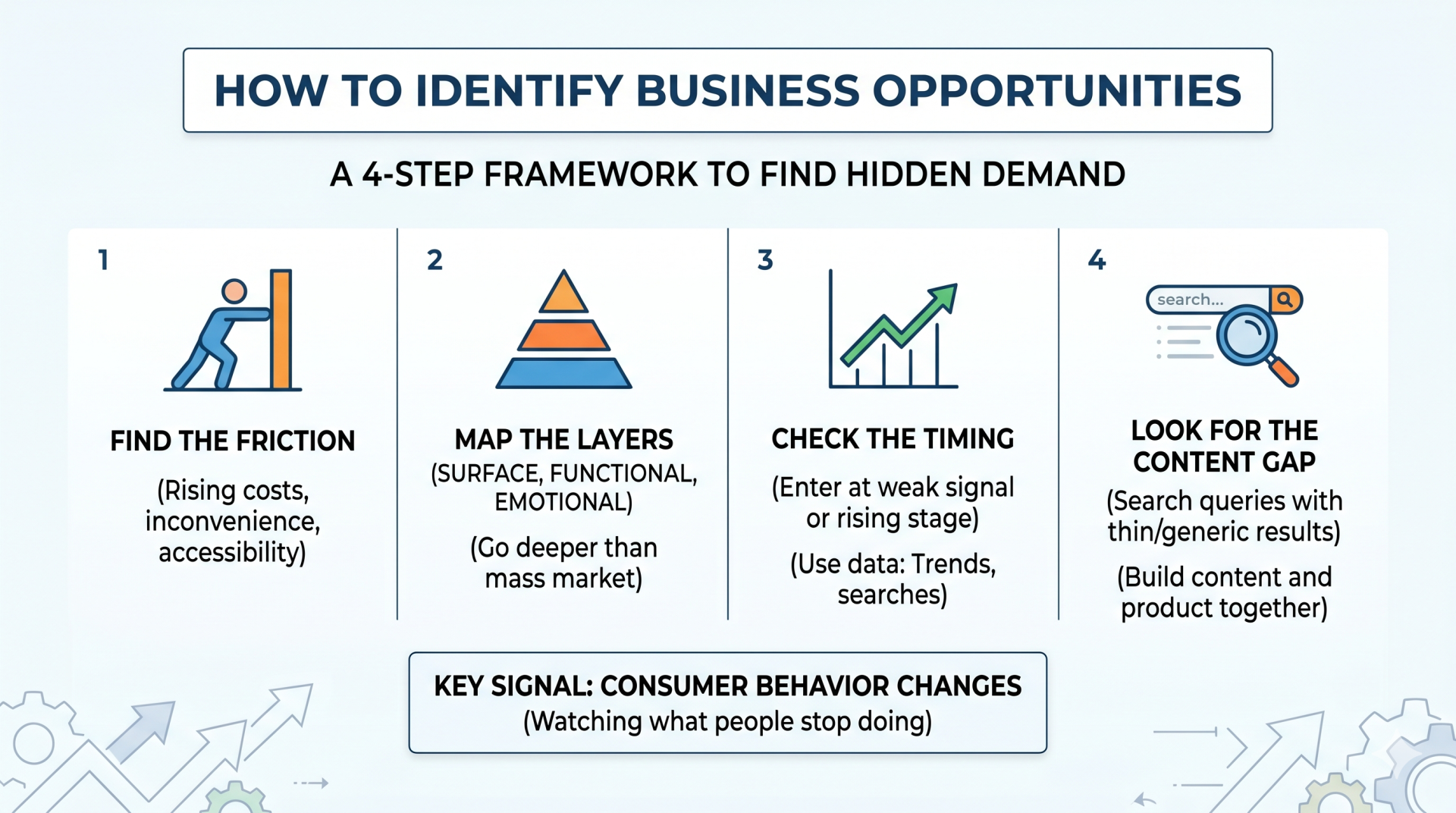
Here’s what I took from the press-on nail rabbit hole — a framework that applies to any industry — not limited to beauty. These four questions will help you identify business opportunities wherever consumer behavior is shifting.
Step 1: Find the friction. What outcome do consumers want that’s becoming more expensive, inconvenient, or inaccessible? Rising costs and time scarcity are the two biggest friction generators right now. The more universal the friction, the bigger the market.
Step 2: Map the layers. Apply the three-layer test. Is the surface need well-served? Good. Go deeper. Who is being ignored at the functional or emotional layer? That’s where the money is for a small entrepreneur who can’t outspend the big players.
Step 3: Check the timing. Is this at the weak signal or rising stage? Use Google Trends, TikTok Creative Center, and Etsy search data to gauge demand and competition. If you can’t find many listings or videos on a niche, that’s promising — not a red flag.
Step 4: Look for the content gap. Search the exact phrase your target customer would type. If search results come back thin or generic, you have an opening. Build the content and the product together. Own the SEO before anyone else thinks to show up.
⚠️ REALITY CHECK
The press-on nail market earned $738 million in 2024. Glamnetic went from $1 million to $100 million in revenue in roughly two years — largely by identifying an emotional-layer need that every mass brand had overlooked. But here’s the part that matters most for entrepreneurs like you: those multi-million dollar brands didn’t start with a better product. They started by paying closer attention to what their customer was feeling. The framework is the same whether you sell nails or coaching or plumbing services.
What This Means for Your Business
You don’t sell press-on nails. Probably. But the same framework applies to whatever industry you’re in.
Ask yourself: where is friction building in your customer’s life right now? What outcome do they want that’s getting harder or more expensive to achieve? Who in your market is being completely ignored by the current dominant players?
The businesses winning right now are not the ones who found a brand-new product category. They found an existing, proven desire and served it to the person the big players left behind — at a price point that made sense for 2025 and 2026.
That’s how to identify business opportunities. Not by reading trend reports. By watching what people choose to stop doing — and building the better alternative they’re already searching for.
The press-on nail rabbit hole taught me that. And now I have an order arriving Thursday.
Frequently Asked Questions About How to Identify Business Opportunities
How do I identify a business opportunity before it becomes too competitive?
The key is entering at the “weak signal” or “rising” stage of a trend — before mass-market brands and big-box retailers show up. Use Google Trends to check the trajectory of a niche search term over five years. Look for consistent upward growth with relatively low search volume. Then check Etsy and TikTok for supply gaps: when demand exists but few products or content pieces address it directly, you’ve found a timing window. The shorter your supply, the longer your runway to build brand and SEO authority before competition arrives.
What is a content gap and how does it signal a business opportunity?
A content gap is a search query that gets real traffic but produces few specific, useful results. It represents unmet demand. When someone searches “press-on nails for nurses” and finds generic content rather than products and guides tailored to healthcare workers, that’s a content gap — and simultaneously a product positioning gap. Entrepreneurs who build both the content (SEO-optimized articles, TikTok videos) and the product for those underserved search queries own both the attention and the sale. Search Reddit communities, Etsy autocomplete, and TikTok Creative Center to find these gaps in your own industry.
How does consumer trade-down behavior create business opportunities?
Trade-down behavior happens when consumers decide the premium option no longer justifies the price gap — and they seek equivalent outcomes at lower cost. McKinsey found that 63% of consumers don’t see premium salon services as inherently superior to alternatives. That shift opens markets for entrepreneurs who position their offer as the smart, informed choice — not the cheap substitute. In the nail space, press-on nail brands positioned as “salon-quality results on your schedule” captured this audience far more effectively than brands selling purely on price savings. The opportunity isn’t the low price. The opportunity is the empowered consumer who chooses you because you understand their decision.
How do I find underserved market segments for a new business?
Start with four questions about any potential customer group. Does the mass market ignore or poorly serve their specific needs? Is there a physical or practical requirement — sizing, durability, material — that current products don’t address? Is there a life moment or occasion where solutions don’t exist? Are they actively searching online for something tailored to them and finding nothing? Segments that answer “yes” to multiple questions are underserved. In the press-on nail market, this analysis points to athletes needing high-adhesion sets, men seeking minimalist nail options, and people recovering from gel or acrylic nail damage — all three searching for solutions that barely exist.
What free tools help with identifying business opportunities and market trends?
Several free tools work well together for this kind of research. Google Trends gives you baseline trajectory data — search a niche term and compare 5-year interest. The Glimpse Chrome extension layers absolute search volumes on top of Google Trends results, surfacing rising related queries. TikTok Creative Center shows trending hashtags and content gap data — high-demand searches with few competing videos. Etsy’s search autocomplete and listing counts reveal how much supply exists for a given niche. Reddit communities in your target category surface real complaints, unmet requests, and product gaps that no formal research tool will show you. Running all four together takes two to three hours and costs nothing.