
[ad_1]
Key takeaways:
- Azure UAE data residency compliance is not just about choosing UAE North or Central; logs, backups, APIs, identity flows, and monitoring paths also need control.
- DESC-aligned Azure architecture should be planned before deployment or migration to avoid audit issues, delayed approvals, and expensive rework.
- Enterprises must map the full data journey across storage, processing, integrations, telemetry, backup, and recovery before workloads go live.
- Private networking, controlled egress, identity governance, localized observability, and Azure Policy are key to building compliant cloud systems in the UAE.
- A compliance-first Azure setup helps UAE enterprises launch faster, reduce risk, scale confidently, and stay audit-ready as workloads grow.
Building on Azure in the UAE is no longer just a cloud deployment decision. For enterprises in Dubai and Abu Dhabi, it is an architecture, compliance, and business continuity decision that must be planned before workloads go live.
Many teams assume choosing UAE North or UAE Central is enough for Azure UAE data residency compliance. It is not. Data can still move through logs, backups, APIs, identity flows, monitoring tools, admin access paths, and third-party integrations. One missed route can delay approvals, increase rework, or expose the business to audit risks as real enterprise data starts to move.
The urgency is clear. The UAE cloud computing market is expected to reach approximately $30 billion by 2030, showing how quickly enterprises are moving critical workloads to the cloud. But faster adoption also brings stronger expectations around data localization, DESC compliance, UAE data protection, and secure cloud operations.
That is why enterprises need a DESC-aligned Azure architecture before deployment or migration.
In this blog, we’ll explain how to build a compliant, scalable, and audit-ready Azure setup in the UAE without hidden data residency risks.
Avoid Azure Compliance Penalties in the UAE
Find data residency gaps before they turn into audit issues, fines, or launch delays.

How to Build a DESC-Compliant Azure Enterprise Architecture in Dubai
Cloud teams in Dubai may choose the right Azure region, but compliance can still slip through logs, backups, APIs, admin routes, or vendor tools.
For enterprises, Azure UAE data residency compliance has to be built into the architecture, not added later during audit checks.
Here’s what needs to be done:
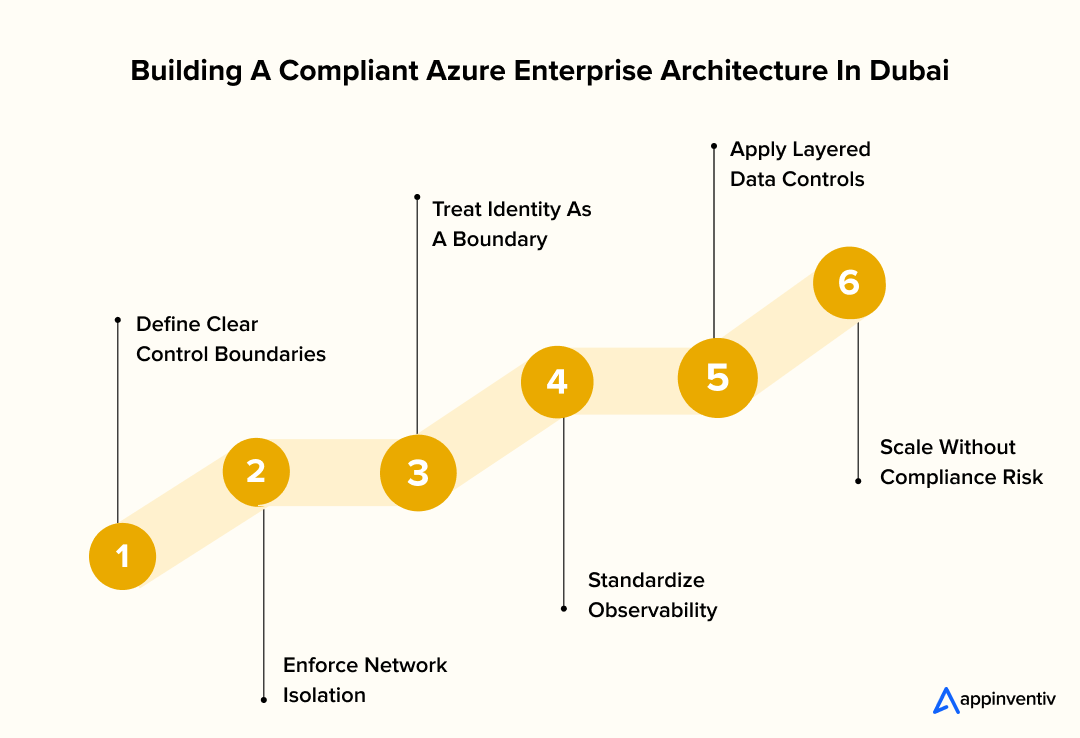
1. Define Clear Data Boundaries From Day One
Start by separating workloads based on data sensitivity, business function, and regulatory exposure. Customer records, payment data, employee files, logs, and cloud analytics should not move through loosely connected systems.
Each workload should have a clear data owner, an approved Azure region, a storage path, an access rule, a retention policy, and an integration boundary. This gives teams visibility into where sensitive data lives, which systems can process it, and which routes need stricter control before go-live.
2. Build Private Networking as the Default
Public endpoints add avoidable risk, especially for regulated workloads. A strong Azure enterprise architecture setup in Dubai should use VNets, subnet segmentation, Private Link, private endpoints, Azure Firewall, NSGs, and controlled outbound routing.
The goal is not only to block external threats. It is to control the daily movement of data across applications, APIs, monitoring systems, and vendor tools. Unrestricted outbound access should be reviewed early because it can quietly create cross-border data flow risks.
3. Treat Identity as a Compliance Boundary
Identity decides who can access data, from where, and for how long. Use managed identities instead of stored credentials, least-privilege RBAC, conditional access, just-in-time access, and privileged identity management for sensitive roles.
Admin activity should flow through controlled routes, such as Azure Bastion or approved jump hosts. This keeps privileged access traceable and reduces risks from shared credentials, excessive permissions, and unmanaged vendor access.
4. Keep Observability Inside UAE Boundaries
Logs are not harmless technical output. They can include user IDs, IP addresses, transaction details, request errors, service metadata, and operational patterns.
Azure Monitor, Application Insights, diagnostic settings, and Log Analytics workspaces should follow the approved UAE region strategy. Retention policies, exports, alerting tools, and third-party monitoring integrations should also be reviewed before deployment.
This is one of the most common areas where compliance gaps appear. The application may be hosted locally, but logs can still move through global workspaces or external tools if defaults are not checked.
5. Apply Layered Data Protection
One control is never enough for enterprise cloud compliance. Use encryption at rest and in transit, private access, RBAC, API-level authorization, and database-level restrictions such as row-level security when sensitive data is involved.
For critical workloads, encryption and key management in Azure UAE should include customer-managed keys, controlled key rotation, restricted access to Key Vault, and clear ownership of key management responsibilities. This reduces the impact of misconfiguration and strengthens audit readiness.
6. Design Backup and DR With Residency in Mind
Backups, snapshots, replicas, and failover plans must follow the same residency rules as production workloads. Many teams host the application locally but overlook where recovery data is copied, restored, retained, or tested.
If UAE Central is used for disaster recovery, backup vaults, replication policies, restore testing, and failover workflows, data movement should still remain within approved UAE boundaries. This helps enterprises maintain resilience without creating compliance exposure.
7. Scale Without Breaking Compliance Controls
Scaling should not weaken compliance. New app instances, autoscaling groups, staging environments, temporary workloads, and integrations must inherit the same network, identity, logging, backup, and residency rules.
Infrastructure-as-code and Azure Policy help enforce this consistently. When private endpoints, access roles, diagnostic settings, backup rules, and region restrictions are templated, teams can scale without manually rebuilding controls.
What Makes Enterprise Architecture in Dubai Different
- Cloud compliance is validated through system behavior, not just configuration
- Data, identity, and network controls are reviewed together as one system
- Hybrid and controlled architectures are more common than open cloud models
Building a compliant architecture in Dubai is about consistency across layers. When data flow, identity, and network boundaries are aligned from the start, the system remains predictable under audit, even as it scales.
Also Read: Redefining Mobile App Development Success in the Middle East
How to Design Azure Deployments for UAE Data Residency Compliancey
A strong Azure setup in the UAE is not just about creating resources in the right region. The real test begins when applications, logs, APIs, backups, identities, and third-party tools work together. That is where Azure deployment UAE data residency planning becomes important.
The goal is to build a secure Azure deployment that UAE enterprises can operate without hidden cross-border data movement or last-minute audit surprises. Here’s what needs to be handled before go-live:
- Map the full data path
Track how data moves across compute, storage, APIs, queues, Service Bus, Event Grid, background jobs, and third-party integrations. This helps detect routes that may conflict with Azure UAE data residency compliance before they become expensive fixes.
- Keep logs and telemetry in-region
Azure Monitor, Application Insights, diagnostic settings, and Log Analytics workspaces should follow the approved UAE region strategy. Logs may include user IDs, IP addresses, transaction details, errors, and service metadata, so they require the same level of compliance attention as application data.
- Control outbound access
Use private endpoints, Private Link, Azure Firewall, route tables, and NSGs to reduce unnecessary public exposure. Open outbound traffic can quietly move data through SaaS tools, APIs, analytics platforms, or vendor systems if it is not reviewed early.
- Plan backup and DR inside the UAE boundaries
Backup vaults, snapshots, replication, and failover policies should be checked before go-live. UAE North and UAE Central can support in-country resilience, but default backup and recovery settings still need validation.
- Validate before launch
Test API calls, logging, failover, scaling, admin access, and background processing before the system goes live. A deployment is ready only when the team can prove how data behaves under real operating conditions.
Getting this right early helps enterprises build a secure Azure deployment in the UAE that is easier to audit, operate, and scale. It also reduces rework later, especially when compliance teams start reviewing logs, integrations, backup paths, and access flows.
Don’t Let Hidden Data Flows Trigger Compliance Issues
Logs, APIs, backups, and vendor tools can move sensitive data outside approved UAE boundaries.

Choosing the Right Azure UAE Regions for Data Residency Compliance
Choosing an Azure region in the UAE is not just a technical decision. It affects where data sits, how backups work, how recovery is handled, and how easily the setup can pass compliance checks. That is why your Microsoft Azure UAE regions data residency strategy should be planned around control, resilience, and workload risk, not just speed or latency.
- Primary vs Secondary Region Strategy Within the UAE
For many Dubai-based enterprises, UAE North works well for primary workloads. UAE Central can support in-country backup, failover, and disaster recovery where needed. The point is simple: build resilience without pushing recovery data outside approved UAE boundaries.
- In-Country High Availability Using Availability Zones
For critical systems, Azure availability zones in the UAE can help improve uptime without depending on global failover. This gives enterprises better continuity while keeping data movement easier to manage.
- Workload Placement Based on Data Sensitivity
Not every workload needs the same level of control. Customer records, financial data, employee information, regulated transactions, and logs need stricter region, access, backup, and monitoring rules. Lower-risk services can be placed based on performance needs, but they should still follow the approved governance model.
- Managing Hidden Cross-Region Dependencies
This is where teams often get caught. The main workload may run in a UAE region, but logs, backup settings, monitoring tools, APIs, SaaS platforms, or support workflows may still move data through uncontrolled paths. These dependencies should be checked before deployment or migration.
- Aligning Region Strategy With Architecture Decisions
A strong UAE region strategy should answer a few practical questions: where will workloads run, where will backups and telemetry sit, how will failover work, and which services can connect outside approved boundaries?
Choosing the right Azure region in the UAE is not just about picking a location. It is about building an architecture that stays compliant, resilient, and predictable once real enterprise workloads start running.
Also Read: Shariah Compliant Platform Development
Azure Migration UAE Compliance: Moving Workloads Without Risk
Azure migration projects in the UAE rarely fail because resources are difficult to move. They run into trouble when hidden dependencies are missed before cutover, such as external APIs, logging endpoints, SaaS tools, or background jobs that still move data outside approved UAE boundaries.
That is why Azure migration UAE compliance needs to be planned before workloads are moved. Enterprises are not just relocating applications to Azure; they are redesigning data flows, integrations, access paths, logs, backups, and processing routes to stay within approved UAE boundaries.
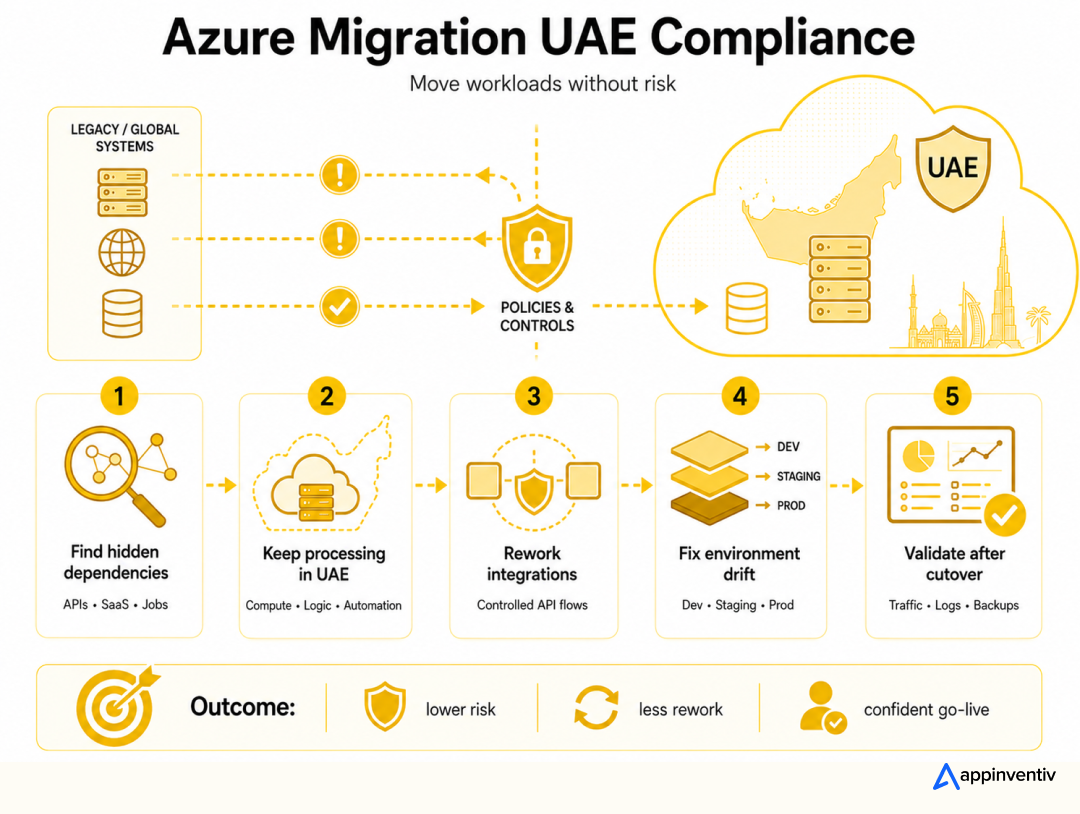
1. Identify Hidden Dependencies Before You Move
Most legacy or global deployments carry unseen links to external systems.
- External APIs, SaaS tools, or cloud analytics platforms processing data outside the UAE
- Background jobs or schedulers pushing data to global endpoints
- Hardcoded service URLs or legacy integrations
Catching these early helps avoid migration delays, compliance rework, rollback risks, and post-cutover surprises.
2. Localize Processing, Not Just Storage
A common assumption is that moving databases to the UAE regions is enough. In reality, processing paths matter just as much.
- Ensure compute workloads, automation flows, background jobs, and application logic do not depend on external processing layers
- Replace or reconfigure services that process sensitive data outside the UAE
- Validate that scheduled tasks, integrations, and event-driven workflows do not trigger cross-region execution
This is where many migrations fall short during compliance validation.
3. Rework Integration Architecture for UAE Constraints
Integrations often need redesign, not just relocation.
- Route sensitive data exchange through controlled API layers
- Replace direct external calls with region-bound services where possible
- Review SaaS tools, analytics platforms, vendor systems, and third-party APIs before cutover
- Introduce stricter validation and monitoring for every data exchange
In UAE environments, integrations are one of the first areas auditors examine closely.
4. Stabilize Environment Differences Before Cutover
Moving from global or on-prem environments introduces configuration drift.
- Align environment configurations across dev, staging, and production
- Ensure consistent region-specific settings for services and dependencies
- Remove fallback configurations, hardcoded URLs, and legacy endpoints that may route data outside approved UAE boundaries.
This helps prevent unexpected behavior after go-live.
5. Run Controlled Cutover and Post-Migration Validation
The final stage is not just switching traffic. It’s validating behavior under real conditions.
- Monitor live traffic, API calls, service interactions, admin access, logs, backup activity, and background jobs
- Track how data flows between components during actual usage
- Watch for unexpected external calls, routing changes, or fallback behavior
In UAE projects, this step is where compliance is truly confirmed.
A smooth Azure migration in the UAE is not about moving fast alone. It is about moving with control. When dependencies are cleaned up, processing stays local, and post-migration behavior is validated, enterprises can reduce compliance risk, avoid expensive rework, and go live with stronger confidence.
Also Read: Legacy System Modernization in Dubai: Costs, ROI, Use …
How DESC Compliance and Data Residency Redefine Azure Enterprise Architecture in the UAE
Azure architecture in the UAE cannot be planned solely around region selection. A setup may run in UAE North or UAE Central and still create risks through logs, backups, APIs, identity flows, admin access, or external monitoring tools.
For Dubai enterprises, Azure UAE data residency compliance has to be built into the architecture before deployment or migration. DESC expectations push teams to look beyond hosting and ask a sharper question: can we prove where data moves, who can access it, and how it is protected once the system is live?
Here’s where the architecture needs tighter control:
- Data flow visibility: Map how data moves across services, APIs, queues, background jobs, logs, and third-party tools. This helps catch compliance gaps before go-live.
- Identity and access control: RBAC, admin access, privileged roles, token flows, and vendor access need clear governance. Identity is part of the compliance boundary.
- Network isolation: Use VNets, private endpoints, controlled egress, and limited public access. Internal traffic should also be monitored rather than assumed safe.
- Logs and backups: Telemetry, diagnostics, monitoring data, snapshots, and backup copies should follow the approved UAE region strategy.
- Region and recovery planning: UAE North and UAE Central can support primary and recovery workloads, but failover, restore testing, and backup policies still need validation.
For regulated workloads, hybrid or sovereign cloud patterns may also be needed. In simple terms, DESC-aligned Azure architecture is not just about where the system is hosted. It is about building a controlled operating model where data, identity, network, logging, backup, and governance work together from day one.
Also Read: Everything you need to know about cloud application security
Business Impact of Building Azure in the UAE with Compliance First
In most UAE projects, the real delay doesn’t come from building the system. It comes later, when compliance reviews start asking questions that the architecture can’t answer quickly. Teams that factor compliance in early tend to avoid that phase altogether.
- Faster Approvals When It Matters: When your setup already aligns with Azure UAE data residency compliance, internal reviews and regulatory checks move more quickly. This is especially noticeable in Dubai-based enterprises where approval cycles can slow things down if gaps appear late.
- Less Rework, Fewer Surprises: Fixing data flow or logging issues after deployment is rarely simple. Designing around cloud compliance, UAE data protection early avoids reconfiguring services, retesting integrations, or delaying go-live timelines.
- Stronger Confidence With Local Stakeholders: Whether it’s regulators, partners, or clients, there’s an expectation that systems respect data localization UAE regulations. When that’s built into the architecture, conversations shift from justification to execution.
- Scaling Without Breaking Compliance: As workloads grow, the architecture doesn’t need to be rechecked every time. If boundaries are defined early, scaling across UAE regions stays predictable and controlled.
- Lower Risk During Audits and Operations: Clear visibility into data movement, access, and logs reduces the chances of audit issues. It also helps teams respond faster when something goes wrong in production.
- Flexibility for Hybrid and Sovereign Setups: Many UAE enterprises eventually adopt hybrid or sovereign cloud models. A compliance-first foundation makes that transition much easier without reworking the core system.
In the UAE, compliance isn’t something you “add later.” It directly affects how fast you can launch, scale, and operate. Teams that account for it early usually spend less time fixing things and more time moving forward.
Avoid Costly Azure Compliance Rework and Penalties
Fixing data residency gaps after deployment can delay launches, increase costs, and expose your business to regulatory risk.
Azure Data Residency Risks UAE Enterprises Often Miss and How to Avoid Them
Even when workloads run in UAE North or Central, data residency risks can still slip in through the systems around the main application. Logs, backups, APIs, admin access, SaaS tools, and migration leftovers often create the real gaps.
Here are the risks enterprises should catch early:
1. Assuming the UAE Region Selection is Enough
Choosing a UAE Azure region is only the starting point. It does not automatically guarantee compliance with Azure UAE data residency requirements.
How to avoid it: Map where data is stored, processed, logged, backed up, restored, and accessed before deployment.
2. Ignoring Logs and Telemetry
Logs can carry user IDs, IP addresses, transaction details, errors, and service metadata. If they move to global workspaces or third-party tools, compliance risks can appear quietly.
How to avoid it: Review Azure Monitor, Application Insights, diagnostic settings, Log Analytics, exports, retention rules, and external monitoring tools before go-live.
3. Overlooking Backup and DR Paths
Backups, snapshots, replicas, and restore workflows can contain the same sensitive data as production systems.
How to avoid it: Check backup vaults, replication settings, restore testing, and failover workflows early. If UAE Central is used for DR, ensure the recovery data remains within the approved UAE boundaries.
4. Leaving Outbound Access to Open
Open outbound access can send data through SaaS tools, APIs, analytics platforms, or vendor systems without teams noticing.
How to avoid it: Use private endpoints, Private Link, Azure Firewall, NSGs, route tables, and controlled egress policies.
5. Missing Migration Dependencies
Old systems often carry hardcoded URLs, global endpoints, external schedulers, or background jobs that still push data outside the UAE.
How to avoid it: Run dependency checks before cutover. Review APIs, SaaS tools, analytics platforms, background jobs, and legacy integrations as part of Azure migration UAE compliance planning.
6. Giving Too Much Admin or Vendor Access
Even if data is hosted locally, weak access control can still create audit and security issues.
How to avoid it: Use managed identities, least-privilege RBAC, conditional access, PIM, Azure Bastion, and approved jump hosts. Access should be limited, traceable, and regularly reviewed.
7. Scaling Without Governance
New staging environments, temporary workloads, or integrations can break compliance if they are built manually without the same controls.
How to avoid it: Use Infrastructure-as-Code, Azure Policy, tagging, region restrictions, diagnostic templates, and backup rules so every new workload follows the same compliance model.
A compliant Azure setup in the UAE is not built solely by choosing the right region. It comes from knowing how data moves across every layer and from fixing weak spots before they become audit issues or costly rework.
Also Read: Top 15 Cloud Security Risks in 2026 & How to Tackle Them
How Appinventiv Supports Azure Builds in the UAE
Most teams don’t struggle with spinning up Azure. The slowdown usually comes later, when compliance questions surface or systems start interacting at scale. That’s where Appinventiv’s cloud computing services make a difference, by helping you set up Azure in a way that already accounts for data residency and DESC expectations, not as an afterthought.
For UAE enterprises, this means we help design Azure systems where data movement, access, logs, backups, integrations, and disaster recovery paths are planned before go-live.
What we support:
- Azure architecture planning: Region strategy, workload placement, network design, and governance setup
- Data residency controls: Storage, processing, logging, backup, and recovery path validation
- DESC-aligned cloud setup: Identity, access, monitoring, audit visibility, and security controls
- Azure migration compliance: Dependency checks, integration cleanup, cutover planning, and post-migration validation
- Scalable cloud operations: Policy-based controls, Infrastructure-as-Code, and compliance-ready expansion
A strong example here is:
Y.K. Almoayyed Retail & Distribution Platform
Challenge: Rising data volumes, manual archival, weak retrieval visibility, and audit risks were slowing YKA’s automotive operations.
Appinventiv’s role: Built a secure AWS-based archival and retrieval system using Amazon S3, Glacier tiers, Commvault, AWS KMS, Lambda, EventBridge, CloudTrail, and AWS Config.
Impact
- 32% reduction in storage costs
- 40 GB+ media archived securely
- 40% less IT intervention through self-service retrieval
Across projects, we’ve delivered 500+ cloud migrations, 20+ hybrid-cloud setups, and 2000+ deployments. If you’re planning your Azure setup in the UAE, it helps to get the architecture right early.
Connect with our team to build a cloud setup that stays compliant as you scale.
FAQs
Q. How does DESC compliance impact Azure architecture in Dubai?
A. In Dubai, DESC compliance Azure UAE changes how you design the system, not just where you host it. During reviews, teams are asked to show how data moves, who can access it, and how that access is controlled.
In practical terms, this means tighter network boundaries, stricter identity control, and clear visibility into logs and activity. If any part of the system behaves outside those controls, it gets flagged quickly.
Q. What are Azure data residency requirements in the UAE?
A. Under UAE data residency laws, cloud and PDPL UAE cloud compliance, the expectation is simple on paper but detailed in execution: data should stay within UAE boundaries.
What catches teams off guard is that this includes more than databases. Logs, backups, and even background processing need to be reviewed, because that’s where data often moves without being noticed.
Q. Which Azure regions support UAE data residency?
A. Azure currently offers UAE North (Dubai) and UAE Central (Abu Dhabi) for Microsoft Azure UAE regions data residency.
Most teams use Dubai for primary workloads and Abu Dhabi for backup or failover. With Azure availability zones in the UAE, you can also handle availability within a region without moving data across regions unnecessarily.
Q. How can enterprises ensure compliance when migrating to Azure in the UAE?
A. Getting Azure migration UAE compliance right usually starts before anything is moved. Teams need to look at existing systems and identify what might not fit, things like external APIs or logging setups.
During migration, it’s often necessary to adjust how services interact, not just relocate them. Aligning these changes with cloud compliance and UAE data protection helps avoid issues once the system is live.
Q. Why is data residency important for UAE enterprises using Azure?
Data residency plays a bigger role in the UAE than many teams expect. It affects approvals, partnerships, and how systems are evaluated once they go live.
With data localization, UAE regulations and the push toward sovereign cloud in the UAE, enterprises are expected to keep tighter control over data. When that’s built in early, everything from audits to scaling becomes easier to manage.
Q. What are the key elements of a compliance framework for cloud deployments in the UAE?
A. In UAE cloud projects, a compliance framework is less about documents and more about how your system actually runs. You need clear ownership, strong data governance, and security controls that are applied consistently.
Alongside that, teams should maintain audit logs, run regular checks, and have a clear incident response plan. Ongoing training and transparent data handling practices help ensure compliance is not just set once, but maintained over time.
[ad_2]
Source_link