
[ad_1]

Regardless of the industry you are in, customers are the most important part of your business. Consequently, knowing what they think of your services or products is essential. To find out how they see your business, you must consistently ask customers for feedback.
This guide covers ten proven ways to ask, the right questions to use, and the timing and mistakes that decide whether anyone actually replies.
TL;DR: 10 ways to ask customers for feedback:
What is the purpose of customer feedback?
Customer feedback tells you how people actually experience your product, in their words, not your assumptions. Used well, it shows you what to fix, what to double down on, and what to build next.
Often, companies request customer feedback but don’t use it. The reason is that they haven’t defined the purpose of the feedback before asking for it.
🔄 One trap to avoid: asking without a plan. If you don’t decide what you’ll do with the answers before you collect them, you’ll gather data and act on none of it. Set the goal first, cut churn, fix a feature, win more reviews, then ask the questions that serve it.
Why do customers avoid leaving feedback?
Most people are happy to help. Around 95% of consumers will leave a review when asked. When they don’t, it’s friction, not unwillingness:
- A pop-up that interrupts them
- Feedback emails that are too formal
- Requesting feedback at the wrong time
- Complicated submission process
- Weak social link between them and your business
- Surveys that are too long or ask the wrong questions
Any feedback, even negative, is better than no feedback at all. Naturally, customers often leave feedback when unsatisfied with a business or service.
Negative reviews should be viewed as an opportunity to improve. When addressed correctly, they might also encourage unhappy customers to give your business another chance.
The importance of asking for feedback
Asking pays off in four concrete ways:
- Direction (you learn what to fix instead of guessing),
- Retention (acting on feedback is one of the clearest signals that you’re listening),
- A better product (customers surface the gaps your roadmap misses),
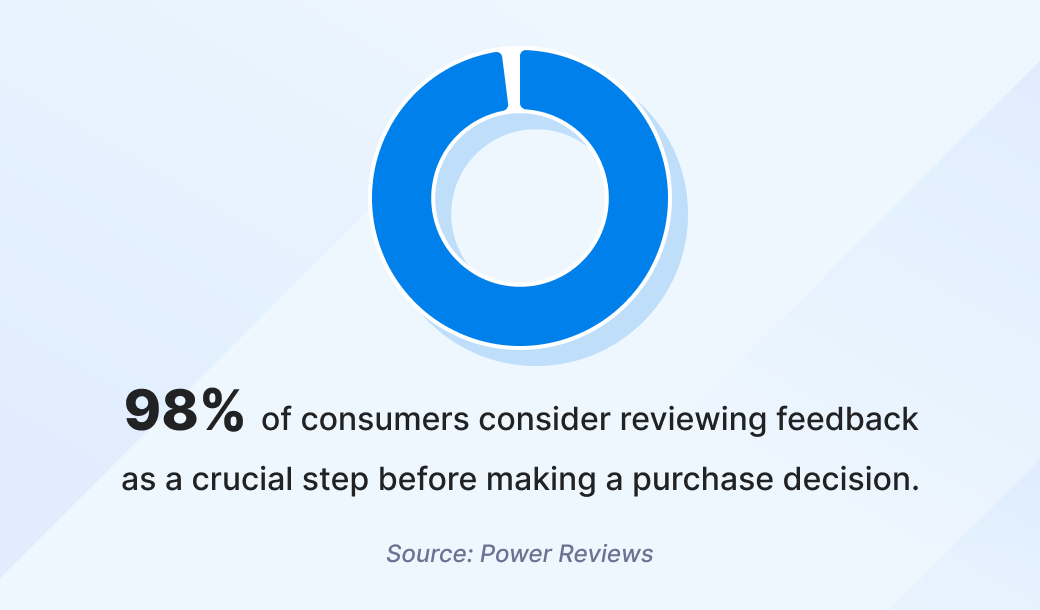
- Trust (around 98% of consumers check reviews before buying, so the feedback you collect publicly becomes proof for the next customer).
How to ask customers for feedback
There’s no single best channel. Match the method to the moment.
1. Create feedback opportunities through conversations
The easiest feedback to get is what you ask for in the moment, right after a support chat, a sale, or a delivered project.
Skip “How was everything?” and ask one specific question: “Was there anything about setup that slowed you down?” Specific questions get specific answers. Reach out by email, live chat, SMS, or a quick call while the experience is fresh.
2. Serve relevant feedback forms at critical points
Inserting feedback requests at critical points of the customer journey is an excellent way to discover why they decided to do what they are doing.
Trigger a short form at the moments that carry an important decision.
If someone abandons a cart or cancels a trial, ask why right then. Tie the question to the action: a cancelled trial gets “What was missing?”, not a generic satisfaction survey. Tools like Hotjar help you spot the behavioral patterns behind the answers.
3. Request customer feedback via SMS
Despite the rise of newer communication methods, SMS marketing is still at its peak. In our 2025 survey of 1,800 US consumers, we found out that 9 in 10 still read texts from businesses and only 8% ignore them.
This widespread use makes SMS an excellent method for requesting customer feedback.

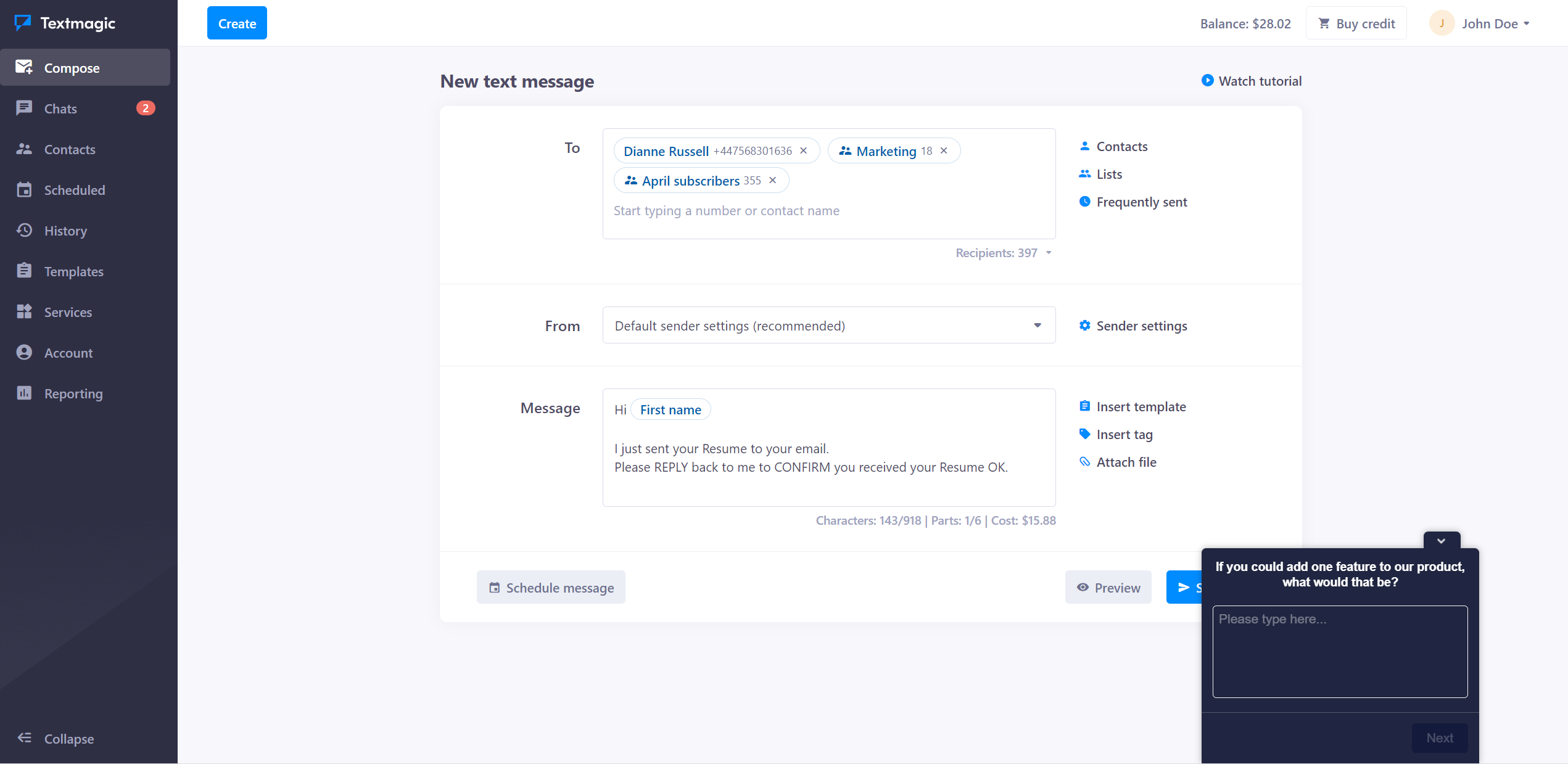
Set up an automated flow to text a request a few hours after a service or a day after delivery, and keep it to one question with a single link.
You can also send regular messages to inquire about the customer’s experience over a particular period. SMS for customer support is great because it allows for two-way communication with customers and more organic feedback requests.
Here is a short and effective template to help you get started:
Hi [Customer name]! We hope you enjoyed your experience with [Your company name]. We are always trying to improve our services and would love to hear your thoughts about your experience. Please use this link to leave your feedback: [survey link]
Need the exact wording for every situation? We have 30+ ready-to-use feedback request text templates, grouped by moment (post-purchase, post-appointment, follow-ups, and more), each one compliance-checked and under 160 characters.
Collect customer feedback with SMS surveys
Automate survey collection with intuitive SMS surveys
4. Make feedback easy to leave on your website
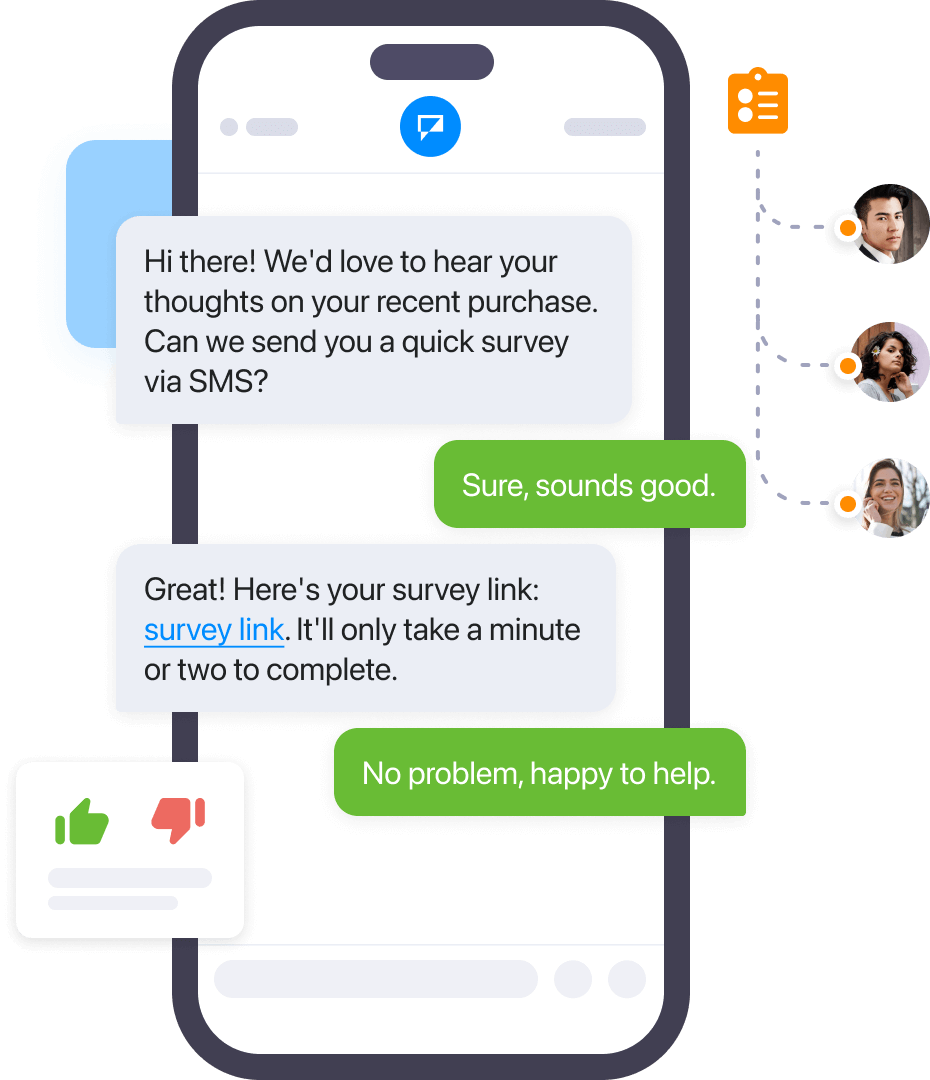
Every extra click costs you responses. Here are a few ideas to help you simplify the feedback submission process on your website:
- Create an easily accessible “Leave us your feedback” page so customers can quickly type their feedback. To encourage more feedback, it is also a good idea to include other customer reviews.
- Feature reviews and feedback prominently on your pages for social proof, and add call to action buttons to encourage others to leave their review.
- Add a quick line requesting feedback to all relevant email communications you send to customers.
- Reward customers who share their feedback with you. Follow up after every review request to show them you are taking action based on their feedback.
5. Ask for feedback on social media
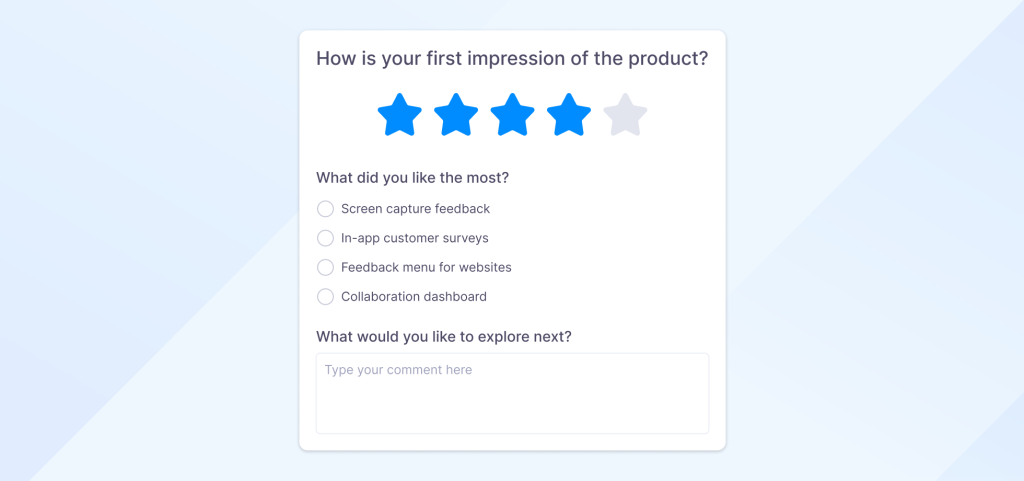
Social is where your happiest customers already are. Run polls, ask open questions, and link your review page in captions.
We started featuring reviews from Textmagic users in our social posts. Other customers jumped in, commenting, sharing their own experience, and reinforcing our value prop better than we could ourselves.
📲 We started featuring reviews from Textmagic users in our social posts. The feedback from other customers was very positive. They started commenting on the posts, sharing their own experience, and reinforcing our value proposition.
Example of customer comments:
- “It works great! I had other providers saying they couldn’t do email to SMS the way I wanted it, but I worked it out in minutes with Textmagic!”
- “Highly recommend and super easy to use. Don’t be afraid of ‘scaring off’ customers, they will only love you more.”
- “Congrats on creating such an amazing platform! 🎉🥂”
6. Request feedback through third-party websites
Asking for a review is really asking for feedback in public. Send customers a direct link to your Google, G2, or Trustpilot page at the moment they’re happiest, and see our full guide on how to increase Google reviews for the review-specific playbook.
Third-party review websites are more than just an effective way of getting customer input; they also help boost your market reach. Sites like Trustpilot and G2 have specific review pages that customers can fill out. Once published, these pages can be used to capture demand.
Here are a few ways that you can benefit from feedback on third-party websites:
- Become a top performer or market leader in your niche.
- Receive awards and badges that you can display on your website or banners to boost credibility.
- See how you are performing against competitors and identify your unique competitive advantage.
- Evaluate specific aspects of your product or service. Third-party surveys request feedback on various business areas, such as functionalities, quality of support, price, etc.

7. Use longer questionnaires for engaged customers
Product and service experience questionnaires are surveys in which customers describe their experience using your products or services. After creating such a questionnaire, you can publish it on your website so that long-term customers can fill it in. Please note that these types of surveys are different from quick one-question surveys.
Typically, these surveys are longer and much more detailed. Our recommendation is to request this type of feedback from customers who have already responded positively to shorter feedback requests or who use your products often.
8. Thank customers for their feedback and act on it
Collecting feedback is half the job; responding is the other half. In our survey, 53% of consumers said they’d texted a business and gotten no reply, and silence reads as neglect.
Thank everyone who responds, then close the loop: tell them what changed because of what they said. A customer who watches their feedback turn into a fix keeps giving it.
9. Build feedback into your loyalty program
Loyalty programs are a great source of customer feedback. Customers who are already engaged with your brand know it best. They offer honest, constructive feedback even without being asked. If you combine their loyalty with the occasional reward, like points or exclusive offers, you get continuous feedback with little to no effort on your part.
Here’s how to make the most of your company’s loyalty program.
- Create tiered rewards that encourage customers to provide feedback regularly.
- Keep surveys short and to the point. This shows respect for your customers’ time and keeps their enthusiasm going long-term.
- Set up a system where members earn extra points for completing a feedback survey after making a purchase or using a service.
10. Host feedback sessions or focus groups
When you need the “why” behind the numbers, run a small focus group.
This is how you can leverage feedback collection groups.
- Invite a diverse group of customers to ensure a wide range of perspectives.
- Consider offering a small incentive for their time, such as a gift card or a discount on future purchases.
- Show active listening through nodding, summarizing whatever is said, and asking clarifying questions.
- Create a comfortable, open environment where participants feel free to share both positive and negative feedback.
Examples of customer feedback questions
Customer feedback questions have various purposes. Some will help you to improve your products and services, while others will help you to understand the customer’s general experience.
Here are a few typical examples of customer feedback questions to get you started, but we encourage you to check out our full list of survey questions organized by user journey:
- Where did you hear about us?
- What almost stopped you from buying?
- What is the one thing we could do better?
- Which feature do you use most, and why?
- How likely are you to recommend us, and what would make that a 10?
- Were our staff courteous while taking care of the issue?
- Has any of our services exceeded your expectations?
- What would have made our services exceed your expectations?
- Would you recommend us to others or use our services again?
How NOT to ask customers for feedback
We asked Aleksandra Lemzyakova, our head of customer support, to share a few words on the mistakes to avoid when requesting customer feedback after a support interaction. This is what she said:
“When requesting feedback following a support interaction, it’s crucial to avoid making the process feel like a transaction or an obligation for the customer. We never pressure our customers into giving feedback or make them feel that their support experience is contingent on their participation in a survey. Instead, we invite feedback in a way that communicates genuine interest in their thoughts and experiences. Bombarding customers with multiple reminders or using overly aggressive language can detract from the positive experience we strive to provide.”
Here are some things to avoid when requesting customer feedback:
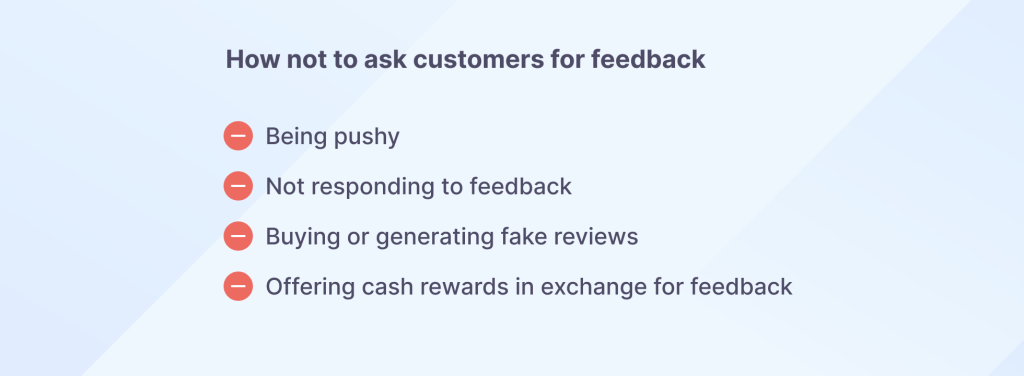
- Being pushy: Nobody wants to be bombarded by pop-ups or emails when they’re trying to do something. Be mindful of the frequency at which you are requesting feedback.
- Not responding to feedback: Not replying to customers’ complaints on time is bad for business. Responding to customer feedback shows how much you value your customers and, ultimately, will boost your company’s image.
- Conditioning a reward on a positive review: Offering an incentive in exchange for a good rating, rather than for honest feedback of any kind, is now a federal violation under the FTC’s Consumer Review Rule, with penalties per review. You can thank customers for leaving feedback; just never tie the reward to the sentiment.
- Offering cash rewards in exchange for feedback: While this might be tempting, offering rewards to customers for their feedback is never a good idea. Rewards in the form of gifts, discounts, or monetary incentives can be seen as a bribe to the customer and thus may damage your image.
- Gating your reviews: Screening customers first and sending the public review link only to the happy ones violates Google’s policies and counts as review suppression under the same FTC rule. Ask everyone the same way.
Client feedback determines how fast you grow
Feedback only matters if you act on it. Collect it, close the loop, and let it steer what you fix and build next.
Pick the two or three methods above that fit how your customers already reach you, and make asking a habit, not a one-off.
[ad_2]
Source_link