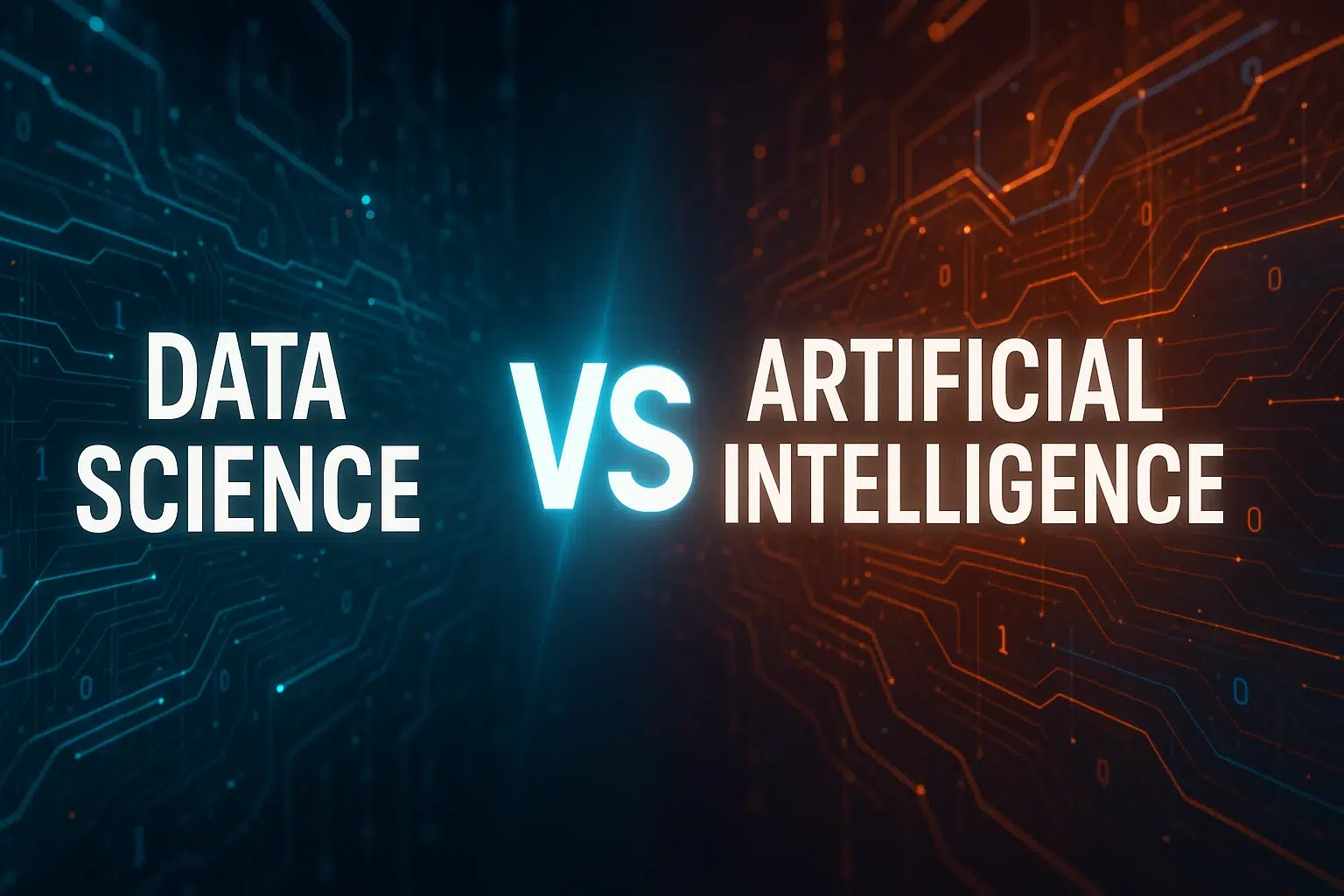
The rise of Data Science and Artificial Intelligence has changed industries worldwide. Both terms contribute to digital innovation, but they are commonly misinterpreted. Data science and AI differ in scope, purpose, and application, regardless of some overlap. Understanding the distinctions requires more than just technical knowledge.
This blog explores Data Science vs Artificial Intelligence, highlighting their scope, applications, business impact, and future trends.
What is Data Science?
Data Science is about finding useful information from raw data. It looks for patterns and connections in the data so that businesses can make better choices.
Data scientists often use technologies such as Python, R, SQL, Tableau, and Spark to work. Such as data cleaning, engineering, feature modeling, and visualization. In the context of data science vs Artificial Intelligence, the latter is aimed at copying human intelligence, while data science focuses on scientific analysis of data. It involves understanding what happened, why this happened, and what is likely to happen next.
Real-World Applications of Data Science
-
Business Analytics – Analyze customer behavior, sales trends, and market forecasts to make smart decisions.
-
Healthcare – Predict diseases, support diagnosis, and provide personalized treatment plans.
-
Finance – Detect fraud, manage risks, and improve algorithmic trading strategies.
-
Marketing – Support customer segmentation, targeted advertising, and performance analysis.
-
Manufacturing – Enable predictive maintenance, quality control, and supply chain optimization.
-
Energy – Forecast energy demand, optimize grid performance, and improve efficiency.
-
Transport – Enhance traffic management, route planning, and vehicle maintenance.
What is Artificial Intelligence?
Artificial Intelligence (AI) is a part of computer science that deals with creating machines and software that can do tasks which require human intelligence. These tasks include things like learning, thinking, solving problems, and making decisions.
Such systems are built to understand what’s happening around them, adjust when things change, and get better over time through practice. It uses machine learning (ML) algorithms that learn from data without clear programming. According to Grand View Research, AI industry is projected to increase in value by around 5x over the next 5 years.
Real-world Applications of Artificial Intelligence
-
Healthcare: AI is focused on medical imaging, predictive analytics, and hospital operations.
-
Finance: Algorithm trading, fraud detection, and risk management.
-
Customer Service: Chatbots and virtual assistants provide 24-hour service.
-
Marketing: This includes recommendation algorithms, predictive analysis, and targeted advertisements.
-
Autonomous Vehicles: Self-driving cars are powered by computer vision and machine learning.
-
Manufacturing: Predictive maintenance and AI-managed quality control.
-
Cybersecurity: This includes threat detection, identification of discrepancies, and automated reactions.
Data Science vs. Artificial Intelligence: Key Differences
| Aspect | Data Science | Artificial Intelligence (AI) |
| Purpose | Finds trends, insights, decisions | Automates actions, simulates intelligence |
| Value | Past + future insights | Efficiency, personalization |
| Data Need | Relies on large, clean data | Needs structured, pre-processed data |
| Operations | Reporting, forecasting, strategy | Automation, process optimization |
| Cost & ROI | Lower cost, higher planning ROI | Higher investment, automation ROI |
Here is the detailed comparison between the two smart technologies.
Business Purpose
Data Science: This enables businesses to better analyze their data, identify hidden trends, and make informed decisions.
Artificial Intelligence: This enables businesses to automatically make decisions, imitate human intelligence, and create autonomous systems.
A bank can use data science to evaluate the expense behavior for predicting risk. While AI powers Chatbots to automatically respond to client concerns. Many organizations also partner with an AI agent development company to create customized virtual agents that enhance customer interaction.
Value Delivered
Data Science: It provides insight into previous events and predictions for future results. This provides the facility of a strategic plan.
Artificial Intelligence: It aims to increase efficiency, personalization, and real-time customer participation.
In Data Science vs. Artificial Intelligence, the retail vendors use data science to discover seasonal sales trends, but AI enables personalized recommendations.
Data Dependency
Data Science: It depends on both historical and real-time data. Without clean and large amounts of data, the results go wrong.
Artificial Intelligence: This requires well-structured and pre-developed data, which is often supplied by data science. AI is only as intelligent as it learns from data.
Businesses should understand that AI success is associated with the foundation set by data science. This shows the importance of AI integration with existing data strategies to maximize outcomes.
Business Operations
Data Science: It improves reporting, forecasting, and strategic decision-making for officials.
Artificial Intelligence: It optimizes processes, automates activities, and reduces manual labor on a large scale.
A logistics company uses data science to estimate regional demand and optimize distribution routes.
ROI Considerations
Data Science: It is more economical, especially for small-to-medium organizations. Also, it seeks insights without heavy infrastructure. Better planning leads to increased ROI.
Artificial Intelligence: It requires initial investment in infrastructure, algorithms, and training data. But it provides ROI through automation, efficiency, and customer delight.
Businesses should begin with Data Science to create a solid basis before expanding into AI.
Why Should Businesses Care About Differences?
 The differences between Data Science and Artificial Intelligence have direct financial and operational impacts. Choosing an incorrect approach can lead to meaningless resources, poor insight, or ineffective automation.
Data science is important for businesses that use insight to make decisions. Financial institutions use it to detect the trend of fraud. While healthcare organizations use it to improve the results for the patient
AI enables firms to operate, automate, tailor experiences, and maximize productivity. Ecommerce companies use AI-powered chatbots for client service. Even logistics companies use AI to predict and accelerate delivery routes. According to Hostinger Tutorials, 35% of companies have turned to AI services to address labor shortages.
The Future of Data Science and AI
Real-time data science is becoming increasingly important in analytics and automatic data pipelines. With the rise of IOT and Edge Computing, Organizations will move beyond analyzing only past data and gain insights that allow rapid responses to market changes.
In contrast, AI is becoming more autonomous and clear.
Advanced generic AI models, natural language processing, and computer vision are already bringing revolution in various areas. The future AI will not only automate work but will also provide a transparent reason for its findings. Since it is essential in highly regulated industries such as finance and healthcare.
One key trend is AI-managed data science, where repetitive tasks are automated. This data allows scientists to focus on high-level strategies. Businesses using this hybrid approach will receive rapid insight and low operational expenses.
Conclusion
Artificial Intelligence and Data Science are complementary forces. Data science collects insight from data, but AI enforces those insights to make wise decisions. They are changing industries, enabling sensible decisions and developing creative solutions. For professionals, both provide possible job opportunities. For businesses, the key is to connect investment with data science for analytics and predictions. Working with a reliable AI development company or using data analytics services can help businesses adopt new technology faster and stay ahead of competitors.
FAQs
How to affect data science and AI business decisions differently?
Data science gives insight to guide strategy from data, while AI automatically makes actions and decisions. Together, they turn business intelligence into execution.
Which technology, data science or AI, provides rapid ROI for businesses?
Data provides a quick win through science reporting and analytics, while AI requires high investment but provides long-term automation and competitive benefits.
Can small businesses benefit from AI, or is data science a better starting point?
Small businesses often begin with data science for strength and insight, then grow on the scale of AI as the customers’ demand and automation needs grow.
How do data science and AI vary in handling customer privacy?
Data science identifies customer behavior trends, while AI uses those insights in real time to create hyper-personalized shopping, marketing, or service experiences.
What will be the future business trends in AI over data science?
Future trends such as autonomous systems, future healthcare, fraud detection, and AI-powered supply chains will be overwhelmed by AI, which is powered by data science insights.