Reading Time: 11 minutes
If you’re running a Shopify store and looking for a customer engagement or marketing automation platform, MoEngage vs. Klaviyo will almost certainly show up in your shortlist. At first glance, they seem similar. Both integrate with Shopify, segment your audiences, send personalized campaigns, and use AI to improve performance.
But the way they’re built, and who they’re built for, is very different.
Klaviyo has its roots in helping SMB Shopify brands send email and SMS campaigns quickly, using Ecommerce triggers like purchases, abandoned carts, and product views. It’s strong at campaign automation, but was designed email-and-SMS-first, and its profile-based pricing model can become expensive at scale. Many brands also flag customer support quality as a pain point as they grow and their needs become more complex.
By contrast, as an omnichannel customer engagement platform for mid-market and enterprise marketers, MoEngage turns Shopify store events into connected journeys across email, SMS, mobile push, in‑app messaging, WhatsApp, web push, RCS, and more, all in one unified customer lifecycle view. Its Monthly Tracked Users (MTU) pricing makes costs far more predictable at scale than profile-based billing.
That doesn’t mean there aren’t other Klaviyo alternatives worth considering. But since you’re already here, let’s break down where MoEngage and Klaviyo overlap, where they differ, and the questions you should ask to confidently present both options to your internal buying committee.
MoEngage vs. Klaviyo: Key Takeaways for Shopify Brands
|

How do MoEngage and Klaviyo Compare on Omnichannel Support for Shopify Brands?
When you’re choosing a customer engagement platform for your Shopify brand, true omnichannel flexibility is a big deal. The more seamlessly your channels work together, the easier it is to deliver timely, personalized customer experiences wherever customers choose to interact.
Both platforms support multiple channels. But the difference between MoEngage vs. Klaviyo lies in how those channels are integrated and in the breadth of native support.
Klaviyo began as an email marketing platform and later expanded into SMS and other channels. Its Shopify email and SMS integration is robust, making it easy to launch Shopify campaigns triggered by store events, such as purchases, cart abandonments, and product views.
While Klaviyo does support other channels like push notifications or social integrations, these are typically layered in via separate tools or additional setup. This means marketers, especially lean teams, often end up juggling multiple platforms for on-site messaging, web personalization, and push, adding cost, complexity, and fragmented customer data.
So, Klaviyo is best suited for smaller Shopify brands with medium-sized audiences focused on email and SMS, where channel breadth isn’t a priority yet.
MoEngage, by contrast, was built omnichannel from day one. Its email capabilities are on par, if not better than, Klaviyo’s; SMS is stronger, and everything else is native.
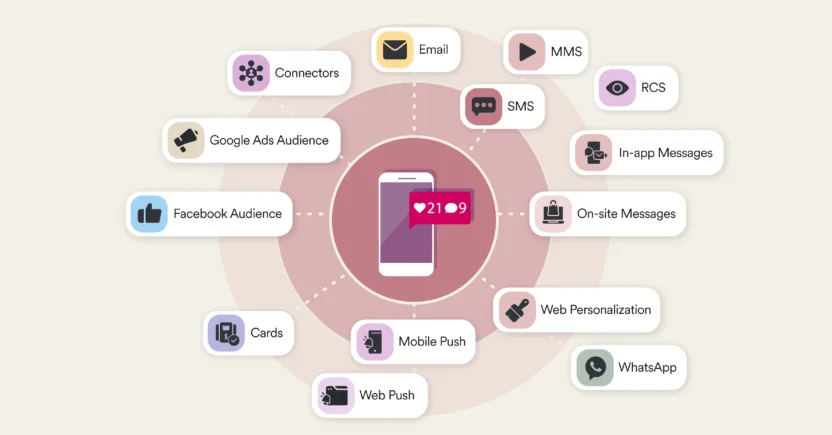
For mobile‑first brands, MoEngage delivers richer push/in‑app experiences with more templates and personalization options. Every Shopify trigger (order, abandon, and product view) can launch complex customer journeys across all channels in our journey builder, with messages automatically routed to each customer’s most preferred channel.
That means you can engage a Shopify customer who browses a product on your site, receives a push notification via your app, and receives a personalized email — all coordinated automatically. Just like Poshmark delivered real-time personalized messages with MoEngage, shooting up their conversions by 30% after sending 1.5 billion emails a month.
Such a unified approach also means a single customer view, easier reporting, and lower operating costs than stitching together disparate point solutions. No wonder Katie Lay, Senior Director of Retention Marketing at Poshmark, said:
We have a complicated business of buyers and sellers, alongside a social component where our Poshers could be creating their small business storefronts for their livelihood, and we needed a platform that would help us speak to each of those users individually. MoEngage helped us personalize these unique messaging needs, while also creating a customer journey for each of our consumers to bring our customer engagement strategies together in one place.

In short:
- Klaviyo: Best for smaller Shopify brands with medium‑sized audiences and focused on email and SMS. Great for quick setup and simple Ecommerce marketing automation. If you add more channels later, expect extra configuration, tool fragmentation, and potentially higher costs.
- MoEngage: Best for Shopify brands that have already scaled (or are planning to scale) and want to run email, SMS, on‑site pop‑ups, web personalization, and add new channels over time. Ideal for orchestrating the entire customer lifecycle across 10+ native channels from Day One, all in a single unified workflow.
Analytics and Reporting: How do Klaviyo and MoEngage Compare?
Both Klaviyo and MoEngage give marketing teams a solid foundation for measuring campaign performance. But they approach reporting from different starting points, and those differences become more meaningful as your team’s analytical needs grow.
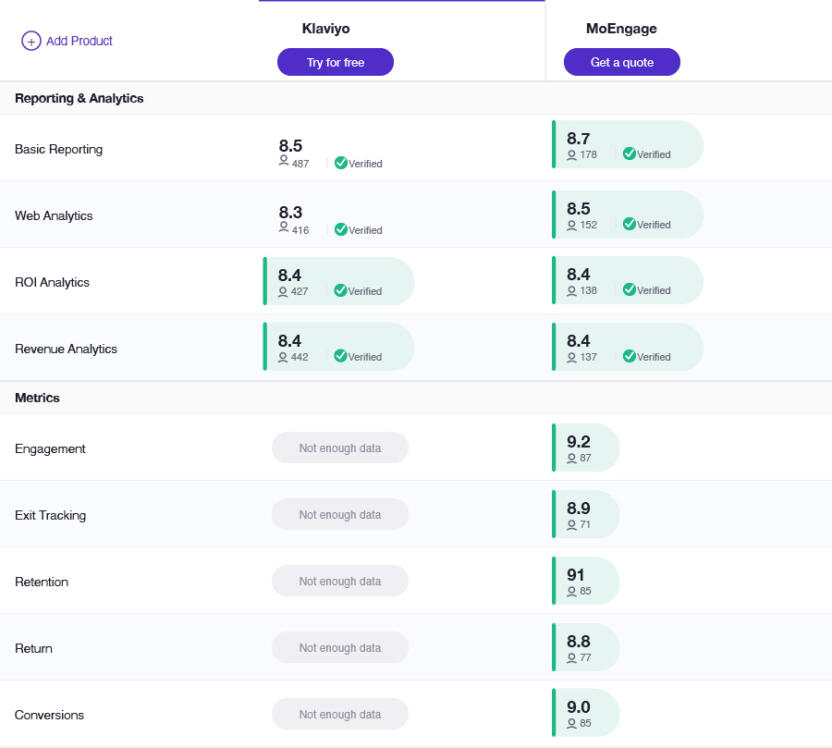
Source: https://www.g2.com/compare/klaviyo-vs-moengage
Klaviyo helps Shopify brands track Ecommerce campaign results with revenue‑first dashboards. Cohort reports track repeat purchase behavior, and benchmarks show how your SMS or email engagement compares with that of similar Shopify stores. Metrics like “placed order” make it easy to present results to non‑technical stakeholders.
But reporting is strongest in email/SMS — cross‑channel metrics (push, in‑app, WhatsApp) are fragmented, and advanced dashboards like CLV, RFM (Recency, Frequency, and Monetary value) analysis, and product analytics require paid add‑ons.
MoEngage’s analytics are designed around the reality that Shopify customers interact with your brand across more touchpoints than just purchase events.
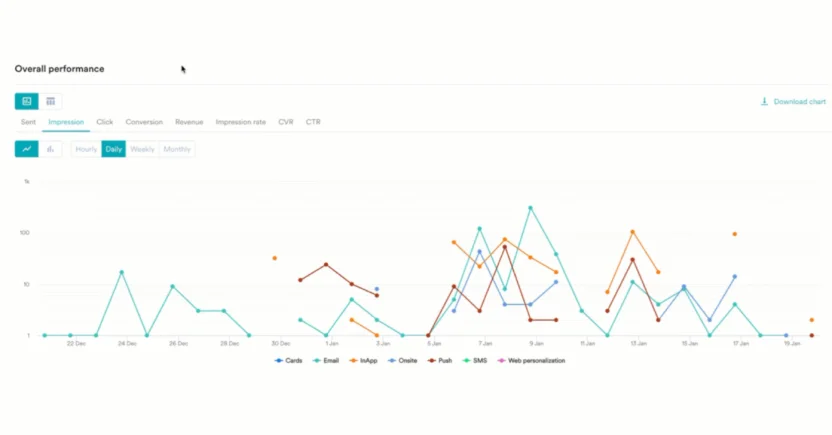
Because it supports push, in-app, SMS, WhatsApp, email, and more channels, its reporting is built to show performance across all of those channels in one place, including customer engagement metrics from your Shopify store alongside app and web behavior.
Attribution is configurable: your team can measure conversions using view-through, click-through, or in-session attribution, depending on how you actually think about campaign impact. Retention cohorts, predictive churn analytics, send frequency analysis, and custom dashboards (shareable or schedulable as email digests) are included at no additional cost.
But for teams whose primary question is simply “How much revenue did this email drive from our Shopify store?”, Klaviyo’s revenue-first interface is easier to present to a non-technical audience.
The bottom line:
- If your most important question is “How much Shopify revenue did this campaign drive?” Klaviyo’s reporting is hard to beat.
- If your Shopify marketing team needs a unified view of customer engagement across channels, configurable attribution, and lifecycle analytics without paying for add-ons, choose MoEngage.
Compare MoEngage vs. Klaviyo in Terms of Customer Support
Platform features win attention, but support determines how quickly you can use them to drive results. For fast-growing, mid‑market, and enterprise Shopify brands, channel breadth and personalization demands mean your marketing team will hit complex scenarios fast. That requires fast, informed answers from a dedicated partner.
Klaviyo was built with SMB Ecommerce in mind. While its Shopify integrations work well for email/SMS, customer support scales less effectively for larger Shopify accounts. Most accounts don’t get a dedicated Customer Success Manager (CSM) by default. Many Klaviyo users have flagged the platform’s declining human touch in support, and response times can sometimes lag for complex, multi‑channel requirements.
On the other hand, MoEngage has always been mid‑market and enterprise‑first. We’ve simply extended that DNA to Shopify brands, too, now. With 500+ large retailers worldwide already running on MoEngage, our customer success playbook is tuned for high-scale, multi-channel Shopify campaigns:
- Proactive onboarding and implementation support to ensure your Shopify store, app, and channels are connected correctly from day one.
- Dedicated Customer Success Managers (CSMs) as your single point of contact (SPOC) for all your strategic and technical needs.
- Engagement managers to guide your campaigns, journeys, and personalization tactics across channels.
- Regional support teams for faster responses and local context, covering your time zone.
- Quarterly briefings to align your customer engagement strategy with your evolving Shopify KPIs.
- Customer Advisory Board access, so you can influence future product features, including Shopify-specific capabilities.
For Shopify B2C marketers, this means you can plan, launch, and troubleshoot complex omnichannel customer journey flows without waiting days for a response — all the while avoiding the cost and risk of channel downtime during peak sales periods. This is why G2 reviewers typically praise MoEngage’s support team for its responsiveness.
MoEngage vs. Klaviyo Pricing for Shopify Brands
Your Shopify customer engagement platform’s pricing model matters more than you think, especially for Shopify brands with large lists or ambitious growth plans. How you’re billed can directly impact ROI as you scale.
Klaviyo, for instance, uses a profile‑based pricing model. As your Shopify store’s database grows, so does your bill, regardless of usage. This can get very expensive at scale, especially when your Shopify store runs seasonal or high‑traffic campaigns.
MoEngage uses a Monthly Active Users (MAU) or Monthly Tracked Users (MTU) pricing model. As in, you pay only for active users in a given month, based on actual Shopify store visitors, app users, or campaign engagements. This keeps costs predictable and tied to actual usage, not database size.
For mid‑market and enterprise Shopify brands with millions of profiles but varying monthly activity, this can be the difference between adding more channels because you can, or holding back because of budget spikes.
Email Campaign Pricing Example for Large Accounts
Let’s look at a realistic example for a growing B2C brand on Shopify. Imagine the hypothetical brand has:
- 100,000 Monthly Active Users (MAUs)
- 400,000 total profiles (4x profile-to-user ratio)
- Sends approximately 1.2 million monthly emails (roughly 12 emails per active contact per month)
Klaviyo (Profile-based pricing)
Klaviyo’s cost = Marketing Platform cost + Data Platform cost
| Component | Slab | Monthly Cost (Approx.) |
| Marketing Platform | 400,000 profiles | $3,680 |
| Klaviyo Data Platform (KDP) | 400,000 profiles | $1,600 |
| Total Klaviyo List Price | $5,280 |
As you can see, Klaviyo forces you into a 4M email tier because it is tied to your profile count (10x). In this scenario, since you’re sending just 1.2M emails per month, you’re still paying for 2.8M emails you aren’t even sending.
MoEngage (MTU-based pricing)
MoEngage’s cost = Enterprise Platform + Analytics + actual Email usage
| Component | Slab | Monthly Cost (Approx.) |
| Enterprise Platform | 100,000 MAU Slab (150 FUP – Fair Usage Policy Default) | $2,400 |
| MoEngage Analytics | 100,000 MAU Slab | $1,400 |
| Monthly Email Pricing | 1,200,000 Emails (rounded to the nearest 100K) | $720 |
| Total MoEngage List Price | $4,520 |
MoEngage charges based on the number of active users and actual emails sent, not on database size.
This difference in MoEngage vs. Klaviyo pricing is key for buying committees: Klaviyo’s profile billing can punish scale, while MoEngage’s MTU pricing lets you expand reach and experiment with channels without constantly recalculating ROI.
MoEngage vs. Klaviyo: Overall Comparison for Shopify Customer Engagement
Both MoEngage and Klaviyo are credible choices for Shopify B2C marketing teams. But they suit different stages of growth and different team structures.
When is Klaviyo the right choice for a Shopify brand?
In Klaviyo, store data flows directly into pre-built segments for churn risks, VIP customers, repeat buyers, and win-back opportunities from day one. Its Flows builder makes it straightforward to launch abandoned cart, post-purchase, and browse abandonment sequences without significant configuration. Revenue attribution, cohort tracking, and benchmark reporting are all anchored to Ecommerce KPIs.
If your Shopify brand’s engagement strategy lives primarily in email and SMS, and fast time-to-value matters more than channel breadth, Klaviyo is often the simpler and more immediately productive choice.
When do Shopify Brands Outgrow Klaviyo?
Klaviyo’s Ecommerce-first approach is quick and effective for email campaigns. But as your marketing needs grow, you’ll hit limits:
- Advanced channel campaigns require extra tools or integrations
- Analytics becomes fragmented across platforms
- Klaviyo’s SMB‑oriented customer support model means most accounts rely on shared resources, making it harder to get strategic help quickly
- Seasonal spikes or inactive profiles can trigger higher bills, even if engagement stays flat
Many teams then migrate to MoEngage, a single platform that keeps Shopify customer data, omnichannel messaging, and analytics in one place. Our enterprise-grade customer support means you don’t need to wait days to get your issues resolved. And our MTU pricing keeps costs predictable as you scale.
So, instead of starting with Klaviyo and facing migration later, brands planning channel expansion can start with MoEngage now and avoid tool fragmentation, data loss, and onboarding twice. No more unpredictable bills or long-queued support tickets, either.
When is MoEngage the right choice for a Shopify brand?
MoEngage is the right choice when your Shopify marketing strategy needs to go beyond sending email and SMS campaigns and instead orchestrate the full customer lifecycle across channels.
Choose MoEngage if:
- You want to turn Shopify store events into cross‑channel journeys that trigger emails, push notifications, WhatsApp messages, in‑app nudges, and on‑site personalization from one platform.
- You need Most Preferred Channel routing so each Shopify customer automatically receives messages where they’re most likely to engage.
- You want real-time segmentation and RFM scoring that works across all channels, without paying for premium tiers.
- You’re scaling into omnichannel campaigns now (or plan to soon) and want to avoid migrating from Klaviyo later when your channels need to expand.
- You prefer a single customer view where Shopify data, app activity, web interactions, and AI insights live together for analysis and optimization.
In short:
- If you’re a Shopify brand focused on email and SMS, want Ecommerce-native segmentation that works out of the box, and need revenue-first analytics that are easy to present to stakeholders, choose Klaviyo.
- If your Shopify brand is scaling to truly omnichannel engagement, needs advanced AI optimization across the full customer lifecycle, and wants unified analytics without paying for separate add-ons, choose MoEngage.
MoEngage vs. Klaviyo FAQs
What is the difference between Klaviyo and MoEngage?
Klaviyo is an Ecommerce-focused marketing automation platform with deep Shopify integration, primarily optimized for email and SMS campaigns tied to store events like purchases, abandoned carts, and product views.
MoEngage is an AI-native customer engagement platform that also integrates directly with Shopify but supports 10+ native channels, including email, SMS, mobile push, in-app messaging, WhatsApp, web push, and RCS, and offers advanced multi-channel segmentation, AI personalization, and analytics.
Which platform is better for Shopify brands focused only on email and SMS?
For Shopify brands prioritizing email and SMS campaigns, Klaviyo’s out-of-the-box templates, pre-built Shopify event segments, and revenue-focused reporting make it a strong choice for quick setup and targeted ecommerce marketing.
However, if your brand plans to expand into channels such as web push notifications, in-app messaging, or web personalization in the future, starting with MoEngage can help you avoid the hassle and cost of migrating from Klaviyo as your channel needs grow.
Which platform is better for Shopify brands looking to run multi-channel engagement?
MoEngage is generally the better fit for Shopify brands managing omnichannel journeys across web, mobile, messaging apps, and email. Its broad native channel coverage lets you keep campaigns coordinated in one place, ensuring consistent personalization across touchpoints.
For brands that may begin with email/SMS but plan to add more channels, MoEngage’s unified approach eliminates future migration pain and maintains historical campaign data in one system.
Does MoEngage integrate with Shopify?
Yes. MoEngage integrates directly with Shopify, enabling brands to use store events (orders, carts, and product views) alongside customer behavior from other touchpoints, such as apps, websites, or offline sources, for segmentation, personalization, and analytics.
What channels does MoEngage natively support?
With MoEngage, you can reach your customers through 10+ channels, including:
- SMS and RCS
- Mobile and web push notifications
- In-app messaging
- On-site messaging (OSM)
- Digital advertising, such as Facebook Ads and Google Ads
- Content Cards
- Connectors for regional channels like LINE
Does Klaviyo integrate with Shopify?
Yes. Klaviyo is built for deep Shopify integration, syncing store events in real-time to trigger email and SMS campaigns. Other channels can be added through third-party tools or extra setup, but scaling beyond email/SMS often means piecing together multiple systems or migrating to a broader customer engagement platform like MoEngage.
How quickly can a Shopify brand start using MoEngage?
With MoEngage’s native Shopify integration, most brands can go live within days. Connecting your store, syncing data, and launching omnichannel journeys is a straightforward process that doesn’t really require a heavy engineering lift.
For example, Drop, a card-linked offers and rewards app, migrated and launched in just 7 days. Another example is ClickRain, which quickly migrated its campaigns to MoEngage and helped its clients save $18,000 annually.

MoEngage vs. Klaviyo: Deciding What Fits Your Shopify Brand
MoEngage vs. Klaviyo is ultimately about matching the platform to your team’s current needs and where you see your Shopify brand going next. Klaviyo delivers quick campaign automation in email and SMS. MoEngage is built for brands that want to connect every channel, go beyond basic journey flows, and work closely with a dedicated support team on growth.
If your marketing strategy involves multiple channels now, or you plan to expand in the future, MoEngage’s native Shopify integration, unified customer view, and MTU pricing make it easier to grow without paying for inactive users, while still keeping their history for personalization and insights.
The fastest way to evaluate MoEngage is with your own Shopify campaigns — the store events you want to act on, the journeys you need to connect, and the channels you plan to run.
Schedule a 1:1 demo to see how MoEngage turns Shopify-triggered campaigns into coordinated customer lifecycle flows across email, SMS, push, in-app, WhatsApp, and web, all without tool fragmentation.
The post MoEngage vs. Klaviyo: Shopify Engagement Platform Comparison appeared first on MoEngage.