[ad_1]
Key takeaways:
- AI, 5G, and cloud computing are considered drivers of digital transformation in Spain and will provide businesses with scale and customizable solutions by 2026.
- Bespoke software is tailored to local requirements, giving businesses a competitive advantage in dealing with regulatory complexity and responding to customer needs.
- In Spain, the pace of AI adoption is fast, and 72% of businesses will have adopted AI by 2026, improving efficiency and customer experiences.
- Innovation acceleration with software is driven by custom solutions, which help businesses automate, increase scalability, and deliver unique solutions to support long-term growth.
- The Spanish digital environment is dynamic, and the government has invested more than 2 billion euros in digitalization to improve SMEs and data governance.
- Bespoke software enables companies across industries such as healthcare, finance, and manufacturing to meet regulatory requirements and operate without issues.
Walk into any boardroom in Madrid or Barcelona today, and the conversation sounds familiar. Legacy systems. New compliance rules. Pressure to move faster. This is the reality driving digital transformation in Spain. It is no longer a long-term vision. It is an immediate business requirement.
Many Spanish enterprises still depend on off-the-shelf platforms. They work fine until local tax rules change, new data protection requirements appear, or expansion into wider EU markets demands system flexibility. That is where friction starts. Integration slows down. Processes become workarounds. Growth feels harder than it should.
This is why the role of custom software in digital transformation has become central for Spanish businesses. These custom software solutions are built around existing operations, regulatory obligations, and real user behavior.
They support software modernization in Spain, connect legacy infrastructure with cloud platforms, and create scalable enterprise applications ready for AI and automation.
If you are leading technology or operations, the goal is simple. Build systems that adapt as regulations shift, data volumes grow, and customer expectations rise. Custom software solutions for Spanish industries provides that foundation.
Join 66% of Spanish Professionals Leading Digital Innovation
Your competitors are already leveraging custom software to automate, scale, and dominate their markets. Don’t fall behind in Spain’s digital-first economy.

What is Driving Digital Transformation in Spain in 2026?
Sit in on a quarterly review meeting in a Spanish enterprise and you will hear the same priority. Systems need to be modernized, data needs to move faster, customers expect more, this is the reality shaping digital transformation in Spain as we approach 2026.
The shift is backed by national direction. Programs like España Digital 2026 are pushing enterprise digitalization in Spain across industries. Banks are upgrading core platforms. Manufacturers are connecting production data to analytics systems. Public services are moving workloads into secure cloud environments. This momentum is driving software modernization in Spain at scale.
The numbers tell the story:
- 5G coverage now reaches over 60% of Spain’s population, opening the door for real-time enterprise applications.
- AI adoption in Spain is expected to reach 72% of enterprises by end of 2026, especially in finance, healthcare, and manufacturing.
- Cloud adoption in Spain is projected to grow 40% by 2026, supporting hybrid and scalable architectures.
- The government has committed €2 billion to digitization, data governance, and cybersecurity.
This environment is accelerating data-driven transformation in Spain. Legacy systems are being re-architected into connected, cloud-ready platforms.
In this context, the role of custom software in digital transformation is practical. It allows Spanish enterprises to plug into new infrastructure, meet regulatory expectations, and execute Spanish digital transformation strategies with confidence.
Also Read: Digital Transformation Strategies You’ll Wish You Knew Sooner
How Spain’s Digital 2026 Strategy Shapes Enterprise Technology Decisions
Spain’s enterprise digital shift is guided by a national modernization agenda, not isolated technology initiatives. Aligning software investments with this strategy reduces risk and accelerates transformation outcomes.
España Digital 2026 focuses on:
- AI and data-driven enterprise innovation
- SME and large-scale digitization funding
- Cloud-first and sovereign data infrastructure
- ENS-led cybersecurity enforcement
- Automation and digital workforce enablement
Custom software acts as the execution layer of this strategy, enabling Spanish enterprises to modernize systems, adopt AI responsibly, and maintain data sovereignty at scale.
How Does Custom Software Enable Enterprise Digitalization in Spain?
Custom software development provides several tangible benefits that matter most to businesses embarking on digital transformation in Spain. From compliance challenges to scaling operations, tailored solutions solve these problems and unlock measurable growth and efficiency.
Spain stands out in Europe for its highly digital workforce, with 66.2% of citizens possessing basic digital skills, significantly exceeding the European average of 55.6%, which further highlights the growing need for businesses to leverage technology to stay competitive.
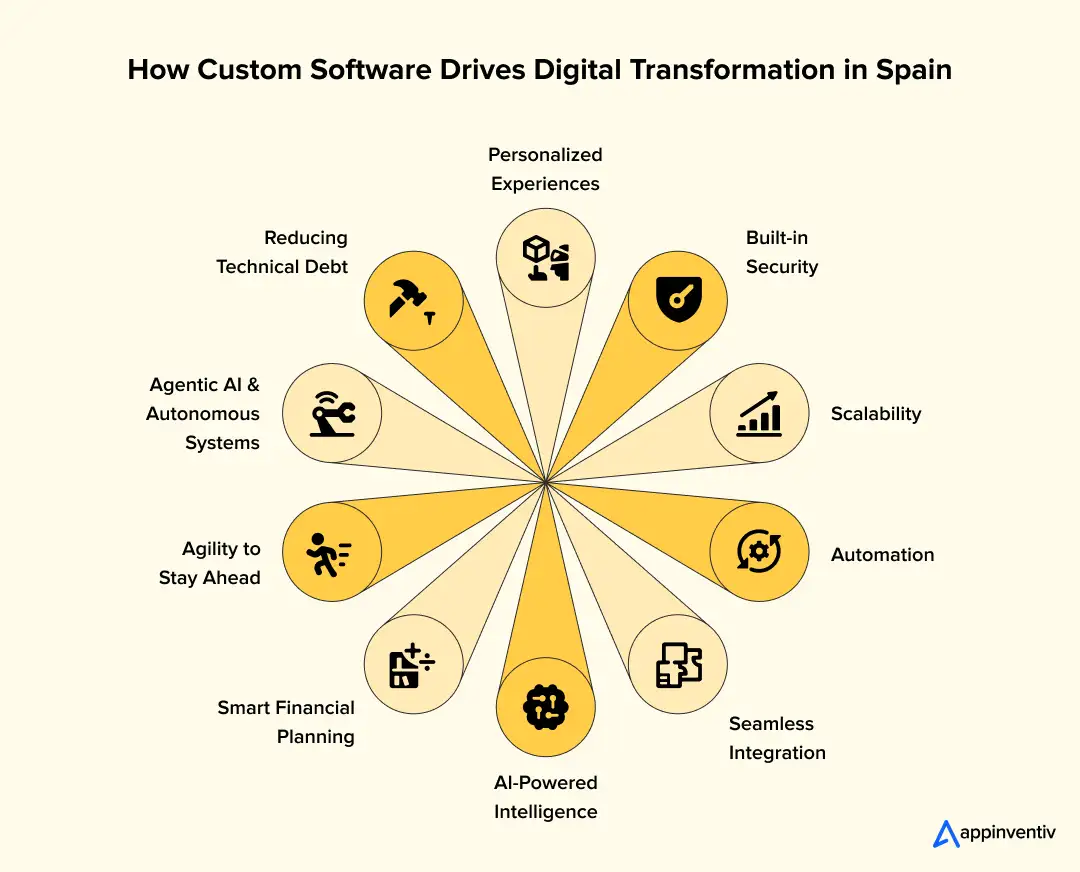
1. Personalized Experiences That Connect
Custom software meets your business needs and the customers’ expectations, demonstrating the impact of technology on Spanish businesses in creating competitive advantages. For companies operating in Spain, this means solutions that fully address regional preferences, language peculiarities, and local legislation.
It provides experiences that no out-of-the-box solution can offer: from personalized shopping journeys that actually feel relevant to Spanish consumers to driving loyalty and sales.
2. Security Built into the Foundation
Closed-source custom solutions significantly reduce the vulnerabilities common in generic software. What this means for Spanish companies is reliable GDPR compliance, with sensitive data protected from day one, not as an afterthought, but as part of the architecture from the outset.
3. Scalability Without the Growing Pains
Scalable enterprise applications through custom software grow with your business. Whether it is rapid growth or expansion into new regions, these solutions adapt without performance issues. This flexibility keeps Spanish businesses competitive as market conditions continue to evolve.
4. Automation That Actually Works
Business process automation in Spanish enterprises implement through custom software reduces manual work and human error in repetitive tasks such as inventory management and customer support
5. Seamless Integration with What You Already Have
Custom solutions integrate with your existing systems without costly extensions or workarounds, saving money, time, and frustration from dealing with ill-matching tools. This seamless integration is essential for successful software modernization in Spain.
6. AI-Powered Integration
Ai-Powered Integrations such as ChatGPT and Gemini enable real-time, tailored customer interactions. Not to mention, these aren’t simply some trendy features. They improve engagement across all touchpoints and provide your team with the competitive insights needed for wiser, faster decision-making, exemplifying data-driven transformation Spain businesses are pursuing.
7. Smart Financial Planning
Yes, custom software requires a bigger upfront investment. But Spanish businesses avoid continuous licensing fees and unpredictable maintenance costs, thus making it financially sensible over time.
8. Staying Ahead of the Market
Custom software gives businesses the agility to turn around when regulations change or market conditions fluctuate quickly. That often proves to be the difference between those who lead and those who follow in Spain’s competitive landscape.
9. Agentic AI and Autonomous Enterprise Systems
AI adoption in Spain is evolving from chat-based tools to Agentic AI, where autonomous software agents execute workflows and operational decisions. Custom-built platforms embed these agents into core systems to orchestrate processes, monitor compliance, and optimize real-time operations. This enables Spanish enterprises to achieve controlled automation, faster decision cycles, and secure AI deployment aligned with data residency and ENS security requirements.
10. Reducing Technical Debt in Spanish Enterprises
Off-the-shelf platforms may speed early digitalization, but over time they create technical debt through rigid workflows, forced integrations, and disruptive upgrades. Custom software avoids this cycle. Platforms are built around real business processes, Spanish compliance needs, and scalable architecture. The result is lower long-term cost, smoother modernization, fewer integration risks, and predictable enterprise growth as digital transformation in Spain accelerates.
Custom software is much more than keeping pace with digital transformation; it’s about having the right tools to innovate, scale, and succeed on your terms.
Why Spanish Enterprises Are Replacing Off-the-Shelf Software in 2026
Sit with an IT lead in Madrid and the story is familiar. Off-the-shelf tools helped early on. Now they limit progress. As digital transformation in Spain accelerates, generic platforms struggle with local compliance, scaling, and system integration.
This is driving software modernization in Spain across industries.
A common scenario is expansion into EU markets. Spanish enterprises need multilingual interfaces, regional tax handling, local payment methods, and real-time data flows. Standard software rarely delivers this out of the box. Workarounds follow. Efficiency drops.
Custom software solutions for Spanish industries solve this by aligning technology with real operations. Enterprises gain:
- Platforms built around existing business workflows
- API-first integration with ERP and data systems
- Modular architectures for continuous upgrades
- Scalable enterprise applications ready for cloud and AI
- Built-in support for compliance and localization
This is why the role of custom software in digital transformation has become central to enterprise growth in Spain.
Custom Software vs Off-the-Shelf: Enterprise View
A quick comparison shows why Spanish enterprises are shifting away from generic tools.
| Custom Software | Off-the-Shelf Software |
|---|---|
| Built for specific workflows | Built for broad use cases |
| Supports regional and regulatory needs | Limited localization |
| Integrates with existing systems | Requires workarounds |
| Scales with business growth | Scaling tied to vendor roadmap |
Custom software enables flexibility and long-term control. Off-the-shelf platforms offer speed, but restrict innovation as complexity grows.
Modern Enterprise Architecture Powering Digital Transformation in Spain
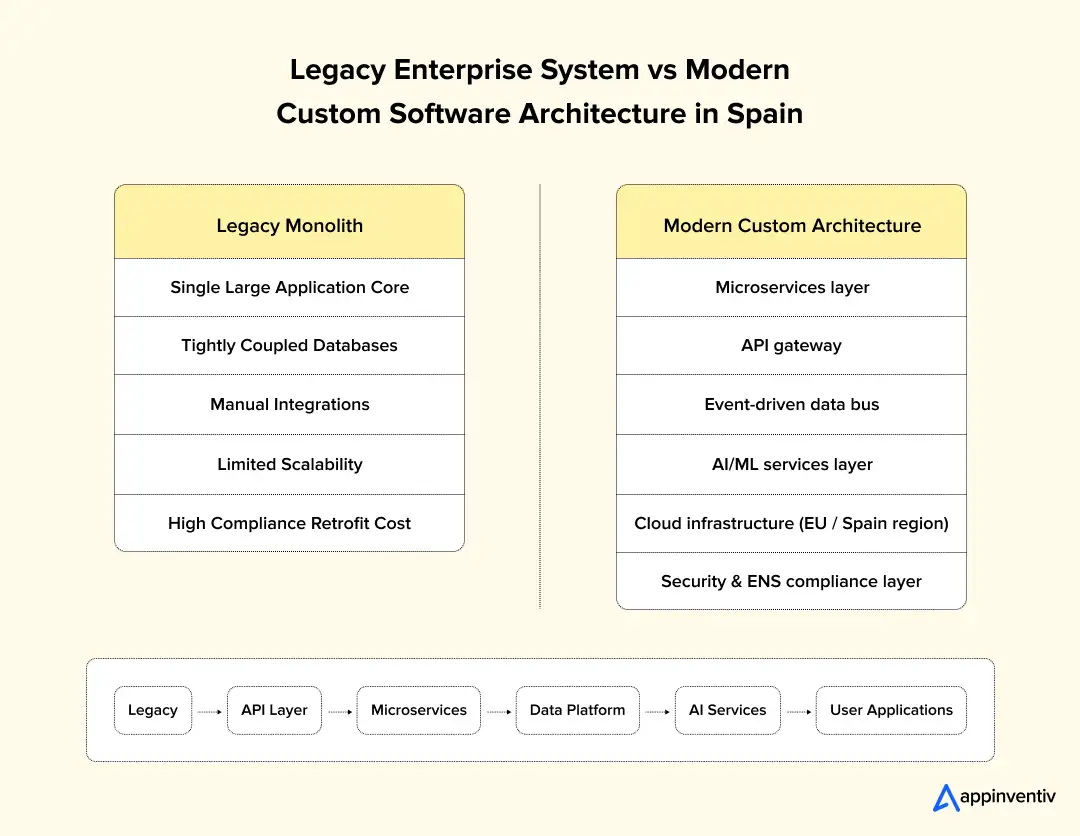
Most Spanish enterprises are still running critical operations on legacy monolithic systems. These platforms were not designed for AI integration, real-time data flows, or continuous compliance updates. As digital transformation accelerates across Spain, architecture modernization has become a prerequisite, not an upgrade.
Custom software enables enterprises to transition from rigid, siloed systems to modular, cloud-native, integration-ready platforms. Instead of rebuilding everything at once, modern architectures allow gradual modernization with zero disruption to core operations.
What a Modern Enterprise Tech Stack Looks Like
- Microservices-based architecture to break large systems into scalable functional units
- API-first integration to connect legacy platforms, third-party services, and data layers
- Containerized deployment (Kubernetes) for resilient, self-healing infrastructure
- Event-driven data pipelines to enable real-time analytics and automation
- AI and ML model pipelines for predictive insights and intelligent process orchestration
- Sovereign and EU-region cloud deployment to meet Spanish data residency and ENS requirements
This architectural approach allows Spanish enterprises to modernize at their own pace, integrate AI capabilities safely, and maintain continuous regulatory alignment.
Modern tech stack adoption is no longer about innovation optics. It is how Spanish enterprises achieve operational agility, compliance readiness, and long-term scalability.
What Does Custom Software Cost Spanish Enterprises in 2026?
Custom software development will require not only a much higher initial investment but also substantial long-term ROI. This is a more expensive upfront option than off-the-shelf solutions, but scalability and security, along with long-term savings, will justify the business decision.
A breakdown of typical costs, depending on complexity and scope of work, is provided here.
| Development Stage | Estimated Cost | Description |
|---|---|---|
| Discovery & Requirements | $40,000 to $70,000 | Initial research, planning, and defining project scope. |
| Design & Prototyping | $50,000 to $100,000 | UI/UX design, wireframing, and prototyping to define user experience. |
| Development (Basic) | $100,000 to $250,000 | Core development for smaller, less complex solutions. |
| Development (Advanced) | $250,000 to $600,000 | Larger, more complex systems require advanced features (such as AI and cloud integration). |
| Maintenance & Support | $20,000 to $50,000/year | Ongoing updates, system optimizations, and troubleshooting. |
Also Read: How Much Does It Cost to Build a Mobile App in Spain?
Ready to Transform Your Business Operations?
Partner with experts who understand Spain’s unique market demands, regulatory landscape, and growth opportunities. Let’s build software that works for you.

Regulatory and Sovereignty Compliance in Spain
Digital transformation in Spain now runs on a simple reality. If software is not compliant by design, it becomes a business risk. Spanish enterprises must operate within EU privacy law, national cybersecurity frameworks, and financial reporting mandates.
Off-the-shelf platforms often require expensive customization just to meet baseline obligations. Custom software removes that friction by embedding compliance into the architecture itself.
A tailored platform allows organizations to align technology with Spain’s regulatory environment instead of adapting business processes to software limitations. It also ensures data control remains in the hands of the enterprise as cloud adoption and AI usage expand.
Key compliance advantages of custom software:
- Built-in GDPR and LOPDGDD data privacy controls
- ENS-aligned security architecture for access management and encryption
- Support for digital invoicing regulations, including Ley Crea y Crece and TicketBAI
- Data residency and sovereign cloud readiness for sensitive workloads
- Audit-ready logging and reporting across enterprise systems
For executive teams, this means fewer compliance surprises, faster audits, and lower long-term risk. Custom software turns regulatory alignment from a constraint into a foundation for confident digital growth in Spain.
What Are the Biggest Software Integration Challenges in Spain?
While the development of custom software may be a key driver of significant business transformation, it comes with its own challenges. The following are some common barriers and how to overcome them:
1. High Initial Costs
Although custom software offers long-term benefits, its initial investment can be substantial. A way to moderate this challenge is to plan the development in phases, prioritized. This would imply a step-by-step investment while providing value from the very outset.
2. Complex Requirement Gathering
It is difficult to precisely define a business’s needs because project objectives often remain unclear. To avoid this problem, involving executives, department heads, and end users at an early stage will ensure that software is developed based on actual business needs as requirements evolve.
3. Software Integration Challenges With Legacy Systems
Many businesses depend on legacy systems, and those most often do not integrate seamlessly with new custom solutions. Solution: Work with a partner with experience in legacy system integration. A good development team will design software that connects with the existing infrastructure while minimizing disruption.
4. Long Development Time
Custom development will take time, thereby delaying the software’s impact on the business. To avoid this, apply Agile development practices that enable incremental releases and regular customer feedback to ensure the project stays on course, and businesses see results early enough.
5. Maintenance Post-Deployment
Custom software requires support continuously, even after deployment. Find a partner who can consistently maintain it and support it post-launch to ensure the solution remains optimized as the business grows and technology advances.
Also Read: Digital Transformation Challenges Enterprises Need To Overcome
How to Choose a Digital Transformation Partner in Spain
Choosing the right partner in custom software development can make all the difference to the success of the digital transformation journey. A good partner will bring technology expertise but also understand the unique business goals and challenges.
Here is why choosing the right partner can make all the difference:
- Industry Knowledge and Regional Experience: A partner experienced in Spain’s market will have valuable knowledge of local regulations and industry needs, ensuring that your software is compliant and adapted to local demand.
- Scalable Solutions for Growth: The right partner develops software that will grow with your business. Whether the markets are expanding or the demand for the solution is increasing, your custom solution grows with you.
- Demonstrated Track Record: Find a partner that has a demonstrated track record in the delivery of successful projects. An experienced partner will ensure you transform as efficiently as possible.
- Technical Capacity and Innovation: It is presumed that your partner would be knowledgeable in AI, cloud technologies, and data analytics to ensure the solution is future-proof and aligned with data-driven transformation in Spain industry trends.
- Continuous Support: Long-term support and maintenance by a powerful partner that responds fast to issues and that modifies your software as your business requirements evolve.
Also Read: How Much Does it Cost to Hire Software Developers in Spain?
What Will Define the Future of Digital Transformation in Spain?
Join a strategy workshop in Seville or Bilbao, and the focus is the same. Enterprises are rethinking how technology supports growth. These trends are shaping the next phase of digital transformation in Spain and guiding leaders investing in custom software solutions for Spanish industries.
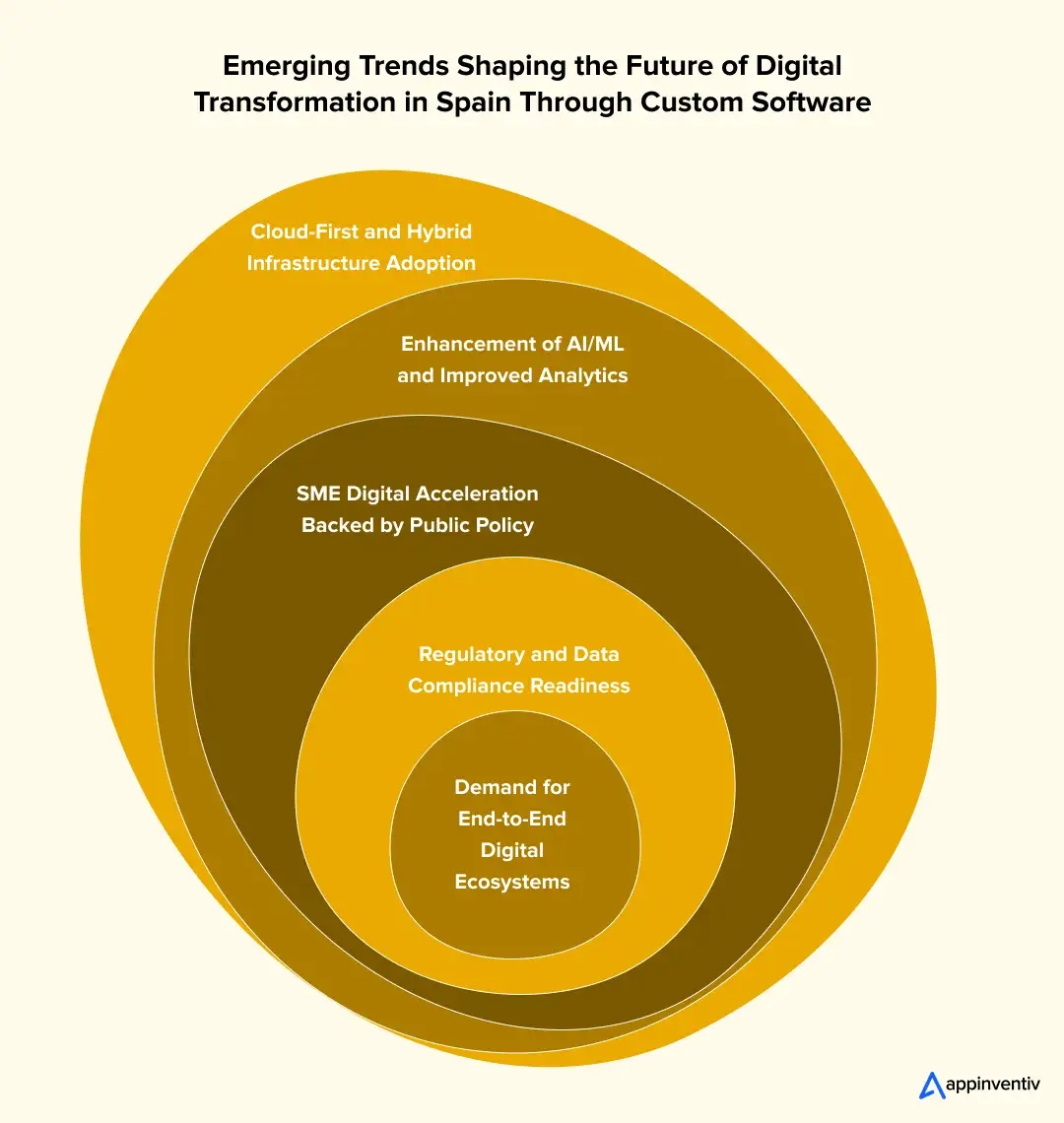
- Cloud-first and hybrid infrastructure: Enterprises are shifting to cloud-native and hybrid environments. Containerized platforms, API gateways, and edge computing are becoming standard. This approach supports scalable enterprise applications that remain resilient as demand grows.
- AI and advanced analytics: AI adoption in Spain is moving beyond pilots. Machine learning models and real-time analytics are being embedded into core systems to automate operations, forecast demand, and improve decision-making.
- Public-backed digital acceleration: The Digital Spain Agenda continues to fund enterprise digitalization in Spain, encouraging SMEs and large firms to invest in tailored software and data platforms.
- Regulatory and data compliance readiness: Stricter privacy and data protection rules are pushing enterprises toward custom platforms that support compliance by design rather than add-on fixes.
- End-to-end digital ecosystems: Spanish businesses are connecting ERP, CRM, cloud, and analytics into unified environments. This is driving software modernization in Spain at an architectural level, not just at the application level.
Together, these shifts reinforce the role of custom software in digital transformation as the foundation for Spain’s next wave of enterprise growth.
How Appinventiv Helps You Drive Digital Transformation with Scalable Custom Software Solutions?
Appinventiv delivers custom software solutions for Spanish and European enterprises looking to modernize operations and scale digital capabilities. As a trusted software development company in Spain, with over a decade of experience across Europe, we help organizations solve complex business challenges through technology built for long-term transformation.
Our team of 1,600+ technology experts has delivered 300+ enterprise projects across the UK and Europe, maintaining a 97% client satisfaction rate. We work closely with leadership teams to understand business objectives, system constraints, and growth priorities, ensuring every solution aligns with digital transformation goals.
We have partnered with global brands including Adidas, Domino’s, Pizza Hut, and Americana, and delivered large-scale platforms in fintech, healthcare, education, and recruitment. Recent projects include a core-banking integrated fintech platform and a real-time hiring ecosystem serving over 150,000 job seekers.
Our expertise in the role of custom software in digital transformation ensures measurable outcomes, scalable architectures, and lasting business value.If you are exploring how custom platforms could support your next phase of growth, our team is ready to share insights and practical guidance. Let’s connect.
Frequently Asked Questions
Q. What industries in Spain benefit the most from custom software development?
A. Sectors in which custom software finds its highest demand in Spain include healthcare, finance, manufacturing, and retail. All these industries understand the role of custom software in digital transformation and have special business requirements like regulatory compliance, efficiency, and customer experience for which industry-specific digital tools are required. It helps businesses be competitive and agile toward the demands of the market.
Q. What role does software modernization play in Spain’s digital shift?
A. The most important contribution of software modernization to digital transformation in Spain is promoting the shift to agile, cloud-based software among businesses reliant on legacy systems. It will facilitate scalability, enhanced operational efficiency, and security, and accommodate the incorporation of emerging technologies like AI and data analytics, which will be required to sustain business competitiveness and future preparedness.
Q. How long does it take to build custom software for digital transformation projects?
A. In general, creating custom software for digital transformation in Spain takes from 6 to 12 months, depending on the project’s complexity, size, and features required. Simple solutions could therefore be developed quickly, while if it is a large enterprise system or involves lots of integrations and more advanced technologies, then it would take longer to make it scalable and secure.
Q. How is the tourism sector in Spain using custom software to innovate?
A. The custom software systems for personalized travel experiences, smart booking, AI recommendations, and data-driven transformation Spain’s tourism sector relies on make all operations smooth.
These kinds of solutions would enhance the level of customer service, improve the management of bookings, and provide real-time insights that will drive growth, innovation, and better quality of service in a competitive market.
Q. How is AI and automation being adopted in Spanish logistics?
A. Besides, AI and automation are increasingly improving inventory, route planning, and supply chain processes within Spanish logistics. As a matter of fact, these technologies reduce manual tasks, enhance delivery times, and improve overall operational efficiency in services. AI helps in predictive analytics for demand forecasting, while automation speeds up sorting and dispatching, hence improving the overall service delivery.
Q. How is custom software transforming Spain’s banking and fintech sector?
A. The use of custom software in Spain helps propel secure digital banking, AI-led services, and a personalized customer experience across the entire spectrum of banking and fintech. Tailor-made solutions can help financial institutions become more efficient in their operations, comply with regulations, and offer innovative services to their customers by automating processes, enhancing data security, and providing real-time insights.
Q. What technologies will shape Spain’s next digital wave?
A. AI, 5G, cloud computing, machine learning, and blockchain form the new wave of digital transformation that is going to set the trend for what will come next in Spain. Such drivers of innovation in finance, manufacturing, health, and logistics, among other areas of the Spanish digital future, are expected to signify even greater automation, data analytics, connected services, and security.
[ad_2]
Source_link