[ad_1]
Reading Time: 18 minutes
According to MoEngage’s Email Marketing Benchmarks 2025 report, retail and Ecommerce brands that personalize emails based on customer behavior see 16x higher conversion rates than those that don’t. However, achieving such high conversion rates for your Shopify store requires using the right Shopify email marketing tools.
In this blog post, we’ll discuss why Shopify stores need specialized email marketing software, what the best Shopify email marketing apps are, what to look for when choosing an email marketing tool, and consider some of the best Shopify marketing integrations that can help you boost revenue.
Best Shopify Email Marketing Tools Compared at a Glance
| Tool | Gartner Rating | Best-Buyer Fit | Key Features |
| MoEngage | 4.7/5 | Mid-to-large enterprise brands needing email as part of a fully unified omnichannel engagement platform at scale |
|
| Klaviyo | 4.7/5 | D2C and Ecommerce brands of all sizes on Shopify wanting the deepest data integration and predictive analytics |
|
| Omnisend | 4.5/5 | Small-to-mid Shopify, WooCommerce & BigCommerce stores wanting affordable ecom-native email + SMS with fast setup |
|
| Shopify Messaging | – | Small or newly-launched Shopify merchants wanting a zero‑setup, low‑cost email solution that lives inside the Shopify admin |
|
| Mailchimp | 4.4/5 | Solopreneurs, non-profits & small businesses under 1,000 contacts needing simple newsletters and free landing pages |
|
| ActiveCampaign | 4.4/5 | B2B companies, agencies & multi-industry businesses needing enterprise-grade automation with a built-in CRM |
|
| Drip | – | Established Ecommerce stores ($100k+/year) that have outgrown Mailchimp and want granular revenue attribution |
|

Why do Shopify Stores Need Specialized Email Marketing Software?
Most business owners don’t have a bottomless bank balance. Hence, they need to ensure that every dollar spent building their business is worth it.
Here are 5 key benefits Shopify store owners derive from using email marketing apps for Shopify:
- Personalization: Perhaps the biggest benefit of using email marketing apps for your Shopify store is the level of personalization they offer. When you use email marketing software, your emails aren’t guesses but messages triggered by real-time signals from potential customers.
- Return on Investment (ROI): Email marketing can deliver truly astonishing returns when optimized with specialized email marketing platforms like MoEngage. According to Forbes, email marketing can deliver $36 in return for every dollar spent, making it cheaper than paid media placements.
- Cart Abandonment Recovery: Cart abandonment remains a persistent problem for Ecommerce brands, with over 70% of online carts abandoned, as per Statista. Brands can reduce this problem by using email marketing. With the right Shopify email marketing tool, they can send automated reminders to potential buyers. When optimized, these campaigns can oversee a significant drop in cart abandonment rates.
- Increased Customer Retention and Engagement: It’s one of the worst-kept secrets in business that it’s cheaper to retain existing customers than to acquire new ones, and email marketing is a tool that can help you boost customer retention and engagement. By using strategies such as personalized product recommendations, exclusive promotions, and follow-ups, your brand can improve customer loyalty.
- Direct Contact with Your Customers: Unlike other forms of marketing, such as social media or radio and TV, email marketing doesn’t require a third party to contact your customers. If something were to happen to the connecting company, for example, if regulations prevent them from operating in a certain region, all your leads and efforts in that region would be lost. On the other hand, with email, unless the customer decides to unsubscribe, you’ll always be able to stay in contact with them.
Now that you know why your Shopify store needs email marketing platforms, let’s explore the top platforms in greater detail.
What are the Best Email Marketing Apps for Shopify in 2026?
Large and growing Shopify stores need tools that integrate deeply with Shopify, support higher volumes, and connect email with omnichannel workflows.
On that note, let’s compare the best Shopify email marketing tools for higher store conversions, weighing features, scalability, pricing, and ease of integration. Whether you’re looking for advanced automation, predictive analytics, or affordable omnichannel support, you’ll find the right fit for mid‑market and enterprise brands below.
1. MoEngage
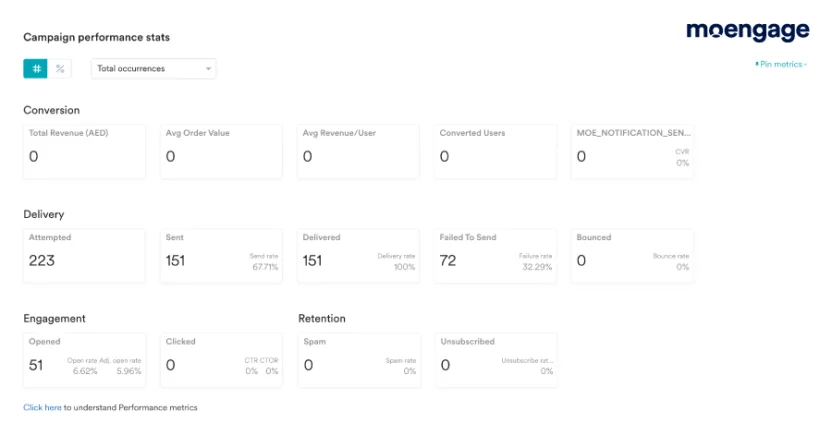
MoEngage is a Shopify customer engagement platform built for mid-market and enterprise brands. With its native support for 10+ channels, full-funnel analytics, dedicated support, and deep Shopify integration, MoEngage is designed to help Ecommerce teams orchestrate campaigns based on both store events and behavioral signals across channels.
Pros
- Omnichannel Engagement: MoEngage supports email and SMS, as well as other native channels such as push notifications, in-app messaging, and web personalization. As such, every Shopify trigger, such as a product view or an order, can launch complex omnichannel customer journeys, with messages automatically sent via the customer’s preferred channel.
- Dedicated Customer Support: MoEngage offers Shopify stores enterprise-grade support, including proactive onboarding and a dedicated Customer Success Manager (CSM) as a point of contact. You also get engagement managers to guide campaigns and personalization tactics, as well as regional support teams for faster responses in your time zone.
- Advanced Analytics: This platform offers an analytics module that includes retention cohorts, churn analytics, send frequency analysis, and custom dashboards. You can also configure attribution across view-through, click-through, or in-session models. Unlike several other email marketing apps for Shopify that you’ll see on this list, you get to monitor and analyze all of these email marketing metrics at no additional cost.
- Leading Segmentation Capabilities: MoEngage boasts of powerful event tracking and segmentation features. Its segmentation is extremely useful for grouping customers based on actual actions rather than static attributes. Furthermore, the segmentation engine is easy to master and design campaigns around.
- Deep Shopify Integration: MoEngage integrates directly with Shopify, enabling Shopify stores to use store events alongside customer behavior from apps or websites for personalization and analytics.
Con
MoEngage’s advanced features, such as AI and journey building, are highly powerful. However, they require a bit of a learning curve to use them effectively.
Pricing
MoEngage uses an MTU‑based (Monthly Tracked Users) pricing model, meaning you pay according to the number of customers who actually engage with your campaigns, not your total contact list size.
Best For
MoEngage is the best email marketing platform for Shopify, especially for mid-market and enterprise Shopify stores that need email as just one channel within a broader omnichannel strategy. If your Shopify store is operating at scale, runs a mobile app, and needs email, push, and SMS, then MoEngage is the best option for you.
2. Klaviyo
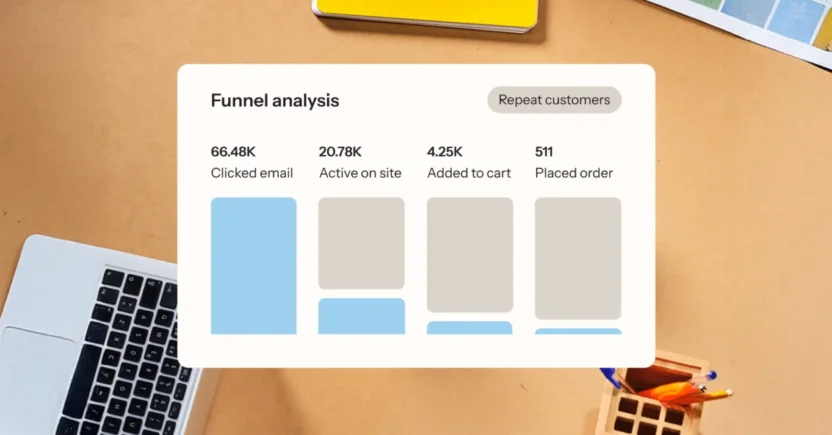
Klaviyo is a high‑performing email and SMS marketing platform with advanced segmentation and predictive analytics, built for Ecommerce. The platform makes it easy for Shopify merchants to sync their entire store, including product catalog, customer history, and browsing behavior, for targeted campaigns.
Pros
- Shopify Integration: Klaviyo offers strong Shopify integrations. When connected with your Ecommerce store, Klaviyo syncs customer profiles, product catalog, browsing behavior, order history, etc, right away. It works with Shopify features like Shopify Flow, which lets you trigger actions based on events right inside Shopify Admin.
- Advanced Segmentation Features: This platform offers powerful segmentation capabilities that set it apart from many competitors. Whether you have a small or large customer base or a diverse product catalog, Klaviyo’s segmentation features let you genuinely personalize campaigns.
- Advanced Predictive Analytics Features: Another reason why Klaviyo works is its impressive slew of analytics features. From Churn Risk Score to Predicted CLV, Expected date of next order, and more, Klaviyo’s predictive analytics features help you get a real sense of who your customers are and how they might behave.
- Impressive Flow Builder: This platform offers an automation builder that helps you handle complex customer journeys. It’s powerful and supports features like A/B testing within flows, branching logic, conditional splits, and more.
- A Rich Template Library: Klaviyo has an extensive library of templates that go beyond generic email marketing. Additionally, it features an email editor that pulls directly from your Shopify catalog, saving you plenty of time.
Cons
- Aggressive Price Scaling: Marketing teams have often complained about Klaviyo’s pricing. Klaviyo uses contact-based pricing, meaning its costs increase as your email list grows. It doesn’t even matter if you’re emailing these contacts or if they’re actually engaging with your emails: as long as they are active profiles, Klaviyo will factor them into your bill, unlike MoEngage. Why not compare MoEngage vs. Klaviyo while you’re at it?
- Steep Learning Curve: Klaviyo is not easy to master. It has a relatively complex interface and will take quite a bit of time to get the most out of its features. If you’re running a small Shopify business, this learning curve might mean you’ll spend weeks or months learning how to use the platform before you start your first campaign. That’s why Ecommerce brands consider Klaviyo alternatives for Shopify.
Pricing
Klaviyo follows a profile‑based pricing model. Costs increase with the size of your contact database, whether or not you email all of them, making Klaviyo expensive for enterprise Shopify stores. It does offer a free plan, but that’s limited to 250 contacts and 500 emails per month, with email support for the first 60 days.
Best For
This platform is best for smaller Ecommerce stores that are new to email marketing. This is mainly due to the steep learning curve and pricing that scales aggressively with the size of your contact list.
3. Omnisend
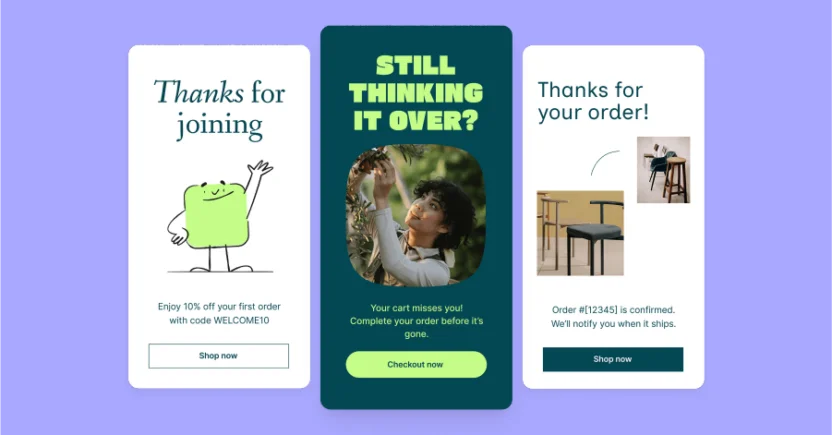
A multi‑channel marketing platform tailored specifically for Ecommerce brands, Omnisend combines email marketing, SMS, and automation into a single dashboard. For Shopify stores, Omnisend’s native integration allows marketers to pull product details directly into campaigns without extra setup, making personalized messaging effortless.
Pros
- Generous Free Plan: Omnisend offers a free plan with near-full functionality. Although you don’t get a large contact list or big send allowance on this free plan, you do get all the features you’d normally get on the paid plan.
- Excellent Email Editor: Omnisend’s drag-and-drop editor has a user-friendly design and feels native for Ecommerce stores. For instance, one of its features, Product Picker, allows you to pull product images, links, and descriptions from your Shopify catalog. Little things like this show this platform’s focus on helping Ecommerce stores make the best from email marketing.
- Good Template Library: Omnisend offers Shopify stores more than 100 form templates for capturing email addresses. These templates are customizable and make it easier for marketers to design forms that increase reach and convert leads.
- Competitive Pricing and Transparent Scaling: Omnisend’s pricing is quite affordable, and its entry-level tier includes features you’ll only find on higher-priced competitors’ tiers. Additionally, the platform uses transparent pay-as-you-go pricing.
Cons
- Relatively Weak Analytics and Testing Tools: While you get the basics of reporting from Omnisend, it falters in multivariate testing. And while you might get CLV insights from the platform, it lacks the predictive capabilities of its competitors.
- Limited Marketing Features: Omnisend focuses primarily on Ecommerce campaigns, so it won’t handle content marketing or social campaigns.
Pricing
Free: For 250 contacts and up to 500 monthly emails
Standard: $11.2 per month
Pro: $41.30 per month
Best For
Omnisend is best for small- to mid-sized Shopify stores that want affordable email and SMS without paying a lot.
4. Shopify Messaging
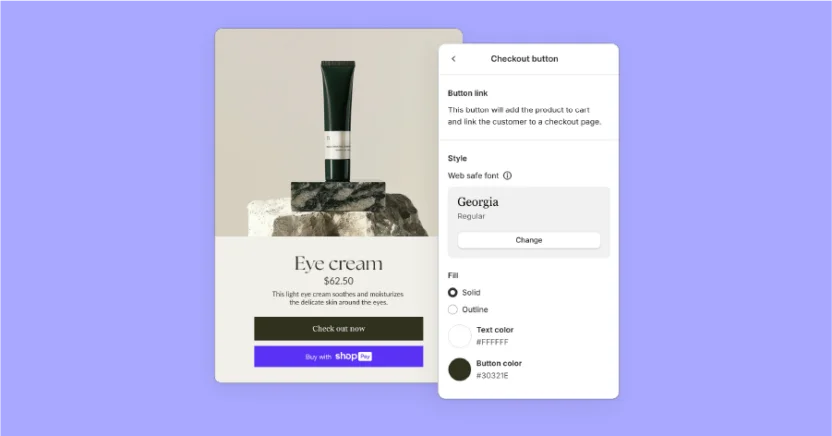
Shopify Messaging is Shopify’s own built‑in email marketing tool, fully integrated into the Shopify admin experience. It removes the need for third‑party connectors or complicated installations, allowing merchants to launch campaigns directly from their store’s dashboard. With its AI‑powered copy suggestions, pre‑built templates, and pay‑as‑you‑go pricing, Shopify Messaging offers an accessible starting point for small and growing stores, while maintaining tight alignment with existing Shopify operations.
Pros
- Easy to Set Up: After installation, Shopify Messaging lives entirely inside your Shopify admin. You don’t have to worry about things like external accounts, API keys, DNS verification, or billing setup. Furthermore, everything on your store, from branding to products and pricing, syncs automatically.
- 10,000 Free Emails Every Month: Another advantage is that the first 10,000 emails per month are free on all Shopify plans, with additional emails costing $1 per 1,000 sent. There’s no time limit on this allowance and no separate subscription needed. If you’re a small store sending, for example, 1 campaign per week to 2000 subscribers, this platform is free.
- Shopify Magic AI Built Right In: Shopify Magic supports AI-generated email subject lines, campaign copy, and optimized send times through Shopify Email, all available at no additional cost. Sidekick, Shopify’s broader AI assistant, can set up campaigns, query your store’s performance data, and even make admin changes via natural language prompts.
- Pre-Built Automations That Work Out of the Box: Shopify Email includes pre-built automations for welcome series, abandoned cart, and win-back campaigns, ready to activate from the dashboard.
- Transparent, Pay-As-You-Go Pricing: Unlike Mailchimp’s contact-count billing or Klaviyo’s profile-based scaling, Shopify Email charges only for emails actually sent beyond the free 10,000 allowance. If you send 15,000 emails in a month, you pay $5 extra, so no surprise tier upgrades, no inflated billing for inactive contacts.
Cons
- Thin Template Library: This platform has a thin template library, meaning its basic functionality can quickly become outgrown as brands scale. There’s no seasonal library, no industry-specific layouts, and every campaign risks looking identical to every other Shopify Email campaign.
- No A/B Testing: Unfortunately, you can’t split-test subject lines, preview text, content variations, send times, or CTAs in either campaigns or automations.
- Shallow Analytics: Another drawback of this platform is its lack of in-depth analytics and reporting features. You don’t get lifecycle stage analysis, customer-level CLV prediction, cohort analysis, and or comparison against industry benchmarks.
Pricing
Free: 10,000 emails per month included on all paid Shopify plans (Basic at $39/mo, Grow at $105/mo, Advanced at $399/mo, Plus)
Paid: $1 per 1,000 additional emails beyond the free monthly allowance
Best For
Shopify Messaging is best for small and/or new Shopify merchants and stores. It’s a great starter option, however, as we’ve pointed out, your growth can very quickly require you to migrate to a more robust email marketing platform like MoEngage.
5. Mailchimp
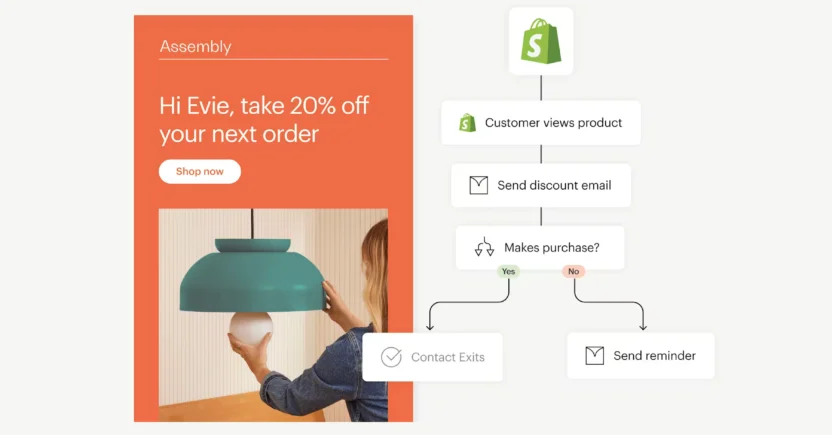
Mailchimp is one of the most-recognized email marketing apps for Shopify, offering a suite of tools spanning email, SMS, landing pages, and even lightweight website building. Known for its approachable interface and extensive template library, Mailchimp caters to marketers of all skill levels. For Shopify merchants, it provides quick setup and easy design tools, though its Ecommerce automation depth lags behind platforms built specifically for online retail.
Pros
- Beginner-Friendly Email Editor: Mailchimp’s website and interface are easy to use. But its standout performer is the drag-and-drop email builder. Even with hardly any lick of technical know-how, it’s easy to produce polished, professional-looking campaigns in just a couple of minutes. With 100+ templates and an AI Creative Assistant that pulls brand colors, logos, and fonts directly from your website, it’s an excellent platform to get up and running.
- Time Warp Scheduling: Time Warp is one of Mailchimp’s best features because it delivers emails to every subscriber at the same local time, regardless of time zone. It delivers emails based on the recipient’s time zone, consistently achieving higher open rates for global lists without requiring manual time zone segmentation.
- Great AI Features: Mailchimp’s AI features include tools for generating and optimizing email copy, design customization by applying your brand’s colors, fonts, and logos to email designs, an AI-powered automated email generator, and a send-time optimization feature. These tools work reliably for non-technical marketers and reduce the time spent on basic copywriting tasks.
- Multi-Channel Scope: Mailchimp’s expansion into SMS, Facebook, and Instagram retargeting ads, and basic website building means a small business can manage most of its marketing output from one platform. Although none of these satellite features are best-in-class, the convenience of unified reporting across email and paid social is genuinely valuable for resource-constrained teams.
Cons
- Limited Shopify Integration: Compared to Ecommerce-focused tools, Mailchimp’s integration lacks depth in terms of real-time behavioral data and event tracking.
- Basic Ecommerce Automation: Unfortunately, this platform is not ideal for advanced flows such as abandoned-cart sequences or post-purchase upsells.
- Segmentation Limitations: Its segmentation features are usable; however, they aren’t as robust or as dynamic as those of competitors like Klaviyo or MoEngage.
Pricing
- Free: 500 contacts, 1,000 emails/month
- Essentials: From ~$13/mo for 500 contacts
- Standard: From ~$20/mo for 500 contacts
- Premium: From $350/mo — unlimited audiences
Best For
Mailchimp is best for solopreneurs, content creators, non-profits, and small businesses with fewer than 1,000 contacts who need simple, well-designed email newsletters and don’t require advanced automation.
6. ActiveCampaign
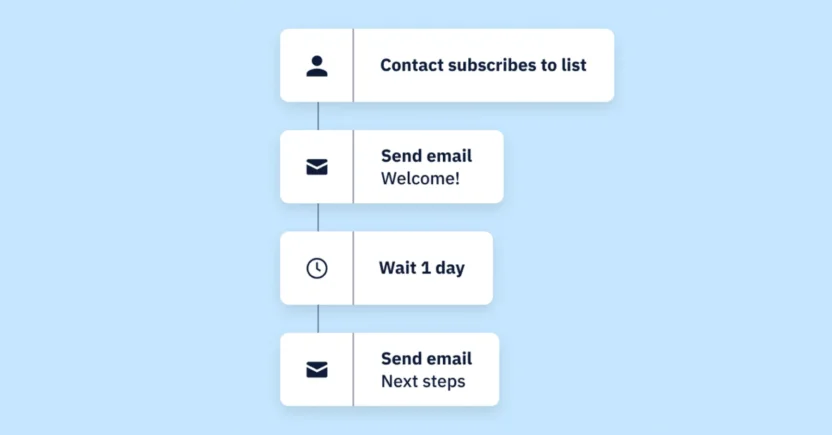
ActiveCampaign is a feature‑rich marketing automation platform that combines email marketing, CRM, and machine‑learning capabilities in one system. With its deep segmentation, predictive sending, and intent‑based targeting, ActiveCampaign enables Shopify stores to connect marketing and sales workflows while delivering highly personalized campaigns.
Pros
- Powerful Automation Builder: ActiveCampaign’s automation builder is one of the most powerful on the market, with over 130 triggers and actions, and over 500 pre-built automation recipes. Its depth of automation is unmatched for the cost.
- Great CRM Functionality: Having marketing automation and CRM in one platform eliminates the need for separate tools and ensures your marketing and sales data stays perfectly synchronized.
- Powerful AI Features: ActiveBuilder includes an AI Automation Builder that generates complete workflows from plain-language descriptions. It also uses Predictive Sending, which analyses individual contact behavior to determine the best send time, and Predictive Content, which determines which email variation each recipient is most likely to engage with.
- Leading Behavioral Trigger Capabilities: This platform’s site tracking monitors which specific pages each contact visits, allowing automations to fire based on browsing intent — for example, automatically sending a targeted follow-up email when someone visits your pricing page. This level of behavioral-trigger capability typically requires a separate customer data platform rather than competing tools.
Cons
- Short Trial: Although there’s a 14-day trial, it is limited to 100 contacts and 100 emails, which isn’t enough to build and properly test before committing to a paid plan.
- Steep Learning Curve: The platform is feature-rich but can feel overwhelming, especially for beginners.
Pricing
Starter: From $15/mo for 1,000 contacts
Plus: From $49/mo for 1,000 contacts
Pro: From $79/mo for 1,000 contacts
Enterprise: From $179/mo for 1,000 contacts
Best For
This platform is best for brands that need advanced automation and CRM capabilities alongside email marketing.
7. Drip
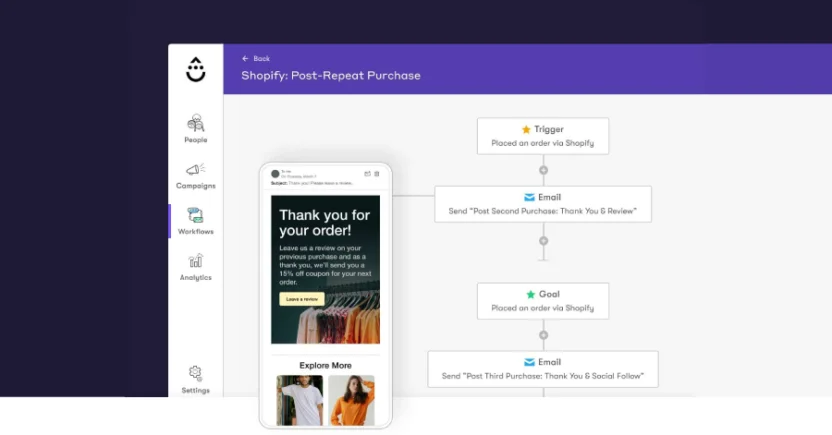
Drip is a Shopify email marketing tool with a strong focus on behavior‑driven workflows and dynamic segmentation. Shopify merchants can use Drip to track customer actions, purchases, and browsing patterns, then feed this data into personalized automations such as abandoned-cart, browse-abandonment, and post-purchase-upsell automations. Designed for marketers who want more control over targeting and attribution, Drip offers a balance of advanced capabilities and user‑friendly design, making it a natural step up from entry‑level email tools.
Pros
- Advanced Behavior-Based Automation: Drip lets you trigger workflows based on real user actions (e.g., purchases, browsing, engagement), enabling highly targeted campaigns that adapt to customer behavior.
- Dynamic Segmentation That Updates Automatically: Drip continuously updates audience segments based on behavior, engagement, and purchase data, ensuring emails are always relevant without manual updates.
- Pre-Built Ecommerce Workflows: Includes ready-made automation templates like abandoned cart, onboarding, and browse abandonment, allowing you to launch revenue-generating flows quickly.
- Visual Workflow Builder: Despite its advanced features, Drip emphasizes ease of use with a visual builder and guided setup, making it more accessible than some enterprise tools.
Con
Learning Curve for Advanced Features: Although easier than some other tools, building effective automation and segmentation strategies still requires time and experience.
Pricing
Free: 14-day trial only
Paid: Starts at $39/month
Best For
Drip is best suited for Shopify Ecommerce stores that have outgrown less powerful platforms and want granular revenue attribution and behavior-based automation.

How to Choose the Right Shopify Email Marketing Tool
With so many email marketing apps for Shopify, it can be tempting to choose the one with the most features or the lowest starting price. But what are the key features to look for?
For mid‑market and enterprise B2C brands, the real differentiator is how well the platform aligns with your store’s needs and growth ambitions. From integration quality to automation depth, the tools you choose will directly impact your ability to convert browsers into buyers and keep customers coming back.
Below, we outline the key factors that separate the truly top‑tier Shopify email marketing platforms from the rest — criteria worth considering before you commit to a long‑term vendor.
- Deep Shopify email marketing integrations: Your email marketing app must offer deep, useful integrations with Shopify. For starters, it must natively sync real-time data, such as products, customer behavior, and orders. When choosing a Shopify email marketing tool for your store, consider whether it can sync real-time browsing data, trigger flows from Shopify Flow events, and pull in product variants, not just product titles.
- Automation workflows: Whatever Shopify email marketing tool you choose should also support automated email marketing campaigns. It should include prebuilt Ecommerce flows for order confirmations, shipping updates, and refund information. It should support advanced workflow logic, such as conditional splits, branching, and delays, too. It’s also helpful to have a visual builder and the ability to trigger flows from real purchases and browser behavior.
- Segmentation and personalization: Another thing to look for in your best email marketing software for Shopify is its segmentation and personalization capabilities. You want a tool that provides dynamic, behavior-based segmentation. You should be able to create customer segments based on purchase history, email engagement, browsing behavior, and more. The best options on the market, like MoEngage, let you track products that customers have viewed but not bought, create prebuilt segments for you as soon as you import them from Shopify, and automatically update them based on customer behavior.
- Deliverability and sender reputation: It doesn’t matter how well-crafted your campaign is if it ends up in the spam folder of your contacts. Therefore, before choosing your solution, verify that the provider has a strong email sender reputation and robust inbox placement compliance tools. When looking for the best email marketing platform for Shopify, look for SPF, DKIM, and DMARC authentication support, a dedicated email deliverability team and dashboard, and list hygiene tools.
- Reporting and attribution: Without robust, accurate reporting, your email marketing campaign becomes less precise and drifts into guesswork. So look for a platform that has reporting tools that let you see exactly what is working and what isn’t. It should, for example, include features such as A/B testing insights and customer journey tracking.
- Easily customizable templates: The best email marketing software for Shopify should include templates for the most common marketing scenarios, such as promotional campaigns and cart abandonment email templates. These templates can be tailored to your brand’s aesthetic and tone, helping you achieve greater engagement. MoEngage’s HTML builder can help you create campaigns from scratch, or you can use the drag-and-drop email builder to create beautiful and engaging campaigns.
- Pricing: Pricing can start attractive and affordable, but can quickly become prohibitively expensive as your customer base grows. So, look for clear pricing information before committing to any tool. Watch out for hidden costs for reporting, AI, or automation.
Shopify Email Marketing Integrations That Matter
We have repeatedly emphasized the importance of choosing a Shopify email marketing tool that integrates seamlessly with Shopify. In this section, we’ll consider 3 of the must-have integrations.
Shopify + customer data/segmentation integrations
Customer data/segmentation integrations are vital because they enable your email marketing software of choice to send highly targeted, revenue-driving emails rather than generic, forgettable messages. MoEngage’s Shopify integration, for example, allows you to integrate the MoEngage Web SDK into your brand’s Shopify store.
With the integration, you can create dynamic customer segments based on attributes and behaviors, such as purchase history, demographics, and browsing history. MoEngage also supports RFM (Recency, Frequency and Monetary value) segmentation, allowing you to segment customers into loyal, new, idle, and at-risk directly from purchase data.
Shopify + SMS / push integrations
SMS and push notification integrations are some of the strongest features of products like MoEngage. With this integration, you can leverage a variety of channels, including on-site messaging, web personalization, web push notifications, SMS, and, of course, email. This integration allows you to reach customers by triggering cross-channel campaigns.
MoEngage’s proprietary Push Amplification+ increases your push notification delivery rate by bypassing device-level restrictions that can cause other push notifications to be silently dropped.
Furthermore, with Merlin AI, MoEngage can determine each customer’s most preferred channel, increasing the likelihood that your campaign reaches targeted customers.
Shopify + analytics/attribution integrations
Analytics and attribution tools and integrations help you identify what’s actually driving your conversions; hence, your Shopify email marketing tool must offer these integrations.
The analytics dashboard must provide in-depth information to analyze and understand the customer journey across the website, mobile apps, and web apps.
For instance, MoEngage offers behavioral analytics, retention cohort tracking, RFM segmentation, conversion funnel analysis, and more, all of which are actionable from the campaign creation screen.
5 Shopify Email Marketing Tool FAQs
1. What is the best email marketing platform for Shopify?
The best email marketing platform for Shopify depends on your Shopify store’s size, channels, and automation needs. Mid‑market and enterprise stores often look for tools with deep Shopify integrations, advanced segmentation, omnichannel messaging, and robust reporting. Popular options among Shopify merchants include MoEngage, Klaviyo, Omnisend, and ActiveCampaign, each offering different strengths in marketing automation and personalization.
2. Which is the best email marketing software for Shopify for growing brands?
For growing Shopify brands, the ideal email marketing software scales with your customer base and adds new channels without disrupting workflows. Look for platforms that combine email with SMS, push notifications, and real‑time personalization, plus powerful segmentation and analytics.
Tools like MoEngage or Drip are often considered by expanding Ecommerce brands because they can handle more complex automation and larger datasets over time. If you’re a growing brand planning to expand into channels like web personalization or web push notifications, starting with MoEngage can help you avoid the complications of migrating to another marketing solution as your brand grows.
3. Which Shopify email marketing integrations matter most?
The email marketing integrations that matter most are those that close Shopify’s biggest native gaps:
- Customer data & segmentation: Real‑time syncing of browsing, purchase, and engagement behavior.
- SMS & Push: Multi‑channel messaging that supports revenue recovery and retention.
- Analytics/Attribution: Transparent performance tracking and customer journey insights that align marketing activity with actual sales results.
4. Is Shopify Email enough for Ecommerce growth?
Shopify Email is a good starting point due to the free allowance and easy setup. However, it lacks key features such as A/B testing, limited analytics, and poor deliverability at scale. Most Ecommerce stores soon outgrow it and need to migrate to more powerful options like MoEngage, Omnisend, or Klaviyo.
5. How much do Shopify email marketing tools cost?
Costs vary widely by list size, feature depth, and needs:
- MoEngage: Uses a Monthly Tracked Users (MTU) model, meaning costs are tied to actual engaged users rather than the total database size. This structure can be more predictable for brands managing large but inactive contact lists.
- Shopify Email: Free up to 10,000 emails/mo, then $1/1,000 additional emails
- Omnisend: From $16/mo for 251-500 contacts and up to 6K monthly emails
- Mailchimp: From $13/mo
- Drip: From $39/mo for unlimited monthly email sends to up to 2,500 contacts
- ActiveCampaign: From $15/mo for 1K email contacts and limited segmentation
- Klaviyo: Free for up to 250 contacts and 500 email sends/mo; Paid plans start at $20 for 251-500 contacts and 5K emails/mo

Choose the Best Shopify Email Marketing Tool Today
The best Shopify email marketing tool is the one that matches your current needs and growth plans.
To get the best results, it’s vital to choose a solution that delivers quick campaign automation in email, that connects every channel, transcends beyond generic journey flows, and has a dedicated support team as you grow.
MoEngage’s native Shopify integration, MTU pricing, powerful segmentation, and omnichannel capabilities make it easier for your business to grow without paying more than you should.
Schedule a demo to see how MoEngage can help you manage your email marketing campaigns and seamlessly integrate them into your overall Shopify marketing strategy.
The post 7 Best Shopify Email Marketing Tools: Features & Pricing appeared first on MoEngage.
[ad_2]
Source_link