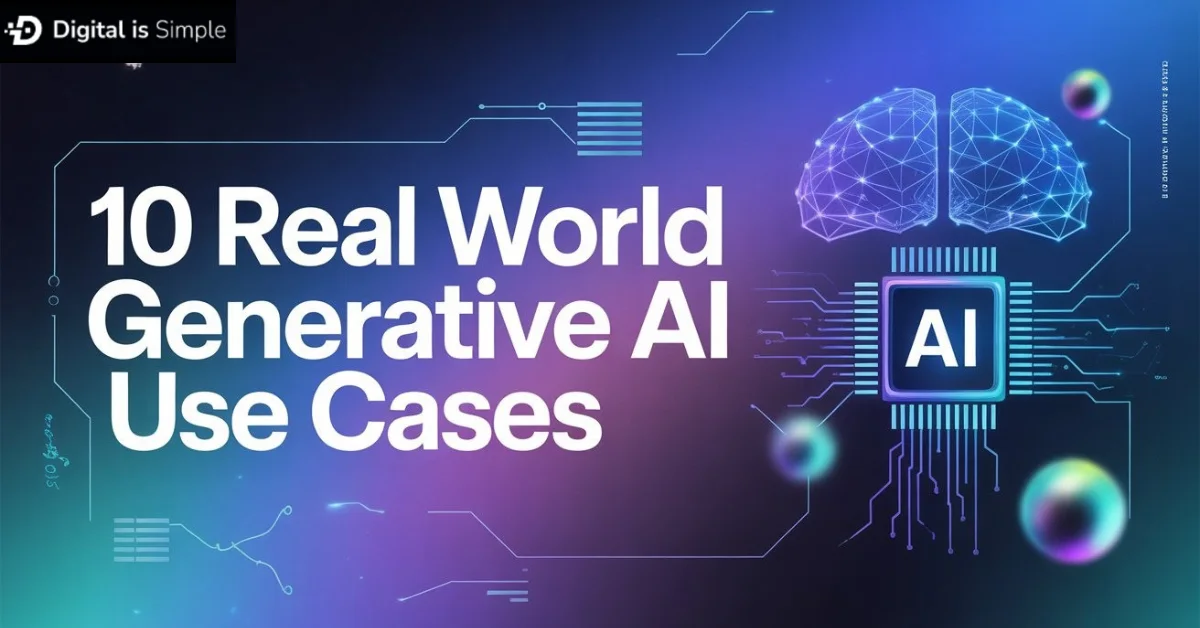
Artificial intelligence is no longer a future promise. It is happening right now, across every industry, and at a pace that few predicted even two years ago. According to Statista, the generative AI market is experiencing exponential growth, driven by increasing enterprise adoption and advancements in AI technologies.
If you have been wondering how generative AI use cases translate from research papers into real business outcomes, this blog is for you. We break down 10 industries where generative AI is making a tangible difference right now, with real examples, clear business impact, and no unnecessary jargon.
Whether you are a startup founder, a product manager, or a business leader exploring your next strategic move, this guide will help you see exactly where generative AI applications are delivering value today.
Top 10 Generative AI Use Cases in 2026
Let’s explore the most impactful use cases of generative AI transforming industries in 2026.
1. Healthcare
What it is: Generative AI in healthcare helps doctors, researchers, and hospital systems process large volumes of clinical data to improve patient outcomes.
How generative AI is used: AI models generate diagnostic summaries from patient records, assist radiologists in reading medical scans, accelerate drug discovery by predicting molecular behavior, and create personalized treatment plans based on patient history.
Real-world example: Google’s Med-PaLM 2 is being used in clinical trials to answer complex medical questions with accuracy comparable to licensed physicians. Hospitals are using AI to reduce misdiagnosis rates and cut time-to-diagnosis significantly.
Business impact: Reduced clinical workload, faster diagnoses, and lower operational costs.
2. Marketing and Content Creation
What it is: One of the most widely adopted generative AI applications today, AI-powered content generation helps marketing teams produce blogs, ads, product descriptions, and social posts at scale.
How generative AI is used: Brands use large language models to draft campaign copy, generate A/B test variants, personalize email sequences, and create short-form video scripts automatically.
Real-world example: Coca-Cola used generative AI to co-create a holiday campaign, letting consumers interact with AI to generate personalized ad content. Jasper AI and Copy.ai now serve thousands of marketing teams globally.
Business impact: Content teams report up to 70 percent faster production cycles and reduced dependency on large creative agencies for routine content work.
3. Customer Support
What it is: AI chatbots and voice assistants powered by generative models now handle millions of customer interactions every day across industries.
How generative AI is used: Instead of scripted chatbots, generative AI understands context, handles follow-up questions, resolves complaints, and escalates complex issues to human agents intelligently.
Real-world example: Klarna reported that its AI assistant now handles the workload equivalent of 700 full-time agents and resolves most queries in under 2 minutes.
Business impact: Lower support costs, faster resolution times, and improved customer satisfaction scores across digital channels.
4. Software Development
What it is: AI-assisted coding tools help developers write, review, debug, and document code significantly faster than before.
How generative AI is used: Tools like GitHub Copilot and Amazon CodeWhisperer suggest code in real time, generate unit tests, explain legacy code, and identify security vulnerabilities automatically.
Real-world example: GitHub reports that developers using Copilot complete tasks up to 55 percent faster. Major tech companies have embedded AI coding assistants into their development pipelines as a standard practice.
Business impact: Faster product delivery, fewer bugs in production, and reduced onboarding time for new engineers joining complex codebases. Understanding the right generative AI technology stack is key to integrating these tools effectively.
5. E-Commerce
What it is: Generative AI is transforming how online retailers manage product discovery, personalization, and content at scale.
How generative AI is used: AI generates personalized product recommendations, creates unique product descriptions for thousands of SKUs, powers visual search features, and simulates virtual try-on experiences for fashion and beauty brands.
Real-world example: Amazon uses generative AI to create product listing summaries and review highlights, while Shopify offers AI-powered storefront personalization tools to merchants of all sizes.
Business impact: Higher conversion rates, lower cart abandonment, and dramatically reduced time spent on product content operations.
6. Finance
What it is: Banks, insurance companies, and investment firms are using generative AI for fraud detection, report generation, risk analysis, and customer advisory services.
How generative AI is used: AI generates financial reports from raw data, summarizes earnings calls, flags suspicious transaction patterns, and provides personalized financial advice through conversational interfaces.
Real-world example: JPMorgan Chase’s COiN platform uses AI to review commercial loan agreements in seconds, a task that previously took legal teams over 360,000 hours annually.
Business impact: Massive reduction in manual processing time, improved compliance accuracy, and better fraud detection with fewer false positives.
7. Education
What it is: Generative AI is reshaping how students learn and how educators teach, moving toward more personalized and adaptive learning experiences.
How generative AI is used: AI tutors adapt to each student’s learning pace, generate practice questions, provide instant feedback on essays, and help teachers create lesson plans and assessments automatically.
Real-world example: Khan Academy’s Khanmigo is an AI tutor that guides students through problems using the Socratic method, rather than simply giving answers. Duolingo uses AI to personalize language learning paths for over 50 million active users.
Business impact: Improved learning outcomes, reduced educator workload, and greater accessibility of quality education across income levels and geographies.
8. Gaming and Entertainment
What it is: The gaming and entertainment industries are using generative AI to create dynamic content, realistic characters, and immersive interactive experiences.
How generative AI is used: Game studios use AI to generate open-world environments, create non-player character (NPC) dialogue in real time, produce background music, and test games automatically for bugs and balance issues.
Real-world example: NVIDIA’s ACE (Avatar Cloud Engine) brings AI-generated, contextually aware dialogue to game characters. Netflix uses generative AI for content personalization and thumbnail optimization across 270 million subscribers.
Business impact: Lower game development costs, richer player experiences, and new revenue streams from dynamically generated in-game content.
9. Manufacturing
What it is: Manufacturers are applying generative AI to design, quality control, predictive maintenance, and supply chain optimization.
How generative AI is used: AI generates optimized product designs based on engineering constraints, monitors equipment health in real time to predict failures, and creates simulation models for testing manufacturing processes before physical prototyping.
Real-world example: Airbus uses generative design AI to create aircraft partition walls that are 45 percent lighter than conventional designs. Siemens uses AI-powered digital twins to simulate factory operations and identify bottlenecks before they occur.
Business impact: Reduced material waste, fewer production stoppages, faster time-to-market for new products, and significant cost savings on prototyping.
10. Legal
What it is: Law firms and legal departments are using generative AI to handle document-heavy tasks that traditionally required hundreds of billable hours.
How generative AI is used: AI reviews contracts, flags risky clauses, drafts standard legal documents, conducts case law research, and prepares deposition summaries at a fraction of the time a human associate would need.
Real-world example: Harvey AI, built on GPT-4, is used by global law firms like Allen and Overy to assist with legal research and contract analysis. LexisNexis has integrated generative AI into its legal research platform used by thousands of attorneys globally.
Business impact: Faster turnaround on legal work, reduced billing hours, lower costs for clients, and improved consistency in document review quality.
Why Businesses Are Adopting Generative AI in 2026
The adoption of generative AI in business is accelerating for four primary reasons.
- Automation at scale: Tasks that once required entire teams, from writing to coding to data analysis, can now be automated without sacrificing quality.
- Cost savings: Companies report significant reductions in labor costs for repetitive, high-volume tasks. The generative AI development cost in 2026 has also become more accessible for businesses of all sizes.
- Productivity gains: Employees augmented by AI tools consistently outperform those without, and the productivity delta is growing wider every quarter.
- Competitive pressure: As more companies integrate AI, those that do not are at risk of falling behind in speed, cost efficiency, and customer experience.
The real-world generative AI examples we covered above are not isolated experiments. They represent a structural shift in how modern businesses operate.
How to Get Started with Generative AI
Starting with generative AI does not mean rebuilding your entire business overnight. Here is a practical, business-focused approach.
- Identify one high-impact use case: Look for a process in your business that is repetitive, data-heavy, or bottlenecked. Start there.
- Audit your data readiness: Generative AI needs clean, structured data. Assess what you have and what you need before building anything.
- Choose your approach: Decide whether to use an off-the-shelf API, fine-tune an existing model, or build a custom solution. Understand the full generative AI development process before committing to a direction.
- Build a prototype and measure: Start small. Deploy a minimum viable AI feature, measure its impact, and iterate based on real results.
- Scale with governance: Once you see results, build AI governance frameworks, establish monitoring, and expand thoughtfully across your organization.
Most successful AI adopters started with a single, well-defined problem. They built confidence and capability before scaling to enterprise-wide transformation.
Conclusion
Generative AI is no longer something for the future. It is already helping businesses work faster, reduce costs, and improve results across different industries.
As you saw in these examples, the real value of generative ai use cases comes from solving simple business problems in a smarter way. You do not need to start big. Just pick one use case, test it, and improve from there.
If you want to turn these ideas into real solutions, working with experts in generative AI development services can help you build the right system for your business needs.
FAQ
1. What are the most practical generative AI use cases for businesses in 2026
The most practical generative ai use cases include content creation, customer support automation, software development, and personalized recommendations. These areas deliver quick returns and are easier to implement compared to more complex use cases like drug discovery.
2. How do companies choose the right generative AI use case
Businesses typically start by identifying repetitive and time-consuming tasks. The best use cases are those where AI can reduce manual effort, improve accuracy, and scale operations without increasing costs.
3. Are generative AI applications expensive to implement
The cost depends on the complexity of the solution. Simple implementations using APIs are relatively affordable, while custom solutions require more investment. However, costs have become more accessible, making AI adoption feasible for mid-sized companies as well.
4. Which industries benefit the most from generative AI
Industries like healthcare, finance, retail, and technology are currently seeing the highest impact. However, adoption is growing rapidly across manufacturing, education, and legal sectors as well.