
Key takeaways:
- The operating model determines survival. The code does not.
- Compliance under PDPL in the UAE and SDAIA in Saudi Arabia must be engineered into architecture, not added before launch.
- A serious build costs between AED 147,000 and AED 1,470,000 (USD 40,000 to USD 400,000), depending on scope.
- The single largest cost most operators underestimate is the wrong team. Rework consumes 30 to 40 percent of the budget.
In March 2025, Yalla Market closed. The Dubai dark store operator had run for four years, raised roughly AED 36.7 million (USD 10 million), and built micro-fulfillment infrastructure across JLT, Business Bay, and JVC. Its founder, Leo Dovbenko, stated the reason directly in a public LinkedIn announcement: the team could not construct a sustainable economic model quickly enough to outlast its capital.
Yalla Market is not the exception. The pattern it represents is the rule for dark store operators across the Gulf.
The cause of failure is rarely technology. It is the distance between what an operating model promises on a spreadsheet and what it can sustain under live conditions. Order surges exceed queue capacity. Dispatch logic degrades in dense vertical neighborhoods. Real estate costs grow faster than order density. The platform that ignores these realities at the architecture stage cannot recover them through later optimization.
Avoid making the mistake Yalla Market made
Talk to experts and spend right.

What Are the Steps to Build a Dark Store Hyperlocal Delivery Platform?
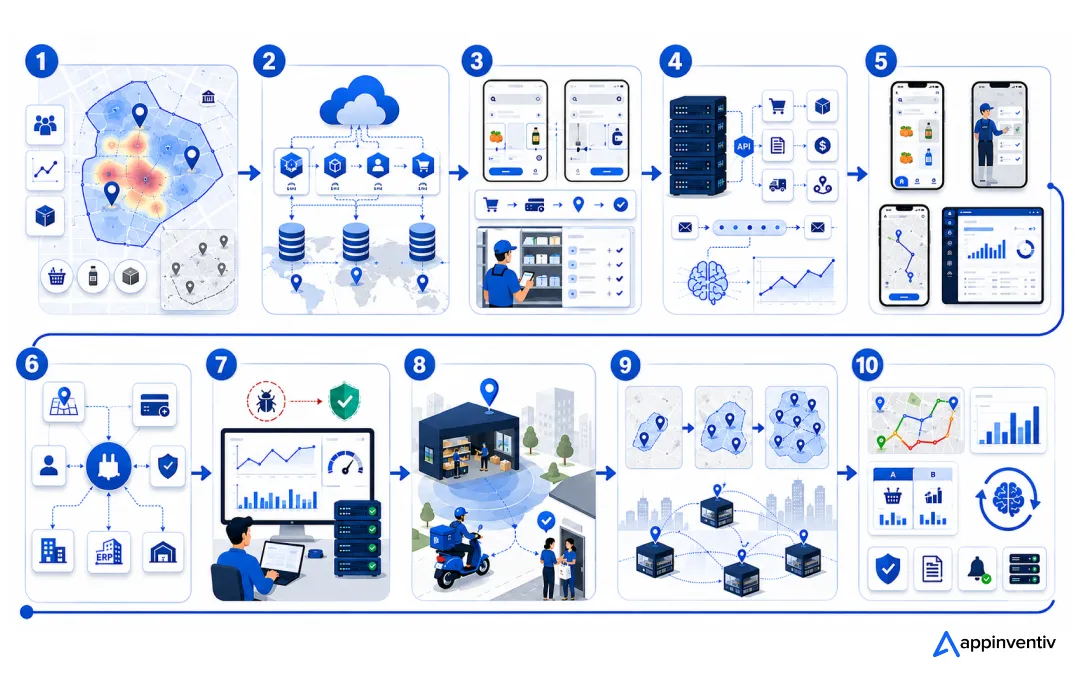
The steps follow a sequence that has been validated repeatedly in the region. Features and technology decisions belong inside each step, not in separate documents detached from the work they describe.
1. Product discovery and zone analysis
The first task is empirical, not creative. Map service zones, SKU velocity, payment patterns, language preferences, and competitor coverage before any code is committed. Zones unable to clear 150 daily orders should be abandoned at this stage, not after a year of operation.
This phase also defines the customer-facing feature set: personalized catalog, geofencing for SKU availability, Ramadan slot management, and bilingual Arabic-English UX with proper Khaleeji copy.
2. Technical architecture planning
Microservices outperform monoliths for multi-country Gulf rollouts because each country imposes its own payment rails, tax logic, and compliance requirements.
The working technology stack for dark store platforms is consistent across serious operators:
- Node.js, Python (Django or FastAPI), or Go for backend services;
- PostgreSQL for relational integrity;
- MongoDB for catalog;
- Redis for caching and queues;
- Kafka or RabbitMQ for event streaming;
- WebSockets and MQTT for real-time tracking.
Hosting belongs in regional zones (AWS Bahrain, Azure UAE North, Google Cloud Dammam) to satisfy data residency. The same patterns govern logistics software development for Dubai and the development of transportation apps like Aramex. Some complexities overlap multiple industries.
3. UX and UI design
Bilingual flows, right-to-left layout, and culturally fluent iconography are not decorative. They determine whether a Gulf user completes checkout. The Friday-Saturday weekend and the Iftar order surge must shape slot logic before the first wireframe is approved.
Customer-side features take their final form at this stage: real-time order tracking, one-tap reorder, multi-address support, in-app chat, and payment options spanning cards, Apple Pay, Samsung Pay, Tabby, Tamara, PayTabs, HyperPay, and cash on delivery.
The picker app deserves equal investment. A poorly designed picker workflow turns a 25-minute pack into an hour and destroys unit economics.
4. Backend development.
The backend must be designed for elasticity. Iftar order volume exceeds the normal peak by a factor of four to five within ninety minutes. Queues, caches, and connection pools that cannot absorb that load will fail at the moment of greatest commercial exposure. Core services include catalog, inventory, order management, payment, dispatch, rider management, geofencing, notifications, and analytics.
AI dispatch and demand forecasting belong in the architecture from the start, which is why teams offering AI development and integration services typically embed during this phase rather than after.
5. Frontend and mobile development
Sub-two-second first meaningful paint is the operational floor in Gulf markets. Cross-platform Flutter or React Native covers most use cases at a lower cost. Native Swift and Kotlin remain warranted for camera, AR, and deep payment integrations. The four-app system (customer, picker, rider, admin) should share a common design system and component library, so updates propagate without weeks of re-skinning.
6. API and integration layer
Integrate maps through Google Maps Platform, Mapbox, or HERE. Payments through Network International, Checkout.com, Telr, PayTabs, or Tap. Identity through the UAE Pass or the Saudi Absher. ERP, POS, and WMS hooks for store-owned operators. Each integration is a versioned contract that will outlast the engineers who built it. Document and test accordingly.
7. Quality assurance and load testing
Effective testing assumes failure. Load test to ten times the projected peak, then break the system deliberately. The failures that matter are payment reconciliation errors, partial refund flows, GPS drift in tower clusters, address mismatches in older neighborhoods, and rider connectivity loss in basement loading bays. The gap between “demo works” and “production survives” is closed here.
8. Pilot deployment
Deploy in one or two zones first. Riders, stores, and customers each require shakedown time. The assumptions that fail in the pilot are cheap to correct. The same assumptions failing post-launch are not. Most remediation engagements trace back to a skipped pilot.
9. Phased rollout
Zone by zone, not city by city. Each new zone presents its own density problem. The instinct to replicate a working Dubai zone in Sharjah or Riyadh without rerunning the discovery phase produces predictable failures.
10. Continuous optimization
Plan for quarterly routing refresh, monthly model retraining, annual compliance audit, and ongoing A/B testing of checkout, cart, dispatch, and promotional flows. Operators who treat post-launch as half the project remain operational at year three. Those who do not, do not.
How Much Does It Cost to Develop a Dark Store Hyperlocal Delivery App?
The cost to build a dark store hyperlocal delivery app is determined by scope, not ambition. A single-city app cannot be compared meaningfully to a multi-country platform with proprietary AI dispatch. The cost breakdown by complexity follows three tiers in the region:
| Tier | Scope | AED | USD | Build Time |
|---|---|---|---|---|
| Single-city pilot | One zone, catalog, real-time tracking, single payment rail, manual dispatch | 147,000 to 294,000 | 40,000 to 80,000 | 3 to 5 months |
| Mid-tier hyperlocal | Multi-zone, multi-payment, picker app, basic routing AI, bilingual UX | 330,000 to 660,000 | 90,000 to 180,000 | 6 to 9 months |
| Enterprise dark store / Q-commerce | Multi-country, AI dispatch, predictive inventory, full compliance, advanced analytics | 735,000 to 1,470,000+ | 200,000 to 400,000+ | 9 to 14 months |
For Saudi-anchored teams, the tiers translate to SAR 150,000 to SAR 300,000 at the basic level and above SAR 750,000 at the enterprise level. The numbers align with documented quick commerce platform development projects.
Cost breakdown by region introduces a second variable. Pure Western European or North American builds run two to three times higher. The structure that consistently produces results is hybrid: senior architects and product leadership based in Dubai or Riyadh, with execution teams in Bangalore or Hyderabad.
That structure delivered the seven KFC food delivery apps shipped across the UAE, KSA, Kuwait, Qatar, Bahrain, and Oman in twelve months.
The total cost of ownership is the metric most operators underestimate. The build invoice is the smaller half of the lifecycle expense:
| Ongoing Cost | AED per year | USD per year | What It Covers |
|---|---|---|---|
| Cloud hosting | 66,000 to 330,000 | 18,000 to 90,000 | Scales with order volume and country footprint |
| API usage (maps, SMS, payments) | 44,000 to 220,000 | 12,000 to 60,000 | Maps and OTP gateways drive the bulk |
| Analytics and automation tools | 30,000 to 150,000 | 8,000 to 40,000 | BI, monitoring, observability |
| Ongoing support and maintenance | 15% to 25% of the build cost | Same | Bug fixes, version upgrades, security patches |
| Region-specific compliance | 37,000 to 185,000 | 10,000 to 50,000 | PDPL audits, DPO retainer, penetration testing |
| AI/ML model retraining | 55,000 to 275,000 | 15,000 to 75,000 | Forecasting and dispatch model upkeep |
Last-mile cost optimization is the single largest lever on ongoing economics. Last-mile delivery expanded from 41 percent to 53 percent of total shipping costs between 2018 and 2023, per Statista.
Avoid spending millions on a team that hasn’t tested local waters.
We are here, in the heart of Dubai and in other ME locations, ready to assist you with your requirements.

How Do You Stay Compliant Across the UAE, KSA, and the Wider Middle East?
Compliance is an architectural decision, not a launch task. A platform that treats it otherwise will face regulatory exposure that no later remediation can resolve cleanly.
UAE
Federal Decree-Law No. 45 of 2021, the PDPL, is the country’s first comprehensive data protection framework, per the UAE government’s official data protection page. The UAE Data Office now issues active guidance.
Fines reach AED 5 million. DIFC operates a separate regime with fines raised to USD 50,000 per violation following July 2025 amendments, per Al Ateibi Advocates’ 2025 compliance guide. ADGM maintains its own framework. Operators expanding across these jurisdictions must map data flows by regime, not by geography.
KSA
The PDPL is fully enforceable under the Saudi Data and Artificial Intelligence Authority, which issued 48 enforcement decisions during its first year of full enforcement, per the IAPP. Severe violations carry penalties up to SAR 5 million, per the Saudi Privacy Law’s 2025 regulatory update. Breach notification windows are 72 hours.
Remote access from outside the Kingdom is treated as a cross-border data transfer and requires documentation.
Wider Middle East
Bahrain (PDPL 2018), Qatar (Law No. 13 of 2016), and Oman (Royal Decree 6 of 2022) each operate distinct frameworks. Levant markets such as Jordan and Lebanon impose their own conditions on data handling. Each border resets the compliance map.
The discipline required for mobile app development in the Middle East considers these complexities significantly.
Six requirements consistently determine whether a platform survives audit:
- Customer data hosted in-region.
- Encryption at rest and in transit, with key management on regional HSMs.
- Consent captured at onboarding, designed into the flow rather than retrofitted.
- Data Protection Impact Assessments are completed before deploying AI features that involve profiling.
- A qualified DPO appointed where the law requires one.
- Data flow documentation is maintained from day one. Regulators request proof, not assurance.
The discipline transfers directly from regulated sectors. Operators building dark store platforms benefit from team members with prior exposure to fintech and healthcare compliance, where the same principles have been settled for longer.
What Are the Top Challenges in Dark Store and Hyperlocal Delivery Platforms Development, and How Are They Resolved?
The challenges in dark store and hyperlocal delivery software development are well-documented. The variable is whether the team building the platform has internalized the solutions before encountering the problems.
| Challenge | Operational Symptom | Resolution |
|---|---|---|
| Real-time tracking accuracy | GPS drift in tower clusters, signal loss in basement parking, and address mismatches in older districts | Hybrid GPS plus cellular triangulation, dead-reckoning, and bay-level address validation |
| Last-mile cost expansion | Inefficient routes, low order density, long-distance runs | Dynamic batching, AI route planning, density-driven zone design |
| Inventory visibility gaps | Stockouts, oversells, recurring refund tickets | Real-time inventory sync, computer-vision shelf scanning, IoT shelf sensors |
| Peak operational load | Iftar order surge, Eid demand spike, payday clustering | Pre-staged inventory, ML-based shift planning, surge pricing logic |
| Multi-vendor workflows | Inconsistent prep times, payment terms and stock conditions | Unified merchant dashboard, automated order routing, contract testing |
| Scalability bottlenecks | Database locks, queue backlogs and payment timeouts under load | Microservices, event streaming, autoscaling, read replicas |
| Data law compliance | PDPL, SDAIA, DIFC, ADGM, sector-specific rules | Data residency, encryption, DPO oversight, consent management |
| Modular integrations | ERP, POS, WMS, payment gateways, identity providers | API-first design, versioned contracts, contract testing |
| Real-time communication | Customer, rider, and store coordination breakdown | WebSockets, push notifications, in-app chat, IVR fallback |
| Rider retention | Driver attrition mid-shift in favor of competing platforms | Gamified earnings, instant payouts, performance scoring, shift planning |
A general principle holds across these problems. Platforms designed with failure modes in mind recover quickly. Platforms designed with the assumption that conditions will hold do not.
How Do You Hire the Right Team for Dark Store and Hyperlocal Delivery Platform Development?
The team determines the outcome. Capital, ambition, and timing matter, but they cannot compensate for the wrong people executing the work. The most expensive line item in most failed dark store builds is rework caused by an early hiring error, often consuming 30 to 40 percent of the budget before the platform reaches pilot.
Six criteria distinguish the right team from the wrong one when you decide to hire app developers in ME
- Compliance fluency. Engineers who have built in regulated sectors design naturally for audit trails, encryption boundaries, and consent capture. Engineers who have not will treat compliance as a checklist applied late. The first audit under PDPL or SDAIA will surface the difference.
- Arabic-first design capability. Right-to-left layout, dialect-appropriate copy, and culturally fluent flows are not translations of an English product. A team that treats them as translation work will produce an app that fails to convert with local users.
- Category-specific experience. A team that has shipped a banking app has not necessarily shipped a dispatch engine. Routing, geofencing, real-time inventory, and rider management form their own discipline. The right question is not whether the team has built mobile apps but whether they have shipped delivery, logistics, or quick commerce platforms in this region.
- The right blend of onshore and offshore capacity. Pure onshore in Dubai or Riyadh runs two to three times the cost of a blended team. Pure offshore eliminates time zone overlap and local context. The structure that survives across Middle East software development strategies places senior architects, product leads, and compliance counsel in the region, with execution teams operating from cost-efficient hubs.
- The right engagement model. Fixed-cost suits tightly scoped apps. Time-and-material suits evolving scopes. Dedicated teams suit long-term builds with shifting priorities. BOOT (Build, Operate, Optimize, Transfer) suits operators planning to internalize the platform within 18 to 24 months. The match between model and intent is itself a hiring decision.
- Retention discipline. Cheap teams with high attrition cost more than premium teams with stable retention. The relevant metrics are average engineer tenure, attrition rate, and demonstrated knowledge transfer practice. A single point of failure on the dispatch engine is both an operational risk and a compliance exposure.
How to Make Your Dark Store Future Ready?
Future readiness in the Gulf is no longer an operator’s private bet. It is aligned with national policy. Saudi Arabia’s SDAIA reports that 66 of the 96 direct and indirect goals of Vision 2030 are tied to data and AI, the UAE AI Strategy 2031 targets AI’s share of national GDP rising from roughly 9 percent today to 45 percent by 2031, adding an estimated AED 335 billion in value, and Qatar’s National AI Strategy and National Digital Agenda 2030 back substantial investment in AI and digital infrastructure under Qatar National Vision 2030.
Dark stores that align with these directions inherit policy tailwind. Those that do not, swim against it. Eight moves close the gap.
- Build the demand model before scaling the footprint. Train forecasting on buying behaviour, weather, Ramadan and Eid cycles, local events, and traffic before opening the next zone. Vision 2030 explicitly prioritises AI, IoT, and cloud platforms to predict demand patterns and optimise logistics routes, and the operators executing on that early will outpace those retrofitting later.
- Phase robotics into the pick line, not the pitch deck. Start with automated sorting and conveyors in the highest-volume zone, prove the unit economics, then extend. UAE AI Strategy 2031 positions the country to capture up to AED 335 billion in additional growth through AI and autonomous systems, and dark stores are among the most direct applications.
- Instrument the shelf, not just the system. Install IoT sensors for stock levels, expiry dates, and cold-chain monitoring. This earns audit credit under PDPL and SFDA without adding manual workload.
- Move dispatch from rules to learning. Replace static routing with models that read rider location, traffic, weather, and order density live. This matches what Qatar National Vision 2030 prioritises across logistics and smart systems.
- Deploy computer vision on the floor. Cameras for misplacement, damage, and shrinkage close the gap between system inventory and physical inventory, which is where most refunds originate.
- Add Arabic voice to the ordering surface. Smart speaker, in-app, and car infotainment voice flows convert in markets where typing is the friction. SDAIA has invested directly in Arabic language and character recognition through AI.
- Pilot autonomous last-mile in the right zones. Test delivery robots and drones in gated communities, mega-projects, and smart-city districts such as NEOM and Lusail before generalising.
- Engineer the supply chain to self-correct. Predictive reorders, automated vendor alerts, and dynamic route shifts turn exception handling from a daily task into a quarterly review.
Why Should You Get on a Call with Appinventiv?
The case for Appinventiv rests on demonstrated work, not on description. Over ten years in operation. 3,000+ digital products shipped. 1,600+ engineers on staff. Compliance-heavy systems delivered across fintech, healthcare, and on-demand commerce.
Regional presence as a mobile app development agency in Dubai at Meydan Grand Stand, with parallel operations in Saudi Arabia and Abu Dhabi.
Documented outcomes for regional clients include:
- Americana Group’s KFC. Seven food delivery apps shipped across the UAE, KSA, Kuwait, Qatar, Bahrain, and Oman within one year. 22 percent conversion lift. Aggregator dependency reduced from 90 percent to under 50 percent. Repeat orders up 60 percent.
- IKEA. IoT-powered ERP deployed across seven regional stores with a custom catalog and onboarding workflows.
- Adidas, 6th Street, Edamama, Edfundo. Consumer apps shaped for Gulf user behavior, language conventions, and payment patterns.
For dark store and hyperlocal delivery platform development specifically, Appinventiv provides:
- End-to-end product discovery, technical architecture, and UX shaped for Gulf operating conditions
- AI development services embedded into the platform from day one
- Real-time order tracking systems, delivery routing and dispatch systems, and backend infrastructure engineered for Iftar-scale load
- PDPL, SDAIA, SAMA, DIFC, and ADGM compliance integration into architectures
- Blended team structures combining regional leadership with execution scale
- BOOT, fixed-cost, time-and-material, and dedicated-team engagement models
Share where the platform is now, where it should be in 18 months, and the response will follow within 48 hours with technical observations, a working cost estimate, and a next-step plan. NDA-protected.
FAQs
Q. What is a hyperlocal delivery app, and how does it work?
A. A hyperlocal delivery app connects customers with nearby stores or dark stores inside a small service zone, usually two to five kilometers wide, and gets the order delivered in 10 to 30 minutes.
The app handles ordering, inventory sync, real-time dispatch, route optimization, payment, and live tracking through coordinated mobile apps for customers, pickers, riders, and admins.
Q. How much time does it take to build a hyperlocal grocery delivery app?
A. A single-city basic app usually takes three to five months. A mid-tier multi-zone platform with picker apps and routing AI runs for six to nine months. A full enterprise dark store or quick commerce build with multi-country compliance takes nine to fourteen months.
Timelines compress when teams reuse proven modules and stretch when legacy ERP, POS, or WMS integrations require custom work.
Q. How to integrate real-time inventory management in a dark store delivery app?
A. Real-time inventory management requires three layers: a centralized inventory service synced via APIs to WMS, POS, and ERP; event-driven updates that fire on every pick or restock; and computer-vision or IoT shelf scanning to catch physical-versus-system mismatches before they cause oversells.
The absence of any one layer produces recurring stockouts and refund volume.
Q. What are the essential steps to establish a dark store fulfillment center in Dubai?
A. The requirements are a commercial license aligned with warehousing and e-commerce activity through DED or a relevant free zone such as Dubai CommerCity or JAFZA, a location inside a high-density residential cluster within two to four kilometers of target customers, and a WMS integrated with the delivery platform.
Add cold storage for perishables, fast-pick racking layouts, food safety certifications, and a single-zone pilot before scaling.
Q. How do dark store models optimize delivery speed in urban areas?
A. Dark stores compress delivery time by pre-positioning high-velocity SKUs within two to three kilometers of dense residential clusters, which reduces pick time to under eight minutes.
AI dispatch assigns the nearest available rider and live route optimization for traffic and weather, then sustains 10 to 30-minute delivery windows across Dubai, Riyadh, Doha, and Kuwait City.
Q. What are the top challenges faced by dark store delivery startups in the UAE?
A. The principal challenges are high real estate costs in dense zones, unit economics that only clear above 150 orders per store per day, rider supply during Iftar and weekend surges, PDPL and free zone compliance obligations, inventory shrinkage from manual processes, and competition from well-capitalized incumbents such as Talabat Mart, Noon Minutes, and Careem Quik.
Most early-stage failures trace to launching in low-density zones, underbuilding the dispatch layer, or treating compliance as a launch-week task.