
Marketing keeps failing when you switch tactics before any single one has enough time or focus to work. The real problem is not the tactics themselves — it’s the pattern of abandoning them too soon and too often, which guarantees you never see results from any of them.
I watched a business owner do this for three years straight. Instagram one quarter, email newsletters the next, then a podcast, then paid ads, then back to Instagram. Her revenue flatlined the entire time. The tactics were not bad. The tactic-hopping was. If you recognize that marketing frustration, you’re in the right place.
What Tactic-Hopping Actually Looks Like
You see a LinkedIn post from a business coach saying TikTok is where all the buyers are now. You spend six weeks learning TikTok. Nothing happens. Someone in a Facebook group says email is dead and SEO is the only thing that scales. You start writing blog posts. Three months in, you check your analytics, see no meaningful traffic, and drop it.
Meanwhile, your competitor who started a simple referral program two years ago is getting 60% of their new clients from word of mouth. They are not smarter than you. They are not better at marketing. They picked one thing and stayed with it long enough for it to work.
This is why marketing keeps failing for so many small business owners — not because the strategies are wrong, but because they never get enough runway. If you’ve already searched “why my marketing isn’t working” and landed somewhere that told you to try harder or post more often, that advice missed the actual problem entirely.
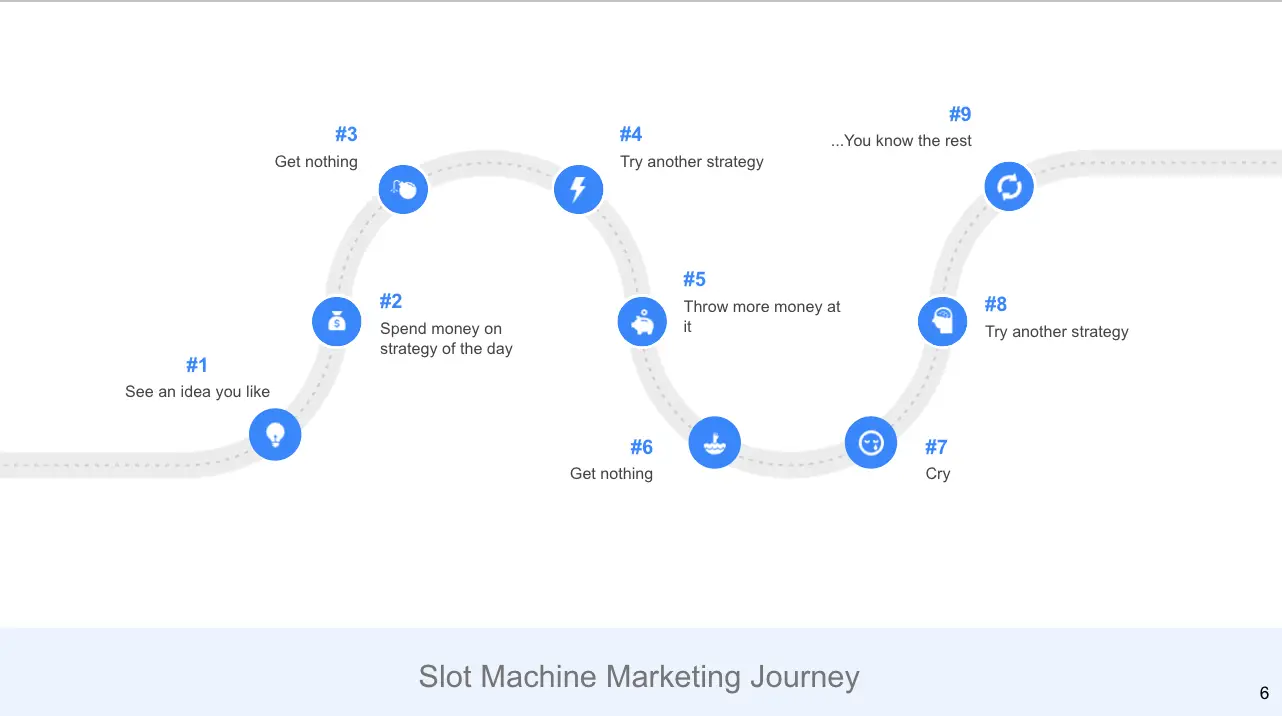
The Slot Machine Marketing Trap (And Why You Keep Falling Into It)
Picture a casino floor. You sit down at a slot machine, pull the lever three times, win nothing, and move to the next machine. Then the next. Then the one by the door that someone said was “hot.” You’re not being irrational — you’re responding to an environment designed to make you feel like the next pull might be the one.
The marketing industry is that casino floor. Every new platform, every new format, every guru declaring that this is the channel where your buyers actually are — it’s the same psychology. Pull the lever. Nothing. Move to the next machine.
Here’s what makes the Slot Machine Marketing Trap so effective at keeping you stuck: it feels like action. You are doing things. You are trying. From the outside, it looks like hustle. From the inside, it feels like effort. But activity without commitment to a timeline is not marketing — it’s sampling. And sampling never builds momentum.
The difference between a slot machine and real marketing is compounding. A slot machine has no memory. Each pull is independent of the last. Your marketing is the opposite — every email you send to your list makes the next one land better. Every referral you generate makes the next conversation easier. Every piece of content you publish builds domain authority that makes the next piece rank faster. The value accumulates. But only if you stay long enough for it to accumulate.
The Slot Machine Marketing Trap resets that accumulation to zero every time you switch. Three months into blogging? Zero. Six weeks into email? Zero. Quit your referral outreach after two months of slow results? Zero. The mechanism that was starting to build momentum gets abandoned right before it would have paid off.
Recognizing this pattern is the first step out of it. The second step is understanding exactly why you keep falling back in.
The Three Real Reasons Your Marketing Keeps Failing
There are three distinct failure modes at play here. Most business owners are dealing with at least two of them simultaneously, which is why the problem feels so confusing.
1. You Have No Strategy — Only Tactics
A tactic is a tool. A strategy is the plan that tells you which tool to pick and why. At DIYMarketers, we teach that there are only three marketing strategies: Direct Marketing, Content Marketing, and Paid Advertising. Every tactic — email, SEO, social media, referrals, podcasts, direct mail — lives under one of those three.
When you hop from Instagram to email to podcasting, you are not switching strategies. You are randomly shuffling tactics inside the same strategic bucket (Content Marketing), getting confused, and blaming the tools instead of the missing plan underneath them.
Before you pick any tactic, the question is: which of the three strategies fits your business model, your budget, and your stage of growth? If you are brand new with no audience and no budget, Paid Advertising is a fast track to a depleted bank account. If you hate writing and have no patience for compound growth, Content Marketing will break you. If you are a relationship-driven service business, Direct Marketing through referrals is almost always the highest-return starting point.
2. You Are Measuring the Wrong Things at the Wrong Time
New businesses check their email open rates after two sends. They check their blog traffic after four posts. They look at their Instagram follower count after three weeks. These numbers mean nothing at that stage — and making decisions based on them is like a doctor diagnosing a patient after a 30-second exam.
Content Marketing, which includes SEO and blogging, typically takes 6 to 12 months before organic traffic starts compounding. Referral programs take three to six months before the network effect kicks in. Email lists take time to grow to a size where open rates tell you anything meaningful.
The mistake is not starting these channels. The mistake is evaluating them on a timeline that makes success mathematically impossible.
💡 STRATEGY ALERT
Set a minimum commitment window before you evaluate any marketing channel. For content and SEO: 9 months. For referrals: 6 months. For email: 3 months to build the list, then measure. If you evaluate earlier than that, you are measuring noise, not signal. Write that commitment window down before you start so you do not talk yourself out of it when things feel slow.
3. You Are Solving a Visibility Problem When You Actually Have a Conversion Problem
This one surprises people. Your marketing might not be failing because you are not reaching enough people. It might be failing because the people you are reaching are not converting — and you keep responding by reaching more people with the same broken message.
Adding more traffic to a leaky funnel does not fix the leak. It just speeds up the water loss.
Before you add a new tactic or channel, audit your existing touchpoints. If someone does find you through Google, what do they see? If a referral lands on your website, is your offer clear? If you send an email, does it tell people exactly what to do next? Small businesses that beat tough economic conditions tend to obsess over conversion before they obsess over reach.
How to Tell If You Have a Strategy Problem or a Tactics Problem
Here is a diagnostic I walk through with every client before we touch any specific marketing channel:
| If You See This… | It Means… | Your Next Move |
|---|---|---|
| You’ve tried 4+ channels in under a year | You have a strategy gap, not a tactics gap | Stop adding channels. Choose one strategy and stay with it 6+ months |
| You get traffic but no inquiries | You have a conversion problem | Audit your offer, your messaging, and your calls to action before spending on traffic |
| You get inquiries but no sales | You have a sales process problem | Fix your follow-up and your offer before generating more leads |
| You get clients but they don’t refer | You have a client experience gap | Build a referral system before spending on new client acquisition — here’s how to ask for referrals |
| Your marketing works sometimes but not consistently | You have a process problem | Document what worked, systematize it, and repeat it before adding anything new |
Why the Marketing Industry Makes This Worse
The marketing industry has a financial incentive to keep you confused and chasing. A new platform launches, influencers declare it a “must,” agencies offer to manage it for you, and the cycle continues. Every new tactic announcement is also an implicit accusation — you’re not doing enough, you’re behind, the people beating you are using something you haven’t tried yet.
This is not true. It is marketing for marketers.
The businesses I have watched grow consistently over 10, 15, 20 years are almost always the ones that got boring early. They picked a channel, built competency in it, systematized it, and added a second channel only after the first was stable. They don’t chase. They compound.
⚠️ REALITY CHECK
According to [Insert statistic from SBA or HubSpot on how long SMBs stick with a marketing channel before abandoning it], most small business owners abandon a marketing channel within 90 days — far before the point where results become visible. Meanwhile, the businesses consistently outperforming their peers in local markets tend to have 1-2 marketing channels they’ve worked consistently for 12+ months. There’s a word for that kind of consistency: boring. And boring, in marketing, is a competitive advantage.
What Fixing This Actually Looks Like
The fix is not complicated, but it does require resisting a few very tempting impulses.
Step 1: Audit What You’ve Already Done
Before you do anything new, list every marketing channel or tactic you’ve tried in the last 24 months. Next to each one, write how long you ran it and what result you measured. Most people who do this exercise discover two things: they quit everything earlier than they thought, and they never actually measured results in a consistent way.
That audit is your real starting point. It tells you whether you have a patience problem, a measurement problem, or a strategy problem — and those have very different solutions.
Step 2: Pick One Strategy and Commit to Its Tactics
Choose Direct Marketing, Content Marketing, or Paid Advertising. For most solopreneurs and small service businesses under $500K in revenue, referral-based direct marketing is the most capital-efficient place to start. It requires no ad budget, compounds through relationships, and works for almost every service category.
If you’re considering networking groups as a referral channel, the BNI review on DIYMarketers gives you an honest look at the commitment and return before you sign up. You can also compare networking groups similar to BNI if you want alternatives to the structured weekly meeting model.
Step 3: Set a Measurement Framework Before You Start
Decide in advance what you will measure and when. For a referral program: How many referrals per month do you need to hit your revenue goal? How many conversations do you need to generate one referral? For content marketing: How many posts per month, and at what traffic milestone do you evaluate whether to continue?
Write these numbers down before you start. This prevents you from making emotional decisions when growth feels slow.
Step 4: Watch for the Point Where Referral Marketing Stops Working
Every strategy has a ceiling. Referral marketing is powerful at startup and growth stages, but referral marketing eventually stops being enough as you scale. The point at which you add a second channel is when your first channel is stable and systematized — not when you’re bored or anxious.
🛑 DON’T COPY BLINDLY
Adding a second marketing channel before your first one is systematized is how you end up with two half-built machines instead of one that works. The marketing industry glorifies “omnichannel” strategies that require teams to execute. You’re one person. One channel, done well and consistently, beats five channels managed badly every single time. Only add a second channel when the first runs without you actively managing every piece of it.
The Compounding Math Nobody Talks About
Here’s why staying with one strategy longer than feels comfortable pays off: marketing results are not linear. A blog with 20 articles does not get twice the traffic of one with 10. At some point, the internal linking, the domain authority, and the topical depth create a compounding effect that accelerates growth non-linearly. Same with referrals — your fifth referred client is more valuable than your first because they come with a stronger trust transfer and are more likely to refer others themselves.
The business owner who sticks with one strategy for 18 months does not get 18x the results of the one who stuck with it for one month. They typically get 100x the results, because they hit the compound curve.
This is the argument for investing in content marketing as a long-term asset, not a short-term lead generation tactic. It is also the argument for building a marketing budget strategy that accounts for the time-to-payoff of each channel before you spend a dollar.
Frequently Asked Questions About Why Marketing Keeps Failing
How long should I try a marketing tactic before giving up?
The minimum commitment depends on the channel. Referral programs need at least 6 months before you can measure the network effect. Content marketing and SEO need 9 to 12 months before organic traffic compounds meaningfully. Email marketing needs at least 3 months to build a list large enough for open rates to be statistically useful. If you evaluate results before these windows, you are measuring startup friction, not actual channel performance.
What is the biggest mistake small business owners make with marketing?
The most common mistake is adding new tactics before existing ones are working. When marketing does not produce results quickly, the instinct is to try something different. The more productive response is to diagnose why the current tactic is not converting — whether that’s a messaging problem, a targeting problem, or simply a timeline problem — before switching channels entirely.
How do I know if I have a strategy problem or a tactics problem?
A strategy problem looks like this: you have no clear answer to “who am I targeting, what do I want them to do, and how will I reach them?” A tactics problem looks like this: you have a clear strategy but the specific execution is off — the wrong platform, the wrong content format, or the wrong offer. Most small business owners think they have a tactics problem when they actually have a strategy gap underneath it.
Is it okay to run more than one marketing channel at a time?
Yes, but only once your first channel is systematized and running without requiring your constant manual effort. The point where you add a second channel is not when you’re bored with the first one — it’s when the first one is producing predictable results consistently and you have documented the process so it runs without you managing every step.
Why does marketing that worked for another business fail for mine?
Marketing results are context-dependent. What works for a B2C e-commerce brand with a $50K monthly ad budget does not translate to a solo consultant with $500 a month to spend. The strategy, the timeline, the measurement criteria, and the channels all have to match your business model, your audience, and your stage of growth. Copying another business’s tactics without understanding the strategy underneath them is the most common reason tactics fail on arrival.




![Transparency in B2B Branding with Focus Lab’s Bill Kenney [Video]](https://mgrowtech.com/wp-content/uploads/2026/08/G2CM_FI1124_Learn_Article_Images-Professional_Spotlight_Bill_Kenney_V2a-350x250.png)