[ad_1]
As AI changes how work gets done, the most effective communicators will understand how to make better decisions and deliver greater strategic value.
Diane Schwartz is CEO of Ragan Communications.
Every developer and business operator knows their tech stack. Communicators need a leadership stack.
In previous articles and presentations, I’ve called this part of the equation the Human OS. It’s the operating system AI can’t replicate, and it’s worth showcasing rather than downplaying. What will make you indispensable in this new environment is exactly the stack of leadership capabilities once dismissed as soft skills. They were nice to have but not essential. As AI changes how work gets done, the most effective communicators will understand the capabilities, systems, workflows and talent that allow them to make better decisions and deliver greater strategic value.
When a machine can draft the press release, build the presentation, summarize the coverage, write the CEO’s town hall remarks and map out the communications plan in seconds, the work that once hid behind “communications skills” becomes the job itself: judgment, strategy, influence and leadership.
What’s left isn’t a smaller stack. It’s a more exposed one. The leadership stack I’ve envisioned has seven layers; yours may have a few more or a few less. The important takeaway is that these are capabilities AI cannot provide for you, which drives up your value to your organization.
Here’s a look at the modern leadership stack and how I’ve applied it to my role leading Ragan.
Judgment. At the top of the stack, judgment is tested daily. The Human OS relies on the ability to discern right from wrong and good from great in whatever context presents itself. It’s knowing when to push back on an executive who wants to move too quickly, how to read a team’s morale and shift it toward better outcomes, and when a technically accurate statement will still erode trust. This comes from experience, emotional intelligence, business acumen and the courage to speak up.
Trust. Trust is built several ways: by keeping people close whose job is to tell you when you’re wrong, by being consistently truthful and acknowledging mistakes and by knowing when to say nothing at all. I keep a standing group of five people whose mandate is to disagree with me on purpose. This is an inversion of the echo chamber. And some of my best decisions as CEO have been the statements I never issued and the actions I set aside.
Emotional intelligence. This used to get filed under soft skills, which was always a strange way to describe the one skill no algorithm can fake. It shows up in the obvious places, such as reading a tense room or delivering hard news well. It also shows up somewhere smaller and rarer: the ability to strike up a real conversation with a stranger at an event who can’t do a single thing for your career because you’re curious, not because you’re working the room. That instinct is disappearing faster than most executives realize, and it happens to be the one most correlated with getting the call before a crisis breaks, not after.
Executive presence. People often mistake this for charisma. It’s closer to the opposite. It’s your ability to present a strong opinion, facilitate difficult conversations between leaders with competing agendas and stand tall even when you’re feeling small. You can build your executive presence by putting yourself in hard rooms.
Influence. As you prepare your 2027 budget, the difference between getting the resources you need and hearing “not this year” will come down to your ability to influence the conversation before the decision is made. The most effective communications leaders don’t rely on formal authority. They know how to build consensus, navigate competing priorities, negotiate trade-offs and persuade executives without forcing the issue.
Data literacy. Comms leaders surely deserve a seat at the table, but only if they can read a P&L or defend their own metrics once they’re in the room. Data literacy is two things at once: understanding the business you’re communicating for and proving the value of the work you do inside it. Without both, everything else in the stack is decoration.
Creative thinking. AI can remix yesterday’s best ideas, but it struggles to create tomorrow’s. Your curiosity makes the difference. Great communicators read outside their field, ask questions others don’t ask, look for patterns others overlook and connect ideas across industries, disciplines and experiences. Creative thinking is intellectual curiosity put to work. The leaders who stay indispensable will be the ones who remain relentlessly curious.
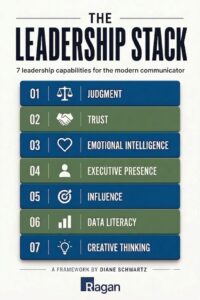
As you build your own Leadership Stack, consider what your unique skills and competencies are and align them with your organization’s top business challenges. Where you’re strong, sharpen the iron. Where you’re weak, double down on honing that skill.
A stack borrowed wholesale from someone else’s leadership won’t hold up under pressure. Every durable stack I’ve studied shares a structure: something technical, something relational, something quantitative and something that has nothing to do with work at all.
I’ve been Ragan’s first female CEO for nearly eight years. Being the first anything means building without a playbook, in full view, with no cover if something doesn’t work. I wouldn’t trade that visibility for the comfort of following someone else’s map.
What’s in your leadership stack?
The post What’s in my leadership stack appeared first on PR Daily.
[ad_2]
Source_link