[ad_1]
Reading Time: 18 minutes
Your agentic commerce strategy just got harder. Because Google Universal Cart means your best customers can now buy without ever visiting your website.
In short, AI agents are discovering, comparing, and completing purchases on shoppers’ behalf across Google Search, Gemini, YouTube, and Gmail.
Discovery is only one piece of the equation for enterprise and mid-market Shopify brands now. The harder problem is what happens after the AI places the order. No browse session, no welcome flow trigger, and no on-site behavioral data to power your retention program.
The engagement layer, including post-purchase journeys, owned channel relationships, and lifecycle marketing, is the part of your Shopify AI commerce strategy that determines whether an AI-acquired customer ever buys from you again.
This guide breaks down what agentic commerce is, the retention architecture enterprise Shopify brands need, the measurement framework that tells you what’s working, and how to roll out your agentic commerce strategy in 90 days.
TL;DR: How Can Shopify and Other Ecommerce Brands Prepare for Agentic Commerce?
Shopify and other Ecommerce brands can prepare an agentic commerce strategy by building a customer retention engine that works even when the customer’s first purchase happens outside the website.
| Preparation area | What your Shopify marketing team should do |
| Order-based triggers | Trigger post-purchase journeys from Shopify order events, not just website sessions or abandoned carts. |
| Unified customer profiles | Connect Shopify, email, SMS, push, loyalty, support, and purchase data into one customer profile. |
| Purchase-based segmentation | Build segments using order history, product category, AOV, frequency, discount usage, and replenishment cycles. |
| Owned-channel engagement | Move first-time buyers into email, SMS, push, in-app, web, loyalty, or app-based journeys as quickly as possible. |
| Post-purchase lifecycle journeys | Launch onboarding, replenishment, second-purchase, refund recovery, loyalty, and VIP journeys that don’t depend on on-site behavior. |
| Predictive retention | Use predictive segmentation to identify likely repeat buyers, churn-risk customers, replenishment audiences, and high-LTV customers. |
| Agentic campaign execution | Use marketer-controlled AI agents to speed up segmentation, campaign creation, QA, and performance analysis. |

But first…
What is Agentic Commerce?
Agentic commerce is a model of online shopping where AI agents research, compare, and complete purchases on a customer’s behalf autonomously, within guardrails the shopper sets.
Here’s the difference in practice.
In traditional Ecommerce, a shopper does every step manually — search > compare > add to cart > enter payment details > confirm.
In agentic commerce, the shopper sets the parameters once: preferred brands, maximum budget, and delivery window. For example, they might say, “Find my usual running shoes under $150 and make sure they arrive by Friday.” The AI finds the product, applies discounts, and buys it. The shopper gets an order confirmation. That’s it.
For mid-market and enterprise Shopify brands, the infrastructure is already live. Google Universal Cart, Microsoft Copilot Checkout, and ChatGPT Shopping are all operational. In fact, AI-driven orders on Shopify grew 15x in 2025. The future of Ecommerce is here.
And that creates a new challenge: if the first purchase happens outside your owned journey, your retention plan in your omnichannel Ecommerce strategy has to start after the order.
Benefits of Agentic Commerce
Of course, with agentic commerce, the shopper faces less friction, faster decisions, and better outcomes. But agentic commerce creates real commercial opportunities for Shopify brands too, if they’re positioned correctly.
- Larger basket sizes through AI-assisted combination purchases. AI agents don’t just find one product; they reason across an entire purchase goal. A shopper building a home office gets a desk, chair, monitor, and cable management solution recommended together. Brands with complementary product lines and clean, structured data get surfaced as complete solutions, not individual SKUs.
- Higher purchase frequency through autonomous reordering. Replenishment categories, such as supplements, skincare, household consumables, and pet food, are the natural first wave of agentic adoption. A shopper who sets up an AI agent to reorder their usual protein powder becomes a predictable, recurring revenue source. The brands that make reordering frictionless compound that advantage every cycle.
- Reduced cart abandonment at the moment of intent. Traditional cart abandonment happens because friction exists between intent and purchase. Agentic commerce removes that friction entirely. The AI completes the transaction at the exact moment the shopper is ready. For Shopify and other Ecommerce brands whose products appear in AI shortlists, abandonment at the decision stage drops significantly.
- First-mover advantage in AI recommendation rankings. Just like early SEO investment created compounding organic visibility, early investment in agentic commerce readiness, including clean product data, strong review signals, and loyalty program infrastructure, creates a compounding advantage in AI agent recommendations. The Shopify brands that establish strong signals now will be systematically preferred over brands that arrive late.
- You reach buyers at peak purchase intent. Agentic shoppers aren’t browsing. They have already decided they want something. They’ve delegated the execution to an AI. Getting surfaced in that context means reaching a buyer at peak purchase intent, with none of the consideration-phase friction that normally burns your retargeting budget.
Here’s the catch, though.
Every single one of these benefits requires the same foundation: clean product data, strong owned channel relationships, and an engagement infrastructure that works independently of on-site behavior.
Without that foundation, agentic commerce delivers customers you can acquire once and lose forever.
Is Your Current Shopify Retention Stack Ready for Agentic Commerce?
Before you can build an agentic commerce strategy, you need to know where your current stack breaks.
Shopify has a free scanner that audits your store’s agentic commerce readiness across 31 checks, including product schema, AI discoverability, and transaction infrastructure.
It tells you whether AI agents can find and buy your products. But it tells you nothing about what happens to that customer after they buy.
That’s the gap we’re going to talk about.
Here’s a fast self-assessment for your customer retention stack specifically.
The Agentic Commerce Retention Readiness Test
Answer these 6 questions honestly.
1. Can you trigger a post-purchase journey from an order confirmation alone, with no on-site session data?
If your welcome sequence, onboarding flow, or first-purchase follow-up requires a browse event, a cookie, or a session to fire, it won’t fire for customers acquired through Google Universal Cart or any other AI surface.
2. If a customer buys through Google Universal Cart and never visits your website, do they automatically enter a post-purchase email or SMS sequence?
If a customer buys through an AI agent and you don’t capture their contact at checkout or post-purchase, you have no way to reach them again. No retargeting. No re-engagement. No second purchase.
3. Can you build meaningful customer segments from purchase data alone?
No browse history. No session data. No on-site behavioral events. Just order frequency, product category, AOV, and purchase timing. If your segmentation logic collapses without behavioral signals, you have a gap.
4. Do you have a single unified customer profile that combines Shopify order data, email engagement, SMS opt-in status, and loyalty tier in one place?
If your Shopify email marketing tool, SMS tool, and push provider each need their own trigger to fire, you’re running three disconnected sequences for the same customer. That’s noise, not a customer purchase journey.
5. Can you use purchase history, order frequency, and product category data to personalize lifecycle messages without relying on browsing behavior?
If your post-purchase flow starts with a browser session, a cookie, or an on-site event, it won’t fire for a customer who bought through Google Universal Cart. That customer never visited your website. So, there’s no session to detect, and no cookie to read. Your flow sits waiting for a trigger that never comes, and the customer receives nothing.
6. Do you have a win-back sequence specifically designed for customers who haven’t returned after an AI-mediated first purchase?
Not a modified version of your standard welcome flow. A win-back sequence built from scratch around a customer whose entire relationship with your Shopify brand started at an order confirmation. If the answer is no, that’s your most urgent gap to close.
How to score yourself:
Count the questions you’ve answered with a “Yes.”
- 6-7 yes: You’re ahead of most enterprise Shopify brands. The architecture section below is about optimizing what you have.
- 3-5 yes: You have the foundation, but meaningful gaps. The architecture section will show you exactly what’s missing.
- 0-2 yes: Your retention stack was built for a world where every customer started on your website. That world is changing fast.
Where Enterprise Shopify Teams Usually Find Gaps
After running through that test, most enterprise Shopify marketing teams find their gaps in one of three places.
- The unified profile problem: Customer profiles exist in different places: you might be running Klaviyo for email, Attentive or a separate Shopify SMS marketing app, a loyalty platform like Yotpo or LoyaltyLion, and a CDP or analytics layer on top. Each tool has a piece of the customer profile. None of them has the whole picture. Building a complete picture of a single customer requires a manual export from each system.
- The trigger problem: Your Shopify brand’s customer journeys fire from on-site events, such as browse, add-to-cart, and session. Remove those events, and the journeys don’t fire at all. An AI-acquired customer completes a purchase and receives nothing.
- The measurement problem: You can report on email open rates and SMS click rates. But can you answer the question that actually matters: “Of the customers we acquired through AI surfaces last quarter, what percentage made a second purchase within 60 days?”
These gaps turn a strong acquisition engine into a leaky bucket, especially as AI surfaces drive a growing share of new customer volume.
Why Point Solutions Struggle When Customer Journeys Get Fragmented
Each point solution needs its own trigger, customer profile, data sync from Shopify, and reporting logic.
When every customer started their journey on your website, that fragmentation was manageable. The on-site session was the common thread that tied everything together. Every tool is fired from the same behavioral signal.
Remove the on-site session, which is exactly what happens when a customer buys through Google Universal Cart, and every tool in your omnichannel Ecommerce platform stack loses its primary trigger simultaneously.
You’re left dealing with every journey breaking at once, for an entire cohort of customers, with no single place to diagnose or fix it.
A unified customer engagement platform — one that builds customer profiles from order data, fires journeys from any trigger source, and orchestrates across channels from a single logic layer — is no longer just a nice-to-have in this environment.
It’s the difference between a retention program that works and one that silently fails for your fastest-growing acquisition cohort.
The Retention Architecture Shopify Brands Need for an Agentic Commerce Strategy
Most enterprise Shopify brands already have a retention stack. The problem is that what they have was built around assumptions that agentic commerce is quietly breaking.
Here’s what your retention architecture actually needs to handle the era we all are in.
Real-Time Shopify and Commerce Event Sync
Your customer engagement platform needs to be connected to Shopify’s server-side webhook infrastructure, not just the browser-side SDK. Webhook-based order events fire from Shopify’s backend the instant a transaction is confirmed, regardless of where the purchase originated.
A batch sync that runs every few hours means a customer who bought at 9 AM receives their first post-purchase message at noon — or not at all if they don’t return to your site. In the agentic era, real-time is not a nice-to-have. It’s the minimum viable trigger layer.
Unified Customer Profiles Across Channels
When a customer buys through an AI surface, you may receive their email address from the order. That’s it.
Your retention stack needs to build a complete customer profile from that single data point and enrich it progressively with every subsequent interaction across every channel.
That means purchase history, order frequency, product category affinity, AOV, channel engagement signals, and loyalty status, all need to live in one place and update in real-time.
If your email marketing automation software platform, SMS tool, and loyalty system each maintain separate customer records that don’t sync, you can’t build a coherent picture of who this customer is or what they need next. A unified profile is the foundation that makes every other part of the retention architecture work.
Predictive Segmentation for Repeat Purchase and Customer Churn
In the agentic commerce model, you don’t have browse signals for a growing share of your customer base. What you do have is purchase data: what they bought, when, how often, at what price point, and from which product category.
Your retention and Ecommerce personalization software stack needs to turn those purchase signals into forward-looking predictions. Which customers are likely to buy again in the next 30 days? Which ones are showing early churn signals based on recency and frequency alone? Which product categories predict high customer Lifetime Value (LTV) vs. one-and-done buyers?
Segmentation built on purchase behavior, not browse behavior, is what keeps your lifecycle program effective when on-site signals are no longer available.
Cross-Channel Journey Orchestration
A customer acquired through Google Universal Cart needs a post-purchase customer experience and journey that’s triggered by the order, not by a return visit to your website.
That journey can’t live in 3 separate tools. If your email platform fires one sequence, your SMS tool fires another, and your push provider fires a third — each triggered by different events, each maintaining separate customer data — you’re running 3 disconnected campaigns that the customer experiences as noise.
The right architecture orchestrates all three from a single trigger, with shared customer data, conditional logic that adapts based on engagement, and channel sequencing that reflects how that specific customer actually responds. One trigger. One logic layer. One view of what the customer did and what they need next.
Marketer-Controlled AI Execution
The missing piece in most enterprise Shopify retention stacks is execution speed.
Your team can identify the right segment, design the right journey using customer journey mapping tools, and write the right message. But building, QA-ing, and launching that campaign still takes days. Meanwhile, the window to reach a newly acquired customer at peak engagement is measured in hours.
The right architecture gives marketers AI execution tools they control directly — not tools that require engineering support or a data science team to operate. That means AI that can build segments from a plain-language description, generate journey logic from a campaign brief, write and QA message copy before it sends, and run post-purchase cross-sell flows end-to-end based on marketer-defined rules.
The AI handles execution. Your marketing team sets the strategy and retains final control.
How to Measure Agentic Commerce Impact on Customer Engagement
Fast-forward to the next 12 months, and your retention program will still be working. Journeys will be firing, emails will be opening, and orders will be coming in. But your numbers could still look flat, or worse, declining. You know why?
Because the metrics you’re looking at were designed for a world where every customer started on your Shopify brand’s website.
The shift is from session-based metrics to order-based metrics, from what customers did on your website to what they did with your brand across every channel.
Here’s the measurement framework that works in an agentic commerce strategy:
| What You’re Measuring Today | What You Need to Measure in Agentic Commerce |
| Cart abandonment rate | Owned channel opt-in rate at first purchase |
| Browse-triggered email CTR | Order-triggered email open rate by cohort |
| Retargeting ROAS | Repeat purchase rate: first-time buyer cohorts |
| On-site conversion rate | Time to second purchase |
| Last-click attribution | Journey conversion rate by entry trigger |
| Session behavioral segments | Purchase-history-based segments |
Why Last-Click Attribution Becomes Less Useful
Last-click attribution has one job: to tell you which campaign was last clicked before a purchase.
In agentic commerce, last-click attribution breaks in two places.
- The purchase decision happens before the click. When a customer’s AI agent selects your product and completes a transaction, there may be no campaign click at all — just an order appearing in your Shopify backend. Last-click attribution either misattributes it to the last campaign that happened to be in the attribution window, or it shows as entirely unattributed.
- The post-purchase engagement sequence involves multiple touchpoints. A customer enters a Shopify post-purchase journey triggered by an order confirmation. They receive an email on Day 0, an SMS on Day 3, and a push notification on Day 7. They make a second purchase on Day 9. Which touchpoint gets credit? Last-click says the push notification. But that’s not the right answer, is it? The whole sequence contributed, and what you actually need to know is whether the journey as a whole is driving repeat purchase in this cohort.
An honest reality check: any Ecommerce customer engagement platform tracks attribution for the campaigns it sends. If a customer buys through Google Universal Cart with no prior campaign interaction, that order arrives as a confirmed purchase. But it won’t be attributed to any campaign, because there was no campaign in the path.
For full acquisition-channel attribution, you’ll need Shopify’s order attribution data passed into your engagement platform as a user attribute. That’s a setup step worth prioritizing early in your agentic commerce strategy.
Why Cohort-Based Retention Reporting Becomes More Important
As an enterprise Shopify brand navigating agentic commerce, you don’t need to know which channel drove a purchase. You need to know whether customers who bought for the first time are coming back, and how fast.
Cohort retention analysis works like this: You define a cohort by a starting event (first purchase) and track what percentage of that cohort performs a return event (a second purchase) over any time window you define — Day 7, Day 30, Day 60, or Day 90.
More importantly, you can split that cohort by acquisition source. If you tag first-time buyers with their acquisition channel (organic, paid, email, or AI-referred, based on Shopify’s order attribution data), you can compare cohort retention curves side by side.
That comparison is the most valuable measurement you can run for your agentic commerce strategy. It answers the question your CMO is going to ask: “Are customers we’re acquiring through AI surfaces coming back at the same rate as customers we acquired through paid or organic?”
If the answer is yes, your retention infrastructure is working.
If the answer is no, your cohort retention chart will show you exactly where the curve diverges, and that divergence point is where your lifecycle journeys need to be fixed.
That’s what MoEngage is built for.
MoEngage is an agentic customer engagement platform for Shopify and Ecommerce brands. It helps marketing teams turn Shopify order data, customer behavior, product signals, and engagement history into personalized customer journeys across email, SMS, push, in-app, web, and other owned channels.
In other words, Shopify helps you process the order, while MoEngage helps you grow the customer relationship after the order.
Let’s find out how to do exactly that.
Your 90-Day Shopify AI Commerce Strategy With MoEngage
To respond to agentic commerce, your team needs a concrete starting point.
Here’s yours.
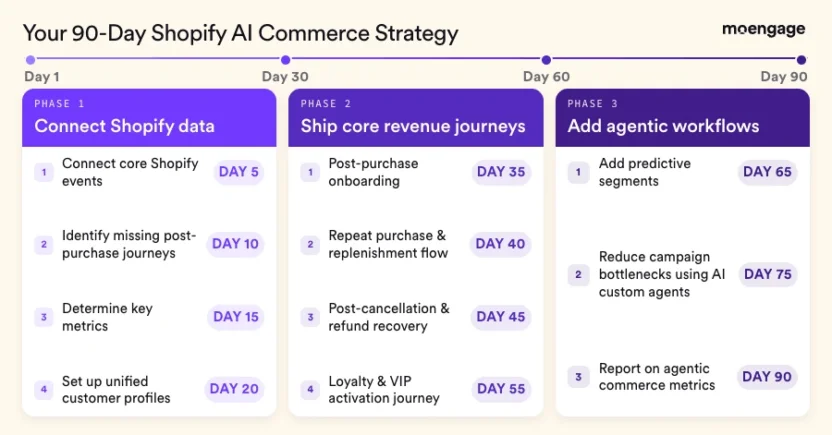
This 90-day Shopify AI commerce strategy is a phased plan your marketing team can execute, starting this week, that builds the retention infrastructure agentic commerce requires, in the order that generates revenue fastest.
Days 1-30: Connect Shopify Data and Find Retention Gaps
Before you can build an agentic commerce strategy, you need to know exactly where your current retention stack breaks.
Most enterprise Shopify marketing teams discover the same three gaps when they do this honestly: their post-purchase Ecommerce customer journeys require on-site events to fire, their customer profiles are fragmented across tools, and they have no baseline metric for repeat purchase rate from customers who didn’t start on their website.
Days 1–30 are about closing those diagnostic gaps and building the data foundation everything else runs on. By the end of the first 30 days, your goal is to know where customer data lives, where lifecycle journeys break, and where repeat revenue is leaking.
Week 1: Connect Your Brand’s Core Shopify Events to MoEngage
The Shopify-MoEngage integration syncs order events via server-side webhooks. These fire from Shopify’s backend regardless of where the purchase originated. No on-site session required.
At a minimum, your team should be able to ingest and act on events like:
- Customer created
- Product viewed
- Cart created
- Checkout started
- Order placed
- Product purchased
- Discount used
- Order fulfilled
- Delivery completed
- Return initiated
- Refund processed
- Repeat purchase completed
This is the single most important technical step in your Shopify AI commerce strategy. Every lifecycle journey in this plan runs from these events.
Week 2: Audit Your Current Data Sources and Identify Missing Post-Purchase Journeys
Next, look at what happens after a first purchase.
Many post-purchase flows were built for customers who visited the website first. But in the Google Universal Cart and agentic commerce era, some customers may arrive through AI-assisted search, marketplaces, or third-party checkout surfaces without ever experiencing your brand-owned journey.
For each flow currently running, ask:
- Does every first-time buyer enter a welcome journey?
- Are customers educated based on what they bought?
- Do one-time buyers get a second-purchase journey?
- Are returns and refunds treated as retention moments?
- Are high-value buyers routed into loyalty or VIP journeys?
If your answer is “no” to any of these questions, you’ve found a retention gap.
Document every broken trigger. That list is your priority build queue for Days 31–60.
Week 3: Determine Your Key Metrics
Before launching new journeys, set your retention baseline.
Pull three numbers that you’ll monitor for the rest of this plan.
- Repeat purchase rate: What percentage of first-time buyers make a second purchase within 60 days?
- Owned channel opt-in rate: What percentage of customers give you an email or SMS contact at or after their first purchase?
- Time to second purchase: For customers who do buy again, how many days does it take?
These agentic commerce readiness metrics tell you whether your retention program is working for customers who arrived without a site session. They’ll also tell you whether this 90-day plan is working.
Week 4: Set Up Unified Customer Profiles
AI-assisted orders may arrive with fewer traditional browsing signals. So your customer profile needs to be built from transaction data, engagement data, loyalty data, and lifecycle behavior.
MoEngage’s Unified Identity helps unify these signals so your team can understand who the customer is, what they bought, where they came from, how they engage, and what they’re likely to do next. A customer who buys through Google Universal Cart and then opens your post-purchase email should resolve to a single profile, not create a second anonymous record that your segmentation can’t act on.
Days 31-60: Launch Core Revenue Journeys
Once your Shopify data is connected and your retention gaps are clear, the next 30 days are about execution.
Now you build the journeys that fill those retention gaps, and start generating revenue from customers your current stack is currently losing.
1. Post-Purchase Onboarding for First-Time Buyers (Launch by Day 35)
Trigger: Shopify – Order Placed. First-time buyer, no prior email engagement history.
Goal: Turn the first transaction into a relationship.
This customer journey should introduce the brand, explain product value, capture preferences, and invite the customer into owned channels like email, SMS, push, app, or loyalty.
A strong five-touch welcome journey sequence can include: order confirmation > delivery update > loyalty enrolment invite > brand story email > social proof > second-purchase recommendation
This is the journey designed for customers who bought through an AI surface and have never visited your website. It runs entirely from the order event. No on-site behavior required.
2. Repeat Purchase and Replenishment Flow (Launch by Day 40)
Trigger: Shopify – Order Placed for replenishable product categories, timed to estimated depletion cycle.
Goal: Reduce time to second purchase.
A customer who buys twice is more likely to become profitable, loyal, and easier to retain.
The problem is that in agentic commerce, repeat purchases may become more competitive.
A shopper might tell an AI agent: “Reorder my moisturizer under $40.”
If your brand hasn’t built enough trust, value, and convenience after the first purchase, the agent may recommend another product.
This journey reaches the customer before their AI agent makes the next reorder decision. Use MoEngage to personalize this journey based on the first product purchased, product category, average reorder window, discount usage, AOV, predicted next-best product, channel preference, and engagement behavior.
Examples:
- A beauty customer gets a routine-building cross-sell.
- A footwear customer gets care tips and accessory recommendations.
- A pet care customer gets a replenishment reminder.
- A fashion customer gets new arrivals in the same style category.
The aim is to send the next most relevant message to the right customer.
3. Post-Cancellation and Refund Recovery (Launch by Day 45)
Trigger: Shopify – Order Canceled or Shopify – Refund Created
Goal: Prevent a bad experience from becoming churn.
This journey matters more in agentic commerce than it ever did before. A customer whose AI-mediated purchase goes wrong and never hears from you again is not just a lost customer, but a negative signal too. A customer who gets a fast, proactive resolution is statistically your most likely repeat buyer.
A recovery journey can include:
- Return status updates
- Exchange recommendations
- Support escalation
- Fit or usage guidance
- Recovery offer
- Satisfaction check
- Win-back flow
A clean recovery experience can turn a disappointed first-time buyer into a repeat customer.
4. Loyalty and VIP Activation Journey (Launch by Day 55)
Trigger: Customer reaches a value, frequency, or engagement threshold.
Goal: Move high-value customers into a stronger owned relationship.
In agentic commerce, loyalty can actually become a signal. Purchase history, loyalty status, rewards balance, and brand preference may all influence whether a customer’s AI agent chooses your brand again.
That means high-value customers should be moved into stronger owned relationships as early as possible.
Use MoEngage to identify customers who are ready for loyalty enrolment, VIP access, early product drops, subscriptions, memberships, referrals, or exclusive offers.
By Day 60, you should have 4 core revenue journeys live, all firing from order events and across the channels your customers actually use: email, SMS, push, in-app, web, and other owned channels. That’s your core Shopify agentic commerce retention infrastructure.
Days 61-90: Add Predictive Segmentation and Agentic Workflows
The final 30 days are about scale.
At this point, you have your data foundation and core journeys in place. Now the question becomes: How do you make your AI lifecycle marketing engine smarter and faster without adding more manual work to your marketing team?
This is where your Shopify AI commerce strategy shifts from reactive (responding to what customers just did) to predictive: reaching customers before they churn, before they switch brands, and before their AI agent makes the next decision without your input. Here’s what you can do:
1. Add Predictive Segments (by Day 65)
With MoEngage, enterprise Shopify marketing teams can start building audiences based on likely future behavior, not just past actions. Our predictive segmentation uses purchase history, order frequency, category affinity, and AOV to identify the following 3 customer cohorts your Shopify team needs to act on right now:
- High-LTV signals: Customers whose purchase pattern predicts strong lifetime value. These are your VIP journey candidates. Get them into a loyalty tier before a competitor does.
- Churn risk signals: Customers whose recency and frequency are dropping below your category’s expected purchase cycle. These customers are drifting — and their AI agent is about to start recommending alternatives.
- Repeat purchase propensity: Customers who are most likely to buy again in the next 30 days based on their purchase behavior. These are your highest-conversion targets for cross-sell and upsell campaigns right now.
This helps your team prioritize the customers most likely to drive incremental revenue. Instead of sending the same campaign to everyone, you can focus each journey on the customer’s next best action.
2. Reduce Campaign Bottlenecks Using MoEngage Merlin AI Custom Agents (by Day 75)
Here’s the execution problem that predictive segmentation creates: it surfaces more opportunities than your team can manually build campaigns for.
A segment of high-LTV customers ready for a VIP journey. A churn-risk cohort that needs a win-back campaign this week. A replenishment audience that changes in size every day as new orders come in.
MoEngage Merlin AI Custom Agents handle the execution layer. Your team defines the strategy — the segment, the goal, the guardrails, the brand voice. The agent builds the campaign draft: segment filters, journey logic, message copy, and QA checks. Your marketing team reviews and approves. The campaign goes live.
Actually, agents run asynchronously. You can set a complex task running and come back to the output without keeping the session open. They have persistent memory across sessions, so an agent building your replenishment program remembers the brand guidelines, tone, and product context from the last session. And critically: custom agents can’t auto-publish. Every campaign draft requires human review and approval before it goes live. The AI accelerates execution. Your marketing team retains final control.
The practical result for enterprise Shopify marketing teams: campaigns that used to take days to brief, build, QA, and launch now take hours. For a team managing retention across a large customer base with growing AI-acquired cohorts, that speed compounds directly into revenue.
3. Report on Your Agentic Commerce Metrics
By day 90, your team should be able to show leadership more than opens, clicks, and sends.
Show how lifecycle marketing impacts repeat purchase, LTV, replenishment revenue, loyalty revenue, churn reduction, and return recovery.
That’s the reporting shift enterprise Ecommerce teams need to make.
Because in the agentic commerce era, the most important question is not just: “Where did the customer come from?” It is: “Did we turn that customer into repeat revenue?”
So, by the end of 90 days, your Shopify AI commerce strategy should move from planning to proof. You should know which customers are coming in, which journeys are moving them toward a second purchase, which channels are working, and which retention gaps still need to be fixed.

Implement Your Agentic Commerce Strategy Before Your Competitors Do
Agentic commerce is already moving revenue. The brands that win won’t just be the ones with the best product feeds or the most sophisticated Universal Commerce Protocol (UCP) integration. They’ll be the ones who executed a Shopify AI commerce strategy to build the post-purchase relationship before the AI made the next recommendation.
That’s what this playbook is for. The 90-day plan gives you the starting point. The measurement framework gives you the metrics that tell you whether it’s working.
The only thing left for you to do now is to start.
Want to see what the retention gaps look like for your specific Shopify store? Schedule a MoEngage demo, and we’ll walk through your retention stack against our 90-day framework, gap by gap.
The post The Agentic Commerce Strategy Every Shopify Brand Needs Now appeared first on MoEngage.
[ad_2]
Source_link