Summary:
Modern B2B buyers and AI answer engines are evaluating your content against the same types of criteria: proof, source authority and consensus among credible sources. Original research and unique customer insights can provide the proof. Industry influencers, executives and customers can supply the credible voices. And thought leadership connects them into a platform that earns both visibility and belief across the entire buyer journey.
In Answer Engine: The State of B2B Thought Leadership in 2026, our survey with Ascend2 of 797 B2B marketers found that 97% say thought leadership is critical to full-funnel success, 93% say research-based content is effective at driving engagement and leads, and 72% of marketers who frequently collaborate with influencers rate their research content very effective compared with 29% of everyone else. At the same time, 32% of buyers now discover thought leadership through GenAI tools, a channel that was missing from most marketer distribution lists a year ago.
Who is actually reading your B2B content in 2026?
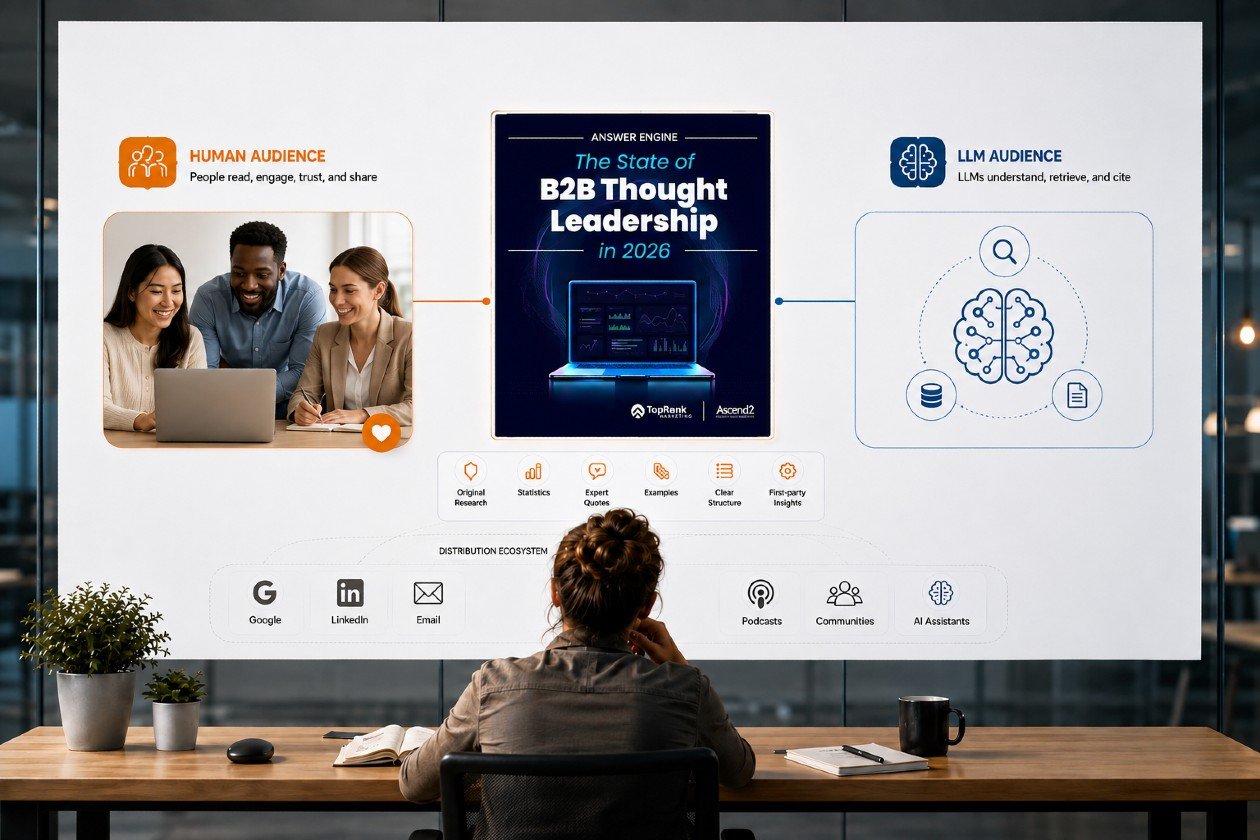
Most B2B marketers are now dealing with two distinct audiences for their content. The first is a buying group of eight to ten people who are skeptical, short on time, and personally exposed if their recommendation goes wrong. The second is a set of retrieval and reasoning systems that read, summarize, and decide which brands get chosen when someone asks a question in ChatGPT, Perplexity, Google AI Mode or Claude.
B2B marketers are wrestling with prioritizing those audiences and often treat them as separate problems with separate sets of resources. The reality is, they respond to pretty much the same signals. Buying groups look for proof they can defend internally. Answer engines look for evidence they can attribute and corroborate. The good news is that original research or proprietary data, credible human voices and a consistent point of view can satisfy the expectations of both.
Our research with Ascend2 found that 35% of B2B marketers say original research is significantly more valuable than AI-generated content for building trust and authority, with another 32% saying it is more impactful overall (The State of B2B Thought Leadership in 2026). This is an important insight for those now relying on AI to generate B2B content. The content most likely to be repeated by a machine is content a machine could never have created on its own. Even synthetic data comes from original source content at some point.
Why is original research the fuel for becoming the best answer?
New knowledge is one of the only assets in your content program that can’t be summarized from somewhere else. When you publish insights that nobody else has, you become the citable source for that fact. The result? Journalists cite it. Analysts reference it. Influencers argue about it. AI systems attribute it. Every one of those actions is a trust signal that points back at your brand.
The data on performance of research based content supports the investment. 93% of B2B marketers using original research based content say it is effective at driving engagement and leads, with 48% calling it very effective (The State of B2B Thought Leadership in 2026). This performance is inspiring investment with 47% of B2B marketers planning to increase their use of original research and data-driven content in the next year.
The starting point for generating original research matters. We found that 53% of B2B marketers rate direct customer feedback as the top influence on the topics they choose for research-based thought leadership, followed by 44% citing CRM data and 44% citing competitor or market trend analysis. Research that answers a question your buyers are already asking is research that gets used. Research that simply validates an opinion is most likely to be ignored.
How do B2B influencers make research more credible and more discoverable?
Data on its own means little, but it becomes relevant when the people that your buyers already trust engage with it to add context and validation.
This is one of the most significant findings from our B2B thought leadership research. 72% of B2B marketers who frequently collaborate with influencers rate their research-based content very effective, compared with 29% of everyone else (The State of B2B Thought Leadership in 2026). That’s the same category of content but a significantly different outcome. One version gets consumed with third-party validation and the other is simply a brand claim. And B2B buyers are not exactly feeling trust when it comes to brand claims.
B2B Marketers know this. 45% say featuring industry influencers or experts would make their thought leadership content more impactful. The issue is that far fewer act on it consistently.
Independent research points the same direction. In The Credibility Code from the B2B Institute at LinkedIn and Ipsos, 94% of B2B marketers say trust is the key to success, (2025 B2B Marketing Benchmark Report from LinkedIn and Ipsos). That study also reports that 82% of B2B buyers say creator content influences purchasing decisions, (LinkedIn x GWI, 2024).
But here is where our perspective differs from the platform view. LinkedIn’s findings treats creators as the layer that scales credibility inside a single professional feed, activated through platform ad products. Of course that is a reasonable read of an ad platform, but it is an incomplete read of the full B2B buying journey.
Here’s why: Our research found that LinkedIn is used by 54% of marketers to distribute thought leadership, but only 38% of professionals say they consume thought leadership there most often. YouTube shows the same pattern at 50% versus 34%. Webinars show it at 48% versus 34% (The State of B2B Thought Leadership in 2026). B2B marketers are concentrated where consumption is less than they assume.
Credibility built inside one platform often stays inside that platform.
Credibility built on evidence that you own, validated, contextualized and shared by credible experts, published in structured formats and cited across owned, earned and social channels, travels. It travels into search results, into media coverage, into peer communities, and into the training and retrieval data that AI answer engines draw from. That portability is the whole point of being the best answer for your buyers.
How the six answer engine drivers fuel two audiences at once
The six drivers of the Best Answer Marketing framework work as a system. Each one does a job for human buyers and a parallel job for machine discovery.
- Data Informed: Replaces guesswork with clarity. Buyers get answers to questions they actually have. Answer engines get specific, attributable facts.
- Integrated Strategy: Aligns narratives, formats and channels across the full funnel. Buyers encounter a consistent story. Retrieval systems encounter consistent entities and claims.
- Trust System: Builds credibility at scale through influencers, executives, customers and earned media. Buyers get validation. Answer engines get corroboration from independent sources.
- Experiential Content: Turns ideas into memorable encounters through video, audio, interactive and live formats. Buyers remember. Multi-format assets create more surfaces to be found on.
- Multi-Channel Discovery: Places answers wherever buyers search and learn. Presence in more credible contexts increases the odds of being surfaced by people and by machines.
- Unified Analytics: Unifies insight into what works. 41% of marketers cite difficulty measuring performance as the top cause of underperforming content.
Implementing any one driver creates or influences a marketing result. But when they work together as a system, those results can compound.
Which content formats bring B2B research, influence and thought leadership together?
The formats worth prioritizing share three important characteristics:
- they include proof
- they feature the consensus of credible humans
- they produce artifacts that people and machines can easily find and cite.
Our research shows what B2B marketers believe would make their thought leadership more impactful:
- video content at 48%
- live and virtual events at 48%
- interactive experiences at 48%
- industry influencers or experts at 45%
- customer and executive stories at 39%
- optimizing for search and GenAI platforms at 39%
- a complementary podcast at 33%
- targeted newsletters at 30%.
Using that original research data from a survey of nearly 800 B2B marketers, here’s how those formats translate into a working B2B content mix.
Flagship original research report: A primary survey or proprietary dataset published with a documented methodology. This is the anchor asset that every other format draws from, and the only one that creates a fact your competitors have to credit you for.
Research statistics hub: A permanent, well-structured page presenting the findings as discrete statistics with dates, sample size and methodology. Pages built this way attract citations and links, and they give answer engines an unambiguous source to attribute.
Video podcast series: Recorded conversations where practitioners and analysts react to your findings in their own words. One production yields video, audio, a transcript, quote graphics and short clips, and the transcript is the part search and AI systems can actually read.
Research-backed webinars and virtual roundtables: Live sessions where three or four credible voices interpret the data for a specific segment. The live audience gets debate and nuance, and the recording becomes an on-demand asset with a searchable transcript.
Interactive data experiences: Assessments, benchmark tools and data explorers that let a buyer see their own situation reflected in the research. Participation produces first-party insight for you and a personalized result the buyer is willing to share internally.
Earned media and digital PR: Pitching findings to trade publications, industry newsletters and analysts. Third-party coverage validates the work for human readers and creates the off-site mentions that heavily influence which brands AI systems name.
Co-created guides and eBooks: Longer-form assets where influencers and internal experts contribute original commentary alongside the data. Contributors gain a credible byline and become genuine distribution partners at launch.
Executive and influencer bylines: Placed opinion pieces in the publications your buyers already read, authored by a named person with a real track record. Bylines carry authority signals that brand-authored content struggles to earn.
Real world events: Conference sessions, executive roundtable dinners and on-site studio recordings at industry events. In-person conversation builds relationships with experts and produces a queue of content for the following quarter.
Digital events and livestreams: Recurring LinkedIn Live sessions, AMAs and virtual panels with a light production footprint. Consistency matters more than polish here, and the format works well for reacting to industry news with your data.
Short-form video: Individual findings delivered by a person on camera in under 90 seconds. These clips do the work of moving a statistic into feeds where buyers are scrolling, and they extend the life of a report long past launch week.
Documentary and masterclass content: Cinematic or instructional treatments that turn research into a story with customers and experts on screen. Sprinklr used this approach with its Socialverse program, pairing research and influencer collaboration with a masterclass hosted by the American Marketing Association.
Newsletters, owned and sponsored: Your own list plus paid placement in newsletters your audience already trusts. Sponsorship borrows an established relationship, which reaches people who will never see your organic posts.
Peer communities and Slack groups: Participation in the private spaces where buyers ask candid questions. Top performers are nearly twice as likely to diversify distribution across emerging channels, with 55% using YouTube, 41% podcasts and 28% peer communities (The State of B2B Thought Leadership in 2026).
Serialized blog and article program: Publishing the research as a sustained sequence of articles, each answering one specific buyer question in depth. A report is a single moment. A series is an ongoing supply of indexed, citable answers.
What does measurement look like when the audience includes machines?
Traditional B2B marketing funnel reporting can miss where impact is happening. A buyer might encounter your research in an AI summary, hear a podcast guest reference it, see an influencer post about it, then land on your website through a branded search with no attributable first touch in sight.
Unified measurement means connecting brand engagement, demand signals and revenue outcomes in one view, then adding visibility in answer engines as a tracked metric alongside organic rankings. This is an essential challenge to solve for and if you’re feeling it, you’re not alone. 41% of marketers cite measurement difficulty as the top cause of underperforming content, which makes this a differentiator for the teams that solve it.
Where to start with the dual audience opportunity
Pick one question your buyers keep asking that nobody in your category has answered with evidence. Design a small piece of primary research around it. Bring five credible voices into the interpretation before you publish. Then build the formats above around that single insight for the next two quarters.
That sequence is how a brand stops competing for attention and starts becoming the answer. Original research earns the right to a point of view. Credible voices make that point of view believable. Consistent, multi-format publishing makes it findable everywhere your buyers and their AI assistants are looking.
What question could your team answer with original data that nobody else in your market can? That is the beginning of building your own best answer marketing strategy.
Learn more about the intersection of B2B thought leadership, influence and content in our ungated report
Of course if you’re interested in talking to one of our experts about making your brand the best answer for LLMs and buyers, we’re happy to meet.