
[ad_1]
Key takeaways:
- Augmentation is now a structural response to Australia’s senior-talent shortage, not a stopgap. Treat it as a planned part of how you scale delivery.
- The model you pick sets your control and compliance exposure. Choose augmentation, outsourcing or managed services deliberately, never by vendor default.
- For regulated entities, security, data sovereignty and governance carry veto power over rate and speed.
- Evaluate partners on hard delivery metrics and AEST overlap, not resumes and promises.
- Capability depth in AI, cloud and platform engineering is the differentiator that will matter most through 2026.
Australia’s technology labour market is under structural strain. According to the ACS Digital Pulse 2024 report, the country will need 1.3 million technology workers by 2030. Yet current workforce growth is not on track to meet that demand.
The gaps are most acute in AI engineering, cybersecurity, and cloud architecture, precisely the capabilities driving enterprise transformation agendas right now.
For technology leaders, the traditional response; post a role, wait three months, onboard, ramp up, has become commercially indefensible. Competing for the same constrained talent pool while attempting to maintain delivery momentum is a losing proposition.
Staff augmentation offers a structural alternative: bringing credentialed, pre-vetted engineers into your delivery environment without the permanence, overhead, or compliance exposure of full-time hiring.
But the model only works if the partner selection is rigorous. A wrong engagement erodes delivery velocity, creates compliance liability, and wastes the very time it was meant to save.
This blog outlines how to choose the right IT staff augmentation partner in Australia to ensure predictable, compliant, and scalable delivery.
Planning your next technology engagement?
Talk to our team about how we approach staff augmentation for Australian businesses.

Why IT Staff Augmentation Is Growing in Australia?
Technology staff augmentation in Australia is no longer a tactical workaround. It has become a mainstream delivery strategy for organisations that need specialist capability faster than the domestic talent market can supply it. Understanding the structural pressures driving adoption helps leadership teams frame augmentation not as a cost measure but as a delivery architecture decision.
Persistent Technical Talent Shortages
The talent shortage is real, but the problem runs deeper than headcount. Gartner’s 2025 ANZ CIO Survey found that 82% of Australian and New Zealand technology executives identified cybersecurity as their top investment priority. Yet securing experienced security engineers locally remains one of the most difficult hiring challenges in the market.
High-Demand Tech Capabilities
Beyond talent scarcity, the AI adoption wave in Australia is reshaping demand. The ACS projects that 1.3 million workers skilled in artificial intelligence, cloud and cybersecurity will be needed by 2030, against current supply that falls tens of thousands short. Organisations waiting for the market to self-correct are deferring transformation timelines that boards are holding leadership accountable for.
Pressure to Accelerate Digital Transformation
Aussie innovators cannot afford protracted product delivery cycles. Whether modernising a core banking platform, launching a connected healthcare application, or upgrading an industrial supply chain platform, speed-to-market dictates competitive relevance. Augmentation bypasses the typical recruitment lag, injecting immediate velocity into active development tracks.
Optimising Engineering Budgets
The cost pressure is also real. Hiring a senior software developer in Australia now comes with a typical base salary above $150,000, plus 12% superannuation, potential payroll tax liabilities, and recruitment fees averaging 15–20% of first-year salary.
When you factor in onboarding time and ramp-up duration, the total first-year cost can exceed nearly $240,000, before accounting for attrition risk. Enterprise IT staff augmentation converts that fixed liability to a variable, scalable engagement.
Understanding IT Staff Augmentation vs Traditional Outsourcing vs Managed Teams
Before choosing a staff augmentation company in Australia, technology leaders need clarity on which delivery model fits their context. The three most commonly conflated options – staff augmentation, project outsourcing, and managed services – differ significantly in terms of control, compliance accountability, and cost structure.
| Criteria | Staff Augmentation | Project Outsourcing | Managed Services |
|---|---|---|---|
| Control over daily work | Full — engineers report to your team | Delegated to vendor | Delegated, governed by SLA |
| IP ownership risk | Low — IP stays with your organisation | Contractual risk if scope is ambiguous | Low for operations; risk exists for new development |
| Management overhead | High — you manage the people | Low — vendor manages delivery | Low — vendor manages outcomes |
| Best-fit scenario | Core product development; skill gap filling; direct team integration | Defined, time-boxed projects with clear scope | Ongoing IT operations, infrastructure, support functions |
| Typical AU cost structure | $40–$150/hr depending on model and seniority | Fixed price or T&M per project | Monthly retainer |
| Compliance exposure | Stays with your organisation; vendor is a data processor | Shared; contract must clearly allocate | Vendor typically carries operational compliance |
Staff augmentation is the right choice when you need strategic control over architecture and engineering decisions, where the work sits close to your product core, or where the regulatory environment requires you to retain direct accountability for how data is handled.
The Enterprise Dilemma: When Australian Businesses Should Consider Staff Augmentation
The real decision is rarely build versus buy. It is how much control and continuity you need against how fast you must move. Understanding when staff augmentation helps leaders make the right decisions at the right time:
Rapid product delivery timelines
When release schedules cannot absorb a three-month hiring cycle, augmented engineers can be integrated within two to four weeks with the right partner.
AI, data, and cloud skill gaps
Internal teams built for traditional software delivery rarely carry the depth needed for LLM integration, MLOps pipeline management, or cloud-native architecture at scale. Augmentation fills this gap without permanently reshaping your headcount structure.
Transformation program spikes
ERP modernisation, platform rebuilds, and data migration programs create temporary demand that does not warrant permanent headcount. Augmentation lets you scale for the program and scale back cleanly.
Legacy modernisation
Organisations running end-of-life systems often lack internal expertise to execute the migration safely. Bringing in engineers with modernisation-specific experience reduces delivery risk considerably.
Key Challenges Facing Australian Tech Leaders in Selecting a Partner
Identifying the right Australian staff augmentation provider is harder than it looks. The vendor landscape is crowded, assessment processes are inconsistent, and the consequences of a poor selection compound quickly once a programme is in motion. Understanding where the process typically breaks down is the first step toward avoiding it.
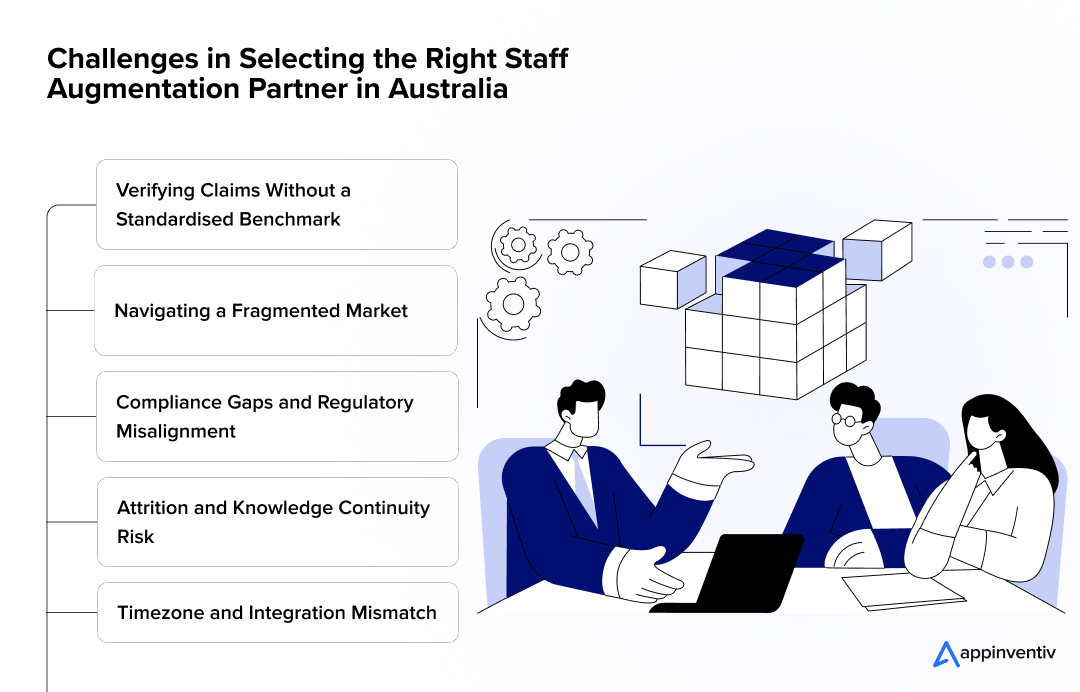
Verifying Claims Without a Standardised Benchmark
There is no universal accreditation for staff augmentation providers in Australia. Any vendor can claim enterprise delivery experience, APAC coverage, or compliance readiness. The burden of verification falls entirely on the buyer. Reference-checking is inconsistent, case studies are often sanitised beyond usefulness, and technical assessments are rarely conducted rigorously during procurement. By the time a delivery shortfall surfaces, several sprints of momentum have already been lost.
Navigating a Fragmented Market
The AU market includes onshore-only firms, offshore-delivery models with nominal Australian presence, and genuine hybrid providers. Each presents differently during sales conversations. Rate cards vary enormously without a reliable quality signal attached to the difference. Technology leaders evaluating multiple vendors simultaneously are often comparing proposals that use incompatible definitions of the same service.
Compliance Gaps and Regulatory Misalignment
Many offshore and cross-regional vendors do not fully understand the complexities of the Australian regulatory environment. Integrating developers who lack formal training in localized compliance mandates can create immediate legal and operational vulnerabilities:
Attrition and Knowledge Continuity Risk
Staff augmentation challenges centre heavily on one recurring problem: continuity. Mid-engagement attrition is more common than vendors acknowledge, and the handover quality when it happens is often poor. Internal teams absorb the context loss while still being held to the original release timeline. Providers who do not have documented retention and succession protocols within their delivery model represent a structural risk that is easy to underestimate during procurement.
Timezone and Integration Mismatch
Many providers overstate their AEST delivery coverage. A vendor headquartered in Eastern Europe or Latin America may claim flexible hours, but flexible is not the same as committed and contractual. When delivery ceremonies, code reviews, and incident response windows fail to align with AU business hours, the integration friction compounds daily. This is a risk that surfaces only after the engagement starts, at which point re-negotiating is difficult.
What Are the Key Criteria for Selecting the Right IT Staff Augmentation Partner in Australia?
Choosing a staff augmentation company in Australia involves far more than comparing rate cards. The criteria that matter most to enterprise procurement are technical depth, governance maturity, compliance posture, and the capacity to operate at your speed and standard.
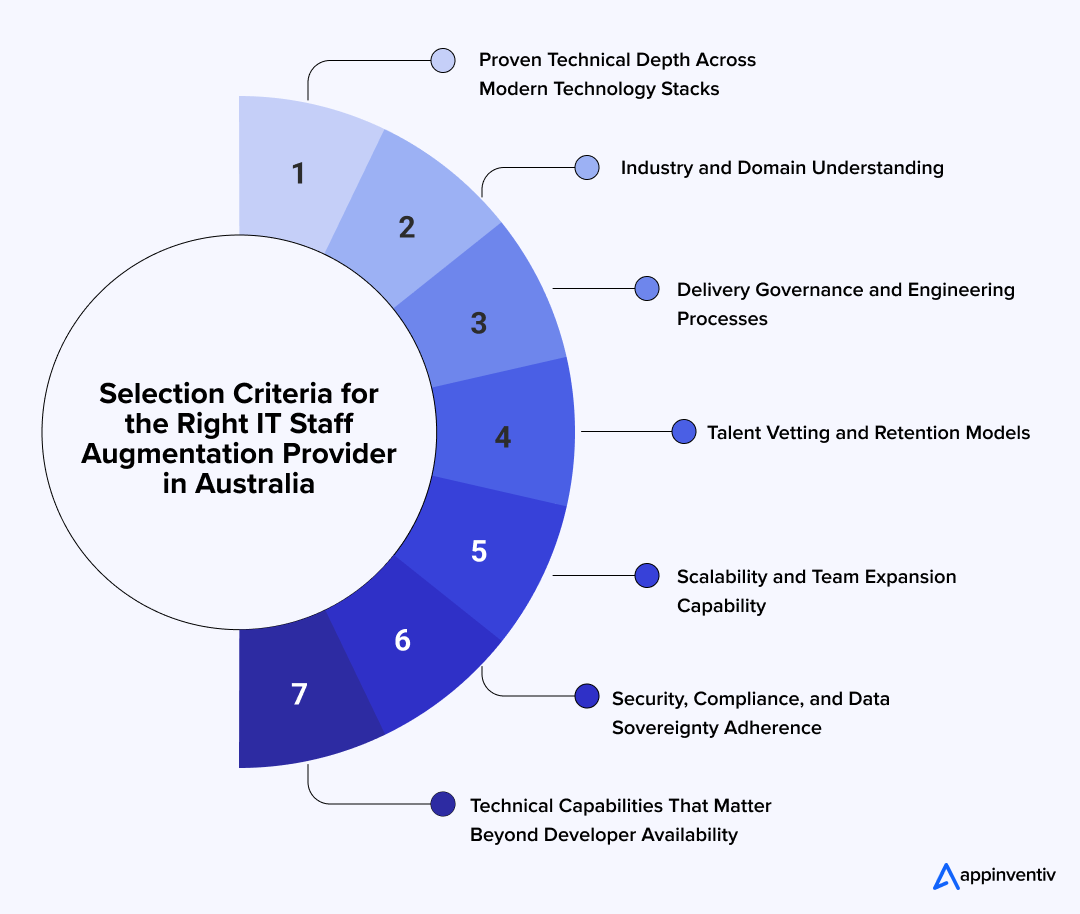
1. Proven Technical Depth Across Modern Stacks
Avoid providers operating as staffing marketplaces that match keywords on CVs to job descriptions. The most valuable augmentation partners embed engineering rigour into their talent selection. Evaluate capability across:
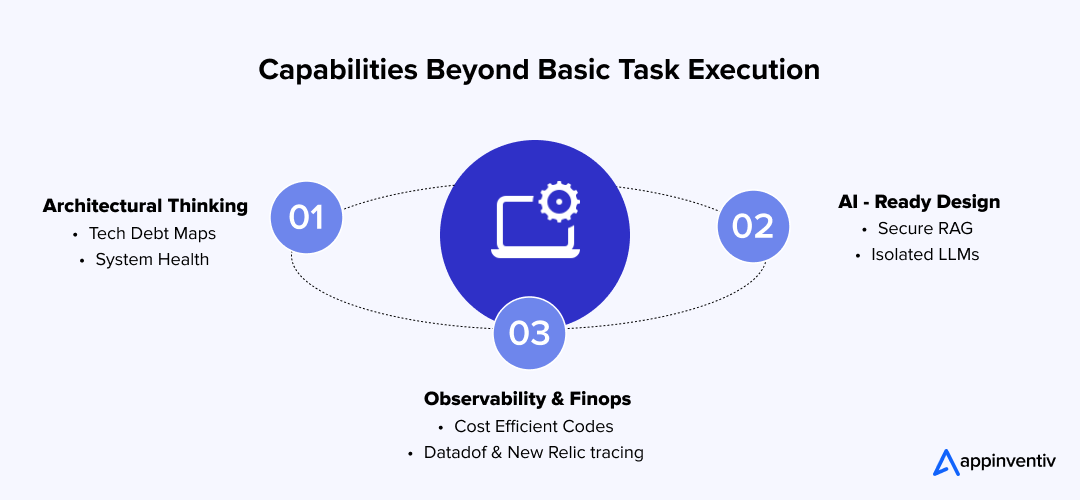
The key diagnostic question is whether the engineers on offer can contribute architecturally, or only execute pre-specified tasks. For enterprise engagements, the former is usually what the work demands.
2. Industry and Domain Understanding
Purely technical aptitude without industry-specific context creates delivery friction. Augmented resources must understand the workflow constraints, terminology, and standard operational patterns of your specific industry sector. For instance:
- Banking and Financial Services (BFSI): Navigating transaction integrity requirements, immutable audit logging, and strict access partitions.
- Healthcare and Lifesciences: Familiarity with health data interoperability rules, patient data privacy controls, and clinical software validation steps.
- Government and Public Sector: Aligning with structured multi-tier procurement steps, clear accountability matrices, and strict security posture guidelines.
- Logistics and Supply Chain: Understanding real-time asset tracking, warehouse management integrations, and high-availability warehouse architectures.
- Mining and Resources: Aligning with rigorous remote-site operational safety frameworks, industrial IoT (IIoT) telemetry integration, and high-availability systems.
3. Delivery Governance and Engineering Processes
Ask specifically how the partner structures sprint management, documentation, QA automation, and release governance. A provider without a demonstrable delivery methodology is a contractor pipeline, not an engineering partner. Mature providers will have documented processes for incident management, defect classification, and reporting cadence. Request evidence, not claims.
4. Talent Vetting and Retention Models
When considering how to choose the right IT staff augmentation partner in Australia, you must focus on three vital questions:
- What percentage of candidates pass the technical screen?
- What is the average tenure of augmented engineers in client engagements?
- How is continuity managed when a key resource exits mid-project?
The answers reveal whether the partner has a genuine talent pipeline or is reactive and unstructured. Attrition mid-engagement is one of the most disruptive risks in software development staff augmentation in Australia, and strong partners have documented mitigation protocols.
5. Scalability and Team Expansion
Capacity should flex in both directions. Can the partner add specialists quickly, support several teams at once, and sustain delivery over a multi-year horizon without quality drift? Scaling on paper is easy; scaling while holding standards is the test.
6. Security, Compliance, and Legal Alignment
This is where most partner shortlists fail proper scrutiny. An enterprise evaluating IT resource augmentation in Australia must assess compliance across several layers:
| Area | What to verify |
|---|---|
| Regulatory alignment | Privacy Act 1988 and APP obligations, SOCI Act duties, CPS 234 for APRA-regulated entities |
| Data sovereignty | Local data handling, regional hosting options, strict access governance |
| Secure development | ISO 27001 maturity, secure SDLC, DevSecOps, audit readiness, IP protection |
Where regulated data is involved, confirm where it lives and who can touch it before anything else. A partner who treats this as a checkbox is telling you something useful.
7. Technical Capabilities Beyond Developer Availability
Resume matching is the starting point, not the end. The stronger question is whether engineers can think architecturally or only execute tickets. Modern programs need LLM integration, MLOps and responsible-AI awareness alongside deep AWS, Azure, Google Cloud and Kubernetes experience. Quality engineering maturity, from test automation to observability, separates partners who ship reliably from those who ship and pray.
Dedicated Team vs Staff Augmentation: How to Choose the Right Operating Model?
The dedicated team vs staff augmentation question is one of the most common decision points for Australian enterprise buyers. Both models can work; the choice depends on programme duration, integration complexity, and the level of operational continuity required.
Staff Augmentation: Staff augmentation places individual engineers within your existing team structure. You manage them directly. This works well for filling specific skill gaps in a functioning delivery team and for engagements where your internal engineering leadership is strong enough to absorb and direct additional capacity.
Dedicated Team: A dedicated development team in Australia operates as a standalone unit embedded in your programme structure. They have their own internal hierarchy, delivery lead, and process framework, but operate exclusively on your work. This model suits multi-year platform programmes, product companies building ongoing feature velocity, and transformation programmes where the scale of delivery exceeds what individual augmentation can support.
The trade-off is management overhead and integration complexity. Dedicated teams require investment in alignment, tooling setup, and communication structure. That investment pays off over time but can be a drag in the early stages of an engagement.
How to Assess Delivery Maturity and Engineering Quality
Claims are easy. Evidence is not. Mature partners can show you operational metrics and real implementations rather than polished narratives. Evaluating IT resource augmentation in Australia requires checking objective indicators of engineering quality and delivery performance.
Case studies and implementation examples. Ask for detailed examples of comparable enterprise implementations, including platform complexity, team scale, delivery cadence, and measurable outcomes. Vague portfolio pages are not evidence of delivery maturity.
Operational KPIs. Request data on deployment frequency, lead time for changes, defect rates, and mean time to recovery from incidents. These metrics reveal engineering culture. Partners who cannot produce them either do not track them or have not achieved the maturity worth tracking.
Communication and escalation structure. Who is the designated delivery lead? What is the escalation path when something goes wrong? Assess these before the engagement starts, not after.
Questions Australian CTOs Should Ask Before Signing an Augmentation Contract
Before finalising an agreement with an Australian staff augmentation provider, ensure your engineering leadership asks these clarifying questions:
- How are engineers technically validated? What is the pass rate through your screening process?
- Who holds delivery accountability on your side once the engagement starts?
- How is knowledge continuity managed if a key engineer exits mid-project?
- What contractual protections exist around IP ownership and source code assignment?
- How is security enforced for engineers accessing our internal systems or handling sensitive data?
- Can the team scale – add two senior engineers, for example – within 30 days if the programme accelerates?
- What reporting does our engineering leadership receive, and at what cadence?
- What is your documented process for managing underperformance in an augmented engineer?
Ask these questions to any shortlisted partner and weigh the specificity of the answers. Vague answers here are themselves the answer.
Staff Augmentation Best Practices: Red Flags to Watch For
Partner selection fails when buyers overlook operational signals during the sales process. These indicators, taken together, suggest a provider who is unlikely to perform at enterprise standards.
Treat the following as cause for serious pause:
- Resume-first engagement with no technical interview process offered
- No engineering leadership involvement in the proposal or discovery process
- Inability or reluctance to provide current ISO 27001 certification
- No documented Privacy Act posture or refusal to sign a data-processing addendum
- Claims of very fast ramp timelines without evidence of a standing talent pipeline
- No Australian client references that are independently verifiable
- Heavy reliance on subcontractors, particularly where data handling is involved
- Governance structure that is entirely dependent on one relationship manager
Any one of these is a yellow flag. Two or more together usually means walking away. When you choose a staff augmentation company in Australia, weigh these signals as heavily as the capability scorecard.
What Are the Structured Steps to Hire an IT Staff Augmentation Partner?
A structured engagement process reduces risk at every stage. The steps below apply whether you are running a rapid capability search or a formal RFP process.
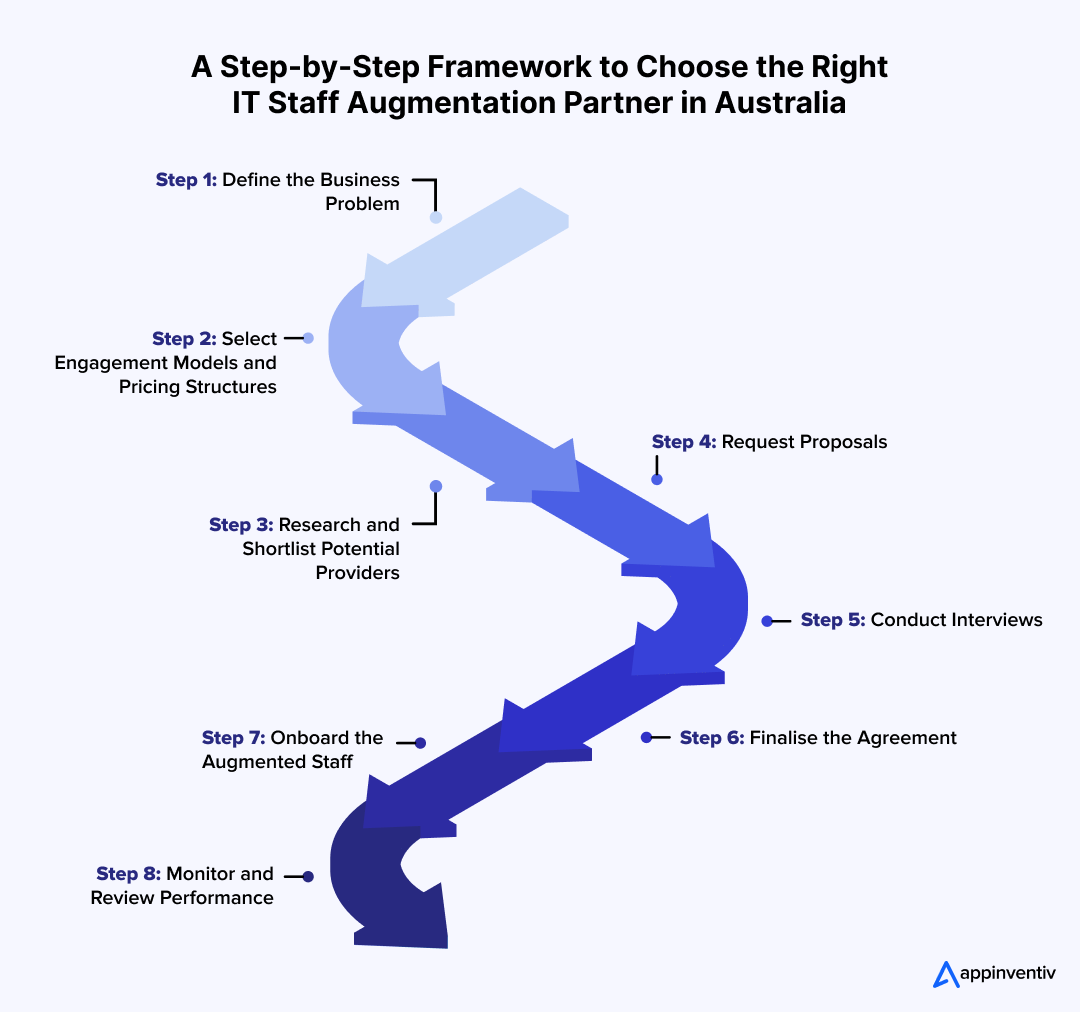
Step 1 — Define the business problem
Specify the capability gap, the delivery context, and the success criteria before approaching any vendor.
Step 2 — Select engagement model and pricing structure
Decide whether individual augmentation, a dedicated team, or a hybrid model fits the programme scale and management capacity available. Here is which model to choose and when:
| Engagement Model | Core Structural Profile | Management Overhead | Best-Fit Scenario |
|---|---|---|---|
| Individual Augmentation | Single specialists embedded into existing scrum teams | High; internal leads direct tasks and code reviews | Filling highly targeted skill gaps or handling short-term sprint peaks |
| Dedicated Team | A complete, self-contained squad with embedded delivery leads | Medium; managed via output metrics and sprint milestones | Long-term delivery of standalone systems or product feature tracks |
| Hybrid Model | Internal core architects managing extended blended teams | High; requires close alignment between local and vendor leads | Large-scale platform modernisations requiring shared system knowledge |
Step 3 — Research and shortlist providers
Use verified directories (Clutch, GoodFirms, The Manifest) alongside referrals from peer CIOs. Filter for AU market presence, sector experience, and compliance certifications.
Step 4 — Request and evaluate detailed proposals
Examine proposals based on screening depth, talent retention rates, transition strategies, and secure development frameworks rather than comparing simple baseline hourly billing estimates.
Step 5 — Conduct technical interviews
Subject the vendor’s pre-vetted engineers to rigorous, internal technical reviews and architectural scenarios to confirm their capabilities align with your existing pipeline quality standards.
Step 6 — Finalise the agreement and governance frameworks
Execute clear Master Services Agreements (MSAs) and Statements of Work (SOWs) that establish undisputed IP ownership, strict data access boundaries, and clear performance mitigation rights.
Step 7 — Onboard the augmented staff
Integrate augmented personnel into company communications, issue tracking tools, and secure code repositories. Ensure complete completion of security orientation modules before granting active repository access.
Step 8 — Monitor and review performance
Track engineering output continuously using automated pipeline metrics and structured delivery reviews, leveraging established escalation pathways to address alignment issues early.
Appinventiv has deployed augmented teams inside APRA-regulated and government-adjacent programs across Australia.

The Timezone Reality: AEST Overlap Is a Delivery Requirement, Not a Preference
Timezone alignment is consistently underweighted in staff augmentation partner selection in Australia. It has material consequences for delivery velocity, code review cycles, and incident response.
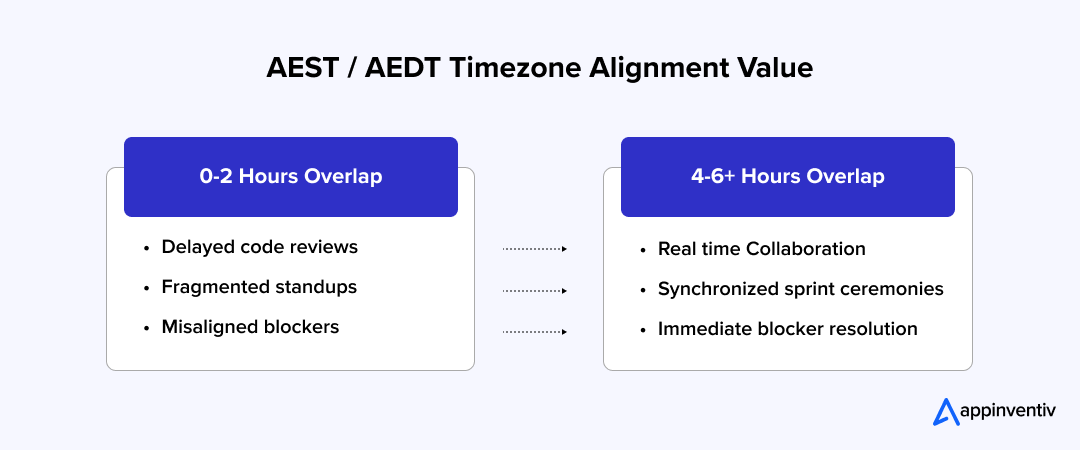
Time zone overlap is a hard operational requirement, not a nicety. Real-time collaboration in Australian business hours decides whether augmented engineers integrate into your sprints or work around them. Treat AEST coverage as a selection criterion with the same weight as technical skill.
Distributed delivery only works when working hours actually meet. A team with four or five hours of genuine AEST overlap can join stand-ups, unblock issues live and respond to incidents while your people are awake. A team asleep when yours is working adds a full day of latency to every decision.
For incident-sensitive and regulated workloads, that lag is a real risk. When you evaluate any partner, treat sustained working-hours overlap as a requirement to be proven, not a logistics detail to sort out later.
Prioritising a partner capable of delivering substantial working-hour overlap with Australian Eastern Standard Time (AEST) or Australian Eastern Daylight Time (AEDT) yields significant operational advantages:
Remember, contractual commitment to AEST delivery hours should appear in the master service agreement. Verbal assurance is not sufficient for enterprise procurement.
AI, Cloud, and Emerging Skill Requirements Shaping the Future of Staff Augmentation in 2026
The skills enterprises need are shifting faster than permanent hiring can track.
Generative and agentic AI engineering, cloud FinOps and platform engineering now sit on near-term roadmaps. The partner worth outsourcing offers capability depth across these, not just a larger pool of available developers.
The implication for selection is simple.
Tomorrow’s augmentation partner has to bring depth, not headcount. A provider who can field a responsible-AI specialist or a platform engineer on short notice is solving a different problem than one who simply supplies more hands. As these skills move from edge cases to baseline, that depth becomes the real differentiator.
Why Appinventiv Is the Right Staff Augmentation Company in Australia
Choosing a staff augmentation company in Australia comes down to one question: can the partner actually deliver at your standard, within your governance framework, and without requiring your leadership team to carry the weight of managing their shortfalls?
Appinventiv’s 11+ years of APAC delivery experience, squad of 1600+ tech architects and 5+ agile delivery centers across Australia answer that question with verifiable evidence. For public sector and regional enterprise initiatives, our pre-approved status on the Queensland Government ICTSS and Local Buy LGA procurement panels demonstrates a commitment to transparent corporate governance.
The numbers below further reinforce that commitment of fully compliant delivery of custom software engineering and modernisation with a clear understanding of enterprise governance.
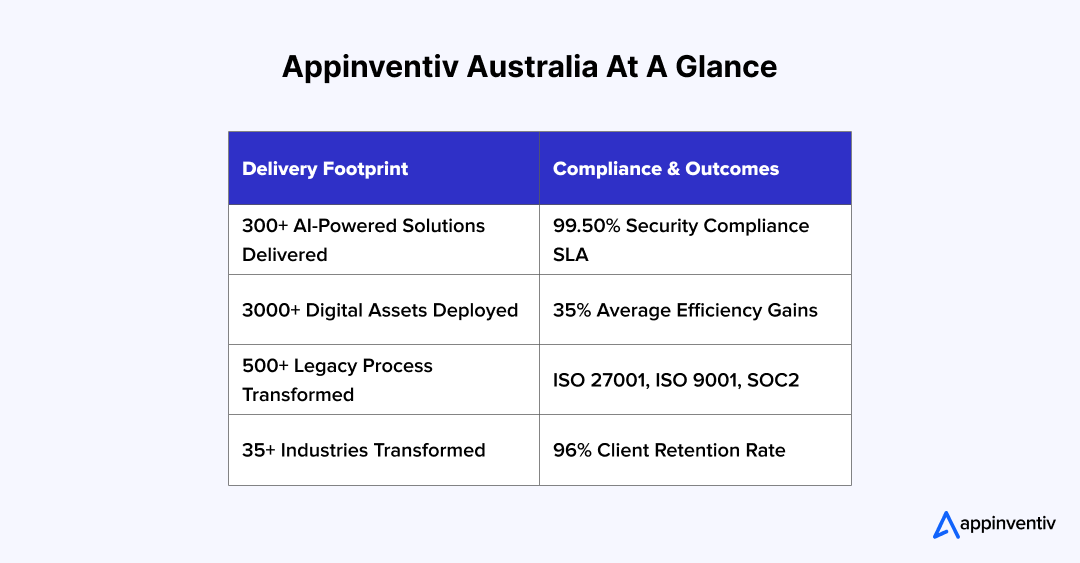
We provide high-quality staff augmentation and technology strategy consulting in Australia, designed specifically for the unique operational, regulatory, and security demands of the Australian enterprise market. By providing significant working-hour overlap with Australian timezones, we ensure our team integrate smoothly into active sprints.
Whether modernising a legacy core system, scaling up an internal product team, or building an AI-driven platform, we deliver the specific engineering expertise and structural reliability required to support strategic enterprise goals.
If you are still weighing how to choose the right IT staff augmentation partner in Australia for a transformation or modernisation program, talk to our Australian delivery team today
FAQs
Q. How does staff augmentation work in Australia?
A. You keep your roadmap and management while a provider supplies vetted engineers who join your existing teams and rituals for a defined period. For regulated entities, the work happens inside your own access controls and security environment.
Q. How do you choose the right IT staff augmentation partner in Australia?
A. You should score partners across technical depth, domain fit, delivery governance, talent vetting, scalability and compliance, then weight security and data sovereignty heavily for regulated work. Ask for operational metrics and real case studies rather than resumes, confirm genuine AEST overlap, and lock accountability and exit terms into the contract before you sign.
Q. How much does staff augmentation cost in Australia?
A. On average, staff augmentation costs in Australia range between AUD 70 and AUD 700+ per hour. The actual hiring cost varies depending on experience, skill scarcity and engagement model.
Most augmentation runs on time and materials, so the staff augmentation cost in Australia scales with the mix of roles and overlap hours you need. Specialised AI, cloud and security engineers command a premium. The relevant comparison is not rate alone but total cost against the speed and retention you get.
Q. How quickly can staff augmentation teams be deployed?
A. A capable provider can place pre-vetted engineers in days to a few weeks, far faster than permanent hiring. Speed depends on skill scarcity and security onboarding. Be wary of any partner promising instant senior teams, since credible vetting takes real time and shortcuts there become risks of staff augmentation later.
Q. What are the benefits of staff augmentation in AUstralia?
A. Staff augmentation in Australia gives enterprises access to specialist skills such as AI, cloud, cybersecurity, etc. that the local talent market cannot supply fast enough. The key practical benefits include:
- Faster Access to Specialised Talent
- Accelerated Project Delivery
- Greater Workforce Flexibility:
- Reduced Hiring and Operational Costs
- Improved Focus for Internal Teams
- Support for Emerging Technology Initiatives
- Lower Project Risk
- Knowledge Transfer and Capability Building
- Enhanced Business Agility
[ad_2]
Source_link