[ad_1]
Key Takeaways
- Check how the vendor handles ransomware recovery, audit logging, access control, and cloud incident response during real outages.
- Review how patient data moves across APIs, cloud workloads, mobile apps, and connected healthcare systems before vendor selection.
- Ask vendors how they secure Kubernetes workloads, backup environments, encryption keys, and privileged healthcare user accounts.
- Examine whether the provider supports continuous monitoring, compliance tracking, and visibility across AWS, Azure, and hybrid infrastructure.
- Look beyond compliance certificates and review real operational security practices, healthcare experience, and recovery preparedness.
Ten years ago, most hospitals stored patient records inside local data centers. That model has changed fast. Health systems now push data through cloud EHRs, telehealth apps, imaging platforms, pharmacy systems, and remote monitoring devices every hour of the day.
That shift created new security problems and made choosing a cloud security partner for sensitive health data storage one of the most critical decisions a healthcare enterprise can make.
Many healthcare breaches now start from simple gaps. An exposed API key. A weak IAM policy. An inactive backup server. A cloud storage bucket was left open longer than expected. Once attackers enter the environment, they move quickly across connected systems.
The pressure on healthcare providers is different from that in other industries. Doctors need access to systems at all times. Delays affect patient care directly. A ransomware attack can lock scheduling tools, diagnostic platforms, billing systems, and clinical records at the same time.
Cloud infrastructure has grown more complex, too. Large providers now split workloads across AWS, Azure, private cloud systems, and edge devices. Security teams must monitor container traffic, user access, encryption keys, audit logs, and FHIR API activity across multiple regions.
Industry growth reflects this shift. The global healthcare cloud computing market is projected to reach $166 billion by 2031, growing at a 17.5% CAGR.
This is why knowing how to choose a reliable healthcare cloud security partner has become a boardroom priority. Healthcare enterprises need partners that understand PHI protection, compliance audits, ransomware recovery, and cloud operations in real clinical environments.
Organizations that hire a cloud security partner for healthcare data storage gain an operational edge in both protection and compliance readiness.
17.5% Cloud Growth Raises Security Pressure
Healthcare providers now face larger attack surfaces across APIs, cloud workloads, backups, and connected patient systems.

How Healthcare Cloud Security Requires a Different Evaluation Approach
Healthcare organizations handle systems that cannot afford long outages. A delayed payment system creates frustration. A locked clinical system can delay treatment, prescriptions, or emergency care. That changes how enterprises should evaluate a cloud security partner for healthcare data protection and clinical uptime.
The Operational Risks Are Much Higher in Healthcare
Modern healthcare systems process large volumes of sensitive data every hour. That includes:
- EHR software and electronic health records
- Medical imaging files
- Insurance and billing data
- Telehealth sessions
- Remote patient monitoring feeds
- Genomics and diagnostic datasets
Most of this information moves through APIs, cloud workloads, and connected applications continuously.
Cloud-Native Healthcare Systems Create More Security Gaps
Cloud computing in healthcare now spans AWS, Azure, hybrid cloud infrastructure, and edge devices. Many environments include Kubernetes clusters, containerized applications, and third-party integrations.
Security teams must monitor:
- IAM policies
- API authentication
- Encryption keys
- Workload activity
- Backup isolation
- Audit logs
Small failures can create large exposure risks.
| Healthcare Environment | Common Security Risk |
|---|---|
| FHIR APIs | Unauthorized token access |
| Cloud EHR platforms | Weak identity controls |
| Medical IoT devices | Limited endpoint visibility |
| Hybrid cloud workloads | Monitoring gaps |
| Telehealth security applications | Third-party integration risks |
Compliance Alone Does Not Reduce Breach Risk
Many vendors focus heavily on HIPAA checklists and certification badges. That is no longer enough. Healthcare enterprises now review incident response maturity, ransomware recovery plans, runtime threat detection, and interoperability security as core standards for cloud security for healthcare data environments.
Step 1: Evaluate Their Healthcare Compliance and Governance Capabilities
Many healthcare providers make the same mistake when choosing a cloud security partner for sensitive health data storage: they treat compliance certificates as proof of security maturity. That creates problems later.
A cloud vendor can pass a compliance audit and still leave gaps inside healthcare data security controls, API security, backup isolation, or logging systems.
Healthcare organizations should look deeper.
Assessing HIPAA, HITRUST, GDPR, and Regional Compliance Expertise
A strong healthcare cloud partner should explain how cloud regulatory compliances apply inside day-to-day operations. That includes cloud storage, user access, third-party integrations, and data movement between systems.
Review their experience with:
- HIPAA Security Rule requirements
- HITRUST CSF assessments
- GDPR data residency rules
- SOC 2 Type II audits
- ISO 27001 controls
Ask how they handle audit logging, PHI retention, privileged access, and regional data transfer restrictions.
| Compliance Standard | Area to Review |
|---|---|
| HIPAA | PHI access controls and audit logging |
| HITRUST | Risk scoring and control mapping |
| GDPR | Cross-border data handling |
| SOC 2 Type II | Operational security controls |
Reviewing Business Associate Agreements (BAAs) and Shared Responsibility Models
Many healthcare breaches happen after teams misunderstand ownership boundaries.
A Business Associate Agreement should clearly define:
- Who manages encryption keys
- Who handles backups
- Who responds during a breach
- Who controls identity policies
- Who manages data deletion requests
Vague language creates operational risk.
Evaluating Audit Readiness, Policy Enforcement, and Compliance Automation
Healthcare environments change constantly. New workloads, APIs, and user roles appear every week. Manual compliance tracking breaks quickly in these environments.
Most mature vendors now use automated controls such as:
- Continuous compliance monitoring
- CSPM platforms
- SIEM integrations
- Real-time configuration alerts
- Infrastructure-as-Code policy checks
A mature healthcare cloud security partner deploys these systems to detect policy drift before auditors or attackers do.
Step 2: Assess Their Core Cloud Security Architecture
Healthcare systems exchange sensitive data constantly. Patient records move between EHR platforms, insurance systems, diagnostic applications, pharmacy networks, and remote care platforms every minute. Weak cloud architecture creates exposure points across all of them.
This is why cloud security for healthcare data starts at the infrastructure level, and enterprises must examine how a vendor builds and secures that environment.
Encryption Standards, Key Management, and Secure Data Storage
Secure cloud storage for healthcare data means protecting PHI across storage, transmission, and active processing, not just one layer. Many vendors advertise AES-256 encryption, but that only covers one layer of protection.
Healthcare organizations should review:
- Encryption key ownership
- Hardware Security Module (HSM) usage
- Backup encryption policies
- Database encryption controls
- Key rotation schedules
Strong vendors usually support customer-managed keys through AWS KMS, Azure Key Vault, or Google Cloud KMS.
| Security Area | What to Verify |
|---|---|
| Data at rest | AES-256 encryption |
| Data in transit | TLS 1.2 or TLS 1.3 |
| Encryption keys | HSM-backed storage |
| Backups | Immutable encrypted copies |
Also Read: HIPAA Compliant App Development Guide
Identity and Access Management (IAM) and Privileged Access Controls
Many healthcare breaches start with compromised credentials, making identity and access management one of the first controls to review.
Also review how the vendor handles:
- Multi-factor authentication
- Role-based access controls
- Privileged Access Management (PAM)
- Service account permissions
- Session monitoring
Overprivileged accounts create unnecessary risk inside healthcare environments.
Zero Trust Architecture and Microsegmentation Strategies
Healthcare providers no longer operate behind a single network perimeter. Cloud workloads, APIs, users, and devices connect from multiple locations at all times.
Zero Trust models verify every request continuously.
Look for controls such as:
- Least-privilege access
- Network microsegmentation
- Identity-aware proxy systems
- Device verification policies
- East-west traffic inspection
API Security for FHIR, HL7, and Healthcare Integrations
APIs in healthcare have become a core dependency across modern health systems. FHIR APIs, HL7 interfaces, and third-party integrations exchange PHI across multiple systems daily.
Security teams should review:
- OAuth 2.0 and OpenID Connect controls
- API gateway protection
- Token expiration policies
- API rate limiting
- Runtime API monitoring
Weak API governance often becomes the fastest path into healthcare cloud environments.
Step 3: Examine Their Threat Detection, Incident Response, and Ransomware Readiness
Healthcare systems face constant attack attempts. Threat actors target hospitals, diagnostic networks, insurers, and telehealth platforms every day. Most attacks now focus on identity systems, cloud workloads, backup repositories, and exposed APIs.
The right cloud security partner for healthcare data environments should detect threats early and contain them fast.
24/7 Security Monitoring and Threat Intelligence Capabilities
Healthcare environments generate huge volumes of activity logs. Security teams must monitor user access, API traffic, workload behavior, endpoint activity, and authentication attempts across multiple systems.
Review whether the vendor supports:
- 24/7 Security Operations Center (SOC) coverage
- SIEM platforms such as Splunk or Microsoft Sentinel
- Extended Detection and Response (XDR) tools
- Behavioral analytics
- Threat intelligence feeds
- Real-time alerting
| Monitoring Area | Common Threat |
|---|---|
| IAM systems | Credential theft |
| APIs | Token abuse |
| Cloud workloads | Lateral movement |
| Backup systems | Ransomware targeting |
| Endpoints | Malware infections |
Incident Response Workflows and Breach Containment Procedures
Strong incident response plans reduce downtime and limit data exposure.
Healthcare organizations should ask vendors:
- How quickly can they isolate compromised workloads?
- How are incidents escalated internally?
- Who leads forensic investigations?
- How are regulators and customers notified?
Clear containment procedures matter during ransomware events.
Backup Architecture, Disaster Recovery, and Ransomware Resilience
Backups fail more often than many organizations expect. Attackers now target backup systems early during ransomware attacks.
Review:
- Immutable backup storage
- Offline backup isolation
- Multi-region replication
- Backup recovery testing
- Air-gapped recovery environments
Recovery SLAs, RTOs, and RPO Commitments
Recovery metrics directly affect hospital operations.
| Recovery Metric | What It Measures |
|---|---|
| RTO | Time needed to restore systems |
| RPO | Maximum acceptable data loss |
| SLA | Service recovery commitment |
Healthcare enterprises should validate these numbers before signing long-term contracts.
Step 4: Evaluate Their Scalability, Multi-Cloud Governance, and Operational Visibility
Most healthcare companies now run systems across more than one cloud provider. An organization may keep patient records in AWS, analytics workloads in Google Cloud, and internal applications in Azure. Some teams still maintain private infrastructure for older systems.
That setup creates security gaps fast and demands a healthcare cloud security partner with multi-cloud governance experience.
Managing Security Across AWS, Azure, and Google Cloud Environments
Each cloud platform works differently. Permissions, logging controls, and monitoring systems vary from one provider to another. Enterprise healthcare cloud solutions must deliver the same level of security control across every environment.
Ask vendors how they manage:
- Identity policies across multiple clouds
- Container and Kubernetes security
- Centralized logging
- Cross-cloud workload monitoring
- Infrastructure configuration reviews
| Cloud Platform | Common Security Issue |
|---|---|
| AWS | Public storage exposure |
| Azure | Excess user permissions |
| Google Cloud | Weak audit settings |
| Kubernetes | Unrestricted container access |
Small configuration mistakes often spread across environments without teams noticing immediately.
Continuous Compliance Monitoring and Security Posture Management
Healthcare infrastructure changes constantly. New APIs, workloads, integrations, and user roles appear every week.
Manual reviews miss too much.
Most mature vendors offering cloud security services now rely on automated monitoring tools, including CSPM platforms, real-time compliance alerts, and configuration drift detection systems. These tools help security teams spot risky changes early.
Data Residency, Sovereignty, and Cross-Border Healthcare Compliance
Healthcare providers operating across regions face strict healthtech regulations around data storage and residency. Some patient records cannot leave specific jurisdictions.
This pressure is influencing infrastructure decisions, too. Private cloud environments held 41.5% market share in healthcare cloud deployments last year, largely tied to tighter PHI governance and compliance requirements.
Review how the vendor handles:
- Regional storage restrictions
- Cross-border backups
- Data retention timelines
- Local compliance requirements
Infrastructure Visibility, Logging, and Auditability
Security teams need complete visibility during audits and incidents. Missing logs slow investigations immediately.
Strong vendors usually support centralized logging, API activity tracking, SIEM integrations, and long-term audit retention across all cloud environments.
Most Healthcare Breaches Start Small
Weak API governance, poor workload monitoring, and access control gaps often trigger larger operational security failures.
Step 5: Conduct a Real-World Vendor Risk Assessment
Many healthcare companies approach choosing a cloud security partner for sensitive health data storage through sales presentations and compliance documents alone. That process leaves major blind spots. A real assessment should examine how the vendor performs under operational pressure, security incidents, and audit conditions.
Questions Healthcare Enterprises Should Ask Before Signing an Agreement
Understanding the factors to consider when choosing a cloud partner starts with asking the right questions, ones that expose weak governance quickly.
Healthcare enterprises should ask vendors:
- How fast can you isolate compromised workloads?
- Who owns encryption keys?
- How often do you test ransomware recovery procedures?
- What SIEM and threat detection tools do you use?
- How long are audit logs retained?
- How do you secure FHIR API traffic?
- What happens during a regional cloud outage?
Clear answers matter more than polished presentations.
Reviewing Third-Party Security Audits and Penetration Testing Practices
Strong vendors regularly test their environments for weaknesses. That testing should include cloud workloads, APIs, IAM systems, and container infrastructure.
Review whether the vendor conducts:
- External penetration testing
- Red team exercises
- Vulnerability scanning
- Kubernetes security testing
- API security assessments
| Security Review Area | What to Verify |
|---|---|
| Penetration testing | Testing frequency and scope |
| Vulnerability scans | Patch timelines |
| API testing | Authentication and token security |
| Cloud workloads | Runtime threat monitoring |
Evaluating Vendor Transparency, Security History, and Case Studies
When you hire a cloud security partner for healthcare data storage, security maturity becomes visible through difficult conversations, not polished presentations. Vendors should explain past incidents, remediation steps, and operational improvements clearly.
Review:
- Healthcare security case studies
- Incident disclosure practices
- Audit findings
- Customer retention history
- Regulatory investigation history
Understanding Vendor Lock-In Risks and Exit Strategies
Cloud migrations become difficult once healthcare workloads scale across environments, which is why many organizations lean on managed IT services for long-term operational support.
Healthcare organizations should review:
- Data export procedures
- Backup portability
- API dependency risks
- Contract termination clauses
- Migration support timelines
Poor exit planning creates operational and financial pressure later.
Red Flags To Avoid When Choosing a Healthcare Cloud Security Partner
Deciding to hire a cloud security partner for healthcare data storage is a high-stakes process, and many vendors look strong during procurement discussions. Their websites show compliance badges, security claims, and long service lists. That does not always reflect real operational maturity.
Healthcare enterprises should examine how vendors respond under pressure, secure cloud workloads, and define security ownership.
Common Warning Signs During Vendor Evaluation
| Red Flag | Why It Matters |
|---|---|
| Compliance-only positioning | Leaves gaps in runtime threat detection |
| Weak incident response visibility | Slows breach containment |
| Limited healthcare integration experience | Creates API and interoperability risks |
| No ransomware recovery guarantees | Increases downtime exposure |
| Poor monitoring coverage | Delays threat detection |
| Weak IAM and API governance | Expands unauthorized access risks |
Questions That Often Expose Weak Vendors
Security gaps usually appear during technical discussions, not sales presentations.
Healthcare enterprises should ask:
- How often do you test ransomware recovery procedures?
- How do you monitor FHIR API traffic?
- Who owns encryption key management?
- How fast can you isolate compromised workloads?
- What happens during a regional cloud outage?
Strong vendors answer directly and with technical detail. Weak vendors rely on broad compliance language and generic cybersecurity in healthcare claims.
Why This Evaluation Stage Matters
Healthcare workloads become difficult to move once systems scale across multiple cloud environments. Poor vendor selection can create long-term operational risk, migration costs, and compliance pressure later.
This is why the factors to consider when choosing a cloud partner deserve thorough evaluation before any long-term commitment is made.
This structure is:
- easier to scan,
- visually lighter,
- better for dwell time,
- and more natural for human readers.
Healthcare Cloud Security Trends Enterprises Should Prepare For
Healthcare security teams now deal with far more systems than they did a few years ago. Patient data moves between mobile apps, cloud databases, imaging systems, telehealth platforms, and analytics tools throughout the day. Every connection creates another security checkpoint.
The technology stack keeps growing, and cloud security for healthcare data must evolve alongside it.
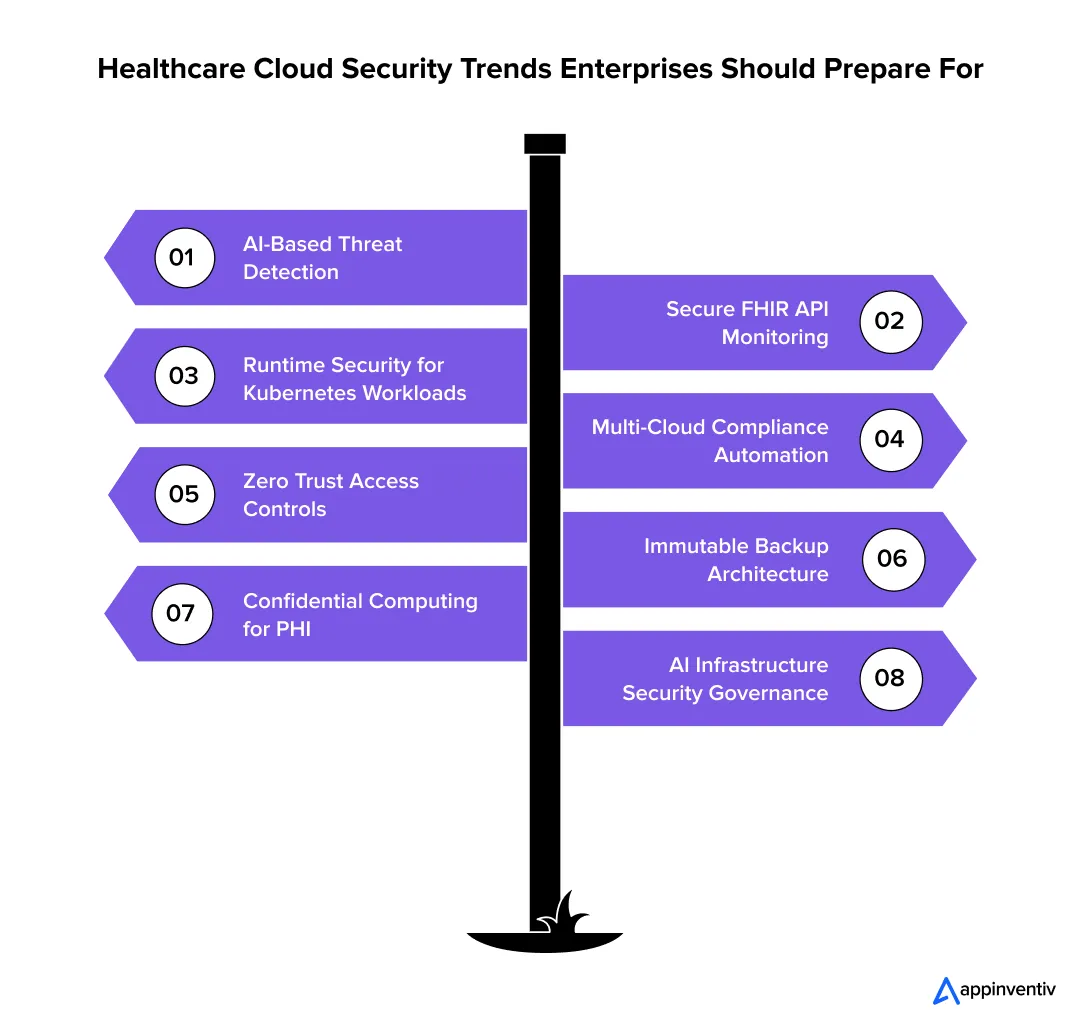
AI-Driven Threat Detection and Autonomous Security Operations
Large healthcare networks generate huge amounts of security data daily. Login attempts, API calls, workload activity, and endpoint events create constant streams of alerts.
Most teams cannot review all of this manually anymore.
Many hospitals and healthcare providers now use AI-based monitoring tools to flag unusual behavior early. These systems help detect:
- Suspicious account activity
- Unexpected workload behavior
- Abnormal API traffic
- Rapid data movement across environments
Security teams still investigate incidents themselves, but AI tools help reduce alert fatigue.
Runtime Security for Cloud-Native Healthcare Workloads
Many healthcare applications now run inside containers and Kubernetes clusters. Older monitoring tools often miss activity inside these environments.
Runtime monitoring platforms track workload behavior continuously.
| Environment | Common Risk |
|---|---|
| Containers | Unauthorized commands |
| Kubernetes | Excess privileges |
| APIs | Invalid token usage |
| Cloud workloads | Lateral movement |
This level of visibility has become more important after recent ransomware attacks targeted cloud workloads directly.
Confidential Computing and Advanced Encryption Models
Healthcare providers now process highly sensitive data sets across shared cloud environments. Standard encryption protects stored and transmitted data. Confidential computing protects data during active processing through isolated memory environments.
Secure Infrastructure for Healthcare AI and Analytics Platforms
Many healthcare providers now build AI models using imaging records, patient histories, and clinical research datasets. Enterprise healthcare cloud solutions supporting AI workloads must define who can access training data, how models are logged, and where those workloads run.
Don’t Wait For a Cloud Security Failure
Healthcare breaches often expose operational gaps long before compliance audits detect infrastructure and access control weaknesses.

Case Study: How Appinventiv Helped DiabeticU Upgrade Its Healthcare Cloud Environment
DiabeticU, a diabetes management platform based in the US, had started running into infrastructure problems after its platform usage increased. The company still relied on an older VMware environment hosted inside a private data center. System updates took longer, backups involved manual work, and scaling resources during peak traffic periods became difficult.
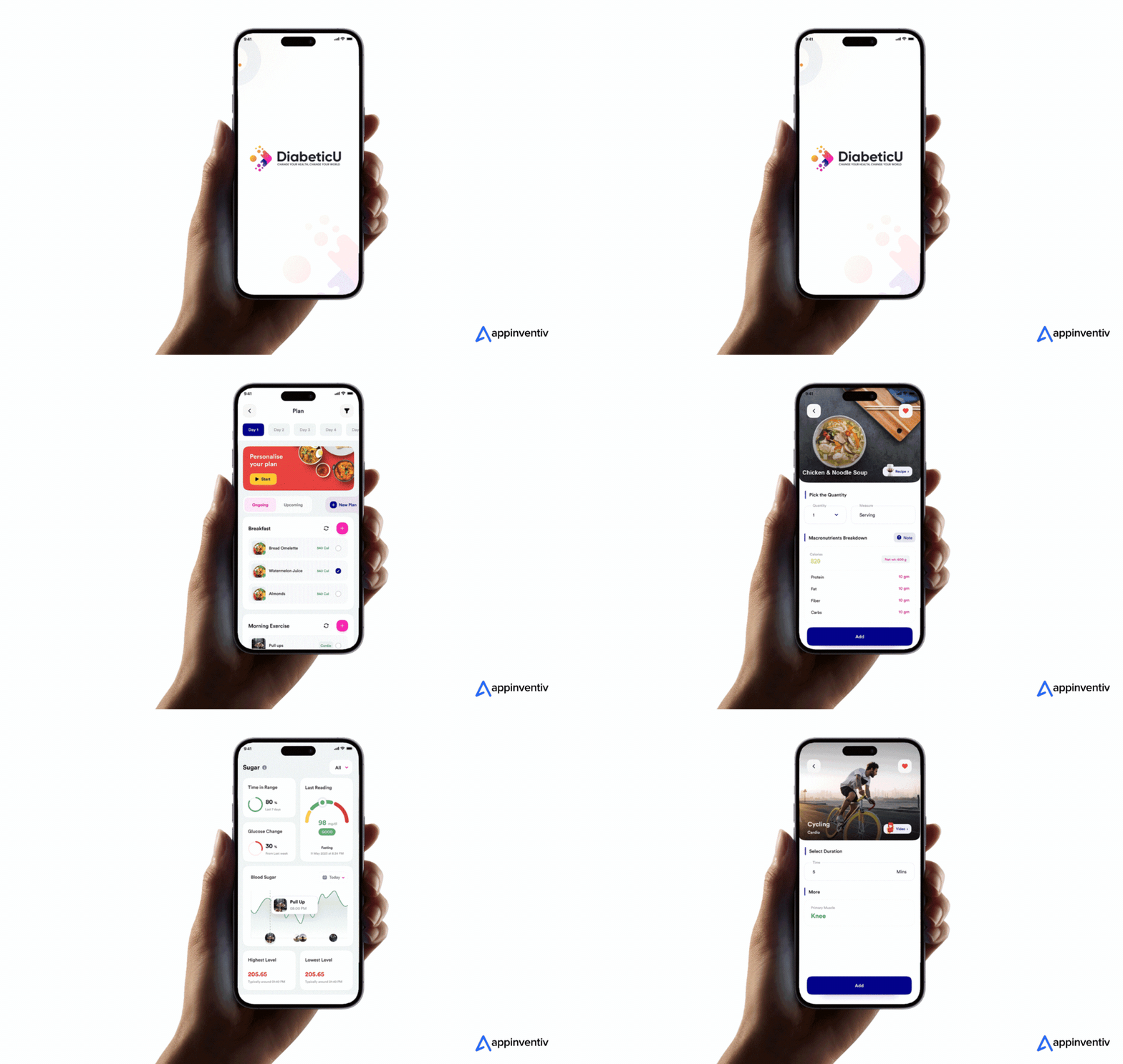
The team also needed stronger control over HIPAA-related security requirements. Audit logging, encryption management, and long-term PHI retention had become harder to manage inside the existing setup.
The Main Issues
The older infrastructure created several operational gaps:
- Delayed deployment cycles
- Rising infrastructure maintenance costs
- Limited scalability during high traffic periods
- Reduced visibility across workloads and logs
- More pressure around compliance management
The Cloud Modernization Work
Appinventiv helped move the platform into AWS through a phased cloud data migration process.
The updated environment included:
- Amazon EC2 for application workloads
- Amazon S3 for storing healthcare assets and files
- MongoDB Atlas for database management
- AWS KMS for encryption key handling
- CloudTrail for audit logging
- AWS Backup for recovery management
Results After Migration
| Area | Outcome |
|---|---|
| Infrastructure spending | Reduced by 30% |
| Migration downtime | Kept under 30 minutes |
| PHI protection | Stronger encryption and logging controls |
| Traffic handling | Better workload scaling |
| Recovery readiness | Faster backup restoration support |
The migration delivered secure cloud storage for healthcare data at scale, giving the DiabeticU team better operational control and reducing several risks tied to the older environment.
How Appinventiv Helps Healthcare Enterprises Secure Sensitive Health Data at Scale
Many healthcare providers struggle with the same cloud security gaps:
- Weak IAM policies
- Limited monitoring visibility
- Poor ransomware recovery planning
- Compliance-heavy security models
- Fragmented multi-cloud governance
Appinventiv delivers enterprise healthcare cloud solutions built specifically for regulated environments, helping organizations close these cloud security gaps.
As a leading healthcare IT consulting services company, our teams support:
- Zero Trust implementation
- FHIR API security
- HIPAA-ready cloud architecture
- Continuous compliance monitoring
- Backup and disaster recovery planning
- Multi-cloud governance across AWS and Azure
We also help healthcare organizations prepare infrastructure for AI workloads, analytics platforms, and large-scale patient data systems.
| Capability | Delivery Scale |
|---|---|
| Cloud migrations executed | 500+ |
| Cloud deployments executed | 2000+ |
| Hybrid-cloud setups delivered | 20+ |
| Cloud operations monitoring | 24/7 |
| Availability SLA | 99.90% |
| Infrastructure efficiency gains | 2x |
The focus goes beyond compliance reporting. For enterprises evaluating how to choose a reliable healthcare cloud security partner, Appinventiv helps build cloud environments that stay secure, scalable, and operational during real-world pressure.
Let’s connect and prepare your healthcare infrastructure for ai, multi-cloud expansion, and rising security threats.
Frequently Asked Questions
Q. Is HIPAA Compliance Enough When Choosing a Healthcare Cloud Provider?
A. No. Understanding how to choose a reliable healthcare cloud security partner goes well beyond HIPAA compliance. A healthcare company can pass a HIPAA audit and still face a serious cloud breach later. Many attacks now start through weak identity controls, exposed APIs, or poor backup separation. Healthcare teams should review how the vendor handles monitoring, recovery testing, access permissions, and incident response before signing long-term agreements.
Q. How Do Healthcare Organizations Secure PHI in Multi-Cloud Environments?
A. Most healthcare providers now use more than one cloud environment. Patient records, analytics workloads, and applications often run across AWS, Azure, and private infrastructure together. Security teams protect PHI through encryption, strict access rules, centralized logging, API monitoring, and isolated backup environments that reduce exposure during security incidents.
Q. Why Is Zero Trust Important for Healthcare Cloud Security?
A. Healthcare systems exchange data constantly between cloud workloads, APIs, mobile applications, and connected medical devices. Older perimeter-based security models cannot track all of this activity properly anymore. Zero Trust limits unnecessary access between systems and checks user activity continuously, which helps reduce damage during ransomware attacks and credential theft attempts.
Q. How Can Healthcare Organizations Reduce Ransomware Risks in Cloud Environments?
A. Ransomware groups often target backups and privileged accounts first. Healthcare providers reduce risk through isolated backups, MFA enforcement, segmented workloads, and regular recovery testing. Many organizations also monitor unusual login behavior, API traffic spikes, and workload activity closely. Recovery planning matters heavily once healthcare systems start facing operational downtime.
Q. Why Should Healthcare Enterprises Choose Appinventiv for Cloud Security Services?
A. Healthcare cloud environments become difficult to manage once systems are spread across multiple providers and connected applications. Appinventiv helps healthcare enterprises strengthen cloud governance, improve PHI protection, secure APIs, and prepare infrastructure for ransomware recovery. Our teams support healthcare organizations through large-scale cloud migrations, continuous monitoring, and regulated cloud infrastructure management.
[ad_2]
Source_link