
Key takeaways:
- Industrial AI could add £550 billion to UK GDP by 2035.
- Predictive maintenance cuts machine downtime by 30 to 50 percent.
- UK manufacturers lead Europe — 98% are deploying or planning generative AI.
- The average UK data breach now costs £4.14 million per incident.
- Made Smarter has subsidised digital uplift for 4,000+ UK manufacturing SMEs.
Made Smarter has subsidised digital uplift for 4,000+ UK manufacturing SMEs.
For UK manufacturers, Industry 4.0 in the UK has moved past the boardroom debate over whether to invest. Most boards in Britain are now wrestling with the harder questions further down the road:
- How is the architecture stitched together?
- Which integrations break first?
- Where does the cost actually land?
- How is the programme governed under UK GDPR, the Modern Industrial Strategy, and – for products crossing the Channel – the EU AI Act?
This guide answers them. Our team has spent more than a decade delivering regulated software for healthcare, fintech, and manufacturing clients across the UK, Europe, and the United States.
Figures below are cross-checked against Make UK, ONS, UKRI, the UK Government, and plenty of other such resources to deliver a working playbook for the next twelve to twenty-four months of Industry 4.0 transformation.
Your competitors are already mid-rollout.
Get a costed Industry 4.0 roadmap before the SME wave reshapes your supply chain.

Industry 4.0 in the UK: Where the Sector Sits in 2026
British manufacturing has steadied. Make UK’s UK Manufacturing: The Facts 2025 puts sector output at roughly £207 billion ($279bn) in 2025, with the UK 11th globally and 2.6 million people employed from Sunderland to Swansea.
The S&P Global UK Manufacturing PMI hit 53.6 in April 2026 — the strongest reading in nearly four years. Underneath, the smart manufacturing layer is moving faster: Grand View Research puts the UK market at £6.6 billion ($8.95bn) in 2025, climbing to £17.9 billion ($24.15bn) by 2033 at a 12.6% CAGR. Policy is underwriting that — the Modern Industrial Strategy (June 2025) earmarked up to £4.3 billion for advanced manufacturing over five years.
Productivity remains the headache every Whitehall briefing opens with. FourJaw, working from ONS data, reported UK factory output up 3.4% to nearly £639 billion in 2025, productivity 1.4% higher in real terms. Sounds healthy in isolation; the wider picture is less so. Barclays’ UK Manufacturing Productivity report (November 2025) found 56% of British manufacturers reckon national productivity is in decline, with 56.5% citing workforce challenges as the main barrier.
The long and short of it: capital and policy support are no longer the binding constraints. Execution capacity, integration discipline, and regulatory readiness are exactly where most digital programmes go pear-shaped.
Top Industry 4.0 Trends Reshaping the UK’s Manufacturing Sector in 2026
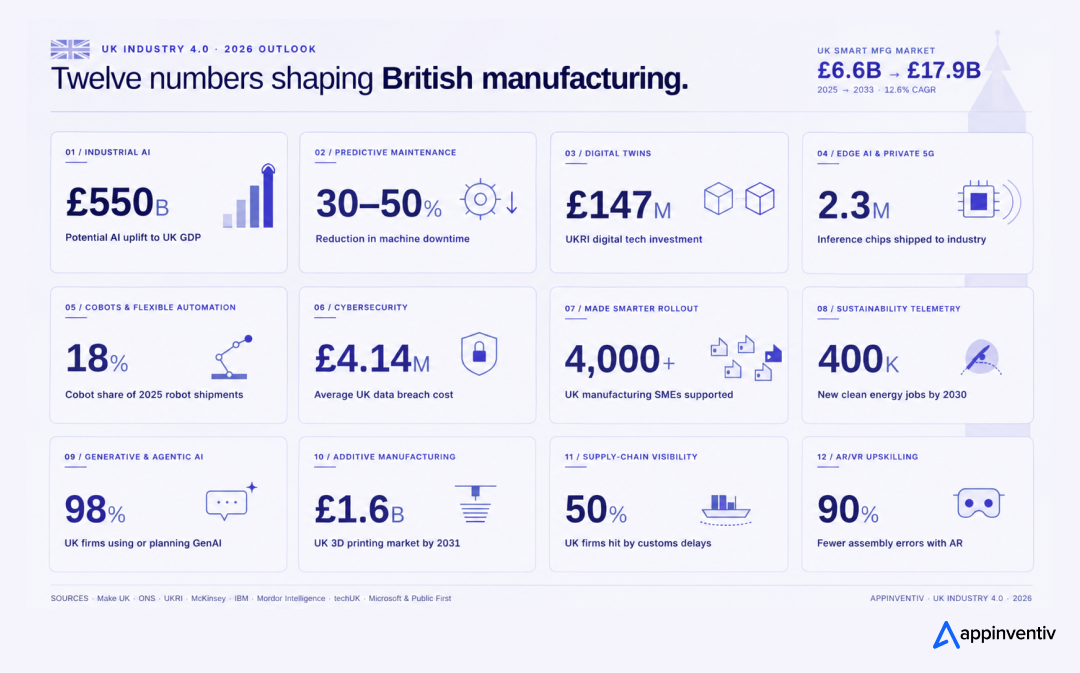
Twelve trends are bidding into nearly every enterprise RFP we are seeing this year. Each of these top Industry 4.0 trends in the UK is paired with research-grade evidence.
1. Industrial AI Moves From Pilot Into the P&L
Industrial AI is the largest single budget line in 2026 manufacturing programmes. Microsoft and Public First’s Unlocking the UK’s AI Potential (2025) estimated AI could add roughly £550 billion to UK GDP by 2035 — enough, techUK has argued, to push Britain back into the global top ten.
The 2025 Industrial Strategy ringfences nearly £4 billion of R&I funding for AI in manufacturing, cyber security, and advanced connectivity. Adoption is uneven, however: the Productivity Institute’s 2025 working paper found around half of UK firms use AI, but 10% have tested it without progressing to production — more than twice the abandonment rate of any other advanced technology.
What this means for the build: model governance, audit-ready data lineage, and human-in-the-loop checkpoints designed in from sprint one. The compliance-first approach is what advanced teams apply in evolving AI development services in the UK.
2. Predictive Maintenance Becomes the Easiest Industry 4.0 ROI to Defend
Predictive maintenance is the use case that finance directors approve first. McKinsey’s analytics-based maintenance research finds predictive approaches cut machine downtime 30%–50%, lower maintenance costs 10%–40%, and extend equipment life 20%–40%.
3. Digital Twins Become the Default Design Surface
Digital twins in manufacturing have moved beyond visualisation toys into the system of record, where engineering, operations, and finance reconcile decisions before capital is committed. Made Smarter Innovation funds this directly through the Materials Made Smarter Centre at Sheffield and the Digital Medicines Manufacturing Research Centre at Strathclyde, both part of UKRI’s £147 million Industrial Digital Technologies investment.
The pattern that works: instrument a single high-value asset (a press, a furnace, a packaging line), stand up the twin within ten to fourteen weeks, and only after the first twin pays for itself in reduced unplanned downtime should the team scale to the next asset.
4. Edge AI and Private 5G Replace Cloud-Only Architectures
Latency-sensitive use cases are migrating to the edge. Mordor Intelligence’s January 2026 analysis reports Intel shipped 2.3 million inference processors to industrial clients in 2025. UK manufacturers are pairing this with private 5G. BT and Vodafone are running active campus deployments to support sub-10-millisecond loops on the factory floor.
Working rule: if a decision must be made in under a hundred milliseconds, design it for the edge; everything else sits in a cloud lakehouse.
5. Cobots and Flexible Automation for High-Mix UK Production
Global robot installations reached 542,000 units in 2024, doubling the volume of a decade earlier. Cobots specifically captured 18% of 2025 shipments. UK manufacturing is a particularly natural home for cobots: Make UK’s 2025 facts report identifies food, drink, and transport sectors as major contributors.
To think, examples of cobots in manufacturing can be Walkers in Leicester, Greene King in Bury St Edmunds, and JCB in Staffordshire, as the largest UK subsectors. All high-mix, lower-volume environments where flexible automation outperforms hard automation.
6. Cybersecurity Becomes a First-Class Architectural Concern
Cybersecurity measures are now an up-front obligation in the Modern Industrial Strategy, with a National Cyber Innovation Centre planned for Cheltenham, a stone’s throw from GCHQ. The IBM Cost of a Data Breach Report 2025 found the average UK breach cost reached £4.14 million in 2025, with financial services costing at £5.56 million (globally).
Organisations using AI extensively across security operations recorded breach costs of £3.11 million on average, versus £3.78 million for those that did not. Only 31% of UK organisations have policies to manage AI use; 63% lack proper AI access controls.
As OT and IT converge, every PLC and HMI becomes a potential attack surface. OT/IT segmentation, zero-trust identity, signed firmware, and SIEM coverage across OPC-UA, Modbus, and MQTT are the controls our team builds in by default for Manufacturing IT services engagements.
7. The Made Smarter National Rollout Reshapes the SME Supply Chain
HM Treasury’s 2024 Autumn Budget committed £16 million to expand Made Smarter Adoption into all nine English regions during 2025–26, with Scotland, Wales, and Northern Ireland following in 2026–27. Over 4,000 manufacturing SMEs have been supported since 2018, with match-funded grants of up to £20,000 available.
For tier-one OEMs — the Rolls-Royces, BAEs, and Airbuses of this island — tier-two and tier-three suppliers are about to receive heavily subsidised digital uplift, so data-sharing platforms must onboard partners at very different maturity levels.
8. Sustainability Telemetry Becomes a Reporting Mandate
Net-zero commitments, scope-three reporting under SECR, and the Made Smarter Innovation Sustainability Accelerator are pushing manufacturers to evidence energy-per-unit and carbon-per-unit at the line and SKU level.
The Government’s Clean Energy Jobs Plan identifies 400,000 new jobs by 2030. Energy-aware MES extensions are now a standard pattern in our roadmaps; the same pipeline tends to feed both ESG disclosures and operational optimisation models.
9. Generative and Agentic AI Land on the Shop Floor
Distinct from the predictive AI in Trend 1, generative and agentic systems are this year’s breakout category. A report found 53% of UK manufacturers already use ML or AI versus a 30% European average, while 98% are using or planning GenAI deployments. 15% of UK firms say GenAI delivered the highest ROI of any technology in the past year.
Agentic AI — autonomous agents orchestrating multi-step workflows — is landing hardest in supply chain, R&D, and quality. Practical UK builds we have shipped include shop-floor copilots, surfacing SOPs from PDFs and design-optimisation agents that compress engineering review cycles.
10. Industrial-Scale Additive Manufacturing Hits Production Maturity
Additive manufacturing has moved decisively from prototyping to serial production. Mordor Intelligence valued the UK 3D printing market at £760 million ($1.01bn) in 2025, growing to £1.6 billion ($2.13bn) by 2031 at a 13.22% CAGR. Innovate UK had committed £78 million to additive projects by 2024, with industrial systems holding 72% of UK demand.
UK anchors are unmistakable: Renishaw in Wotton-under-Edge as a global metal-AM leader, the AMRC in Rotherham, and Hyperion Robotics opening its Forge I concrete-AM factory in Flixborough before summer 2026 — a National Grid partnership projecting 70% concrete reduction and £1.7 million in consumer savings if rolled out across the network.
11. Post-Brexit Supply Chain Visibility Becomes Non-Negotiable
Five years on, Brexit’s operational drag has hardened into a permanent design constraint. McKinsey reports 50% of UK companies have experienced significant customs delays, with delivery timelines extended an average of 30%. ABI Research forecast UK manufacturers’ technology spend will top £13 billion in 2025, up from £7 billion in 2019.
The June 2025 UK Trade Strategy promises relief through the Single Trade Window and Digital Trade Corridors — but the burden currently sits with manufacturers. The architectural pattern: real-time visibility across tier-one through tier-three suppliers, IoT-enabled track-and-trace, and an integration layer ready for the Single Trade Window when it lands.
12. AR/VR-Led Upskilling Closes the Workforce Gap
Engineering UK projects in Britain will need a million more engineers by 2030, and Make UK’s Making it Smarter (August 2025) found nearly half of UK manufacturers cite a skills shortage as the biggest hurdle to digital adoption. Immersive training is the credible response: techUK reports AR-guided assembly cuts errors by up to 90%, while industry XR device shipments grew over 40% year-on-year in 2025.
The Office for Life Sciences’ £4.5 million Resilience programme, managed through Innovate UK, uses VR to train medicines manufacturing skills across 150 schools, colleges and FE centres. Aerospace and defence primes are the heaviest adopters — Forrester finds 93% of manufacturing leaders can orient employees to mixed reality in under an hour.
Ten percent of UK AI pilots never reach production.
Skip the abandonment graveyard with engineers who’ve shipped regulated AI to scale.

Why Industry 4.0 in the UK Looks Different from Its Peers
Before any conversation about architecture or budget, it pays to be precise about the lay of the land. Britain’s 2026 posture is shaped by four conditions any software development company in the UK needs to design around — conditions that distinguish industry 4.0 manufacturing in the UK from comparable programmes in Bavaria or the Midwest.
- The SME tail. Of roughly 269,000 UK manufacturing businesses, more than 250,000 are SMEs (around 90%). From the Black Country to Teesside, that long tail will not run a hyperscaler stack. Architecture must tolerate uneven digital maturity across supply chain partners, not assume a clean room.
- The energy and policy cost calculus. The Industrial Strategy’s Network Charging Compensation Scheme will give energy-intensive manufacturers up to 90% off electricity network costs from April 2026 — a material shift for Nissan in Sunderland, JLR in Solihull and Tata Steel in Port Talbot.
- The regulatory layering. UK GDPR, the NCSC’s Cyber Assessment Framework, sector codes from the FCA, MHRA, and PRA, and the AI Growth Lab apply in parallel. For products bound for the EU, the EU AI Act’s risk tiers apply on top. Compliance is designed in, not retrofitted.
- The Catapult and innovation infrastructure. UKRI’s Made Smarter Innovation has invested £112 million in grants since 2020, secured £200 million in industry co-investment, and upskilled 8,000+ people. Add the High Value Manufacturing Catapult’s seven centres — the AMRC in Rotherham, the MTC in Coventry — and you have a de-risked testbed environment few markets can match.
Britain works as a high-talent, high-compliance launchpad into Europe rather than a smaller version of the US market. Architecture shipped here typically needs to satisfy UK GDPR and the EU AI Act in parallel — designing once for the higher bar.
The Core Technology Stack Behind a UK Smart Factory
Smart manufacturing and industry 4.0 is shorthand for an architectural stack rather than a single product. Expert teams design UK smart factories around six layers. Get the foundations right and use cases compound; rush them, and every later capability becomes a custom workaround.
| Layer | Core Technologies | What It Unlocks for UK Manufacturers |
|---|---|---|
| 1. Sensing and edge | Industrial IoT sensors, PLCs, RFID, edge gateways and computer vision cameras | Real-time visibility into machine, product, and energy state |
| 2. Connectivity | Private 5G, Wi-Fi 6E, OPC-UA, MQTT, time-sensitive networking | Sub-100ms loops for safety, vision, and robotic control |
| 3. Data platform | Time-series database, lakehouse, MES and ERP integration, master data management | A single, trustworthy operational record across plants |
| 4. Intelligence | Industrial AI and ML, digital twins, simulation, generative scheduling | Predictive maintenance, defect detection and autonomous planning |
| 5. Experience | Operator HMIs, AR and VR, mobile apps, control-room dashboards | Faster decisions on the line and in the plant manager’s office |
| 6. Trust and compliance | Zero-trust IAM, OT/IT segmentation, SIEM, model governance, UK GDPR controls | Audit readiness for FCA, MHRA, NCSC, and EU AI Act exposure |
When evaluating proposals from any software development company in the UK, a useful test is: how does the response address all six layers, and how is layer six built in rather than bolted on? A technically elegant pilot that fails an audit is a write-off.
Where AI, IoT, and Digital Twins Actually Plug In
These three technologies dominate the conversation but are not interchangeable. Being precise about which one solves which class of problem materially shortens procurement cycles.
| Technology | Best Fit Use Cases | Typical Time to Value |
|---|---|---|
| Industrial IoT | Asset condition monitoring, OEE tracking, energy telemetry and environmental compliance | Eight to twelve weeks for a single line |
| Industrial AI | Predictive maintenance, vision-based QC, demand forecasting, generative scheduling | Twelve to twenty weeks once data foundations exist |
| Digital twins | Process simulation, capex modelling, training and what-if analysis | Ten to sixteen weeks for a single high-value asset |
| AR and VR | Remote expert support, immersive training, design review, maintenance overlays | Six to ten weeks for a focused use case |
| Robotics and cobots | High-mix assembly, materials handling, repetitive precision tasks | Sixteen to twenty-four weeks, including safety validation |
Benefits of Industry 4.0 for Manufacturers
British boards approve digital programmes on cash flow, not buzzwords. The benefits of Industry 4.0 for manufacturers cluster around five outcomes, the literature corroborates.
- Reduced unplanned downtime. McKinsey finds 30%–50% downtime reductions when predictive approaches mature. Aberdeen Group puts the average cost of unplanned downtime at roughly £193,000 per hour ($260,000).
- Higher first-pass yield. McKinsey reports 18%–25% maintenance cost reductions when predictive systems pair with real-time process telemetry. Make UK’s Making it Smarter (August 2025), with Sage, cites 25% productivity gains and 27% defect reductions among adopters.
- Energy and emissions savings. With SECR reporting in force, energy telemetry is now an operational tool. UK plants we have instrumented surface energy reductions in the high single digits to mid-teens within twelve to eighteen months.
- Inventory and working-capital release. Better demand forecasting cuts safety stock. Mordor Intelligence notes that cloud manufacturing execution systems can reduce upfront software spend by roughly 60%.
- Throughput uplift without capex. FourJaw’s ONS analysis found UK manufacturers proactively using their tech achieve 10%–20% productivity gains, lifting output capacity by as much as 30% — sector-wide, roughly £62 billion of productivity uplift.
Lock in two or three of these as North Star metrics before any pilot begins.
Challenges of Industry 4.0 in Manufacturing: What Actually Goes Wrong
Across hundreds of digital programmes, the challenges of Industry 4.0 in manufacturing rarely originate in the technology. They emerge at the seams where technology meets the existing business.
Brownfield Integration Debt
Most British plants run a mix of equipment from the 1990s, 2000s, and 2020s — OPC-UA and MQTT alongside serial connections and proprietary PLC dialects. Skipping discovery to map this landscape is the single most common reason pilots stall in the move to scale.
Data Quality and Master Data Gaps
AI is only as good as the data feeding it. The Productivity Institute’s 2025 paper found data quality investment lags both cloud and AI adoption. Plan for 20%–30% of programme effort to sit in master data cleanup during year one.
Skills and Operating Model
HSO’s 2025 Industrial Agility Assessment found that only 45% of UK manufacturers consider themselves highly agile — the lowest in five years. Make UK’s Making it Smarter found nearly half cite a lack of technical skills as the biggest hurdle. Building internal capability in parallel with technology delivery is non-negotiable.
Funding Constraints Across the SME Tail
A Made Smarter survey reported by The Manufacturer found 40% of UK manufacturers cite financial constraints as the primary reason for delayed adoption. Made Smarter grants up to £20,000, and the R&D tax credit regime exists to plug this gap, but they need to be architected into the programme structure deliberately.
Cyber and Regulatory Exposure
OT/IT convergence dramatically expands the attack surface. Add UK GDPR, sector regulators, the EU AI Act for products entering Europe, and IBM’s finding that 63% of UK organisations lack proper AI access controls — it is obvious why compliance has to be a built-in constraint, not an audit afterthought.
How Trends are Influencing the Cost of Industry 4.0 Implementation in the UK
There is no honest single number for the cost of Industry 4.0 implementation — the inputs vary too widely. Honest ranges, however, do exist. The bands below reflect what our team uses to ground client conversations, calibrated against a decade of regulated builds in the UK and the US.
| Programme Type | Typical Scope | Indicative (£) |
|---|---|---|
| Connected pilot (single line) | Industrial IoT, dashboard, one or two use cases | £80k – £180k |
| Smart factory build (single plant) | MES integration, AI/ML, twins, OT/IT security | £450k – £1.5m |
| Multi-plant rollout (3–10 plants) | Standardised platform, cross-plant analytics | £1.5m – £6m+ |
| Enterprise transformation | Global data platform, AI factory, governance | £6m – £25m+ |
Five drivers reliably move the number up or down:
- Asset Age and Count: brownfield projects — the British norm — typically run 1.5 to 2 times greenfield equivalents.
- Compliance Scope: FCA, MHRA, or DSPT regimes can add 15%–25% to programme effort.
- Data Maturity: plants without a historian or with fragmented MES often spend 30%–40% of year-one budget on foundations alone.
- Custom AI and ML: vision systems and predictive models trained on proprietary data run two to three times pre-built equivalents but typically deliver materially better accuracy.
- Change Management: at least 10%–15% of the budget; the most common false economy when programmes are squeezed.
UK SMEs should factor in offsets: Made Smarter match-funded grants up to £20,000, R&D tax credits, and the AI Adoption Fund. We routinely structure phased contracts that align with these instruments.
A Practical Implementation Roadmap for Industry 4.0 Transformation
The phased model below is opinionated, deliberately so. The most reliable way to undermine a smart manufacturing programme is to compress phase one or skip phase three — both mistakes carry hidden compounding costs that surface late.
| Phase | Duration | Outcomes | Key Deliverables |
|---|---|---|---|
| 1. Discover and diagnose | Four to six weeks | Shared view of assets, data maturity, compliance, value pools | Capability audit, data maturity score, value-stream map, target architecture |
| 2. Pilot and prove | Ten to sixteen weeks | One end-to-end use case in production with measurable ROI | Connected line, single AI or twin model, executive dashboard, ROI baseline |
| 3. Industrialise | Six to twelve months | Reusable platform across more lines or plants | Reference architecture, DevOps and MLOps pipeline, security baseline |
| 4. Scale and govern | Twelve to twenty-four months | The programme runs as a product portfolio, not a project | Multi-plant rollout, AI governance board, partner ecosystem onboarding |
| 5. Optimise and compound | Ongoing | Continuous model retraining, new use cases, cross-functional value | Quarterly value reviews, model lifecycle management and capability roadmap |
How long does the Industry 4.0 transformation take? A single connected line can deliver measurable ROI within a quarter; an industrialised platform takes around a year; a meaningfully transformed multi-plant operating model lands at twenty-four to thirty-six months. Anyone promising materially faster delivery is either selling shelfware or quietly skipping compliance.
Regulation, Standards, and the Modern Industrial Strategy
British regulators have moved decisively towards outcome-focused, anticipatory regulation. The Regulatory Horizons Council, the Regulators’ Pioneer Fund, and the AI Growth Lab announced in the 2025 Industrial Strategy all signal a regime more sandbox-friendly than three years ago.
The obligations themselves remain serious, however. The canvas below reflects the regulatory map we apply to every UK build.
| Domain | What You Must Address | How Our Team Builds For It |
|---|---|---|
| Data and privacy | UK GDPR, Data Use and Access Act, ICO guidance | Privacy by design, DPIAs, encryption at rest and in transit, regional data residency |
| Cyber resilience | NIS2 (for EU exposure), NCSC Cyber Assessment Framework, ISO 27001 | Zero-trust architecture, OT/IT segmentation, signed firmware, SIEM |
| Sector codes | FCA, PRA, MHRA, DSPT, depending on adjacency | Audit-ready documentation, traceability, role-based access, and validation evidence |
| AI governance | UK AI principles, EU AI Act for European exposure | Model cards, bias testing, human oversight, traceable training data |
| Standards | BSI codes of practice, OPC-UA, ISO 22400, IEC 62443 | Conformance baked into reference architecture and CI pipeline |
For manufacturers whose products touch Europe, the EU AI Act’s risk-tier obligations on industrial AI — anything classified as a safety component in particular — must also be accounted for. Designing once for the higher bar is cheaper than maintaining parallel regimes.
Industry 4.0 for Enterprises in the UK: Sector-Level Realities
The future of manufacturing in the UK looks different by sector. The Modern Industrial Strategy is built around eight priority sectors — the IS-8. The highest-value use cases for Industry 4.0 for enterprises in the UK cluster are as follows.
| Sector | Highest-Value Use Cases | Notable UK Context |
|---|---|---|
| Aerospace | Digital twins, predictive maintenance, traceability | ATI Programme extended with up to £2.3bn by 2035; Airbus in Broughton, Rolls-Royce in Derby |
| Automotive and EV | Robotics, battery analytics, vision-based QC | DRIVE35 expanded to £4bn to 2035; Nissan committing £450m to next-generation Leaf production in Sunderland |
| Pharma and life sciences | Continuous manufacturing, GxP-aligned MES, AI-assisted QC | £520m Life Sciences Innovative Manufacturing Fund; AstraZeneca, GSK |
| Food and drink | Energy telemetry, demand forecasting, traceability | Largest UK manufacturing subsector by output (Make UK 2025) |
| Defence | Autonomous systems, secure data fabrics, predictive logistics | Frontier industry status: BAE Systems in Barrow-in-Furness and Warton |
| Clean energy | Smart grids, asset health, generative scheduling | Wylfa Small Modular Reactor site selected with over £2.5bn of funding |
Life sciences and clean energy manufacturing are particularly accessible UK launchpads given the policy stability now embedded in the Spending Review 2025.
Most pilots stall between week 12 and week 20
Bridge the integration gap with a partner who’s done it across UK plants.

How Appinventiv Can Help You Out
Appinventiv is a digital product engineering partner with 1,600+ technologists, 3,000+ delivered solutions across 35+ industries, and a focus on regulated, compliance-heavy work. Clients include KFC, IKEA, Adidas, American Express, Domino’s, KPMG, the EMAAR Group, and BCG.
Recognition that matters:
- FT High-Growth Companies Asia-Pacific — three consecutive years (2024, 2025, 2026). One appearance is timing; three is a system.
- Economic Times — named “Leader in AI Product Engineering & Digital Transformation 2025.”
- ISO 27001 and ISO 9001 certified for information security and quality management — the baseline UK regulators expect.
For UK manufacturers, our work clusters into four areas.
1. Discovery & architecture
- Capability and data maturity audits against the six-layer smart factory stack.
- Reference architectures for industrial IoT, MES integration, AI, and digital twins — designed for UK GDPR and EU AI Act exposure from day one.
- Compliance roadmaps spanning FCA, MHRA, DSPT, ISO 27001, and IEC 62443.
2. Build: industrial AI, IoT & digital twins
Production-grade systems across the full Industry 4.0 stack — predictive maintenance models, computer-vision QC, energy telemetry, and digital twins built into existing MES and ERP estates. The same multi-market rollout discipline that ships across global retail and QSR translates directly to plant-by-plant smart manufacturing.
3. Generative & agentic AI for the shop floor
Shop-floor copilots, SOP retrieval agents, and design-optimisation systems — engineered with model cards, retrieval grounding, and human oversight. Drawn from our published thinking on IoT in manufacturing, digital twins, and managed IT services for manufacturing.
4. Compliance, cyber & operations
Managed engineering teams keep systems stable long after go-live: proactive monitoring, secure SDLC practices, and audit-ready documentation. UK clients are supported under UK GDPR, ICO guidance, and — where relevant — FCA, PRA, and DSPT obligations.
For teams scoping an Industry 4.0 programme, the conversation can begin with a confidential, GDPR-compliant proposal from our UK team. Reach out to us with your requirements.
FAQs
Q. What is Industry 4.0 in manufacturing?
A. Industry 4.0 is the integration of cyber-physical systems, industrial IoT, AI, digital twins, robotics, and cloud and edge computing into manufacturing operations — a connected, data-driven plant where decisions are made in real time. In Britain, it is operationalised through Made Smarter and the Modern Industrial Strategy’s advanced manufacturing pillar, with up to £4.3 billion of supporting investment over five years.
Q. Why is Industry 4.0 important for UK manufacturers?
A. It directly addresses Britain’s biggest competitiveness challenges: productivity, energy intensity, and skills. With the PMI hitting 53.6 in April 2026 and the Industrial Strategy committing £4.3 billion to advanced manufacturing, policy and market signals are aligned. Manufacturers that digitise now will materially widen the gap on those that wait.
Q. What are examples of Industry 4.0 in the UK?
A. Notable examples: the Smart Manufacturing Data Hub at Ulster University, the Digital Medicines Manufacturing Research Centre at Strathclyde, BAE Systems’ work with Made Smarter, and Siemens’ Digital Industries portfolio. Across the SME long tail, Made Smarter Adoption has supported over 4,000 manufacturers since 2018.
Q. How long does Industry 4.0 implementation take?
A. Plan for these phases:
- Discovery: four to six weeks.
- Pilot: ten to sixteen weeks.
- Industrialise: six to twelve months.
- Scale: twelve to twenty-four months.
A connected line can deliver ROI within a quarter; a transformed multi-plant operating model is a two-to-three-year programme.
Q. How do UK manufacturers implement smart factory technologies?
A. Anchor on two or three measurable outcomes — unplanned downtime, first-pass yield, energy per unit — instrument a single high-value asset, prove the model, and scale on a reference architecture. Pair with Made Smarter funding where eligible, a structured compliance roadmap, and a partner with regulated-build experience.
Q. Where can UK manufacturers find local Industry 4.0 consulting services?
A. UK manufacturers can access the High Value Manufacturing Catapult, Digital Catapult, the Smart Manufacturing Data Hub, and regional Made Smarter delivery partners such as the Growth Company in the North West and the West Midlands Growth Hub. For end-to-end design and build, partners such as Appinventiv operate UK-based teams familiar with UK GDPR, ICO guidance, and sector regulators.
Q. How much does Industry 4.0 implementation cost in the UK?
A. Indicative cost ranges:
- Connected pilots: £80,000 to £180,000.
- Single smart factory build: £450,000 to £1.5 million.
- Multi-plant rollouts: £1.5 million to over £6 million.
- Enterprise transformations: can exceed £25 million.
SMEs can offset costs through Made Smarter match-funded grants up to £20,000, R&D tax credits, and the Industrial Strategy’s AI Adoption Fund.
Q. How does the Modern Industrial Strategy affect Industry 4.0 investment in the UK?
A. The 2025 Industrial Strategy is the most material policy shift in a decade. It commits £4.3 billion to advanced manufacturing, names AI, cyber security, and advanced connectivity as frontier industries, and rolls out Made Smarter Adoption nationally — materially de-risking long-term digital investment, particularly when paired with the Network Charging Compensation Scheme and AI Growth Zones.
Q. What software development services do UK manufacturers most need in 2026?
A. Demand is concentrated in five areas:
- Industrial AI and computer vision.
- Industrial IoT and edge platforms.
- Digital twins and simulation engineering.
- MES and ERP modernisation.
- OT/IT convergence and cybersecurity.
A capable software development company in the UK should deliver across all five, with documented compliance practice for UK GDPR, ICO guidance, and the relevant sector regulator.