[ad_1]
Artificial intelligence (AI) assistants for conversational commerce have moved beyond answering basic questions. They now guide shoppers through discovery, complete transactions, and resolve post-purchase requests across these channels without requiring human agents for every interaction:
- Web chat
- SMS
- Social DMs
The difference between a basic chatbot and a digital shopping agent comes down to autonomy, i.e. can it check inventory, apply promos, and process returns, or does it just surface links?
This guide explains what AI assistants for conversational commerce actually do, how to evaluate vendors on grounding accuracy and pricing transparency instead of feature lists, and how to choose the right deployment path based on your catalog size, channel needs, and compliance requirements.
You’ll learn how to map capabilities to measurable key performance indicators (KPIs) like assisted revenue and deflection rate, build guardrails for brand safety, and design effective human handoffs that preserve context.
What should you know at a glance?
AI assistants for conversational commerce are software agents that guide shoppers through discovery, purchase, and support via real-time, two-way messaging.
- True shopping agents take actions like checking inventory and applying promos, not just answering questions
- Evaluate vendors on grounding accuracy and pricing transparency, not feature lists
- Your deployment path depends on catalog size, channel needs, and compliance requirements
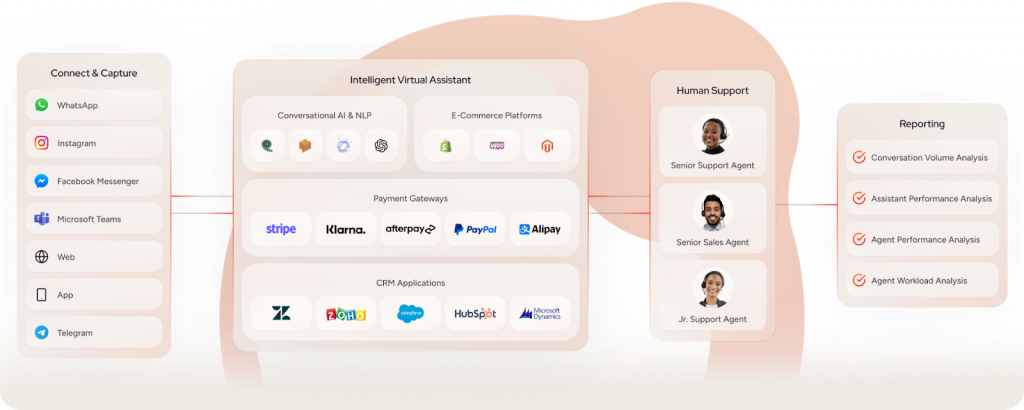
What is an AI assistant for conversational commerce?
A shopper asks, “Do you have this in blue, in my size, and can it arrive by Friday?” A basic FAQ bot replies with a generic link to the shipping policy. That gap between what the customer needs and what the system delivers is exactly what AI assistants close.
An AI assistant for conversational commerce is software that engages shoppers in natural-language dialogue across messaging channels such as:
It guides product discovery, answers pre-purchase questions, completes transactions, and resolves post-purchase requests without requiring a human agent for every interaction.
The category breaks down by autonomy level:
| Term | Autonomy level | Typical actions |
| FAQ chatbot | Low | Returns scripted answers; no system calls |
| Virtual shopping assistant | Medium | Retrieves product data, filters catalog, suggests items |
| Shopping agent / ecommerce agent | High | Checks inventory, applies promos, initiates returns, processes payments |
This category excludes a search bar with a chat interface, a live-chat queue, and a marketing broadcast tool. These boundaries matter because mislabeling a chatbot as an “agent” sets expectations the system can’t meet.
Why do AI assistants matter for conversational commerce KPIs?
When leadership asks about return on investment, vague answers about customer experience stall the project. You need a framework that maps capabilities to measurable outcomes.
| Funnel stage | Capability | Primary KPI | Supporting KPIs |
| Discover | Guided product discovery, attribute filtering | Conversion rate | Pages per session, bounce rate |
| Purchase | Cart recovery, objection handling, payment completion | Average order value (AOV), assisted revenue | Cart abandonment rate, checkout completion |
| Support | Order status, returns, exchanges | Deflection rate, customer satisfaction (CSAT) | Time-to-resolution, repeat contact rate |
Two metrics need clear definitions:
- Assisted revenue: Revenue from sessions where the assistant engaged the shopper and the shopper converted within a defined attribution window
- Deflection rate: The share of support requests resolved by the assistant without human escalation
Without attribution rigor, teams either over-credit the assistant and set impossible future targets, or under-credit it and kill a profitable project. Both outcomes waste resources.
How do AI assistants for conversational commerce work?
A shopper asks, “Is this jacket waterproof?” The assistant confidently says “yes,” but the product page clearly states “water-resistant.” This hallucination happens when the assistant lacks grounded retrieval.
The core execution pipeline:
- Intent recognition: The assistant classifies the shopper’s message as a product question, order status inquiry, objection, or something else
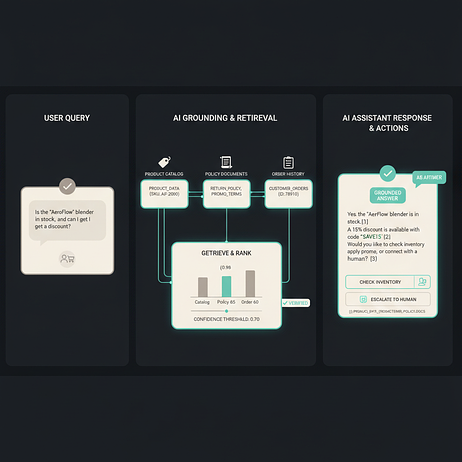
- Retrieval: The assistant queries a vector index or application programming interface (API) to fetch relevant product data, policy text, or order details
- Grounding: The assistant generates a response anchored to retrieved facts, not parametric knowledge
- Action execution: If the intent requires a system call like applying a promo or checking inventory, the assistant triggers it via API
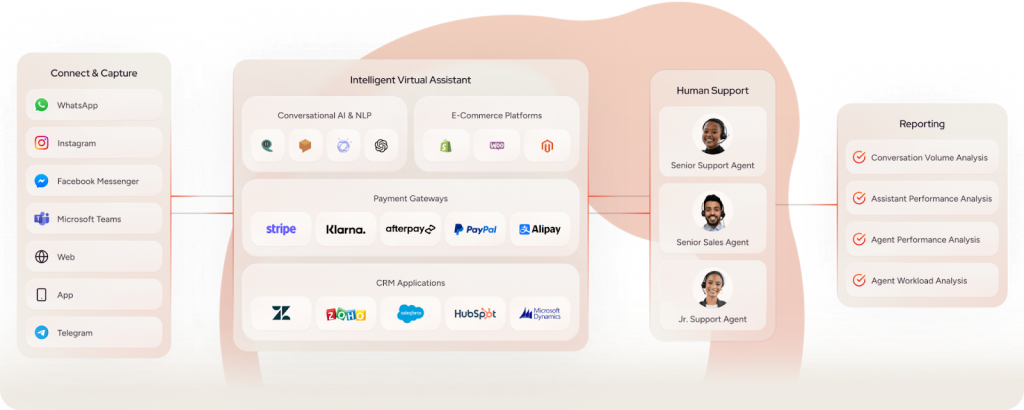
- Handoff decision: If confidence is low or the request is out of scope, the assistant routes to a human with full context
Platforms such as these must expose APIs for real-time queries:
- Shopify
- Magento
- BigCommerce
- Salesforce Commerce Cloud
If the product feed refreshes only nightly, the assistant will quote stale prices. If you want to see what “grounded + actionable” looks like in a real commerce flow, book a demo.
How do you ground knowledge to prevent hallucinations?
A pricing error or false warranty claim can trigger chargebacks, returns, or legal exposure. Grounding isn’t optional for commerce.
The retrieve-rank-cite pattern works like this:
- Retrieve: Pull candidate passages from the product catalog, policy knowledge base, and FAQ index
- Rank: Score passages by semantic similarity and recency
- Cite: Generate a response that references the source passage; if no passage meets the confidence threshold, respond with “I don’t have that information” and offer to connect to a human
For price, inventory, and policy questions, set a higher confidence threshold than for general product descriptions. If the product feed updates hourly but the vector index rebuilds nightly, the assistant will quote outdated stock. Require near-real-time sync for inventory and pricing.
How do you build guardrails for compliance and brand safety?
Regulated industries like financial services and healthcare can’t let an assistant make claims that violate disclosure rules. Even unregulated retailers risk margin erosion if the assistant offers unauthorized discounts.
- Action allowlist: Define which actions the assistant can execute autonomously versus which require human approval
- Claim restrictions: Block the assistant from making health, safety, or performance claims not present in approved product copy
- PII/PCI handling: Ensure the assistant never requests or stores full card numbers, SSNs, or passwords in the chat transcript
- Escalation triggers: Define conditions like legal threats or refunds above a threshold that force immediate human handoff
| Action type | Example | Autonomy level |
| Safe | Answer product FAQ, check order status | Fully autonomous |
| Restricted | Apply promo code, initiate return | Autonomous with guardrails |
| Prohibited | Override refund policy, make health claims | Human-only |
Which common workflows should you automate?
- Order status: Requires an order management system (OMS) API; triggers on “where’s my order” intent
- Return initiation: Requires returns management system; triggers on “I want to return” intent; handoff if item is final sale or outside policy window
- Reorder: Requires order history access; triggers on “reorder my last purchase” intent
- Subscription management: Requires subscription platform API; triggers on “pause,” “skip,” or “cancel” intents; handoff for cancellation if retention offer is configured
How do you design effective human handoffs?
A shopper explains a complex issue to the assistant, gets handed off, and has to repeat everything to the human agent. That friction erodes trust.
Handoff triggers:
- Confidence score below threshold
- Shopper explicitly requests a human
- Sensitive topic detected like a legal complaint or high-value order
- Action requires approval not granted to the assistant
The assistant should pass a context packet containing:
- The full transcript
- Detected intent
- Retrieved product or order data
- Any actions already taken
The human agent should see this before greeting the shopper. Track time-to-human to measure how long shoppers wait after handoff is triggered. If you want to pressure-test handoff design, grounding, and guardrails with real examples, start in the product demo hub.
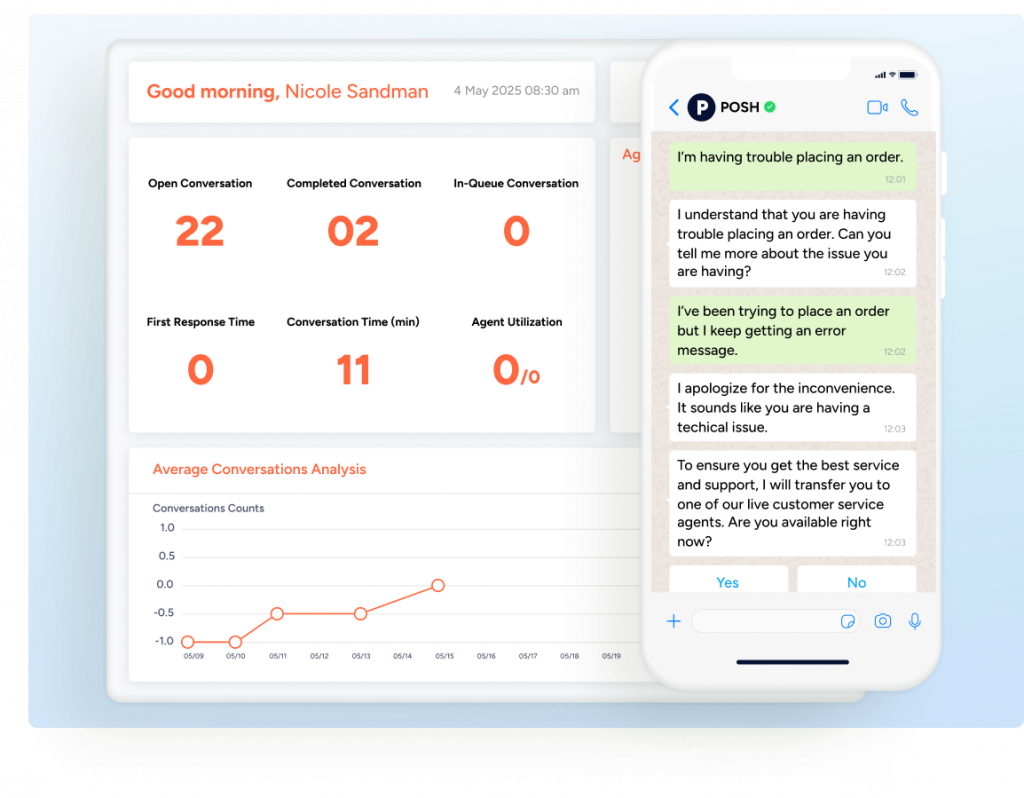
How do you measure resolution and attribute revenue?
“We’ll just track conversations” isn’t measurement. Without event taxonomy and attribution logic, you can’t distinguish correlation from causation.
- Assisted revenue: Sum of order values where the assistant engaged the shopper and the shopper converted within the attribution window
- Deflection rate: Support requests resolved by assistant divided by total support requests, expressed as a percentage
- Resolution rate: Conversations marked resolved by shopper or system divided by total conversations, expressed as a percentage
Use a holdout test design. Randomly assign a share of eligible sessions to a control group that sees no assistant. Compare conversion rate, AOV, and support ticket volume between test and control. Run for a statistically significant duration before drawing conclusions.
Avoid vanity metrics. “Conversations handled” and “messages sent” don’t indicate value.
Conversational commerce use cases powered by AI assistants
Feature lists don’t help buyers visualize value. Annotated transcripts show what the assistant says, what system calls it makes, and what outcome it drives.
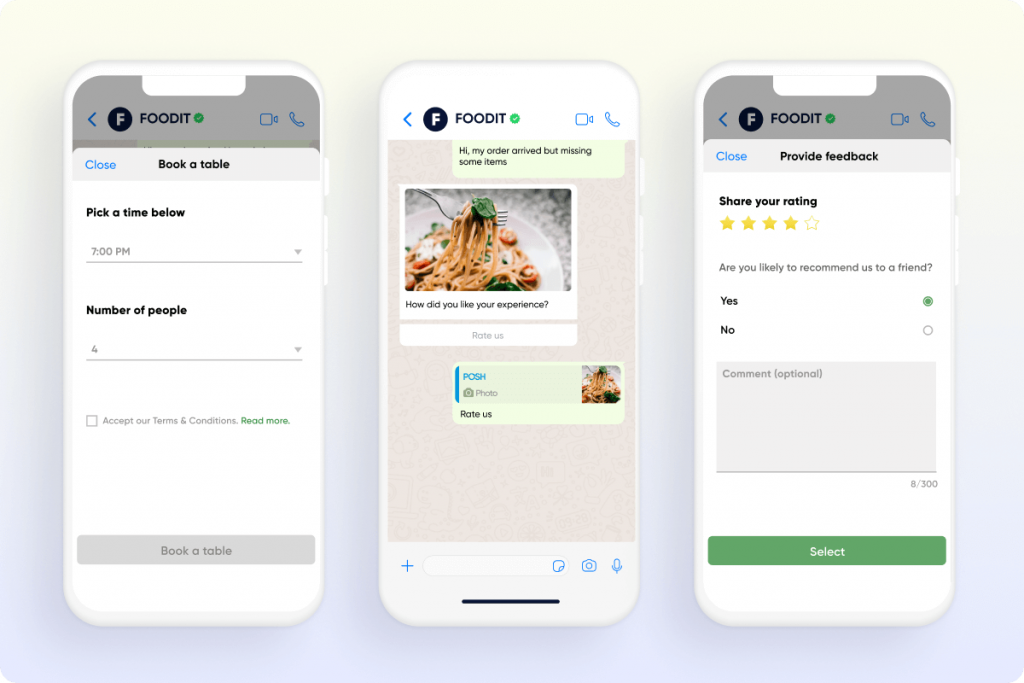
How do AI assistants guide product discovery?
A shopper says, “I need a gift for my sister, she runs marathons.” The assistant responds, “Great! Is she looking for gear, nutrition, or recovery products? And do you have a budget in mind?”
Behind the scenes, the assistant retrieves product categories tagged “running” and filters by gift-appropriate price range. The shopper views three curated options instead of browsing hundreds. Guided sessions can improve conversion rate when the assistant uses structured product attributes and relevant prompts.
Product attributes like category, use case, and price must be structured and queryable. If attributes are missing, the assistant can’t filter effectively.
How do AI assistants recover abandoned carts?
When a shopper adds an item to cart and idles, the assistant asks, “Still thinking about the [product name]? I can answer any questions or check if there’s a promo available.”
The shopper says, “Shipping seems expensive.” The assistant responds, “I checked your order: if you add [complementary item], you’ll qualify for free shipping. Want me to add it?”
This requires integrations with the cart API, promo engine, and shipping calculator. The assistant can also send a “magic link” that restores the cart in one tap, reducing friction for mobile shoppers. If cart recovery is on your Q2 list, book a demo and see how an assistant can pull the right data and take the next best action in real time.
How do AI assistants resolve post-purchase requests?
A shopper says, “I want to return my order.” The assistant responds, “I can help with that. Let me pull up your recent orders. Which item would you like to return?”
After checking return eligibility against policy, the assistant says, “This item is eligible for return. I’ve generated a prepaid label and sent it to your email.”
Deflection means a support request resolved by the assistant without human escalation, where the shopper doesn’t recontact within a defined window. If the item is final sale or outside the return window, the assistant routes to a human.
How do AI assistants enable in-store assistance?
A store associate scans a product that’s out of stock in-store. The assistant responds, “This item is available at [nearby store] or for ship-to-home delivery. Want me to reserve it or place a ship-to-home order?”
This requires a point of sale (POS) system and unified inventory systems to be connected via an API.
How should you evaluate AI assistants for conversational commerce?
Most vendor demos show best-case scenarios. Without a structured test protocol, you can’t distinguish marketing from capability.
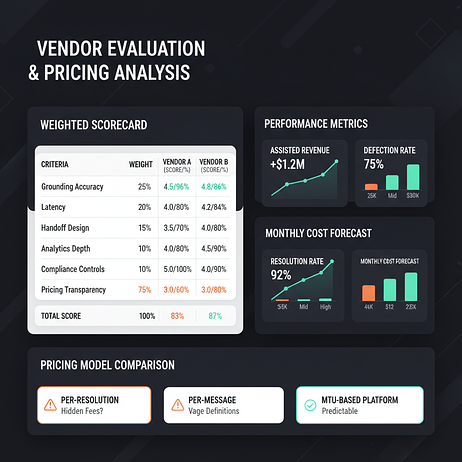
| Criterion | Weight | What to test |
| Grounding accuracy | High | Ask price, policy, and inventory questions; verify answers against source data |
| Latency | Medium | Measure response time under load; target fast replies |
| Handoff design | High | Trigger edge cases; verify context passes to human agent |
| Analytics depth | Medium | Request a sample dashboard; confirm assisted revenue and deflection tracking |
| Compliance controls | High | Request action allowlist configuration; verify PII handling |
| Pricing transparency | High | Request a written quote with all fees; calculate TCO for your volume |
Test prompts to use:
- “What’s the return policy for [specific item]?”
- “Is [item] available in [size/color]?”
- “Can you apply a promo code?”
- “I want to speak to a human.”
- “I’m unhappy with my order.”
- “Can I return this after a certain amount of time?”
How should you compare pricing models?
Per-resolution pricing sounds simple but creates perverse incentives. If the vendor defines “resolution” loosely, costs balloon.
- Per-resolution: Vendor charges for each conversation marked resolved. Risk: vendor may auto-mark conversations resolved to inflate volume
- Per-message: Vendor charges for each message sent. Risk: chatty assistants drive up costs
- Platform fee (monthly tracked users, or MTU, based or flat): Predictable monthly cost based on monthly tracked users. Risk: some vendors include overage fees for data or storage
Red flags:
- A vague “resolution” definition
- Undisclosed overage fees
- Separate charges for analytics
- Separate charges for integrations
What cost drivers should you forecast?
Estimated monthly cost = (monthly conversations × cost per conversation) + platform fee + overage buffer
Scaling factors to consider:
- Seasonality, since peak holiday volume may be multiples of baseline
- Channel expansion, since adding WhatsApp or SMS increases volume
- Catalog growth, since more SKUs may increase query complexity
Build three scenarios (low, mid, high) and stress-test against peak periods.
How should you verify vendor support and onboarding?
- Implementation timeline: Target a short implementation timeline for standard deployments
- Onboarding support: Dedicated onboarding or self-serve only?
- Documentation quality: Is the knowledge base comprehensive and current?
- Service-level agreement (SLA) commitments: What uptime and response-time guarantees are in the contract?
- Escalation path: Who do you contact when something breaks?
Red flags: no named implementation contact, documentation last updated long ago, SLAs buried in fine print.
Should you build, buy, or choose platform-native AI assistants?
The right answer depends on these factors:
- Catalog complexity
- Channel breadth
- Compliance requirements
- Internal engineering capacity
Here are common types of AI assistants in the market:
- Platform-native: Assistants built into Shopify, BigCommerce, or similar platforms. Fastest to deploy; limited customization; often lacks support for channels outside the platform
- Best-of-breed: Standalone assistant vendors that integrate via API. More flexibility; requires integration work; may introduce data silos if not connected to a customer data platform (CDP)
- Custom-built: In-house development using large language model (LLM) application programming interfaces (APIs) and retrieval infrastructure. Maximum control; highest engineering burden; only justified for highly differentiated use cases or strict compliance requirements
Which option fits your constraints?
- If your catalog is relatively small and you sell only on Shopify, platform-native is likely sufficient
- If you need WhatsApp, SMS, and web chat with unified context, best-of-breed with CDP integration is often the strongest fit
- If you operate in a regulated industry with strict data residency requirements, evaluate a best-of-breed vendor with compliance certifications or a custom-built approach
- If you have dedicated machine learning (ML) engineering and unique proprietary data, a custom build is often justified
Many mid-market and enterprise teams choose best-of-breed when they need channel breadth and CDP integration without the engineering burden of custom builds.
Platform-native vs best-of-breed vs custom
| Constraint | Platform-native | Best-of-breed | Custom |
| Time-to-live | Days | Weeks | Months |
| Customization | Limited | Moderate | Full |
| Channel breadth | Platform channels only | Multi-channel | Any |
| Data ownership | Platform-controlled | Varies by vendor | Full |
| Compliance certifications | Inherited from platform | Vendor-dependent | Your responsibility |
| Ongoing maintenance | Vendor-managed | Vendor-managed | In-house |
How does Insider One power AI assistants for conversational commerce?
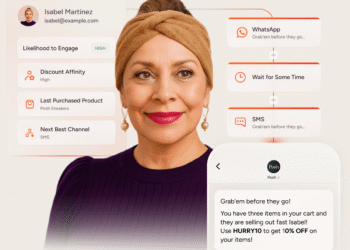
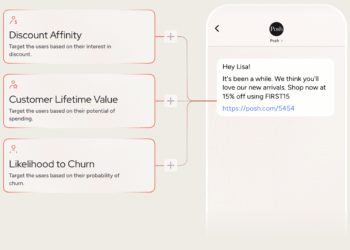
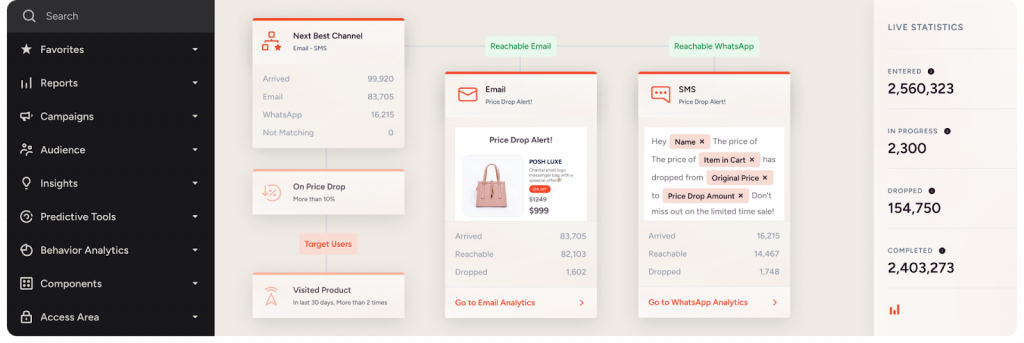
Insider One connects AI-powered conversations to unified customer data and cross-channel orchestration, so every interaction is grounded in real context and can trigger real actions.
- Agent One™, Insider One’s suite of purpose-built agents for customer engagement: Shopping Agent™ guides product discovery with access to Smart Recommender and Eureka, Insider One’s AI search and merchandising solution. Support Agent™ handles multilingual support with access to CDP, customer relationship management (CRM), and policy data. Insights Agent™ monitors campaign performance and surfaces anomalies proactively.
- Grounded in customer data platform (CDP) data: Every conversation draws from unified customer profiles, so the assistant knows purchase history, preferences, and lifecycle stage
- Orchestrated via Architect, Insider One’s customer journey orchestration solution: Assistant interactions can trigger downstream journeys like email follow-up, SMS reminder, or retargeting without manual handoff
- Predictable pricing: MTU-based pricing with no hidden charges for data, storage, or events
If you want to see how this comes together across web chat, WhatsApp, and SMS, grounded in your data and tied to assisted revenue, you can explore real flows in the product demo hub.
FAQs
A chatbot typically returns scripted answers to FAQs without taking actions, while an AI shopping assistant can query product data, apply filters, check inventory, and execute transactions autonomously.
They guide shoppers through discovery, handle objections in real time, and reduce friction at checkout, which shortens the path to purchase and increases the likelihood of conversion.
At minimum, the assistant needs API access to the product catalog, order management system, and returns platform; additional integrations like promo engine, CDP, and support ticketing expand capability.
Track assisted revenue, deflection rate, and compare against a holdout group to isolate the impact.
Per-resolution pricing can create unpredictable costs and perverse incentives; platform-based or MTU-based pricing offers more predictability, especially at scale.
[ad_2]
Source_link