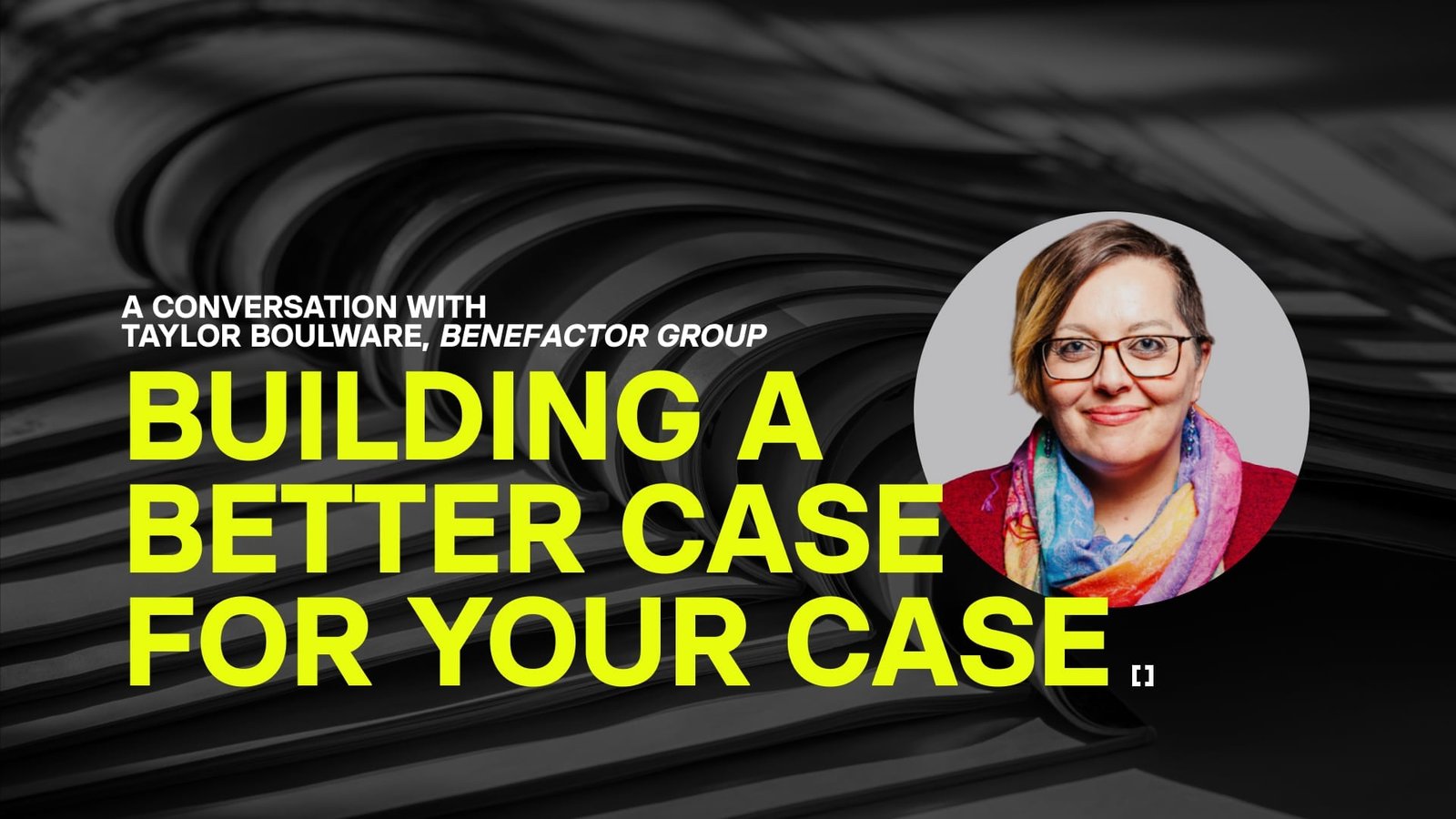
A case for support is one of the most familiar tools in fundraising, but also one of the least consistently understood. Is it a donor-facing brochure? An internal source of truth? A campaign narrative? A conversation guide? The answer often depends on who you ask.
As part of our broader look at how the case for support is evolving, we spoke with Taylor Boulware, a communications consultant at Benefactor Group, about what organizations often misunderstand, why vision matters, and how a strong case can help fundraisers move beyond explaining a need and into building belief.
| A quick note: At Parisleaf, we typically define the Case for Support as the donor-facing expression of a campaign’s priorities, vision, and invitation. It’s intended to help fundraisers and volunteer leaders bring the campaign story into real conversations with prospective donors.
We also develop a Campaign Messaging Guide, which serves as the internal source of truth. That guide gives campaign teams the shared language, narrative structure, and strategic clarity they need before donor-facing materials are created. Different agencies may define the case differently, but we all share the same underlying goal: to give fundraisers the clarity, language, and confidence they need to build donor trust and belief. |
Please introduce yourself and share what energizes you most about your work.
I’m a communications consultant on the fundraising team at Benefactor Group. I’ve been in the nonprofit sector in various ways for several years, but I come to this work from academia.
I made a pretty hard career pivot about ten-plus years ago after getting my Ph.D in English and then deciding, you know what, I don’t actually want to be an English professor. I was looking for ways to use my education, skills, and love of writing to make a tangible impact on the world.
That’s how I ended up in fundraising communications. It’s a way to use everything I know about storytelling and writing, and how to communicate effectively and persuade effectively, toward missions that I believe in and toward visions that are going to make life better for people and make the world better.
What really energizes me is connecting with organizations that are serving their communities in whatever way they can, and giving them the tools to tell their story in a way that connects with people and supports their mission.
Before you begin to develop a case for support, what are you trying to understand first about the partner?
First and foremost, I’m trying to understand their needs in terms of what exactly they are trying to raise money for.
That feels very basic, and it’s obviously not the heart of the case story, but it is the foundation. I can’t write a compelling story that will inspire donors unless I have all the details right and the client is clear on them.
That’s also a moment for the client to recognize: Do we actually know what we want to fundraise for? And that becomes a moment for a conversation about their strategy, vision, and priorities.
I’m really trying to ground myself in their goals and their needs, but also who they are, what their values are, how they talk about themselves, and how they envision themselves. As someone who writes on behalf of an organization, you have to embody their voice. That requires immersing yourself in what they’ve already created, talking to them, their community members, and their staff.
I think it’s absolutely crucial in the case development process to talk to mission staff and mission delivery staff — the people who are actually delivering the work. Those folks are often left out of the conversation about a case.
So I think being inclusive and talking to the folks who are actually doing the work is really vital. You need to hear directly from the people you are writing about and writing on behalf of.
I’m also trying to learn what success looks like for them beyond just filling the funding need. That is where clients tend to struggle when articulating their value proposition or case for support. Clients can very easily point to what they need: “We need to fund this program.” “We need to build this building.”
But they struggle more with the vision of what all of this means. How do we bring this into something that’s more than the sum of its parts, and that’s actually going to inspire our community to want to make this happen?
How do we help donors understand that they can create a solution, rather than just fulfill a need?
How critical is that larger vision to the success of a case for support?
It’s absolutely critical. A vision statement is the thesis statement. Everything you’re doing in that case for support should be building toward or supporting that vision.
For the client partners, it’s also empowering to say, in one sentence, “This is what this campaign is about. This is what we’re raising money for.” Not just “We need a new building,” or “We need to fund this program.” But something bigger, like, “We are transforming how we fulfill our mission in our community.”
Being able to say that in an empowering and inspiring way, and then having the story to back that up, is really crucial. It empowers our partners to be effective fundraisers and effective relationship builders with their donor communities.
What do organizations sometimes misunderstand about what a case for support is supposed to do?
I think, as a sector, and as people who write cases for support, we don’t have a universal standard. We don’t have consistency for what a case for support actually looks like.
Every client is going to get something different depending on who they’re working with or what article they read about what a case for support is. There is no universal shared understanding across the sector of what a case for support actually is, beyond “it’s the thing you need to do your fundraising” or “it’s why people should donate.” I think this is a common struggle.
It’s crucial that we think through which rhetorical moves the story needs to make to achieve the effect we want on the audience, and then articulate them clearly to our client partners.
The other thing organizations don’t often understand, or have different expectations around, is that the case for support is just a tool. It’s not going to do your fundraising for you. It’s a tool you put in the hands of your fundraisers and your volunteer leaders. That tool empowers them to speak on behalf of the campaign so everyone is singing from the same songbook. But everyone still has to sing it. You can’t just have the tool and put it on the shelf.
I believe the case for support serves as an internal resource. It’s not something a donor should ever actually see, because it is for your fundraisers. It’s an internal tool. It’s your source of truth.
You are going to pull all the language you need from it when you’re making your vision deck, writing your proposals, creating your brochure, or building your website. It’s the source material that informs donor-facing content, but it is first and foremost an internal tool for your fundraisers.
That idea — that the case is an internal tool — can feel like a mental shift. How do clients respond to that framing?
It is a mental shift, and I think it goes back to everyone having a different understanding of what the case is.
If you’re coming from an experience where the case for support is a design document that you send to a donor — “Here’s our case for support, and we’d love to talk to you about it” — then it can feel like a hot take when we present it as an internal document that is undesigned, meant for your staff and volunteers, and meant to be your source of truth that you build other things with.
Also, our cases for support are long because we want to give clients everything they need to tell their story. It could be a 15- or 20-page document. You don’t want to give a donor a 20-page, text-heavy document and call that your communication strategy.
That shift helps them understand that the case for support won’t do the work for them. If you think about it as something you put in front of a donor, rather than a tool you use to engage that donor in conversation, that changes how you engage donors as well.
I think it aligns with a shift toward a more relationship-oriented approach to donor engagement.
What are you noticing about rising donors and how their expectations shape the way organizations need to communicate?
I think more and more, philanthropy and one’s giving are becoming entwined with one’s identity and values.
It has always been values-driven. You give to organizations that speak to your values and are achieving the things you want to see in the world. But as our world has become increasingly polarized and politicized, it seems like every choice we make is an identity choice.
If I shop here, that means I’m this kind of person. If I don’t shop here, it means I’m not this kind of person.
That also falls into our giving and philanthropy.
When we’re thinking about how we engage donors, we’re not just engaging them as people we want to inspire to invest their funds in something interesting or exciting. We are asking them to express their identity — who they are — through what they choose to give their money to.
That is a lot. And being able to tell a story that speaks to those values, feels authentic, and remains inspiring and persuasive is the big challenge of the case for support.
More and more, we are going to have to figure out how to really dial in that authenticity. We need to connect to donors not just as agents of change, but as part of a vision, with the understanding that by inviting them to do that, we’re inviting them to make a statement about themselves.
That shapes how we communicate and engage with them.
But as our world has become increasingly polarized and politicized, it seems like every choice we make is an identity choice.
What advice would you give an organization preparing to revisit or redevelop its case for support?
I would say, first, get clear on what you mean by “case for support,” how you want to use that tool, and how it aligns with your fundraising strategy. Make sure there is real intentional clarity around what you’re striving for.
Then talk to the people who use it most. Talk to your fundraisers. Talk to your volunteer leaders. Talk to your donors who have been on the receiving end of it. Be transparent. Ask open questions. Listen.
The listening part is so important. Listen to the community. Listen to the folks who are actually bringing this to life in their conversations with donors. Listen to donors who have responded to that case for support with a gift. Listen to donors who have chosen not to give a gift, because maybe the case for support wasn’t as effective for them.
Learn everything you can from your community about what you’re currently doing. Then synthesize that. Step back and see what the key learnings are, how you can incorporate them, and what you want to lean into going forward.
Before a pen is put to page, before you start typing, get clarity on what you’re trying to achieve, where you’ve struggled, and where there is opportunity to strengthen.
That is the key way to start.