Text message marketing for small business looks like a no-brainer on paper. 98% open rates, near-instant delivery, direct access to your customer’s pocket. The problem is what’s not in those numbers — the 90% of consumers who want brand texts once a week or less, and the reality that most people only allow 1 to 6 brands into their SMS feed at all. You are not competing against other text messages. You are competing against your customer’s tolerance for being marketed to.
I’ve been watching small businesses copy SMS marketing tactics straight from big brand playbooks, and it’s making me uncomfortable. Those big brands are optimizing for quarterly shareholder returns — not customer relationships. Their job is to extract as much revenue as possible from each customer this quarter, and deal with churn next quarter. Your job is different. Your competitive edge IS the relationship. The moment you start blasting promotional texts like a chain retailer, you’ve traded away the one thing that makes you worth choosing.
Text message marketing for small business is the practice of sending SMS messages to customers who have opted in to hear from you. The channel has a near-perfect open rate — and a razor-thin margin for error. Consumers allow fewer than six brands into their text inbox. If your SMS marketing strategy doesn’t deliver clear, immediate value every single send, you don’t get a second chance. You get an opt-out.
What the SMS data actually says about consumer tolerance
In December 2025, SimpleTexting surveyed 1,427 U.S. consumers — 754 Millennials and 673 Gen Z — specifically about how they want brands to text them. The survey is the most current data available on SMS marketing preferences, and what it shows should change how every small business thinks about text message marketing. The headline stat that marketing blogs love to cite is that 69% opted in to receive brand texts in the past 12 months. Marketers read that and think: green light.
Here’s the number I’d focus on instead. Of those who opted in, 46% only allow 1 to 3 brands to text them. Another 35% allow 4 to 6. A mere 9% accept texts from 10 or more brands. Your customer isn’t swimming in an open ocean of brand texts. They’re managing a short list — and that list is close to full.
Think of it the way you think about podcasts. Most people listen to 3 to 6 shows regularly, and adding a new one means something else gets dropped. SMS works the same way. If you’re not clearly earning your slot — delivering real value every single time — you’re the show that gets unsubscribed.
💡 STRATEGY ALERT
What customers actually welcome in their text inbox
The SimpleTexting survey asked people exactly what kinds of brand texts feel welcome. The results are not subtle. Order and shipping notifications topped the list at 73%. Exclusive discounts or early access came in at 67%. Appointment and reservation reminders landed at 56%.
Notice the pattern. Everything in the top tier is either transactional (you told me my package shipped) or genuinely exclusive (you’re giving me access before everyone else). Both categories are about making the customer’s life easier or giving them something real.
Now look at the bottom of the list. Personalized product recommendations: 11%. Feedback or review requests: 6%. People are not using their text inbox for brand relationship-building. They’re using it for things that save them time, save them money, or remind them of something they’d otherwise forget.
Email is where you tell your story. Social is where you build the community. SMS is where you confirm the order and tell them it’s ready for pickup. Getting clear on which channel does what job is one of the most underrated moves in small business marketing.
That’s the channel map for text message marketing for small business — and most people get it backwards.
Why big brands are a terrible role model for your SMS strategy
Here’s what’s happening at the macro level. A publicly traded retailer runs an SMS campaign. Short-term conversion lift looks great. The marketing team gets credit. The strategy scales. The trade press covers it as a success story.
Six months later, the unsubscribe rate is climbing, customer sentiment is softening, and the brand’s Net Promoter Score is quietly sliding. That’s a future quarter’s problem. The exec who approved the SMS campaign already got their bonus.
You don’t have a future quarter to sacrifice. When a customer opts out of your texts and starts mentally categorizing you as “another brand clogging my phone,” you’ve done real damage to a relationship that took months or years to build. That cost doesn’t show up in your SMS dashboard. It shows up when they stop coming back.
There’s also a deeper structural issue at play. Right now, there’s a corporate trend where publicly held companies talk about being “customer focused” while their actual incentive system rewards profit extraction. They dress it up in customer language because that’s what tests well in focus groups. But the decisions — how often to text, what to push, when to upsell — are driven by revenue targets, not customer wellbeing.
Small businesses that copy those tactics without understanding what’s driving them are making a category error. You’re not optimizing for profit at scale. You’re building a brand on trust and relationships — which is a completely different game.
⚠️ REALITY CHECK
Why do customers unsubscribe from business text messages?
Here’s a data point from Postscript’s SMS retention research that doesn’t get nearly enough attention: unsubscribe rates from business text messages are 5 times higher in the first 30 days after opt-in than at any other point in the subscriber lifecycle.
Five times. That means your first three texts are your audition. If you come out swinging with promotional blasts, you’ve already failed the audition. The customer gave you a shot at their phone, you treated it like a mass email list, and they’re done — possibly with a worse impression of your brand than before they ever opted in.
The top reasons consumers unsubscribe from SMS marketing: too many messages (44%), content that feels irrelevant, bad timing, and overly salesy messaging. Every single one of those is a choice you make. You control all of them.
eMarketer reports that 40% of U.S. consumers are unsubscribing from at least one brand’s communications every single week — driven by this pattern of frequency and privacy overreach. If your text message marketing for small business is following the same high-frequency playbook as major retailers, you’re competing against those opt-out statistics too. The businesses that win at text message marketing for small business are the ones that treat every send as a privilege, not a default.
🛑 DON’T COPY BLINDLY
If you’re using SMS because you read that engagement rates are high — stop and ask yourself: high engagement compared to what, for whom, and at what cost? A 98% open rate doesn’t mean 98% of people are happy to hear from you. It means your message physically appeared on their screen before they deleted it. Engagement metrics without relationship context are vanity metrics dressed up as strategy.
How to build an SMS marketing strategy that fits a small business
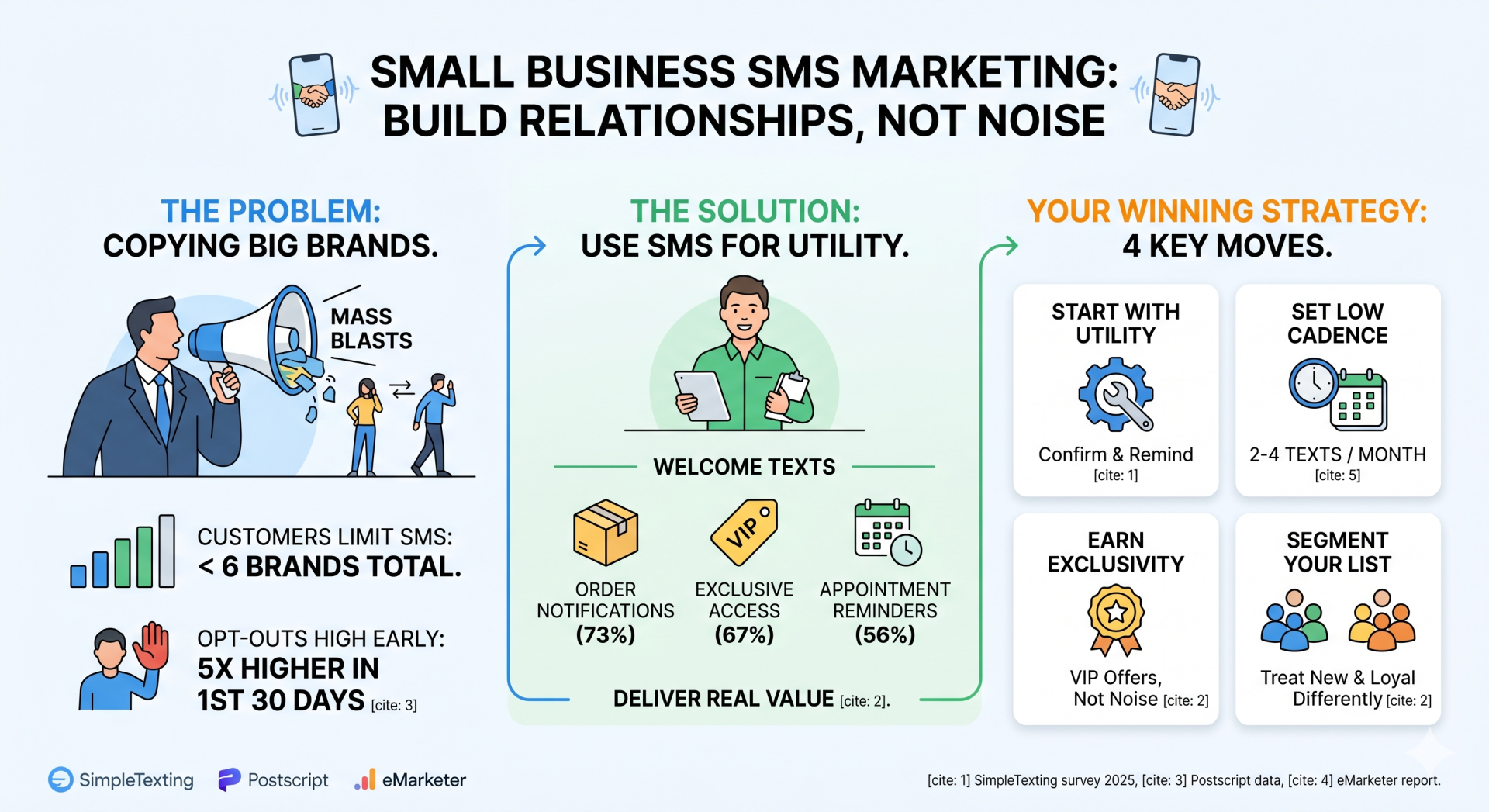
A text message marketing strategy for small business works when it’s built around three uses: utility, exclusivity, and time-sensitive action. The data gives you a clear, straightforward playbook. The problem isn’t that it’s complicated. The problem is that it requires discipline, because the temptation to “just send one more campaign” is always there.
Start with utility. Appointment reminders, order confirmations, “your item is ready for pickup” — these are welcome because they solve a problem for the customer. Set these up first. Automate them. Then stop and ask whether you need anything else at all.
Earn exclusivity before you sell it. An “exclusive VIP offer” only lands if the customer already believes your texts are worth reading. If your first five texts were promotional, your sixth text announcing an “exclusive deal” is noise. The birthday campaign model works precisely because it’s personal, timely, and infrequent.
Design for non-click conversion. Only 41% of consumers regularly click links in brand texts. That means your offer has to work without a click. Include a promo code they can use in-store or at checkout. Use “show this text” language. Make the value obvious from the message itself, not buried behind a link.
Set your cadence at opt-in and hold to it. Tell people exactly what they’re signing up for: “We’ll text you 2 to 3 times a month — reminders and VIP-only offers, nothing else.” Then keep that promise. The opt-in conversation is where you establish trust, and breaking the frequency promise is one of the fastest ways to lose it.
Separate your list by relationship stage. New customers should get utility texts and a low-frequency welcome sequence. Loyal, repeat customers are the only ones who’ve earned the right to hear from you about new products, early access, and occasional promotions. Treating a first-time buyer the same as a three-year regular is a relationship mistake, not a segmentation oversight. Understanding how to choose the right marketing strategy for each stage of the customer journey makes all the difference here.
| Type of SMS message | Customer reception | Your move |
|---|---|---|
| Order/shipping notification | 73% welcome it — highest acceptance of any type | Automate this immediately if you haven’t already |
| Exclusive discount or early access | 67% welcome it — but “exclusive” must mean exclusive | Reserve for loyal customers, use maximum once per month |
| Appointment reminder | 56% welcome it — reduces no-shows, creates goodwill | Set up automated reminders 24 and 2 hours before |
| Personalized recommendations | Only 11% want this via text — it reads as surveillance | Move this to email where it has space and context |
| Review or feedback requests | Only 6% welcome it — the lowest of any category | Send via email post-purchase, never via text |
The one question to ask before every text you send
The SMS Utility-First Rule comes down to a single test. Before every campaign, every message, every “quick promotion” — ask yourself: if a close friend or a trusted local business sent me this exact text, would I be glad they did?
Not “would I tolerate it.” Not “would I probably not unsubscribe.” Would you be genuinely glad to receive it?
That’s the standard small businesses should hold their SMS marketing to — because you’re not a faceless national brand. You’re someone your customer knows. And the texts you send should sound like they came from someone who knows them back.
Text message marketing for small business works when it feels like a service, not a broadcast. The moment it starts feeling like the latter, you’ve already lost the thing that makes you worth texting back.
That’s the competitive advantage. Don’t text it away.
Frequently asked questions about SMS marketing for small business
Is text message marketing effective for small businesses?
Text message marketing for small business is effective when used as a utility channel — order confirmations, appointment reminders, and genuinely exclusive offers sent at low frequency. SMS marketing becomes counterproductive when used as a promotional broadcast tool, because small businesses rely on customer relationships that mass-marketing behavior directly erodes. The channel works; the tactics most small businesses copy from large brands do not.
How often should a small business send marketing texts?
Consumer data is consistent: 90% of people want brand texts once a week or less, and the most preferred cadence is every other week. For most small businesses, 2 to 4 texts per month is the right ceiling. Going above that without a strong utility reason is how you end up in the unsubscribe pile.
What should a small business include in SMS marketing messages?
Focus on messages that save the customer time, save them money, or remind them of something important. Order confirmations, appointment reminders, and early access to limited inventory all perform well. Avoid promotional blasts, review requests, and content that belongs in an email newsletter. Keep the message short, include the offer or information in the text itself (not just a link), and tell them exactly what to do next.
Why are customers opting out of my business text messages?
Frequency is the most common culprit — 44% of consumers say they stop engaging because they receive too many messages. After that, irrelevant content and overly promotional tone are the main drivers. Review your cadence first. If you’re sending more than once a week, cut it. Then look at whether your messages are genuinely useful or primarily self-serving. Unsubscribes are feedback — take them seriously.
What is the difference between SMS marketing and email marketing for small businesses?
SMS marketing for small business is an intimate, high-attention channel suited for short, time-sensitive, action-oriented messages where the value is immediate and clear. Email is a relationship channel suited for storytelling, longer content, product education, and nurture sequences. Most small businesses should use email as their primary content marketing channel and text message marketing as their operations and exclusives channel. Treating SMS like email — with regular sends and promotional content — is the source of most SMS marketing failures.