• About Us
  • Disclaimer
  • Contact Us
  • Privacy Policy
Monday, April 27, 2026
mGrowTech
No Result
View All Result
  • Technology And Software
    • Account Based Marketing
    • Channel Marketing
    • Marketing Automation
      • Al, Analytics and Automation
      • Ad Management
  • Digital Marketing
    • Social Media Management
    • Google Marketing
  • Direct Marketing
    • Brand Management
    • Marketing Attribution and Consulting
  • Mobile Marketing
  • Event Management
  • PR Solutions
  • Technology And Software
    • Account Based Marketing
    • Channel Marketing
    • Marketing Automation
      • Al, Analytics and Automation
      • Ad Management
  • Digital Marketing
    • Social Media Management
    • Google Marketing
  • Direct Marketing
    • Brand Management
    • Marketing Attribution and Consulting
  • Mobile Marketing
  • Event Management
  • PR Solutions
No Result
View All Result
mGrowTech
No Result
View All Result
Home Al, Analytics and Automation

AI Interview Series #4: Transformers vs Mixture of Experts (MoE)

Josh by Josh
December 5, 2025
in Al, Analytics and Automation
0
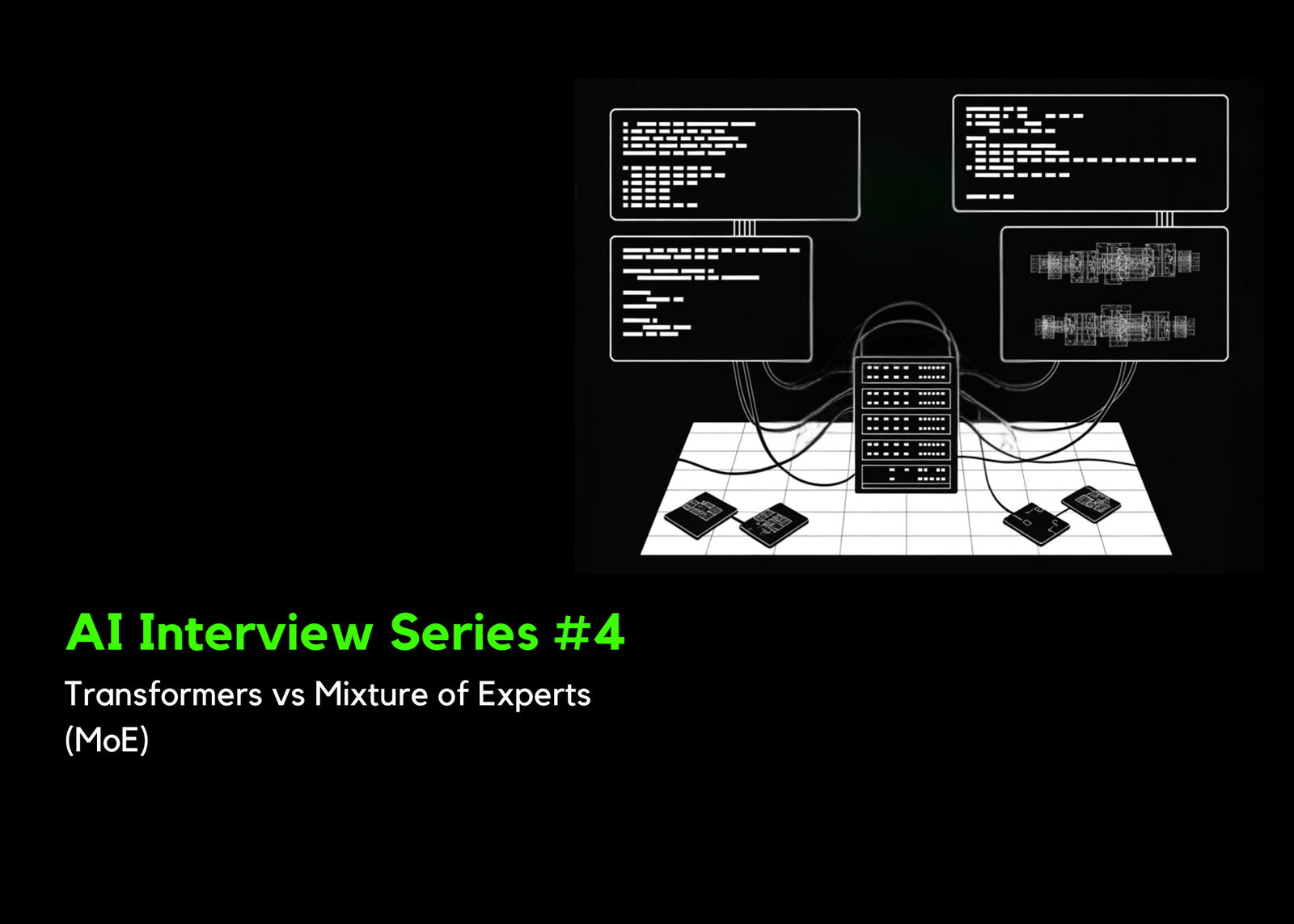
AI Interview Series #4: Transformers vs Mixture of Experts (MoE)


Question:

MoE models contain far more parameters than Transformers, yet they can run faster at inference. How is that possible?

Difference between Transformers & Mixture of Experts (MoE)

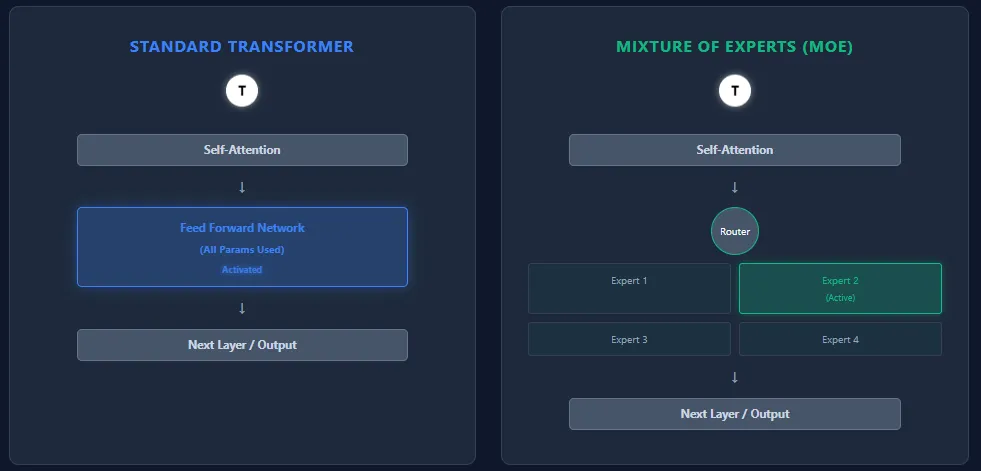
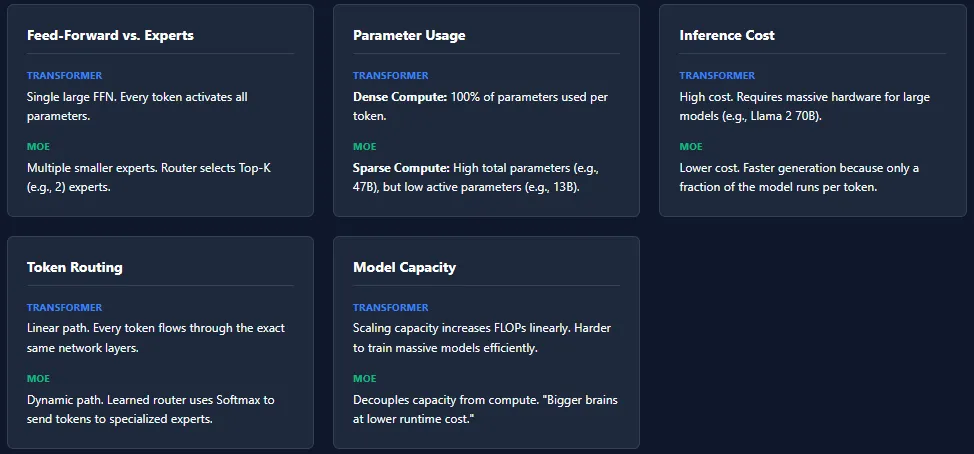
Transformers and Mixture of Experts (MoE) models share the same backbone architecture—self-attention layers followed by feed-forward layers—but they differ fundamentally in how they use parameters and compute.

Feed-Forward Network vs Experts

  • Transformer: Each block contains a single large feed-forward network (FFN). Every token passes through this FFN, activating all parameters during inference.
  • MoE: Replaces the FFN with multiple smaller feed-forward networks, called experts. A routing network selects only a few experts (Top-K) per token, so only a small fraction of total parameters is active.

Parameter Usage

  • Transformer: All parameters across all layers are used for every token → dense compute.
  • MoE: Has more total parameters, but activates only a small portion per token → sparse compute. Example: Mixtral 8×7B has 46.7B total parameters, but uses only ~13B per token.

Inference Cost

  • Transformer: High inference cost due to full parameter activation. Scaling to models like GPT-4 or Llama 2 70B requires powerful hardware.
  • MoE: Lower inference cost because only K experts per layer are active. This makes MoE models faster and cheaper to run, especially at large scales.

Token Routing

  • Transformer: No routing. Every token follows the exact same path through all layers.
  • MoE: A learned router assigns tokens to experts based on softmax scores. Different tokens select different experts. Different layers may activate different experts which  increases specialization and model capacity.

Model Capacity

  • Transformer: To scale capacity, the only option is adding more layers or widening the FFN—both increase FLOPs heavily.
  • MoE: Can scale total parameters massively without increasing per-token compute. This enables “bigger brains at lower runtime cost.”
While MoE architectures offer massive capacity with lower inference cost, they introduce several training challenges. The most common issue is expert collapse, where the router repeatedly selects the same experts, leaving others under-trained. 

Load imbalance is another challenge—some experts may receive far more tokens than others, leading to uneven learning. To address this, MoE models rely on techniques like noise injection in routing, Top-K masking, and expert capacity limits. 

These mechanisms ensure all experts stay active and balanced, but they also make MoE systems more complex to train compared to standard Transformers.


I am a Civil Engineering Graduate (2022) from Jamia Millia Islamia, New Delhi, and I have a keen interest in Data Science, especially Neural Networks and their application in various areas.

🙌 Follow MARKTECHPOST: Add us as a preferred source on Google.


Previous articleHow to Build a Meta-Cognitive AI Agent That Dynamically Adjusts Its Own Reasoning Depth for Efficient Problem Solving


Source_link

READ ALSO

A faster way to estimate AI power consumption | MIT News

The LoRA Assumption That Breaks in Production 

Related Posts

A faster way to estimate AI power consumption | MIT News
Al, Analytics and Automation

A faster way to estimate AI power consumption | MIT News

April 27, 2026
The LoRA Assumption That Breaks in Production 
Al, Analytics and Automation

The LoRA Assumption That Breaks in Production 

April 27, 2026
Top 7 Benchmarks That Actually Matter for Agentic Reasoning in Large Language Models
Al, Analytics and Automation

Top 7 Benchmarks That Actually Matter for Agentic Reasoning in Large Language Models

April 26, 2026
Al, Analytics and Automation

RAG Without Vectors: How PageIndex Retrieves by Reasoning

April 26, 2026
Meet GitNexus: An Open-Source MCP-Native Knowledge Graph Engine That Gives Claude Code and Cursor Full Codebase Structural Awareness
Al, Analytics and Automation

Meet GitNexus: An Open-Source MCP-Native Knowledge Graph Engine That Gives Claude Code and Cursor Full Codebase Structural Awareness

April 25, 2026
Google DeepMind Introduces Vision Banana: An Instruction-Tuned Image Generator That Beats SAM 3 on Segmentation and Depth Anything V3 on Metric Depth Estimation
Al, Analytics and Automation

Google DeepMind Introduces Vision Banana: An Instruction-Tuned Image Generator That Beats SAM 3 on Segmentation and Depth Anything V3 on Metric Depth Estimation

April 25, 2026
Next Post
The 'truth serum' for AI: OpenAI’s new method for training models to confess their mistakes

The 'truth serum' for AI: OpenAI’s new method for training models to confess their mistakes

POPULAR NEWS

Trump ends trade talks with Canada over a digital services tax

Trump ends trade talks with Canada over a digital services tax

June 28, 2025
Communication Effectiveness Skills For Business Leaders

Communication Effectiveness Skills For Business Leaders

June 10, 2025
15 Trending Songs on TikTok in 2025 (+ How to Use Them)

15 Trending Songs on TikTok in 2025 (+ How to Use Them)

June 18, 2025
App Development Cost in Singapore: Pricing Breakdown & Insights

App Development Cost in Singapore: Pricing Breakdown & Insights

June 22, 2025
Comparing the Top 7 Large Language Models LLMs/Systems for Coding in 2025

Comparing the Top 7 Large Language Models LLMs/Systems for Coding in 2025

November 4, 2025

EDITOR'S PICK

How superintelligent AI could rob us of agency, free will, and meaning

How superintelligent AI could rob us of agency, free will, and meaning

December 17, 2025
Guide + Real Examples (2025)

Guide + Real Examples (2025)

May 29, 2025
How to Fix Spotify Wrapped 2025 Not Showing

How to Fix Spotify Wrapped 2025 Not Showing

December 4, 2025
Think Of Positioning Your Organization’s Brand Like Raising A Child

Think Of Positioning Your Organization’s Brand Like Raising A Child

March 26, 2026

About

We bring you the best Premium WordPress Themes that perfect for news, magazine, personal blog, etc. Check our landing page for details.

Follow us

Categories

  • Account Based Marketing
  • Ad Management
  • Al, Analytics and Automation
  • Brand Management
  • Channel Marketing
  • Digital Marketing
  • Direct Marketing
  • Event Management
  • Google Marketing
  • Marketing Attribution and Consulting
  • Marketing Automation
  • Mobile Marketing
  • PR Solutions
  • Social Media Management
  • Technology And Software
  • Uncategorized

Recent Posts

  • How to Fly Through the Cinema Frame with a Chopper in Goat Simulator 3
  • Top 10 Agentic AI Platforms for Enterprise in 2026: Buyer’s Guide
  • A faster way to estimate AI power consumption | MIT News
  • 8 Best E-commerce Analytics Software I Recommend for 2026
  • About Us
  • Disclaimer
  • Contact Us
  • Privacy Policy
No Result
View All Result
  • Technology And Software
    • Account Based Marketing
    • Channel Marketing
    • Marketing Automation
      • Al, Analytics and Automation
      • Ad Management
  • Digital Marketing
    • Social Media Management
    • Google Marketing
  • Direct Marketing
    • Brand Management
    • Marketing Attribution and Consulting
  • Mobile Marketing
  • Event Management
  • PR Solutions