Your IT team is already stretched. Ticket queues grow faster than headcount. Finance demands cost accountability for every cloud dollar. And somewhere in a board meeting, someone just asked why competitors are processing customer requests 65% faster than you are.
The answer, increasingly, is agentic AI.
Not chatbots. Not copilots that suggest the next sentence. Agentic AI platforms deploy autonomous systems that plan multi-step workflows, call tools, make decisions, and execute tasks end-to-end — without a human approving every action. The global AI agents market (related to but distinct from agentic AI) was estimated at $7.63 billion in 2025 by Grand View Research, projected to reach $50.31 billion by 2030 at a 45.8% CAGR from 2025–2030.
The urgency is real. Gartner predicts that 40% of enterprise applications will embed task-specific AI agents by the end of 2026 — up from less than 5% in 2025. According to the LangChain “State of Agent Engineering” report for 2026 (surveying 1,300+ professionals), 57% of organizations have AI agents running in production, with 30% more actively developing with deployment plans—up from 51% in production in the prior year’s report.
The problem is not whether to adopt. The problem is choosing the right platform for your specific stack, use case, and governance maturity. We evaluated the 10 leading enterprise agentic AI platforms so your team can make that call with confidence.
Also Read: Agentic AI vs AI Agents: Key Differences & Impact on the Future of AI
What Makes an Agentic AI Platform — And Why 2026 Is the Tipping Point
An agentic AI platform is not a large language model (LLM) with a chat interface. It is an operational infrastructure layer that delivers multi-agent coordination, deep system integrations, policy enforcement, observability, and full agent lifecycle management. Think of it as the operating system for your AI workforce — the layer that determines whether your agents run reliably at scale or collapse under production load.
What fundamentally changed between early 2025 and now is reliability. Axis Intelligence’s 2026 adoption analysis documents that error rates for production agents dropped from 8–12% in early 2025 to 3–5% by Q4 2025. Implementation timelines for commercial platforms compressed from 6–8 months down to 6–10 weeks.
The risk that overshadows all of this growth is governance. Deloitte’s 2026 State of AI report delivers a stark finding: only 21% of companies currently hold a mature governance model for autonomous AI agents. The remaining 80% deploy agents into production without the oversight infrastructure to manage them safely at scale. The platform you select today determines whether governance is architecturally embedded or an expensive retrofit after your first production incident.
“AI agents will evolve rapidly, progressing from task and application-specific agents to agentic ecosystems. This shift will transform enterprise applications from tools supporting individual productivity into platforms enabling seamless autonomous collaboration and dynamic workflow orchestration.” — Anushree Verma, Sr. Director Analyst, Gartner.
5 Criteria Every Enterprise Buyer Must Evaluate
Before evaluating any vendor, the following five dimensions can help you to lock down your requirements:
- Multi-agent orchestration — Can the platform coordinate specialized agents working in parallel toward a shared goal, or does it manage only single-agent flows?
- Governance and compliance — Does it provide audit trails, role-based access controls, and certifications your industry requires (SOC 2, ISO 27001, HIPAA, FedRAMP)?
- Integration breadth — Does it connect natively to your existing CRM, ERP, and ITSM stack, or does every integration require custom development?
- Model flexibility — Does it support multiple LLM providers, or does it lock you into one vendor’s model roadmap?
- Total cost of ownership — Beyond license pricing, what are the implementation timeline, professional services requirements, and consumption-based cost trajectories at scale?
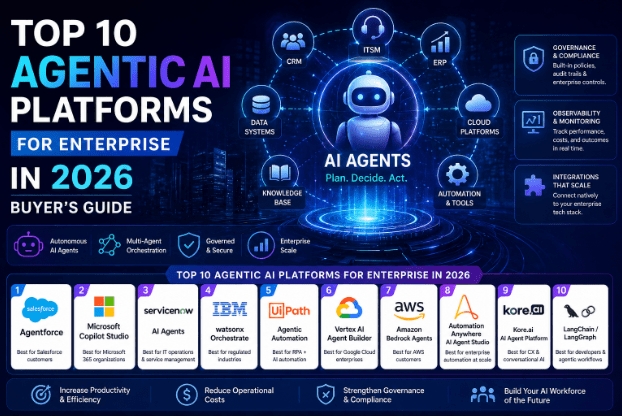
Top 10 Agentic AI Platforms for Enterprise in 2026
The following section represents the top 10 Agentic AI platforms for enterprises in 2026:
- Salesforce Agentforce
Best for: Enterprises running Salesforce for sales, service, or marketing

Agentforce powers autonomous digital labor across customer-facing workflows using Salesforce’s Atlas Reasoning Engine, a hybrid system that pairs deterministic logic with LLM reasoning, enabling enterprises to achieve predictable outcomes without sacrificing conversational flexibility. The platform reached 8,000+ enterprise customers within months of its full launch and now processes over 32,000 weekly customer conversations for Salesforce itself, self-resolving 83% without human escalation.
Pricing runs on Flex Credits at $0.10 per action (20 credits per action, $500 per 100,000 credits) or a flat $2 per conversation for customer-facing use cases. Industry-specific add-ons range from $125/user/month (Sales, Service, Field Service) to $650/user/month for public sector deployments requiring FedRAMP High authorization.
The honest constraint: Agentforce’s value proposition narrows significantly outside the Salesforce ecosystem. Enterprises with SAP-heavy or mixed-stack environments face higher integration overhead than the marketing materials suggest.
Also Read: Top DevOps Tools for Seamless Salesforce CI/CD Integration
- Microsoft Copilot Studio
Best for: Organizations standardized on Microsoft 365

Microsoft embeds Copilot Studio agents natively inside Teams, SharePoint, Dynamics 365, and the broader Microsoft Graph, making it the lowest-friction deployment path for the roughly 1 billion Microsoft 365 users worldwide.
In just three months post-launch, over 160,000 organizations created more than 400,000 custom agents using the platform. The March 2026 integration of GPT-5 via Azure OpenAI delivers the strongest reasoning capability in the Microsoft stack to date.
The platform’s strength is also its constraint. Outside the Microsoft 365 universe, every integration with non-Power Platform systems requires connector configuration or custom API development. CIOs running Oracle, SAP, or multi-cloud environments will hit integration friction quickly.
Also Read: Meet GitHub Copilot: The Future of AI-Powered Coding
- ServiceNow AI Agents
Best for: IT operations, ITSM, and enterprise service management

ServiceNow earned the #1 ranking in Gartner’s 2025 Critical Capabilities report for Building and Managing AI Agents, a direct endorsement of its governance-first architecture. ServiceNow AI Agents Orchestrator coordinates multiple specialized agents across ITSM, HR, and customer service workflows, all built on top of thousands of pre-existing ServiceNow workflow templates.
ServiceNow deployed its own platform internally (“Now on Now”) and reported $10 million in operational benefits within 120 days, equivalent to 50 full-time employees in productivity gains. The Moveworks acquisition in 2025 further strengthened its employee experience capabilities.
The limitation is entry complexity. The platform requires a dedicated sn_aia.admin administrator role before deployment even begins, reflecting enterprise-grade depth that comes with enterprise-grade setup requirements.
- IBM watsonx Orchestrate
Best for: Regulated industries and hybrid cloud enterprises

IBM positions watsonx Orchestrate as the multi-agent supervisor for the entire enterprise stack. The platform comes pre-integrated with 80+ enterprise applications, including Adobe, Microsoft, Oracle, SAP, Salesforce, ServiceNow, and Workday. It also explicitly supports orchestration across agents built on open-source frameworks such as CrewAI, LangGraph, and IBM Bee.
Honda deployed watsonx to extract knowledge from engineering diagrams and presentations, reporting 67% faster knowledge modeling and 30–50% savings on development and planning time.
For regulated industries such as banking, healthcare, insurance, government, watsonx and Kore.ai lead the market on compliance depth.
The trade-off is complexity: watsonx requires meaningful technical investment to deploy at scale and is not a point-and-click solution.
- Google Vertex AI Agent Builder
Best for: GCP-native teams and developer-first enterprises

Google’s Vertex AI Agent Builder provides the full agent lifecycle stack, a visual designer for prototyping, managed infrastructure for production deployment, and observability dashboards covering token usage, latency, errors, and tool calls. The platform’s Agent Development Kit (ADK) recorded over 7 million downloads since launch, making it one of the most adopted developer toolkits in the agentic AI space.
Vertex AI runs on Gemini 2.5 and explicitly supports multi-model routing, giving enterprises flexibility as the LLM landscape continues to evolve. Development teams already standardized on Google Cloud gain first-party monitoring for agent lifecycles without additional middleware.
The constraint is cloud dependency: enterprises not on GCP face architecture trade-offs that reduce the platform’s native advantages.
- AWS Bedrock Agents
Best for: AWS-first architectures and regulated environments

AWS Bedrock Agents gives enterprises access to frontier models from Anthropic, Meta, Mistral, and Amazon within a fully managed infrastructure, and critically, the model provider never touches your data. The platform reached general availability in 2026, with VPC, PrivateLink, and CloudFormation support, targeting the enterprise segment’s non-negotiable requirements for security perimeters and infrastructure-as-code deployment.
For regulated enterprises such as healthcare, financial services, and government, Bedrock’s data residency controls and multi-model flexibility make it the most architecturally conservative choice on this list.
The trade-off is developer overhead: building production-grade agent workflows on Bedrock requires stronger engineering investment than commercial turnkey platforms.
Also Read: AWS Bedrock: Beginner’s Guide to Generative AI
- UiPath Agentic Automation
Best for: Enterprises with existing UiPath RPA deployments

UiPath’s Maestro orchestration layer coordinates bots, AI agents, and human workers within a unified control plane, allowing enterprises to extend existing RPA investments into agentic workflows without rebuilding from scratch. The Agent Builder provides low-code and pro-code creation options, and UiPath’s connector ecosystem spans hundreds of enterprise applications.
The honest caveat: UiPath management stated in early 2026 that agentic capabilities are not expected to materially impact fiscal 2026 revenues, signaling an adoption-first posture rather than production readiness. Gartner Peer Insights reviewers flag that “transparency of AI-driven decision logic is still limited.”
Enterprises evaluating UiPath for agentic AI should treat it as a strong strategic roadmap bet, not a current-state deployment choice unless they have deep existing UiPath commitments.
- AutomationAnywhere AI Agent Studio
Best for: Large enterprises with complex compliance requirements

AutomationAnywhere AI Agent Studio combines RPA infrastructure with AI reasoning, targeting enterprises that need robust governance and cross-system orchestration at scale.
The platform’s strength lies in regulated, process-heavy environments such as finance, procurement, compliance, where auditability is non-negotiable, and workflows span multiple legacy and SaaS systems simultaneously.
The platform positions itself squarely for enterprises where the automation estate is already large, and the requirement is governance-complete orchestration, not rapid prototyping.
- Kore.ai AI Agent Platform
Best for: Enterprise-wide deployment across customer and employee experience

Kore.ai stands out as one of the few platforms built for both CX (customer experience) and EX (employee experience) at enterprise scale simultaneously. The platform earns recognition across Gartner, Forrester, and the Everest Group analyst reports, a trifecta that signals consistent validation across evaluation frameworks, not just marketing positioning.
“Building agents in-house hits a ceiling quickly. Creating one prototype is easy; however, running thousands of governed, observable, reliable agents in production is where most internal teams stall,” notes Kore.ai’s 2026 platform analysis, a distinction that applies directly to enterprises evaluating build-vs-buy decisions.
Kore.ai is the strongest choice for organizations that need a single platform spanning both customer-facing automation and internal productivity agents without managing two separate vendor relationships.
- LangChain / LangGraph
Best for: Developer-first enterprises that want full architectural control

LangGraph v1.0, released in late 2025, has emerged as the framework of choice for enterprises requiring precise state management and durable execution across complex, multi-agent workflows. The broader LangChain ecosystem counts over 7 million developers and serves as the foundational layer within larger commercial deployments on Vertex AI, AWS Bedrock, and Azure AI Foundry.
LangChain is not a turnkey platform. There is no support hotline, no pre-built industry templates, and no out-of-the-box governance dashboard. What it provides is full architectural ownership, the ability to build, customize, and control agent workflows at a depth that no commercial platform currently matches.
Organizations that treat agentic AI as a core competitive differentiator and have the engineering team to back it, choose LangChain over vendor platforms deliberately.
Quick Comparison: Top 10 Agentic AI Platforms at a Glance
The table below summarizes the Agentic AI tool, including what it’s best for, its pricing model, flexibility, and governance strength.
| Platform | Best For | Pricing Model | Governance Strength | Model Flexibility | Deployment Speed |
| Salesforce Agentforce | CRM-native enterprises | Consumption (Flex Credits / $2/conv) | Strong | Salesforce LLMs | 4–6 weeks |
| Microsoft Copilot Studio | Microsoft 365 shops | Per-user + consumption | Strong | GPT-5 via Azure | 4–8 weeks |
| ServiceNow AI Agents | IT/ITSM operations | Enterprise contract | Strongest | Multi-model | 8–16 weeks |
| IBM watsonx Orchestrate | Regulated industries | Enterprise contract | Strongest | Multi-model, open | 12–24 weeks |
| Google Vertex AI Agent Builder | GCP-native, developer-first | Consumption (GCP) | Moderate | Gemini + multi-model | 4–12 weeks |
| AWS Bedrock Agents | AWS-first, regulated | Consumption (AWS) | Strong | Anthropic, Meta, Mistral | 6–12 weeks |
| UiPath Agentic Automation | Existing RPA modernization | Per-user + consumption | Strong | Multi-model | 8–16 weeks |
| Automation Anywhere | Large enterprise process | Enterprise contract | Strong | Multi-model | 8–16 weeks |
| Kore.ai | Enterprise CX + EX | Enterprise contract | Strong | Multi-model | 6–12 weeks |
| LangChain / LangGraph | Custom, developer-built | Open-source (infra costs) | DIY | Fully model-agnostic | Weeks to months |
How to Choose the Right Platform for Your Enterprise
Choosing the right Agent AI platform depends on your requirements. To choose the right platform, you can:
- Start with your existing infrastructure. If your organization runs Salesforce, Agentforce wins on integration speed and data access. If you are Microsoft-standardized, Copilot Studio eliminates the complexity of middleware. If your primary workloads run on AWS, Bedrock provides the most secure and compliant foundation. Choosing against your existing stack creates integration debt that erodes ROI before agents ever go live.
- Match use case to platform category. Customer-facing automation such as service, sales, support, favors Agentforce and Kore.ai. Employee-facing IT and HR workflows favor ServiceNow and Copilot Studio. Back-office and process automation in finance, procurement, and compliance favor Automation Anywhere and UiPath. Custom architectures in which the agent design itself is a competitive differentiator favor LangGraph.
- Evaluate governance before you evaluate features. For healthcare, financial services, insurance, and government, IBM watsonx and ServiceNow lead on compliance depth. Do not select a platform that treats governance as an add-on feature. By the time you discover the gaps, agents are already in production.
- Model total cost of ownership, not just license price. Agentforce and Copilot Studio offer the fastest deployment timelines i.e., 4–6 weeks for pre-built use cases, but consumption-based pricing scales with usage in ways that can surprise finance teams. ServiceNow and IBM offer enterprise contracts with more predictable cost structures but require longer implementation cycles and dedicated admin resources.
The Bottom Line
Agentic AI has crossed the adoption tipping point. The question enterprises face in 2026 is no longer whether autonomous agents deliver value; the ROI data from Salesforce, ServiceNow, Honda, and thousands of other deployments answers that definitively.
The question is execution. Deloitte’s 2026 State of AI in the Enterprise report reveals that only 21% (1 in 5) of enterprises currently possess mature governance infrastructure for managing agentic AI safely at scale, creating a critical gap as adoption accelerates. The organizations that win are those that select platforms with governance built into the architecture — not bolted on after the first production incident.
You can pick the platform that fits your existing stack, matches your most valuable use case, and treats compliance as a first-class capability. Then deploy deliberately, measure relentlessly, and scale the workflows that move your specific business metrics.
The AI workforce is already operational at your competitors. The window for building a compounding advantage is narrowing every quarter.
Want to stay ahead of enterprise AI decisions? Subscribe to Techwrix Newsletter for coverage of the tools, platforms, and strategies that matter to IT decision-makers.