• About Us
  • Disclaimer
  • Contact Us
  • Privacy Policy
Saturday, April 25, 2026
mGrowTech
No Result
View All Result
  • Technology And Software
    • Account Based Marketing
    • Channel Marketing
    • Marketing Automation
      • Al, Analytics and Automation
      • Ad Management
  • Digital Marketing
    • Social Media Management
    • Google Marketing
  • Direct Marketing
    • Brand Management
    • Marketing Attribution and Consulting
  • Mobile Marketing
  • Event Management
  • PR Solutions
  • Technology And Software
    • Account Based Marketing
    • Channel Marketing
    • Marketing Automation
      • Al, Analytics and Automation
      • Ad Management
  • Digital Marketing
    • Social Media Management
    • Google Marketing
  • Direct Marketing
    • Brand Management
    • Marketing Attribution and Consulting
  • Mobile Marketing
  • Event Management
  • PR Solutions
No Result
View All Result
mGrowTech
No Result
View All Result
Home Al, Analytics and Automation

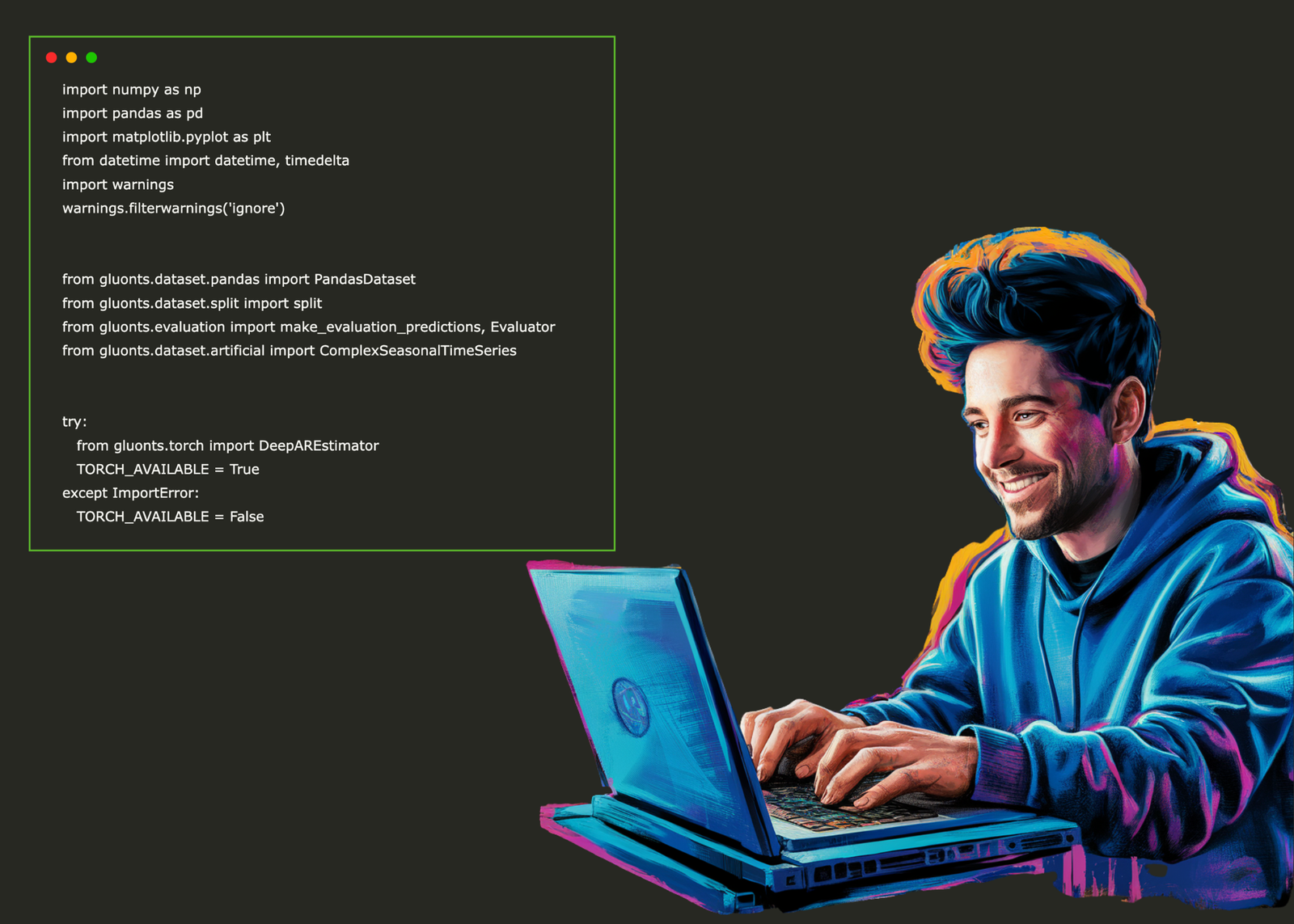
A Coding Guide to Build Flexible Multi-Model Workflows in GluonTS with Synthetic Data, Evaluation, and Advanced Visualizations

Josh by Josh
August 24, 2025
in Al, Analytics and Automation
0
A Coding Guide to Build Flexible Multi-Model Workflows in GluonTS with Synthetic Data, Evaluation, and Advanced Visualizations


def plot_advanced_forecasts(test_data, forecasts_dict, series_idx=0):
   """Advanced plotting with multiple models and uncertainty bands"""
   fig, axes = plt.subplots(2, 2, figsize=(15, 10))
   fig.suptitle('Advanced GluonTS Forecasting Results', fontsize=16, fontweight="bold")
  
   if not forecasts_dict:
       fig.text(0.5, 0.5, 'No successful forecasts to display',
               ha="center", va="center", fontsize=20)
       return fig
  
   if series_idx < len(test_data.label):
       ts_label = test_data.label[series_idx]
       ts_input = test_data.input[series_idx]['target']
      
       colors = ['blue', 'red', 'green', 'purple', 'orange']
      
       ax1 = axes[0, 0]
       ax1.plot(range(len(ts_input)), ts_input, 'k-', label="Historical", alpha=0.8, linewidth=2)
       ax1.plot(range(len(ts_input), len(ts_input) + len(ts_label)),
               ts_label, 'k--', label="True Future", alpha=0.8, linewidth=2)
      
       for i, (name, forecasts) in enumerate(forecasts_dict.items()):
           if series_idx < len(forecasts):
               forecast = forecasts[series_idx]
               forecast_range = range(len(ts_input), len(ts_input) + len(forecast.mean))
              
               color = colors[i % len(colors)]
               ax1.plot(forecast_range, forecast.mean,
                       color=color, label=f'{name} Mean', linewidth=2)
              
               try:
                   ax1.fill_between(forecast_range,
                                  forecast.quantile(0.1), forecast.quantile(0.9),
                                  alpha=0.2, color=color, label=f'{name} 80% CI')
               except:
                   pass 
      
       ax1.set_title('Multi-Model Forecasts Comparison', fontsize=12, fontweight="bold")
       ax1.legend()
       ax1.grid(True, alpha=0.3)
       ax1.set_xlabel('Time Steps')
       ax1.set_ylabel('Value')
      
       ax2 = axes[0, 1]
       if all_forecasts:
           first_model = list(all_forecasts.keys())[0]
           if series_idx < len(all_forecasts[first_model]):
               forecast = all_forecasts[first_model][series_idx]
               ax2.scatter(ts_label, forecast.mean, alpha=0.7, s=60)
              
               min_val = min(min(ts_label), min(forecast.mean))
               max_val = max(max(ts_label), max(forecast.mean))
               ax2.plot([min_val, max_val], [min_val, max_val], 'r--', alpha=0.8)
              
               ax2.set_title(f'Prediction vs Actual - {first_model}', fontsize=12, fontweight="bold")
               ax2.set_xlabel('Actual Values')
               ax2.set_ylabel('Predicted Values')
               ax2.grid(True, alpha=0.3)
      
       ax3 = axes[1, 0]
       if all_forecasts:
           first_model = list(all_forecasts.keys())[0]
           if series_idx < len(all_forecasts[first_model]):
               forecast = all_forecasts[first_model][series_idx]
               residuals = ts_label - forecast.mean
               ax3.hist(residuals, bins=15, alpha=0.7, color="skyblue", edgecolor="black")
               ax3.axvline(x=0, color="r", linestyle="--", linewidth=2)
               ax3.set_title(f'Residuals Distribution - {first_model}', fontsize=12, fontweight="bold")
               ax3.set_xlabel('Residuals')
               ax3.set_ylabel('Frequency')
               ax3.grid(True, alpha=0.3)
      
       ax4 = axes[1, 1]
       if evaluation_results:
           metrics = ['MASE', 'sMAPE'] 
           model_names = list(evaluation_results.keys())
           x = np.arange(len(metrics))
           width = 0.35
          
           for i, model_name in enumerate(model_names):
               values = [evaluation_results[model_name].get(metric, 0) for metric in metrics]
               ax4.bar(x + i*width, values, width,
                      label=model_name, color=colors[i % len(colors)], alpha=0.8)
          
           ax4.set_title('Model Performance Comparison', fontsize=12, fontweight="bold")
           ax4.set_xlabel('Metrics')
           ax4.set_ylabel('Value')
           ax4.set_xticks(x + width/2 if len(model_names) > 1 else x)
           ax4.set_xticklabels(metrics)
           ax4.legend()
           ax4.grid(True, alpha=0.3)
       else:
           ax4.text(0.5, 0.5, 'No evaluation\nresults available',
                   ha="center", va="center", transform=ax4.transAxes, fontsize=14)
  
   plt.tight_layout()
   return fig


if all_forecasts and test_data.label:
   print("📈 Creating advanced visualizations...")
   fig = plot_advanced_forecasts(test_data, all_forecasts, series_idx=0)
   plt.show()
  
   print(f"\n🎉 Tutorial completed successfully!")
   print(f"📊 Trained {len(trained_models)} model(s) on {len(df.columns) if 'df' in locals() else 10} time series")
   print(f"🎯 Prediction length: 30 days")
  
   if evaluation_results:
       best_model = min(evaluation_results.items(), key=lambda x: x[1]['MASE'])
       print(f"🏆 Best performing model: {best_model[0]} (MASE: {best_model[1]['MASE']:.4f})")
  
   print(f"\n🔧 Environment Status:")
   print(f"  PyTorch Support: {'✅' if TORCH_AVAILABLE else '❌'}")
   print(f"  MXNet Support: {'✅' if MX_AVAILABLE else '❌'}")
  
else:
   print("⚠️  Creating demonstration plot with synthetic data...")
  
   fig, ax = plt.subplots(1, 1, figsize=(12, 6))
  
   dates = pd.date_range('2020-01-01', periods=100, freq='D')
   ts = 100 + np.cumsum(np.random.normal(0, 2, 100)) + 20 * np.sin(np.arange(100) * 2 * np.pi / 30)
  
   ax.plot(dates[:70], ts[:70], 'b-', label="Historical Data", linewidth=2)
   ax.plot(dates[70:], ts[70:], 'r--', label="Future (Example)", linewidth=2)
   ax.fill_between(dates[70:], ts[70:] - 5, ts[70:] + 5, alpha=0.3, color="red")
  
   ax.set_title('GluonTS Probabilistic Forecasting Example', fontsize=14, fontweight="bold")
   ax.set_xlabel('Date')
   ax.set_ylabel('Value')
   ax.legend()
   ax.grid(True, alpha=0.3)
  
   plt.tight_layout()
   plt.show()
  
   print("\n📚 Tutorial demonstrates advanced GluonTS concepts:")
   print("  • Multi-series dataset generation")
   print("  • Probabilistic forecasting")
   print("  • Model evaluation and comparison")
   print("  • Advanced visualization techniques")
   print("  • Robust error handling")


Source_link

READ ALSO

Google DeepMind Introduces Vision Banana: An Instruction-Tuned Image Generator That Beats SAM 3 on Segmentation and Depth Anything V3 on Metric Depth Estimation

MIT scientists build the world’s largest collection of Olympiad-level math problems, and open it to everyone | MIT News

Related Posts

Google DeepMind Introduces Vision Banana: An Instruction-Tuned Image Generator That Beats SAM 3 on Segmentation and Depth Anything V3 on Metric Depth Estimation
Al, Analytics and Automation

Google DeepMind Introduces Vision Banana: An Instruction-Tuned Image Generator That Beats SAM 3 on Segmentation and Depth Anything V3 on Metric Depth Estimation

April 25, 2026
MIT scientists build the world’s largest collection of Olympiad-level math problems, and open it to everyone | MIT News
Al, Analytics and Automation

MIT scientists build the world’s largest collection of Olympiad-level math problems, and open it to everyone | MIT News

April 24, 2026
Google DeepMind Introduces Decoupled DiLoCo: An Asynchronous Training Architecture Achieving 88% Goodput Under High Hardware Failure Rates
Al, Analytics and Automation

Google DeepMind Introduces Decoupled DiLoCo: An Asynchronous Training Architecture Achieving 88% Goodput Under High Hardware Failure Rates

April 24, 2026
Mend Releases AI Security Governance Framework: Covering Asset Inventory, Risk Tiering, AI Supply Chain Security, and Maturity Model
Al, Analytics and Automation

Mend Releases AI Security Governance Framework: Covering Asset Inventory, Risk Tiering, AI Supply Chain Security, and Maturity Model

April 24, 2026
“Your Next Coworker May Not Be Human” as Google Bets Everything on AI Agents to Power the Office
Al, Analytics and Automation

“Your Next Coworker May Not Be Human” as Google Bets Everything on AI Agents to Power the Office

April 23, 2026
Google Cloud AI Research Introduces ReasoningBank: A Memory Framework that Distills Reasoning Strategies from Agent Successes and Failures
Al, Analytics and Automation

Google Cloud AI Research Introduces ReasoningBank: A Memory Framework that Distills Reasoning Strategies from Agent Successes and Failures

April 23, 2026
Next Post
Bluesky blocks service in Mississippi over age assurance law

Bluesky blocks service in Mississippi over age assurance law

POPULAR NEWS

Trump ends trade talks with Canada over a digital services tax

Trump ends trade talks with Canada over a digital services tax

June 28, 2025
Communication Effectiveness Skills For Business Leaders

Communication Effectiveness Skills For Business Leaders

June 10, 2025
15 Trending Songs on TikTok in 2025 (+ How to Use Them)

15 Trending Songs on TikTok in 2025 (+ How to Use Them)

June 18, 2025
App Development Cost in Singapore: Pricing Breakdown & Insights

App Development Cost in Singapore: Pricing Breakdown & Insights

June 22, 2025
Comparing the Top 7 Large Language Models LLMs/Systems for Coding in 2025

Comparing the Top 7 Large Language Models LLMs/Systems for Coding in 2025

November 4, 2025

EDITOR'S PICK

Latent Labs launches web-based AI model to democratize protein design

Latent Labs launches web-based AI model to democratize protein design

July 22, 2025

Pinterest Hashtags vs Keywords in 2025: What Actually Drives Discovery (and When to Use Each)

October 24, 2025
Website vs Web Application: What’s the Difference?

Website vs Web Application: What’s the Difference?

July 25, 2025
The Next Generation of Functional Dog Treats

The Next Generation of Functional Dog Treats

August 22, 2025

About

We bring you the best Premium WordPress Themes that perfect for news, magazine, personal blog, etc. Check our landing page for details.

Follow us

Categories

  • Account Based Marketing
  • Ad Management
  • Al, Analytics and Automation
  • Brand Management
  • Channel Marketing
  • Digital Marketing
  • Direct Marketing
  • Event Management
  • Google Marketing
  • Marketing Attribution and Consulting
  • Marketing Automation
  • Mobile Marketing
  • PR Solutions
  • Social Media Management
  • Technology And Software
  • Uncategorized

Recent Posts

  • Which Is the Best Business Process Simulation Tool for a Mid-Size Manufacturing Company?
  • 7 highlights and announcements from Google Cloud Next ‘26
  • How to Do the Hungry for Horns Event (Pizza with Rhino Topping) in Goat Simulator 3
  • XChat, the standalone app for messaging on X, is available on iOS now
  • About Us
  • Disclaimer
  • Contact Us
  • Privacy Policy
No Result
View All Result
  • Technology And Software
    • Account Based Marketing
    • Channel Marketing
    • Marketing Automation
      • Al, Analytics and Automation
      • Ad Management
  • Digital Marketing
    • Social Media Management
    • Google Marketing
  • Direct Marketing
    • Brand Management
    • Marketing Attribution and Consulting
  • Mobile Marketing
  • Event Management
  • PR Solutions