
[ad_1]
Key takeaways:
- A core wearable fitness app in the UAE typically costs AED 150,000 to AED 260,000. AI-led, enterprise-grade platforms can exceed AED 900,000.
- Device integrations, AI complexity, real-time processing, bilingual design, security, and compliance have the biggest impact on the final budget.
- UAE platforms such as STEPPI, Fitze, and Core Direction show that rewards, AI insights, and corporate wellness can sustain user engagement.
- The strongest revenue opportunities include subscriptions, corporate wellness contracts, white-label licensing, insurer partnerships, digital coaching, and remote care programmes.
- A focused MVP should support the devices, features, and business model required by the first target market. Wider integrations can follow after validation.
- UAE PDPL requirements, Arabic interfaces, consent controls, and future healthcare integrations should be planned early to avoid expensive redevelopment.
Not every fitness app needs a wearable. But if you’re building one for today’s market, it’s worth asking whether it should.
A few years ago, fitness apps and wearable devices served different purposes. The app recorded workouts, while the smartwatch or fitness band collected data. That line has blurred. Users now expect both to work together, turning real-time health metrics into personalized coaching, recovery insights, and recommendations that help them make better decisions throughout the day.
The UAE is seeing this shift unfold across its digital health ecosystem. As the country continues to invest in healthcare innovation and preventive wellness, connected health technologies are becoming a bigger part of how people manage their fitness and overall well-being. At the same time, high smartphone penetration and growing adoption of wearable devices are encouraging businesses to think beyond mobile-first experiences. Healthcare providers, insurers, fitness brands, and wellness startups are increasingly exploring wearable solutions to improve engagement, strengthen customer loyalty, and deliver more personalized digital health services.
Naturally, that brings up an important business question: what is the wearable fitness app development cost in the UAE that businesses should plan for?
There isn’t a one-size-fits-all answer. A wearable fitness app with essential activity tracking, workout monitoring, and health platform integrations typically requires an investment of around AED 150,000 to AED 260,000 (USD 40,000 to USD 70,000). Enterprise-grade platforms with AI-powered coaching, advanced health analytics, multi-device compatibility, real-time data processing, and robust security can range from AED 900,000 to AED 1 million+ (USD 250,000+), depending on the product vision and technical complexity.
In this guide, we’ll break down what influences the overall investment, where your budget is likely to be spent, and the decisions that have the biggest impact on development costs. Whether you’re building a consumer fitness platform, a corporate wellness solution, or a wearable healthcare product, this guide will help you plan your investment with greater confidence.
What Will Your Wearable Fitness App Actually Cost?
Get a UAE-specific estimate based on your AI features, wearable integrations, compliance needs, and growth plan.

Why UAE Businesses Should Pay Attention to the Wearable Fitness Market
The clearest way to understand this opportunity is to look at what successful fitness platforms are doing with wearable data. These examples are not included simply because they are popular. Each one shows a different way to attract users, keep them active, and turn engagement into revenue. For UAE businesses planning a wearable fitness app, they offer useful evidence of which product models are already gaining ground.
- Rewards can turn daily activity into repeat engagement: UAE platforms STEPPI and Fitze have built their products around this idea. STEPPI reports more than 450,000 users, while Fitze reports 425,000 users, AED 5.12 million in rewards, and 1.56 trillion steps recorded. Both show how brand offers, challenges, and incentives can keep users returning after the initial download.
- Corporate wellness creates a clear B2B revenue route: Healthmov uses wearable data, AI health assessments, and organisational reporting to support workforce wellness. Hadify takes a similar market position through employee fitness, workshops, team activities, and wellbeing insights. These products show how an app can earn through company contracts rather than depending only on individual subscriptions.
- AI and connected services can move the product beyond tracking: Dubai-based Core Direction recorded 313 wellness events and 8.4 billion steps during 2025. It has since expanded its platform with AI workouts, assessments, subscriptions, and corporate programmes. The model brings physical experiences and digital services into one business.
- Global platforms show how far these models can scale: Strava reported more than 180 million users across 185 countries in 2025, supported by subscriptions, communities, and brand partnerships. WHOOP passed 2.5 million members and ended 2025 at a $1.1 billion bookings run rate.
[Also Read: How Much Does It Cost to Build a Fitness App Like Strava?]
These examples point to the same conclusion. The commercial value does not come from recording steps or heart rate. It comes from what the product does with that information. UAE businesses can use wearable data to build reward ecosystems, sell corporate programmes, offer AI-led coaching, or create paid health services. The right model depends on the market the business wants to own.
Cost to Develop a Wearable Fitness App in the UAE
Everyone asks about the budget first.
Makes sense.
But that question doesn’t have one answer because there isn’t just one kind of wearable fitness app.
Some businesses want a simple app that tracks steps, workouts, calories, and sleep. It connects with Apple Health or Google Fit, stores the data, and gives users a clean dashboard. That’s a very different project from building a platform that analyses heart rate trends, offers AI-powered coaching, supports subscriptions, connects with multiple smartwatch brands, and shares data with corporate wellness programmes.
Both are wearable fitness apps.
The engineering behind them isn’t even close.
If you’re planning to enter the UAE market, a realistic starting point for a wearable fitness app with the core features sits somewhere between AED 150,000 and AED 260,000 (USD 40,000-70,000). That usually covers the essentials, activity tracking, user accounts, basic analytics, and integrations with platforms like Apple Health or Google Fit.
As the product grows, adding support for Apple Watch, Garmin, Fitbit, Huawei, and Samsung increases the engineering effort, even if the interface looks unchanged. AI adds another layer, especially when it must understand health data, remember context, personalise recommendations, and respond responsibly.
That’s why enterprise products often reach AED 900,000 to AED 1 million or more (USD 250,000+). By that stage, you’re no longer building an app. You’re building a connected health platform.
There’s no complicated formula behind software estimates.
It usually comes down to two questions.
How much work needs to be done?
Who’s doing that work?
The first decides the timeline. The second decides the rate.
Everything else follows from there.
Here’s what a typical investment looks like across different stages of development.
| Development Phase | Timeline | Estimated Cost (AED) |
|---|---|---|
| Product discovery and planning | 2–4 weeks | 18,000–37,000 |
| UI/UX design | 3–6 weeks | 25,000–75,000 |
| Mobile and backend development | 4–8 months | 147,000–440,000 |
| Wearable integrations | 1–3 months | 55,000–147,000 |
| AI features and analytics | 2–4 months | 73,000–220,000 |
| Testing and quality assurance | 1–2 months | 30,000–92,000 |
| Security and compliance | Throughout the project | 37,000–110,000 |
| Launch and deployment | 2–4 weeks | 11,000–37,000 |
| Ongoing maintenance | Monthly | 7,000–45,000 |
Key Factors Affecting Wearable Fitness App Development Cost in the UAE
One question comes up in almost every discovery workshop.
“Why did two development companies give us completely different estimates?”
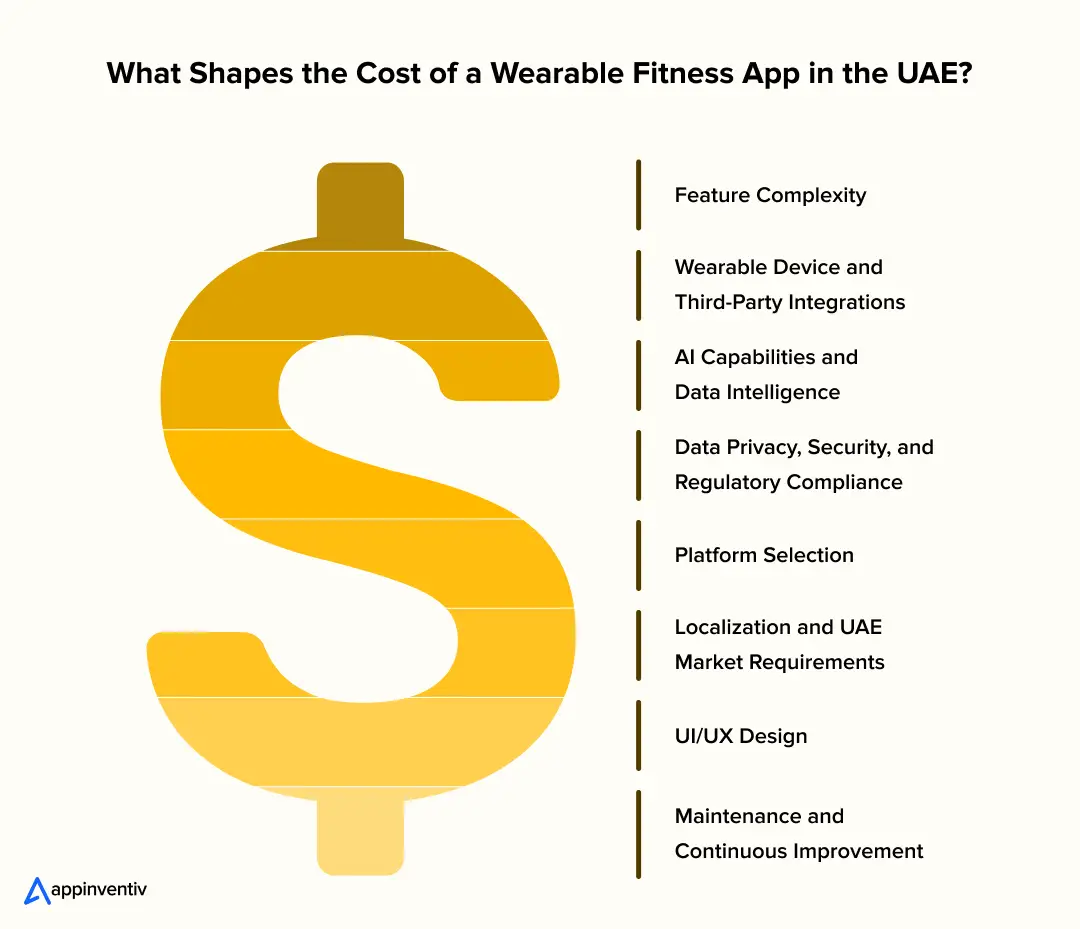
In most cases, the difference isn’t because one company charges more than the other. It’s because they’re estimating different levels of complexity. A wearable fitness app can be anything from a simple activity tracker to a connected health platform with AI coaching, smartwatch integrations, enterprise dashboards, and regulatory compliance built into its foundation.
That’s why the final wearable fitness app development cost is influenced by several technical and business decisions, many of which are made long before development begins.
Feature Complexity
One of the major factors affecting the cost of wearable app development is the overall complexity of its features. This is usually where budgets begin to separate.
If the app is limited to tracking steps, workouts, calories, and sleep, the development effort stays relatively predictable. Start adding AI-powered coaching, recovery analysis, live workout sessions, nutrition guidance, subscription plans, or social challenges, and the project quickly becomes more sophisticated. Every feature brings additional business logic, APIs, testing scenarios, and backend services. Individually they may seem small. Together they can add months to the wearable fitness app development timeline.
Wearable Device and Third-Party Integrations
Many businesses underestimate this part because users never really see it.
Connecting with Apple Health is straightforward compared to supporting Apple Watch, Garmin, Fitbit, Samsung Health, Huawei Health, and Google Fit together. Each platform has its own SDKs, permissions, data formats, and update cycles. Keeping activity data consistent across every device takes considerably more engineering than most businesses expect.
In the UAE, this becomes even more important because the market isn’t dominated by a single wearable ecosystem. Supporting multiple device brands often makes commercial sense from the beginning.
AI Capabilities and Data Intelligence
Adding AI to a wearable fitness app is no longer unusual.
What changes the budget is how much responsibility the AI takes on. A chatbot that answers common fitness questions is very different from an AI engine that studies sleep patterns, heart-rate trends, workout history, and recovery metrics before recommending personalized plans. Those capabilities require more than model integration. They depend on data pipelines, cloud infrastructure, ongoing model optimisation, and continuous testing.
Data Privacy, Security, and Regulatory Compliance
Wearable fitness apps collect some of the most sensitive information a user can share. Health records, activity history, sleep data, location, and biometric information all require strong protection.
For businesses building in the UAE, compliance with the UAE Personal Data Protection Law (PDPL) should be considered early in the project rather than after launch. Encryption, secure authentication, consent management, audit logs, and role-based access controls all increase development cost to build a wearable fitness app, but they’re essential for building trust with users and partners.
Platform Selection
Choosing between native development and a cross-platform framework influences both the initial wearable fitness app development cost in the UAE and its future flexibility.
Cross-platform frameworks such as Flutter help reduce development time and are often suitable for MVPs. Native development generally offers better performance for advanced wearable features, background health monitoring, and deeper integration with Apple Watch and Wear OS devices. The right approach depends on the product roadmap rather than the lowest upfront cost.
Localization and UAE Market Requirements
Launching in the UAE involves more than translating the interface into Arabic.
Many businesses support both English and Arabic from day one, which affects onboarding, notifications, reporting, and overall user experience. Companies targeting corporate wellness programs, insurers, or healthcare providers may also need additional integrations, reporting capabilities, and workflows designed specifically for regional business requirements.
[Also Read: How to do Mobile App Localisation to Increase its Conversion Rate by 200%]
UI/UX Design
People don’t open fitness apps once a week. They interact with them several times a day, often while exercising or checking health progress.
That changes how the product needs to be designed. Navigation has to be simple, dashboards need to surface the right information quickly, and wearable data should be easy to understand at a glance. Achieving that level of usability usually takes multiple design iterations, user testing, and refinements before development is complete. This affects the overall fitness wearable app budget estimation eventually.
Maintenance and Continuous Improvement
The launch isn’t where the investment ends.
Wearable platforms continue to evolve. Apple updates HealthKit, Google changes Android permissions, smartwatch manufacturers introduce new capabilities, and users expect regular improvements. Planning for ongoing maintenance cost, security updates, feature enhancements, and AI model improvements is just as important as planning the initial release.
Hidden Costs That Can Change Your Wearable Fitness App Budget
The first estimate is rarely the final one.
Not because someone got the numbers wrong. More often, the product evolves. A stakeholder asks for another integration. Marketing wants better analytics. The legal team raises a compliance requirement. The app performs well, so now it needs to support five times more users than anyone expected.
None of these are unusual. They’re simply the conversations that happen after development has already started.
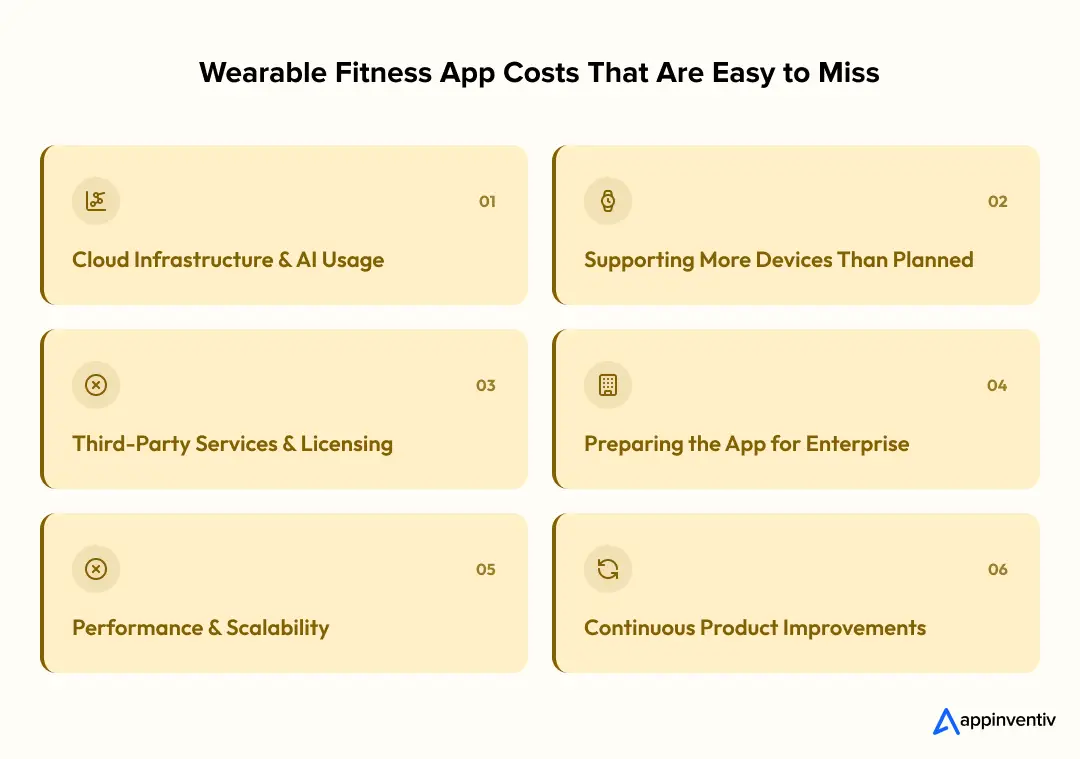
Cloud Infrastructure and AI Usage
Most teams budget for development. Fewer spend enough time thinking about what happens after launch.
A wearable fitness app doesn’t stop working once it’s published. Every workout, heart-rate reading, sleep record, GPS route, and AI recommendation moves through cloud infrastructure before it reaches the user. As usage grows, so do storage, computing, monitoring, backups, and AI processing costs. The app may stay exactly the same from the user’s perspective, but the infrastructure supporting it becomes more demanding every month.
Supporting More Devices Than Originally Planned
It usually starts with one wearable.
Then a customer asks whether Garmin is supported. Another one uses a Huawei watch. A corporate client wants Samsung devices because that’s what employees already have.
Adding another wearable brand sounds like a small request, but each ecosystem comes with different SDKs, permissions, testing requirements, and data formats. This usually affects the overall fitness tracker app development cost in the UAE. If that possibility isn’t considered during planning, expanding later often takes longer than expected.
Third-Party Services and Licensing
Very few modern fitness apps are built entirely from scratch.
Payments, maps, video streaming, authentication, notifications, AI services, analytics, and communication tools often rely on third-party platforms. Some charge per user. Others charge per request or monthly usage. Individually, these costs may not seem significant. Together, they become part of the long-term operating budget rather than the initial development budget.
Preparing the App for Enterprise Customers
This catches many businesses by surprise.
The consumer version of the app is complete, and then the first enterprise customer arrives with a different set of expectations. They need organisation dashboards, employee reports, role-based permissions, SSO, audit trails, and administrative controls. None of these features improve a workout experience, yet they often become essential when the product begins serving employers, insurers, healthcare providers, or wellness programmes across the UAE.
Performance and Scalability
An app that performs well with five hundred users may struggle with fifty thousand.
Wearable apps constantly receive data from thousands of devices throughout the day. Processing that information without delays requires a different backend architecture than most MVPs need. Planning for scale from the beginning isn’t always the cheapest option, but rebuilding the platform after rapid growth can increase the overall health tracking app development cost in the UAE.
Continuous Product Improvements
The first release answers one question: Can people use the product?
The next release answers another: Will they keep using it?
That’s where product analytics, A/B testing, AI improvements, new wearable features, security updates, and performance optimization become part of the roadmap. The work doesn’t stop after launch and neither does the overall wearable app development cost. In many successful products, that’s when the real product development begins.
How to Optimize Wearable Fitness App Development Costs Without Compromising Quality
Reducing the wearable fitness app development cost in the UAE doesn’t always mean reducing the scope.
Some of the most expensive decisions happen when a project is built in the wrong order. Features get rebuilt, integrations are replaced, or the architecture struggles once the user base grows. The initial estimate looks attractive, but the total investment ends up being much higher.
The better approach is to spend where it matters and avoid spending before it adds value.
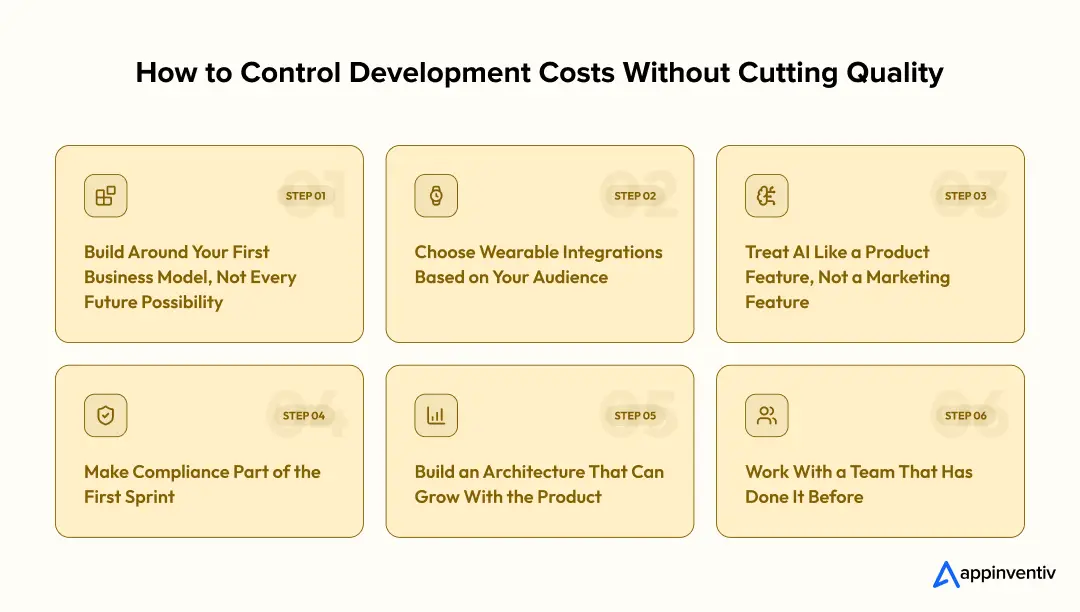
Build Around Your First Business Model, Not Every Future Possibility
It’s tempting to build every feature into the first release. Subscription plans, social challenges, AI coaching, nutrition tracking, corporate dashboards, and insurance integrations all sound like good ideas during planning.
Most products don’t need all of them on day one.
If your first customers are individual consumers, focus on delivering an excellent consumer experience. If your target market is corporate wellness in the UAE, prioritize employee onboarding, reporting, and wearable integrations instead. Expanding in phases usually costs less than building a platform for five different business models before the first user signs up.
Choose Wearable Integrations Based on Your Audience
Supporting every smartwatch brand from the beginning sounds like the safest option. It isn’t always the most practical one.
Look at the audience you’re trying to reach. Building only the integrations that match your launch strategy keeps development focused while leaving room to expand as the product grows.
Treat AI Like a Product Feature, Not a Marketing Feature
Adding AI because competitors have it rarely produces a better product.
Before investing in advanced recommendation engines or predictive health insights, ask where AI genuinely improves the user experience. Many successful fitness apps begin with personalized workout suggestions and gradually introduce more advanced capabilities after enough user data has been collected. That approach reduces upfront investment while giving the AI better information to learn from.
[Also Read: How AI Is Redefining the Fitness Industry: 15 Real-World Use Cases]
Make Compliance Part of the First Sprint
Compliance usually becomes expensive when it’s introduced late.
For wearable fitness apps in the UAE, planning for data privacy, encryption, consent management, and UAE Personal Data Protection Law (PDPL) requirements from the beginning is often more efficient than redesigning security after development is complete.
Build an Architecture That Can Grow With the Product
Not every app needs enterprise-scale infrastructure on the first day.
It should, however, be built with growth in mind.
Choosing a modular architecture makes it easier to introduce new wearable brands, AI capabilities, subscription models, or enterprise dashboards without rebuilding large parts of the platform. It may add a little more planning upfront, but it often prevents expensive redevelopment a year or two later.
Work With a Team That Has Done It Before
Wearable fitness apps combine mobile development, cloud engineering, AI, health data, and device integrations. That mix leaves very little room for trial and error.
An experienced development partner like Appinventiv is more likely to anticipate challenges around wearable SDKs, health data handling, localisation for the UAE market, and long-term scalability before they become costly problems. We can help you avoid months of rework that usually has a much bigger impact on the overall project budget.
Core Features Every Wearable Fitness App Needs
Ask anyone who has built a wearable fitness app what users care about.
It usually isn’t AI.
It isn’t fancy dashboards either.
People notice much simpler things. Does the watch sync? Is the workout history accurate? Can they find yesterday’s run without digging through five screens?
That’s usually where products earn trust.
The features below aren’t there because every fitness app has them. They’re there because removing any one of them creates a gap users notice almost immediately.
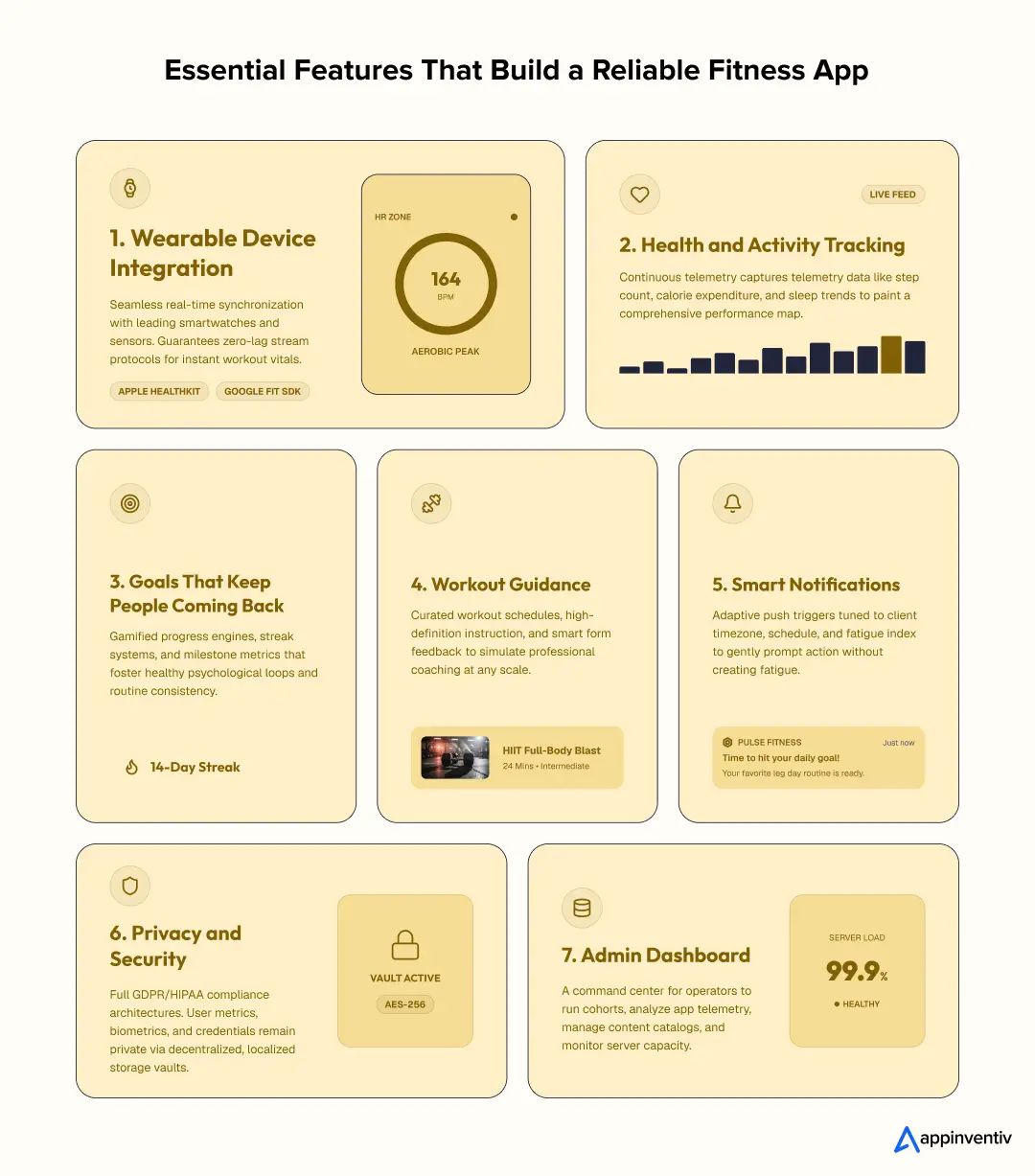
Wearable Device Integration
This is probably the first thing people judge.
If an Apple Watch takes too long to sync or a Garmin workout disappears, the rest of the app suddenly matters a lot less. In the UAE especially, where Apple, Samsung, Garmin and Huawei devices all have a healthy user base, supporting the right ecosystems early makes a noticeable difference. Most businesses don’t need every wearable on day one. They do need the ones their audience already owns.
Health and Activity Tracking
Raw numbers aren’t the product.
Nobody opens a fitness app just to see today’s step count. They open it to answer a question. Am I doing better than last week? Did I actually sleep enough? Why is my recovery score lower today?
The data matters. The way it’s organized matters even more.
Goals That Keep People Coming Back
One thing shows up in almost every successful fitness product- Progress.
Sometimes its closing activity rings. Sometimes it’s preparing for a marathon. Sometimes it’s simply walking a little more each week. Whatever the goal, users should feel they’re moving towards something rather than collecting numbers that disappear into another dashboard.
Workout Guidance
Tracking workouts is useful but helping people decide what to do next is usually more valuable.
That could mean beginner workout plans, recovery sessions, strength programmes or AI-assisted recommendations based on previous activity. The format changes from one product to another. The objective doesn’t.
Smart Notifications
Most fitness apps send too many reminders that users usually switch off.
A better approach is sending fewer notifications that actually match behaviour. Missing a workout for three days deserves a reminder. Completing one doesn’t necessarily deserve three congratulatory messages.
Privacy and Security
People are becoming far more selective about the health information they share.
Heart-rate history, sleep patterns, location and activity records all deserve proper protection. For products launching in the UAE, privacy expectations have become even stronger with PDPL shaping how personal data should be handled. It’s much easier to build those controls into the platform from the beginning than retrofit them later.
Admin Dashboard
The mobile app gets most of the attention.
The admin dashboard usually gets most of the work.
Content updates, subscriptions, analytics, workout libraries, user management and support requests all happen behind the scenes. As the platform grows, this becomes one of the most frequently used parts of the product, even though end users never see it.
Advanced Features That Strengthen a Wearable Fitness App Business
Basic tracking features may help launch a wearable fitness app. They are rarely enough to build a strong business around it.
UAE users already have access to steps, calories, heart rate, and workout records through their devices. A new app must do more with that information. It needs to solve a specific problem for the audience it serves, whether that is gym members, patients, employees, athletes, or insurance customers.
The following features can improve retention while creating room for subscriptions, employer contracts, premium coaching, and healthcare partnerships. Businesses must also understand that these features influence wearable fitness app development costs but are necessary for building a competitive and commercially viable product.
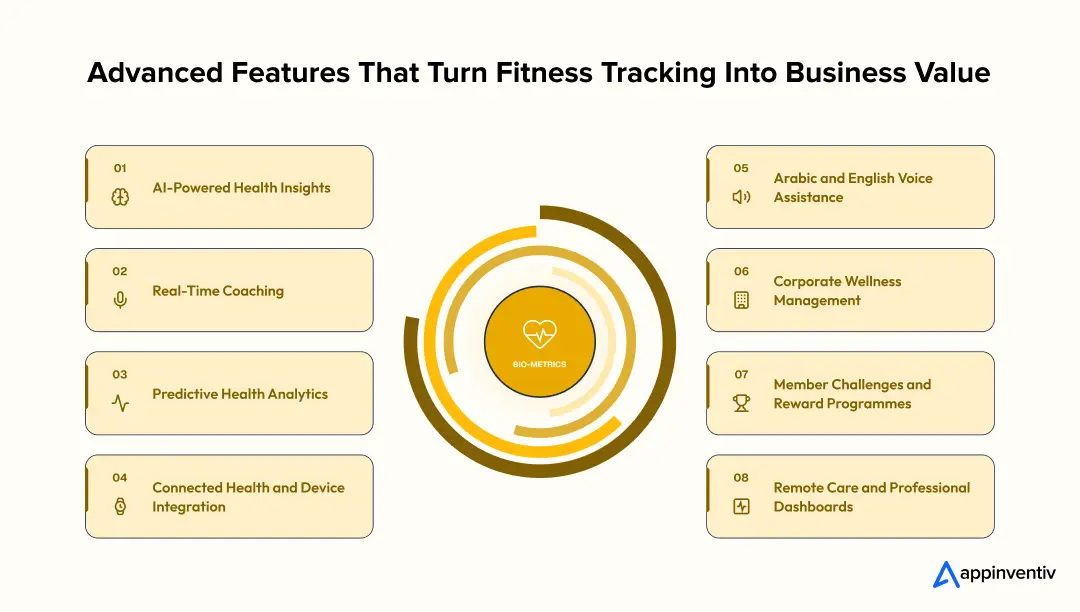
AI-Powered Health Insights
A user may generate thousands of health readings without understanding any of them. Showing more charts will not solve that problem.
AI can turn wearable data into simple, useful guidance. It can explain changes in sleep, recovery, activity, and workout performance. The advice can also reflect local factors such as hot weather, fasting routines, hydration needs, and preferred training hours.
For a UAE business, this feature can support paid health plans, premium reports, and personalised coaching services. It also gives the product a stronger purpose than basic fitness tracking.
How Did We Turn Diabetes Data Into 24/7 Personalized Care?
See how we built DiabeticU with AI, reduced AWS costs by 30%, and achieved 99.9% medical-record durability.

Real-Time Coaching
A fitness app becomes more useful when it can respond during the workout.
It may suggest a slower pace when the user’s heart rate rises too quickly. It can change the next exercise when recovery appears low. During outdoor training, it could also recommend a shorter session based on heat and exertion levels.
Predictive Health Analytics
Historical reports tell users what has already happened. Predictive analytics helps them understand what may happen next.
The app can study changes in sleep, resting heart rate, activity, and recovery. If several readings begin moving in the wrong direction, it can recommend rest or prompt the user to speak with a professional.
Connected Health and Device Integration
Wearable data rarely comes from a single device. Users may own a smartwatch, sleep ring, smart scale, heart rate monitor, or connected gym equipment.
A wearable app must bring those readings together without making the user manage every connection manually. Depending on the target audience, it may need to work with Apple Health, Health Connect, Fitbit, Garmin, Samsung Health, and other device platforms.
Integration choices also affect development cost. A business should first identify which devices its UAE customers already use, then build those connections in priority order.
Arabic and English Voice Assistance
Voice support can make the app easier to use during running, cycling, or strength training. Users can start a workout, record a set, hear their pace, or pause a session without touching the screen.
For the UAE market, voice assistance should not be treated as an English-only feature. Arabic support, clear pronunciation, and simple language choices can make the product relevant to a much wider audience.
Corporate Wellness Management
A consumer dashboard is not enough when the buyer is an employer.
Companies need tools for creating team challenges, managing enrolment, viewing participation, and measuring programme usage. Employees, however, need confidence that their personal health records will remain private.
The system should therefore provide employers with grouped and anonymised information. Individual readings should only be shared when the employee has clearly agreed to it. This balance is essential for building trust and securing long-term corporate wellness contracts.
Member Challenges and Reward Programmes
Challenges can help gyms, employers, and wellness brands bring users back without relying on constant notifications.
The reward model should match the business. It could include membership benefits, coaching sessions, partner discounts, or loyalty points. This gives gamification a commercial purpose instead of adding badges that users quickly ignore.
Remote Care and Professional Dashboards
Some wearable apps need a separate view for doctors, coaches, physiotherapists, or wellness teams.
These professionals may need to review selected readings, follow recovery progress, adjust a programme, or contact the user when something changes. Access must be based on the user’s consent and limited to the professional’s role.
This feature can support remote rehabilitation, chronic condition monitoring, sports coaching, and premium wellness programmes. It also moves the product beyond a standard consumer app and into higher-value business use cases.
Advanced features should not be added simply because competitors offer them. Each one must support a clear customer need and a practical revenue path. That decision will shape the technology, integrations, compliance work, and overall wearable fitness app development cost in the UAE.
How to Develop a Wearable Fitness App in the UAE?
Building a wearable fitness app starts well before the development team writes code.
The first decisions are commercial. Who will use the app? Who will pay for it? And what should the product do better than Apple Health, Garmin Connect, or an existing gym app?
For a UAE business, the answer may involve corporate wellness, connected gyms, remote patient support, insurance rewards, or premium fitness memberships. Once that direction is clear, the wearable fitness app development process becomes far more focused.
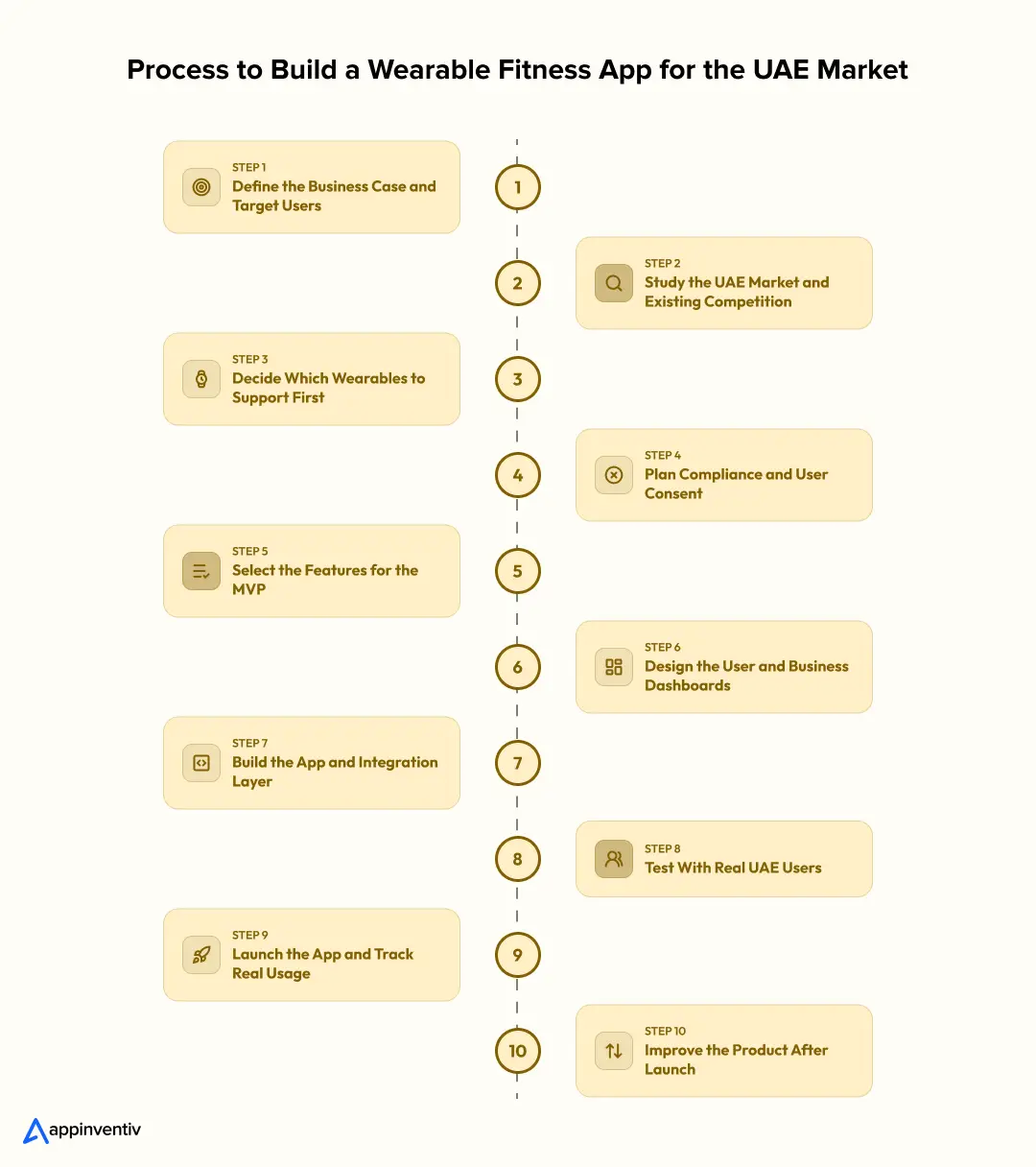
1. Define the Business Case and Target Users
Start with the problem the app needs to solve.
A Dubai gym chain may want to keep members active between visits. An Abu Dhabi healthcare provider may need remote recovery tracking. A company with teams across different Emirates may want one wellness programme for its entire workforce.
These products may all use wearable data, but their features, integrations, and revenue models will be completely different.
At this stage, define the target audience, expected revenue source, and main business outcome. This prevents the first version from becoming a costly mix of unrelated features.
2. Study the UAE Market and Existing Competition
The next step is to understand what users already have.
Review international fitness platforms, local wellness programmes, gym applications, insurer-led rewards, and healthcare apps. Look beyond their feature lists. Check where users face problems with Arabic support, device connections, payment options, or complicated onboarding.
UAE audiences are also highly diverse. An app built only around one language, fitness level, or cultural routine may struggle to gain wider adoption.
This research helps identify a genuine opening in the market instead of building another step tracker with a different logo.
Looking to Turn Wearable Data Into a Business People Will Pay For?
Shape the right mix of AI, subscriptions, corporate wellness, and healthcare partnerships before development begins.

3. Decide Which Wearables to Support First
Supporting every device at launch sounds attractive. It can also make the project expensive and difficult to test.
The team must also check what data each platform allows the app to read and write. Heart rate, sleep, workouts, body temperature, and blood oxygen may have different permissions and technical limits.
Making these choices early keeps the integration plan realistic.
4. Plan Compliance and User Consent
Health and fitness data needs careful handling, even when the app is not presented as a medical product.
The development team should map what information will be collected, where it will be stored, and who can access it. Consent should be clear, especially when data is shared with an employer, doctor, coach, or insurance partner.
UAE data protection requirements must be considered during product planning. If the app serves users in specific free zones or handles clinical information, further rules may apply.
This work should not be left until launch. Changing the data structure later can affect the entire product.
5. Select the Features for the MVP
The first release does not need every feature from the original idea.
It needs enough value to test whether people will use the app and whether the business model works. A gym MVP might include member login, wearable syncing, workout plans, progress reports, and class rewards. A corporate wellness MVP may focus on challenges, employee consent, anonymised reporting, and an HR dashboard.
Arabic and English support should also be planned at this point. Adding Arabic after the interface is complete often creates problems with layouts, navigation, and right-to-left screens.
A focused MVP helps the business enter the market sooner without cutting corners on the features that matter.
6. Design the User and Business Dashboards
Wearable apps usually serve more than one type of user.
The individual wants quick answers about activity, sleep, progress, or recovery. A coach may need client trends. An HR team may only need combined programme results. A healthcare professional may require access to selected patient information.
Each dashboard should therefore be designed around its user’s actual decisions. Putting the same data on every screen creates clutter and may expose information to the wrong people.
The interface should also reflect how people use apps in the UAE. That includes bilingual navigation, readable Arabic layouts, local date and time preferences, and accessible design across common devices.
7. Build the App and Integration Layer
Development usually begins with the mobile app, backend, database, administrative controls, and wearable integrations.
The integration layer deserves particular attention. Devices may record the same activity differently, sync at different times, or return incomplete readings. The backend must clean and organise that information before showing it to the user.
If the product includes AI insights, the team should also decide when the app gives a recommendation and when it stays silent. Health guidance must be understandable, explainable, and based on reliable data.
This stage works best in shorter development cycles. Business teams can review working features early instead of waiting until the complete product is built.
8. Test with Real UAE Users
Technical testing alone will not show how the product performs in daily life.
Run a pilot with a smaller group from the intended audience. That could mean members from one Dubai gym, employees from an Abu Dhabi office, or patients enrolled in a supervised wellness programme.
The pilot should test device syncing, battery use, Arabic screens, notifications, consent flows, and dashboard accuracy. It should also show whether people understand the insights and return after the first few days.
Those findings are usually more valuable than adding another feature before launch.
9. Launch the App and Track Real Usage
A UAE launch may begin with one employer, one gym branch, or one healthcare programme before expanding across the Emirates.
This gives the business time to study activation, wearable connection rates, weekly use, subscription conversion, and challenge participation. For enterprise products, the team should also track contract renewals and programme adoption.
Downloads matter, but they do not tell the full story. A wearable app creates value when users keep syncing data and acting on what the product tells them.
10. Improve the Product After Launch
Wearable app development does not finish when the app reaches the store.
Device software changes. Health platforms revise their permissions. Users request new integrations, while enterprise clients may need different reports or access controls.
The post-launch roadmap should follow real usage. If users check recovery every morning but ignore social features, the next investment is clear. If employers want better participation reports, the business dashboard may deserve attention before another consumer feature.
This approach keeps development tied to user behaviour and commercial demand. It also helps the product grow across the UAE without turning every client request into a custom rebuild.
How Wearable Fitness Apps Make Money in the UAE?
A wearable fitness app does not need millions of paid users to become commercially viable.
In the UAE, the paying customer may not even be the person wearing the device. It could be a gym group, employer, insurer, hospital, hotel, or residential community. This makes the revenue model very different from a standard consumer fitness app.
The local appetite for fitness is already visible. Dubai Fitness Challenge attracts millions of users every year. That does not guarantee app subscriptions, but it shows that businesses are entering a market where organised fitness already has strong public participation.
Thus, the better approach is to choose a revenue model around the organisation being served.
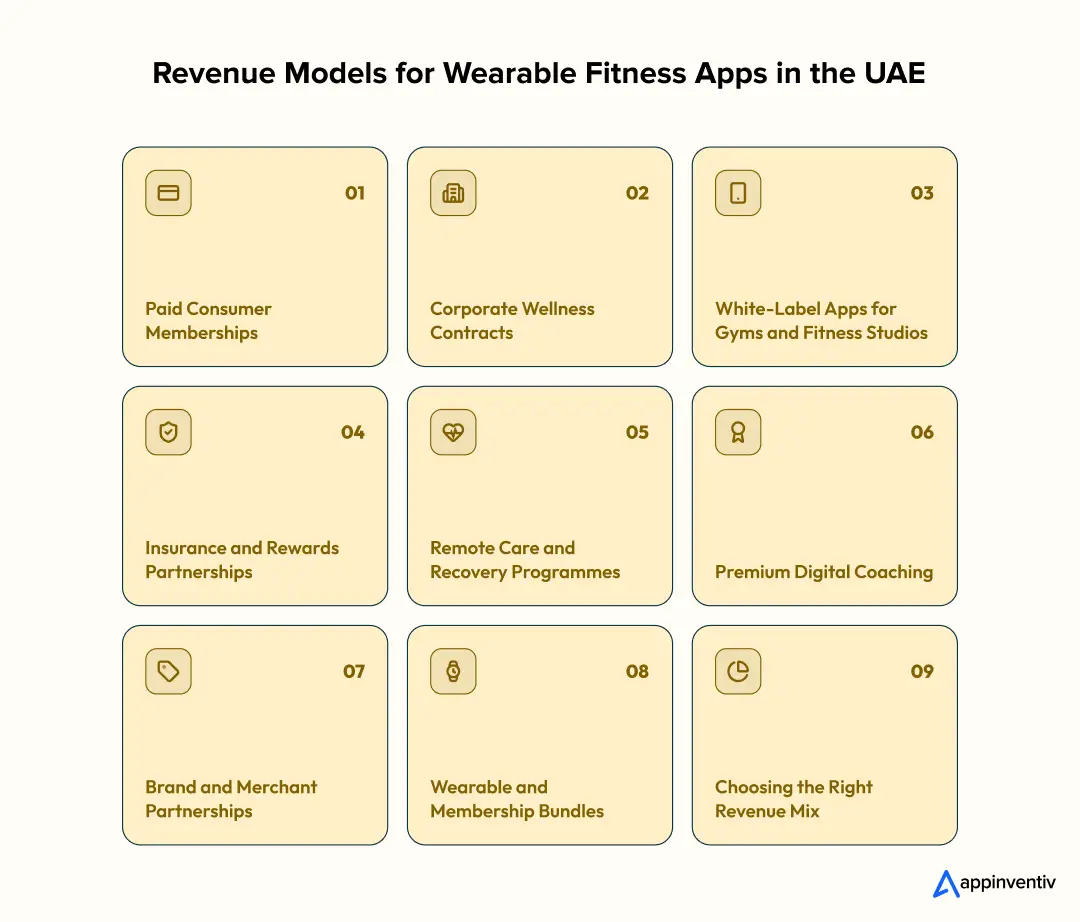
Paid Consumer Memberships
Subscriptions work when the paid plan offers more than information already available through a smartwatch.
A UAE-focused app could charge for AI health insights, Arabic coaching, Ramadan fitness plans, heat-aware outdoor training, advanced recovery reports, or access to a qualified coach.
Instead of placing every feature behind a paywall, the free version can handle activity tracking and basic reports. The paid plan should solve a clearer problem, such as preparing for the Dubai Marathon, managing weight, improving sleep, or training safely during the summer..
Corporate Wellness Contracts
For many UAE wearable fitness apps, employers may offer a stronger revenue opportunity than individual users.
Dubai-registered employers are already responsible for providing health insurance to their employees. In Abu Dhabi, employer-sponsored coverage is also part of the health insurance structure. This makes HR teams, insurers, and benefit providers familiar with paying for employee health services.
The app can be sold through a per-employee monthly or annual contract. A company in DIFC, Dubai Internet City, or Abu Dhabi Global Market may pay for fitness challenges, wellness content, participation reports, and team campaigns.
White-Label Apps for Gyms and Fitness Studios
A fitness operator may not want to send members to a third-party app. It may prefer its own branded platform.
The same wearable app foundation can be licensed to gym chains, boutique studios, personal training businesses, and sports academies. Each client receives its own colours, content, challenges, membership plans, and branch information.
Revenue can come from an initial setup fee followed by a monthly platform charge. Larger clients may pay extra for custom integrations, multilingual content, or connections with their membership and access-control systems.
For a gym with locations across Dubai and Abu Dhabi, this creates one digital member experience without developing separate software for every branch.
Insurance and Rewards Partnerships
Insurers have a reason to support healthier behaviour when the programme is structured responsibly.
A wearable app can power activity challenges, preventive health campaigns, and rewards for approved wellness goals. Users may receive points, partner discounts, fitness memberships, or other benefits for consistent participation.
Dubai’s health insurance network included 43 insurance companies, 140 brokers, 16 claims management entities, and 3,936 healthcare providers as of early 2026. That gives app businesses a broad B2B market to approach, although each partnership will require its own compliance and commercial checks.
The app business may charge the insurer a platform fee, a fee per enrolled member, or a programme management charge. It should not promise lower claims without evidence from an actual pilot.
Remote Care and Recovery Programmes
Hospitals, physiotherapy centres, and rehabilitation providers can use wearable data between appointments.
A clinic may offer a six-week recovery programme that tracks mobility, exercise completion, sleep, and selected vital signs. The patient pays for the complete programme, while the app gives the clinical team a clearer view of progress outside the facility.
Premium Digital Coaching
Not every user needs a live trainer. Many still want advice that feels personal.
The app can sell structured plans for strength, running, weight management, postnatal fitness, or preparation for local sporting events. A lower-priced tier may use automated coaching, while a premium tier includes check-ins with a real coach.
This gives UAE gyms and personal trainers a way to serve clients beyond one location. A coach based in Dubai can manage customers in Sharjah, Abu Dhabi, or Ras Al Khaimah without turning every session into a video call.
The platform may keep a percentage of each plan sold or charge coaches a monthly fee for using its tools.
Brand and Merchant Partnerships
Fitness users already spend money on sportswear, healthy food, supplements, gym memberships, recovery services, and sporting events.
The app can bring selected UAE partners into its rewards programme. A completed challenge might unlock a discount at a sports retailer, a healthy meal brand, or a participating fitness studio.
Revenue may come from campaign fees, sponsored challenges, or commission on completed purchases. The partnership should still make sense for the user.
Wearable and Membership Bundles
Some customers may hesitate to join because they do not own a compatible device.
An employer, insurer, or premium gym can bundle the wearable with the app membership. The device may be included in an annual plan, provided on installments, or offered at a partner rate.
This model can improve enrolment, particularly for corporate programmes where everyone needs access to the same tracking features. The business earns through the software contract, device margin, or both.
It also reduces integration problems because the app is tested around a smaller group of approved devices.
Common Challenges in Wearable Fitness App Development and How to Handle Them
Building a wearable fitness app becomes more complicated once real devices, health data, and enterprise systems enter the picture. For UAE businesses, these challenges can affect compliance, user trust, corporate adoption, and future GCC expansion.
| Challenge | Why It Matters | Recommended Solution |
|---|---|---|
| Inconsistent wearable data | Apple Watch, Garmin, Fitbit, and other devices may calculate workouts, calories, and recovery differently. This can make the app appear inaccurate. | Create a common data structure for all devices. Test missing readings, delayed syncs, duplicate records, and real workouts before adding more integrations. |
| Health data privacy | Wearables may reveal sleep, location, routines, and physical health patterns. Poor consent controls can damage trust and delay enterprise approval. | Add clear consent, data deletion, device disconnection, and role-based access. Review UAE data requirements before designing the database and user flows. |
| Wellness and medical boundaries | An AI-generated heart rate or blood oxygen warning may sound like a diagnosis. This can create regulatory and safety concerns. | Classify every insight as fitness guidance, wellness support, or clinical functionality. Send medical features through professional and regulatory review. |
| UAE healthcare integrations | Healthcare apps may need to connect with electronic medical records, NABIDH in Dubai, or Malaffi in Abu Dhabi. These systems follow defined standards and access rules. | Involve healthcare IT and compliance teams early. Plan data formats, patient identification, consent, security, and integration approvals before building the MVP. |
| Unreliable AI insights | Loose devices, drained batteries, and missing workouts can give the AI incomplete information. Weak data may produce misleading recommendations. | Add data-quality checks before generating insights. Show users why a recommendation appeared and avoid making confident claims from incomplete readings. |
| Arabic and English experience | Direct translation can create awkward fitness terms, broken layouts, and poor voice recognition. Arabic also requires right-to-left interface design. | Design both languages together. Test Arabic screens, charts, navigation, and voice commands with real UAE users and varied accents. |
| Heat-aware recommendations | Standard outdoor workout advice may be unsuitable during the UAE summer. Poorly timed prompts can also reduce the feature’s value. | Connect environmental and activity data. Adjust workout timing, hydration prompts, and exertion guidance without presenting them as medical advice. |
| Enterprise access control | Employers, coaches, clinicians, and users need different information. One shared dashboard can expose personal data to the wrong people. | Create separate dashboards with role-based permissions. Give employers anonymised trends and only share personal readings with clear user consent. |
| Real-time performance | Corporate challenges and large fitness campaigns can create sudden syncing spikes. Delayed or incorrect leaderboards can quickly reduce trust. | Test sync queues, traffic spikes, repeated records, and temporary device failures. Display the last update time when data is not fully live. |
| Low engagement after launch | Users may connect their wearable once and stop opening the app after the initial interest fades. More notifications may only irritate them. | Use recovery summaries, Ramadan plans, corporate challenges, and local event programmes. Measure completed workouts and active connections, not only app opens. |
These challenges should be addressed during product planning, not after launch. Doing so helps UAE businesses build wearable fitness apps that users can trust and enterprise buyers can confidently adopt.
Could Your Next Revenue Engine Fit on a Wrist?
Build an AI-powered wearable fitness platform with Appinventiv, designed for UAE users, enterprise partnerships, and GCC-scale growth.

The Future of Wearable Fitness Apps in the UAE
As of July 2026, the future of wearable fitness apps is no longer limited to better step counts or more detailed workout graphs.
The real opportunity lies in connecting wearable data with healthcare, insurance, corporate wellness, gyms, and preventive care. For UAE businesses, this opens the door to enterprise contracts and long-term digital health services.
The country already has a strong foundation for connected healthcare. The latest reported figures show that Dubai’s NABIDH platform held more than 10.41 million medical records and connected 1,888 healthcare facilities by June 2025.
In Abu Dhabi, Malaffi had reached 3.5 billion clinical records by August 2025. It supported 53,476 authorised healthcare professionals across 3,072 facilities.
The progress continues in 2026. In May, Dubai Health Authority launched a unified medical report project linking NABIDH with other relevant systems. This reflects the UAE’s wider movement towards connected, standardised, and more accessible health information.
For businesses planning a wearable product in 2026, the opportunity is clear. The next generation of apps can support a much wider health journey instead of remaining standalone fitness trackers.
Here are some of the major things businesses can expect in the future:
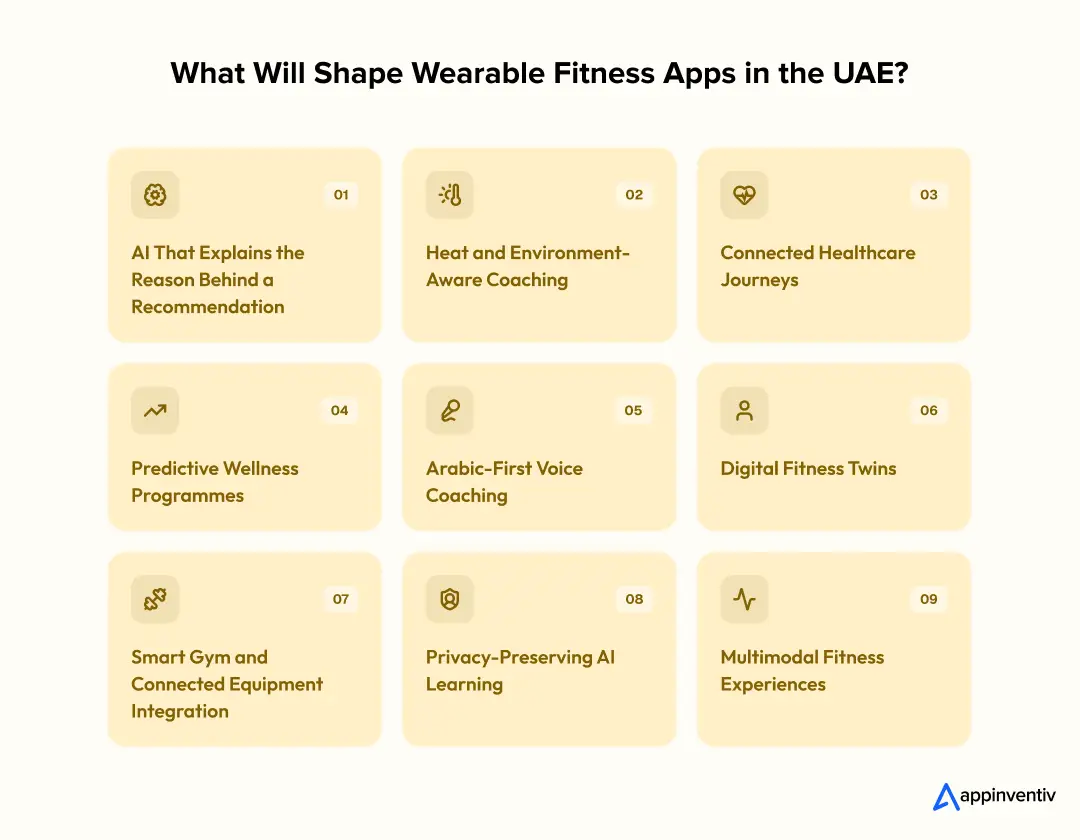
AI That Explains the Reason Behind a Recommendation
Future fitness apps will move beyond statements such as “your recovery is low.”
They will explain what may have contributed to the change. Perhaps sleep dropped for three nights. The last workout was more demanding than usual. Resting heart rate has also moved above the user’s normal range.
That explanation matters because users are more likely to follow advice they understand.
Our recommendation: Start with a small number of insights that can be explained clearly. Test each one with fitness and healthcare professionals before expanding the AI model.
Heat and Environment-Aware Coaching
A workout plan created for London or New York will not always suit someone exercising outdoors in Dubai.
Future apps can adjust training prompts using temperature, humidity, activity intensity, and the user’s usual response. They may recommend an indoor session, a different time, or a reduced training load when conditions become demanding.
This can be valuable for running clubs, sports academies, hotels, and corporate wellness programmes operating in the UAE.
Our recommendation: Treat environmental data as part of the coaching engine, not a separate weather widget. The advice should change only when the conditions genuinely affect the workout.
Connected Healthcare Journeys
Wearable data will become more useful when it can support care beyond the gym.
A physiotherapist may review mobility after surgery. A doctor may follow selected patient readings between visits. A wellness team may monitor progress during a supervised programme.
Dubai’s NABIDH and Abu Dhabi’s Malaffi show how seriously the UAE is investing in connected health information. A wearable product built for healthcare should be designed with interoperability in mind from the start.
Our recommendation: Use recognised healthcare data standards and keep the fitness and clinical layers separate. Not every wearable reading belongs in a medical record.
Predictive Wellness Programmes
Most fitness apps react after something changes. Future products will identify a pattern earlier.
The app may notice that sleep, movement, and recovery have declined together. It can then recommend a smaller goal or suggest speaking with a professional before the user gives up entirely.
For employers and insurers, these tools could support preventive wellness programmes. However, predictive scores should never become a hidden method for judging employees or insurance customers.
Our recommendation: Keep participation voluntary and explain how each prediction is created. Employers should receive group trends, not personal risk labels.
Arabic-First Voice Coaching
Voice interaction fits naturally into fitness because users cannot always touch a screen during a workout.
The next step for the UAE is voice coaching that works naturally in Arabic and English. It should understand different accents and allow users to move between languages without restarting the session.
This may be particularly useful for gyms, home workouts, older users, and people who prefer audio guidance over charts.
Our recommendation: Build voice around a few common workout actions first. Starting a session, recording a set, checking pace, and pausing a workout offer more value than a large but unreliable command library.
Digital Fitness Twins
A digital fitness twin is a changing model of the user’s activity, recovery, and performance.
Instead of using the same plan for everyone, the app continuously adjusts the programme around the individual. A missed session, poor sleep, or a change in heart rate may alter the next workout.
This could support athletes, premium gym members, and structured rehabilitation programmes. It also creates room for higher-priced subscriptions and professional services.
Our recommendation: Introduce this feature in stages. Begin with training adjustments based on a few reliable signals before adding more sensitive health information.
Smart Gym and Connected Equipment Integration
The wearable app of the future will not stop at the smartwatch.
It may connect with treadmills, strength equipment, access gates, body composition machines, and studio booking systems. A member could enter a gym in Abu Dhabi, complete a workout, and see the full session inside the app without recording each exercise manually.
For UAE gym groups, this creates a stronger link between the physical membership and the digital product.
Our recommendation: Prioritize the equipment and membership systems already used by the target gym. Building every possible connection before securing a client will add cost without proving demand.
Privacy-Preserving AI Learning
Fitness models improve when they learn from more users. Sending every personal record into one central database, however, creates unnecessary risk.
Privacy-preserving methods can help models learn from broader patterns while limiting the movement of raw user data. This may become increasingly valuable for hospital groups, insurers, and government-linked wellness programmes.
Our recommendation: Decide which information the model truly needs. Collecting less data is often safer and cheaper than building complex protection around information with no clear business use.
Multimodal Fitness Experiences
Future wearable apps will combine voice, video, sensor data, and visual guidance in one session.
A user may hear a pacing cue through earphones, watch a short exercise correction on the phone, and receive live heart-rate feedback from the watch. The experience feels connected because each format serves a different purpose.
This can support premium coaching, hotel fitness services, home training, and remote rehabilitation.
Our recommendation: Use each format only where it helps. A user running outdoors needs short audio guidance. Someone learning a strength exercise may need a clear video instead.
How Can Appinventiv Help with Wearable Fitness App Development in the UAE?
Knowing the wearable fitness app development cost in the UAE gives you a budget range. It does not tell you how to turn wearable data into a product that users trust and enterprise buyers are willing to fund.
At Appinventiv, we help businesses build wearable platforms around a clear commercial goal. That may be a subscription fitness product, a digital service for a gym chain, an employee wellness platform, or a remote monitoring solution for a healthcare provider. The technology changes with each use case, and so does our development approach.
Our team handles the complete product journey, from early research and experience design to wearable integrations, backend development, AI features, testing, and launch. We can connect the app with platforms such as Apple Health, Health Connect, Garmin, and Fitbit based on the devices your UAE audience already uses. This keeps the first release focused instead of increasing the budget with integrations that add little value.
For products serving Dubai and Abu Dhabi, compliance and integration planning begin early. We consider consent, health-data access, Arabic and English interfaces, user permissions, and data storage while shaping the architecture. Healthcare-focused products can also be prepared for integration with electronic medical records and local health information environments such as NABIDH and Malaffi, subject to the required approvals.
As a wearable app development company in Dubai, we work as a long-term technology partner rather than a team that leaves after deployment. Our aim is to help you build a product that can secure UAE enterprise partnerships, earn recurring revenue, and expand across the wider GCC when the business is ready.
Planning a wearable fitness app for the UAE? Get in touch with our experts to turn your product idea into a secure, market-ready platform.
FAQs
Q. How much does it cost to develop a wearable fitness app?
A. A wearable fitness app with essential activity tracking, workout monitoring, and health-platform integrations generally costs between AED 150,000 and AED 260,000, or approximately USD 40,000 to USD 70,000.
A more sophisticated product with AI-powered coaching, advanced health analytics, multi-device compatibility, real-time data processing, and robust security can cost AED 900,000 to AED 1 million or more, or approximately USD 250,000 and above.
The final wearable fitness app development cost in the UAE depends on the product scope, integration requirements, data architecture, and level of intelligence planned for the platform.
Q. How long does it take to develop a wearable fitness app?
A. A focused product with essential tracking and selected wearable integrations can usually be developed within four to six months.
A more advanced platform with AI capabilities, bilingual experiences, live data processing, and several third-party integrations may require six to nine months. Products involving clinical workflows or larger healthcare ecosystems can take nine to twelve months or longer.
The timeline becomes more reliable once the first release has a defined audience, feature set, and integration plan.
Q. Is AI worth adding to a wearable fitness app?
A. AI is worth the investment when it improves a core part of the product rather than sitting on top of it as an extra feature. It can interpret activity and recovery data, adjust fitness plans, and provide guidance based on changing user patterns.
From a business perspective, this creates room for premium subscriptions, digital coaching, preventive wellness programmes, and partnerships with employers, insurers, and healthcare providers. It also gives the product a clearer position in a market where basic tracking is already widely available.
Q. How much does wearable app maintenance cost?
A. Annual maintenance cost breakdown of wearable fitness app development generally accounts for 15% to 25% of the original development investment.
This budget covers security, cloud infrastructure, device and operating-system updates, performance improvements, and changes to third-party integrations. Products that process live health data or support several wearable brands will usually sit toward the higher end of the range.
A planned maintenance budget protects the initial investment and keeps the product commercially relevant after launch.
Q. What is the ROI of investing in a wearable fitness app?
A. ROI depends on the commercial model behind the product.
Revenue may come from consumer subscriptions, paid coaching, corporate wellness contracts, insurer partnerships, or monitored care programmes. For an established fitness or healthcare business, the app may also increase retention and extend existing services into a recurring digital offering.
The business case should be measured through paid conversion, revenue per user, customer retention, enterprise contract value, and renewal rates. Downloads may show interest, but they do not show whether the product is generating a return.
[ad_2]
Source_link