
[ad_1]
Key takeaways:
- Custom software engineering solves NDIS margin compression by replacing manual intake and claims workflows with automated enterprise intelligence engines.
- A phased methodology, from workflow discovery and private model fine-tuning to security testing, ensures smooth, risk-free enterprise deployment.
- Systems must satisfy NDIS Commission rules, Privacy Act APPs, ACSC Essential Eight Maturity Level 3, and onshore cloud hosting mandates.
- Custom builds scale from $70,000 AUD for basic modules up to $700,000+ AUD for multi-site AI ecosystems, delivering under 1% claim rejections.
- Benchmarks from AWS Health AI and Queensland Health demonstrate how ambient documentation reduces administrative workloads by 40% to 50%.
Australia’s disability care sector is entering a new era. With the National Disability Insurance Scheme (NDIS) supporting 774,456 participants and annual funding exceeding AUD 46 billion in 2026, the scheme has become one of the country’s largest and most complex social programs.
For providers, this growth represents a significant opportunity but it also brings mounting operational pressure. As participant expectations rise and regulatory oversight intensifies, many registered and unregistered providers are finding that traditional software and manual processes can no longer keep pace.
Behind every support plan is an increasingly demanding operational reality. Teams spend countless hours on participant documentation, shift scheduling, SCHADS Award-compliant payroll calculations, service agreements, claims processing, and audit preparation. Even small errors in invoicing or record-keeping can lead to delayed reimbursements, rejected claims, compliance risks, and shrinking profit margins. Rather than enabling better care, administrative work often consumes the very resources providers need to deliver it.
This is where AI-powered NDIS software development in Australia is changing the equation. By combining automation, predictive analytics, generative AI, and intelligent workflows, custom platforms can streamline operations, reduce administrative burden, improve funding accuracy, strengthen compliance, and give support workers more time to focus on participant outcomes instead of paperwork.
In this guide, we’ll explore how AI is reshaping NDIS software development in Australia, the most valuable use cases for providers, the key features and compliance requirements to consider, the development process and the typical costs involved in building a future-ready AI-powered NDIS platform.
Still relying on manual NDIS workflows?
Discover how an AI-powered platform can reduce administrative overhead, improve claims accuracy, and help your team focus more on participant care.
Why the Australian NDIS Sector Is Turning to AI
Provider margins face sustained pressure from SCHADS Award payroll complexity, PRODA claim rejections, and NDIS Quality and Safeguards Commission audit cycles. Workforce shortages and rising participant expectations compound the strain on already thin operating budgets.
AI-powered NDIS software development in Australia responds to this directly, automating documentation, rostering, and compliance evidence so providers absorb regulatory change without expanding headcount.
Current Challenges Facing NDIS Providers
1. Staff shortages
Australia now has more than 325,000 disability support workers serving participants through around 269,000 active providers, yet many regional and remote communities continue to experience persistent workforce shortages.
- How AI Solves This: AI-powered workforce management can help providers optimise rostering by matching support workers to shifts based on qualifications, availability, proximity, and participant preferences, reducing scheduling gaps and missed visits.
2. PRODA and PACE Claim Rejections
Billing errors, minor line-item typos, and unexpected participant budget limits trigger instant claim rejections in government gateways, locking up critical working capital.
- How AI Solves This: Pre-claim validation checks scan every shift entry against active NDIA price guides and remaining plan balances before file submission.
3. Administrative Overload on Support Workers
Support staff routinely spend up to a third of their billable hours filling out paper forms or tapping out basic shift summaries, pulling them away from direct participant care.
- How AI Solves This: Ambient voice tools allow staff to dictate verbal shift debriefs into their phones, turning spoken words into structured SOAP progress notes automatically.
4. Audit Vulnerabilities Under the Safeguards Commission
The NDIS Quality and Safeguards Commission demands airtight evidence trails for incidents, restrictive practices, and service agreements. Loose paperwork leaves organizations exposed during spot checks.
- How AI Solves This: Compliance engines continuously audit participant records, flagging missing documentation, expired screening checks, or unlogged incidents before auditors show up.
5. Participant Churn and Care Disruption
High support worker turnover breaks care continuity, annoying families who expect stable relationships and consistent communication from their service provider.
- How AI Solves This: Matching algorithms pair support workers with participants based on shared interests, specific skill requirements, and proximity, driving up retention for both sides.
Also Read: Healthcare Software Development in Australia: A Complete Guide for 2026
Why Traditional NDIS Software Is No Longer Enough in 2026
Legacy platforms rarely keep pace with how NDIS software development in Australia now needs to work across rostering, billing, and compliance simultaneously. Providers comparing NDIS software Australia options quickly notice the gap between single-function tools and unified platforms.
Here is a quick comparison table between Legacy SaaS and Custom AI NDIS Platforms
| Consideration | Legacy SaaS (off-the-shelf) | Custom AI-Powered Platform |
|---|---|---|
| Data ownership | Vendor-hosted, limited export | Provider-owned, portable |
| Compliance evidence | Manually assembled per audit | Continuously logged and audit-ready |
| Workflow fit | Generic, provider adapts to tool | Built around actual NDIS workflows |
| AI capability | Bolt-on or absent | Embedded across rostering, notes, claims |
| Scaling cost | Per-seat pricing compounds | Fixed build cost, marginal cost falls with scale |
Evaluating custom software against generic NDIS software in australia reveals that custom architectures deliver vastly superior long-term cost-efficiencies, data security, and operational flexibility for scaling enterprise operations.
Core AI Technologies Powering Modern NDIS Platforms
Modern NDIS software architectures move past simple databases by integrating specialized artificial intelligence stacks. Each AI technology solves a distinct operational problem. Platforms that combine several, rather than bolting on one chatbot, deliver the compounding efficiency boards are looking for.
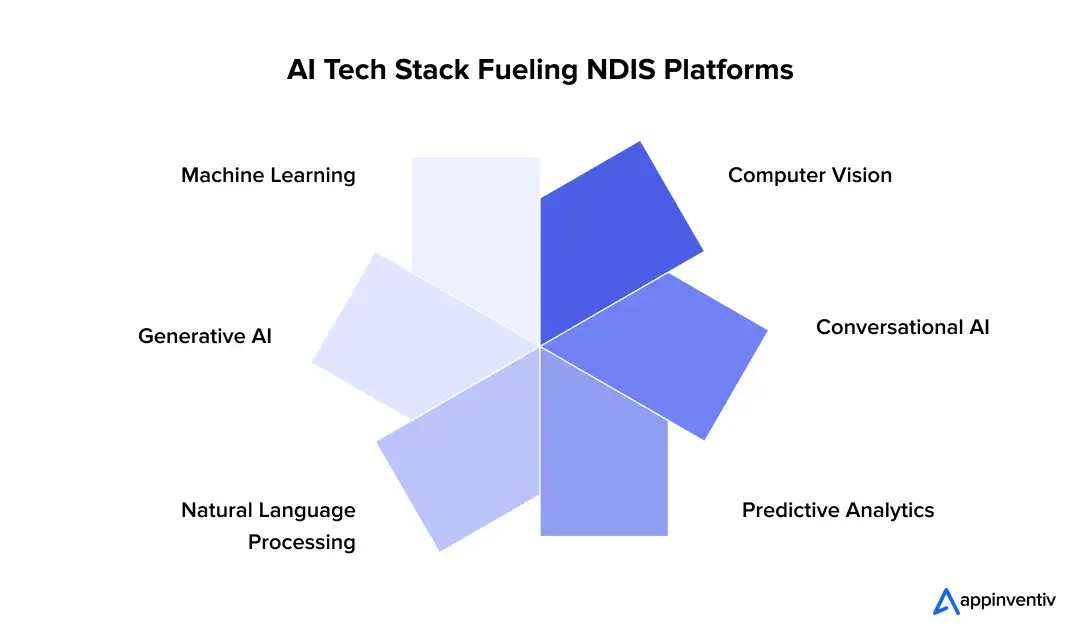
Machine Learning (ML): Used for predictive scheduling, churn risk modeling, and budget burn-rate forecasting. ML models analyze historical participant consumption patterns to flag early risks of plan exhaustion.
Generative AI & LLMs: Custom-tuned, domain-specific large language models and Gen AI in Australia synthesise progress notes, auto-generate quarterly NDIS review summaries, and convert unstructured care notes into formatted clinical insights.
Natural Language Processing (NLP): Parses unstructured shift logs and incident notes to perform sentiment analysis, detecting subtle signs of participant distress or worker burnout.
Computer Vision: Analyses physical care documentation, medication charts, and property safety audits, converting physical imagery into structured database records automatically.
Conversational AI: Enterprise-grade AI agents in Australia process routine participant requests, shift confirmations, and service agreement queries via WhatsApp, SMS, or web portals.
Predictive Analytics: Evaluates participant health records and environmental indicators to forecast medical risks, fall risks, or behavioral escalations before critical incidents occur.
Top 10 Use Cases of AI-Powered NDIS Software Development in Australia
Understanding practical NDIS software use cases matters more than chasing every available AI feature. The use cases below reflect where Appinventiv-delivered platforms have generated the clearest operational return for Australian providers.
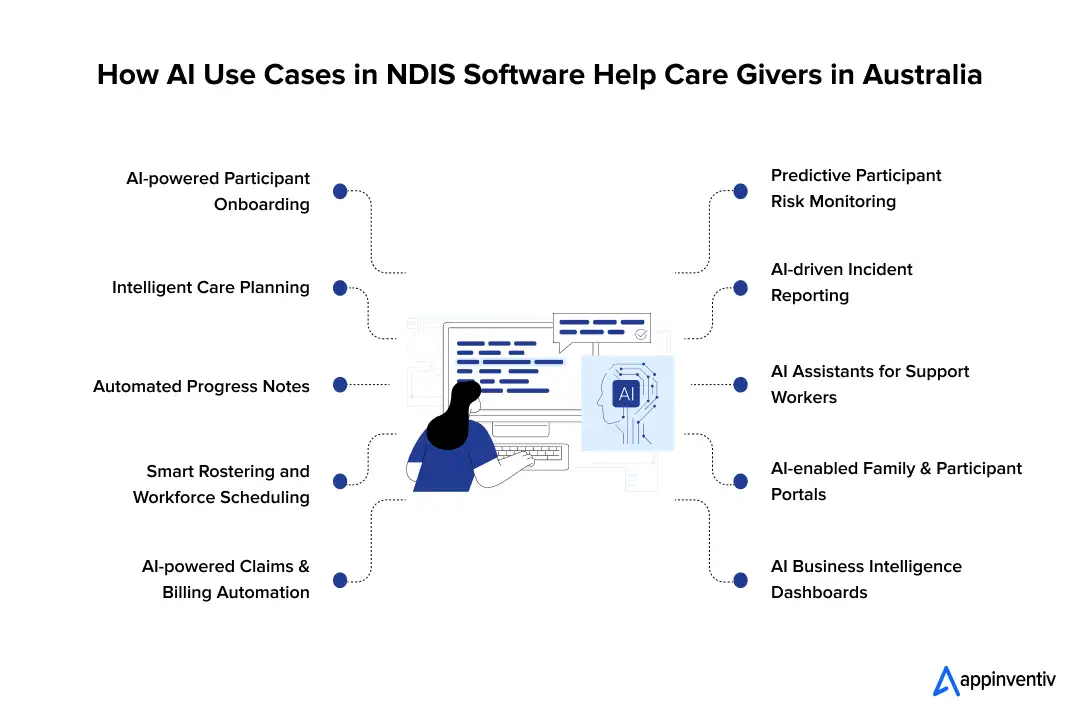
1. AI-Powered Participant Onboarding
- Problem: Intake managers waste hours digging through 40-page NDIS plans, manually copying goal statements and hunting down budget line items just to set up a basic agreement.
- How AI solves it: Document extraction engines read incoming plan PDFs, pulling out core budgets, capacity-building line items, and goal text instantly. The system then populates your standard service agreement templates with zero double-handling.
- Business benefit: What used to take three business days now takes about ten minutes, letting you start support sooner and keep families happy.
2. Intelligent Care Planning
- Problem: Care leads spend far too much time sitting behind desks drafting support plans instead of being out in the field with participants and families.
- How AI solves it: Smart text generators review initial assessment files, allied health reports, and historical shift notes to put together a solid draft care plan.
- Business benefit: Cuts drafting time by more than 50% while giving your clinical leads a consistent, high-quality starting point that auditors love.
3. Automated Progress Notes
- Problem: Support workers usually write their shift notes hours after leaving a participant, leading to vague, rushed summaries that don’t hold up under NDIS Commission scrutiny.
- How AI solves it: Workers talk through their shift debrief on their phone on the way to their car. The speech engine converts their words into clear, properly categorized shift logs mapped to participant goals.
- Business benefit: Gives staff back 30 to 45 minutes every shift and gives management clean, detailed proof of service delivery for audit time.
4. Smart Rostering and Workforce Scheduling
- Problem: Rostering officers spend their entire day playing phone tag, trying to match worker availability, travel routes, and participant needs without running into SCHADS Award overtime traps.
- How AI solves it: Optimization algorithms look at worker locations, qualifications, and live calendars alongside participant support needs, dropping optimised shift options straight onto the roster.
- Business benefit: Less time wasted driving between shifts, fewer accidental overtime errors on payroll, and far fewer open shifts left unfilled.
5. AI-Powered Claims & Billing Automation
- Problem: One wrong line item code or an unexpected plan cap can cause a whole batch of PRODA or PACE claims to bounce back, stalling cash flow for weeks.
- How AI solves it: An automated pre-billing check scans every shift record against current NDIS price guides and remaining participant balances before you batch a claim through the portal.
- Business benefit: Rejection rates drop under 1%, keeping cash flow predictable and saving your finance team from endless manual re-submissions.
6. Predictive Participant Risk Monitoring
- Problem: Small changes in a participant’s health or routine are easy to miss when notes are buried in individual shift logs across dozens of workers.
- How AI solves it: Pattern tracking models scan daily progress notes and logs, picking up on subtle trends like rising anxiety, appetite loss, or mobility changes before they turn into major health issues.
- Business benefit: Clinical teams can jump in early with preventive adjustments, avoiding unnecessary hospital visits and keeping participants safe.
7. AI-Driven Incident Reporting
- Problem: Under pressure, support staff often forget crucial details or miss mandatory reporting windows when critical incidents happen on shift.
- How AI solves it: An interactive mobile form guides staff step-by-step through incident logging, automatically flags severity levels, and drafts the required NDIS Commission notification forms for manager review.
- Business benefit: Eliminates compliance panic by making sure mandatory incident reports go out on time, every time.
8. AI Assistants for Support Workers
- Problem: Field staff working alone in the community frequently need quick answers about complex care plans or behavioral protocols without waiting for a supervisor to call back.
- How AI solves it: A secure mobile assistant lets workers ask direct questions and instantly pulls verified answers straight from that participant’s current care file and your internal policies.
- Business benefit: Gives frontline teams confidence in tough situations and cuts down on urgent escalation calls to care managers.
9. AI-Enabled Family & Participant Portals
- Problem: Support coordinators get overwhelmed by daily calls from family members asking basic questions about budget balances, shift schedules, or goal progress.
- How AI solves it: A secure self-service portal lets participants and their families log in anytime to see upcoming rosters, track budget consumption, and review shift updates in clear, plain language.
- Business benefit: Cuts inbound admin calls significantly while building trust through direct, transparent communication.
10. AI Business Intelligence Dashboards
- Problem: Executives rarely have a clear, real-time view of operating margins, shift delivery costs, or plan utilization across their entire organization.
- How AI solves it: Executive dashboards pull live data from rostering, payroll, and billing, surfacing clear trends, margin warnings, and plan burn rates on one screen.
- Business benefit: Gives executive teams the hard numbers they need to fix margin leaks, manage staff costs, and expand operations into new areas securely.
These NDIS software use cases each reduce one specific cost or compliance risk rather than promising a generic efficiency gain.
Most multi-site providers do not need every use case above on day one.
Appinventiv can help sequence rostering, claims automation, and progress notes against your audit calendar and cash flow.

What Are the Benefits of Custom AI NDIS Software Over Off-the-Shelf Platforms?
The benefits of AI-powered NDIS software are compounding rather than one-off, which is why the comparison below matters most for providers already planning beyond their next audit cycle.
| Dimension | Off-the-Shelf | Custom AI-Powered Platform |
|---|---|---|
| Customisation | Limited to vendor roadmap | Built around provider workflow |
| Ownership | Licensed, not owned | Provider owns code and data |
| Scalability | Per-seat cost compounds | Scales with marginal cost decline |
| Compliance | Generic, provider adapts | Purpose-built to Practice Standards |
| AI flexibility | Fixed feature set | Models tuned to provider data |
| Integrations | Limited API access | Full control over integration depth |
| Long-term ROI | Recurring licence cost | Asset that appreciates with data |
The gap becomes most visible at scale: a provider running two sites feels little difference between a licensed tool and a custom build, but a provider running twelve sites across three states feels it in every audit cycle and every claims run.
What Are the Key Features Every AI NDIS Platform Should Include?
Building software for Australian disability providers means balancing frontline usability with strict executive governance. This feature architecture ensures data moves naturally across care teams, field staff, and payroll desk officers without double handling.
Participant Lifecycle CRM
A Participant Lifecycle CRM centralises profile management by tracking participant enquiries, plan intake, goal statements, support histories, plan reviews, and exit workflows within a single platform.
Instead of relying on fragmented client records, providers gain a single source of truth that can reduce administrative intake efforts by nearly 70%.
Smart Rostering & Matching Engine
A smart rostering and matching engine automates shift allocation by evaluating worker availability, location proximity, required qualifications, and participant preferences.
This helps providers minimise unbillable travel time, improve workforce utilisation, and eliminate unstaffed shift gaps across multi-regional operations.
SCHADS Award Payroll Interpreter
The SCHADS Award Payroll Interpreter calculates complex pay rates in real time, including allowances, sleepover rates, split-shift premiums, and overtime triggers before shifts are published.
By automating payroll calculations, providers can eliminate manual recalculations while reducing underpayment risks during Fair Work or union audits.
PRODA & PACE Claims Gateway
An integrated PRODA and PACE Claims Gateway automates bulk claim generation, authenticates directly with government gateways, and validates claims against the latest NDIA price guides before submission.
This reduces payment rejection rates to below 1%, safeguards cash flow, and significantly cuts manual claim rework.
Ambient Voice Progress Notes
Ambient Voice Progress Notes use speech-to-text technology to convert spoken shift debriefs into structured progress notes that align with participant goals.
This can save support workers between 30 and 45 minutes of administrative work per shift while creating comprehensive documentation for future audits.
Incident & Risk Management
An AI-enabled Incident and Risk Management module guides staff through structured incident reporting workflows, automatically calculates severity scores, triggers escalation alerts, and prepares draft notifications for the NDIS Quality and Safeguards Commission.
This helps providers consistently meet mandatory reporting obligations and maintain compliance.
Offline-Capable Mobile App
An offline-capable mobile application gives support workers uninterrupted access to care plans, participant risk profiles, and shift records, even in areas with limited network coverage.
Once connectivity is restored, all information syncs automatically, ensuring continuity of care in rural and remote communities.
Audit & Governance Dashboard
A real-time Audit and Governance Dashboard monitors document expiry dates, worker screening status, CPR certifications, and missing care plan documentation.
By continuously tracking compliance requirements, providers remain audit-ready and reduce the risk of penalties during NDIS Quality and Safeguards Commission reviews.
Self-Service Family Portal
A self-service web and mobile portal allows participants and their families to access shift schedules, monitor progress toward goals, and view funding or budget balances.
This improves transparency, reduces routine status enquiries to support coordinators, and strengthens trust between providers and participant families.
Role-Based Access Control (RBAC)
Role-Based Access Control (RBAC) applies attribute-based security policies that limit staff access to participant records according to their role and active shift assignments.
This strengthens compliance with the Australian Privacy Principles (APPs) while reducing the risk of unauthorised access and data breaches.
Emerging AI Trends Transforming Australian Disability Care
As machine learning an AI tools in Australia mature, forward-thinking care providers are moving beyond basic databases to adopt smart, proactive support systems. Keeping your underlying software flexible ensures you can integrate these new capabilities without rebuilding your core infrastructure.
| AI Trend | What It Does | Where It Fits Today |
|---|---|---|
| Agentic AI | Handles multi-step admin workflows, such as chasing missing documentation | Early pilots in larger providers |
| Digital twins | Simulates rostering or capacity changes before budget commitment | Operations planning, pre-build |
| Ambient documentation | Captures session context passively during a visit | Progress notes, reducing manual entry |
| AI voice agents | Triages routine family enquiries outside office hours | After-hours participant support |
| Wearables & IoT | Feeds real-time wellbeing data into risk models | Complex support needs monitoring |
| Emotion AI | Flags distress signals in verbal and written communication | Trialled cautiously, human-reviewed |
| Predictive care & intervention engines | Tailors support intensity to actual risk trajectory | Care planning refinement |
| AI copilots | Sits inside coordinator workflows rather than as a separate tool | Daily coordination tasks |
Essential Integrations for NDIS Software Deployment in Australia
Enterprise NDIS Software Development in Australia must ensure custom platforms communicate smoothly with broader government and corporate software infrastructure:
| Category | Systems | Why It Matters |
|---|---|---|
| Claims & Verification | PRODA, NDIS APIs, PACE | Validates claims and provider credentials before submission |
| Finance | Xero, MYOB | Keeps billing and compliance records reconciled without manual entry |
| Health | Medicare, EHR (HL7/FHIR), telehealth platforms | Moves structured clinical data between providers safely |
| Communication | SMS, email, Microsoft Teams, Google Calendar | Keeps coordination inside tools staff already use |
| Devices | Wearables, IoT sensors | Feeds real-time wellbeing data into risk monitoring |
| Payments | Payment gateways | Supports participant and family-facing transactions |
Integration depth increasingly separates credible NDIS software development in Australia from tools that only look complete on a feature list.
Step-by-Step AI Powered NDIS Software Development Process
Building custom enterprise software for the Australian NDIS market requires a disciplined, phase-gate execution model. Skipping steps in regulatory scoping or launching unvetted data pipelines creates severe compliance liability under the NDIS Amendment (Integrity and Safeguarding) Act 2026. Here is how our engineering teams bring complex care management platforms from concept to production.
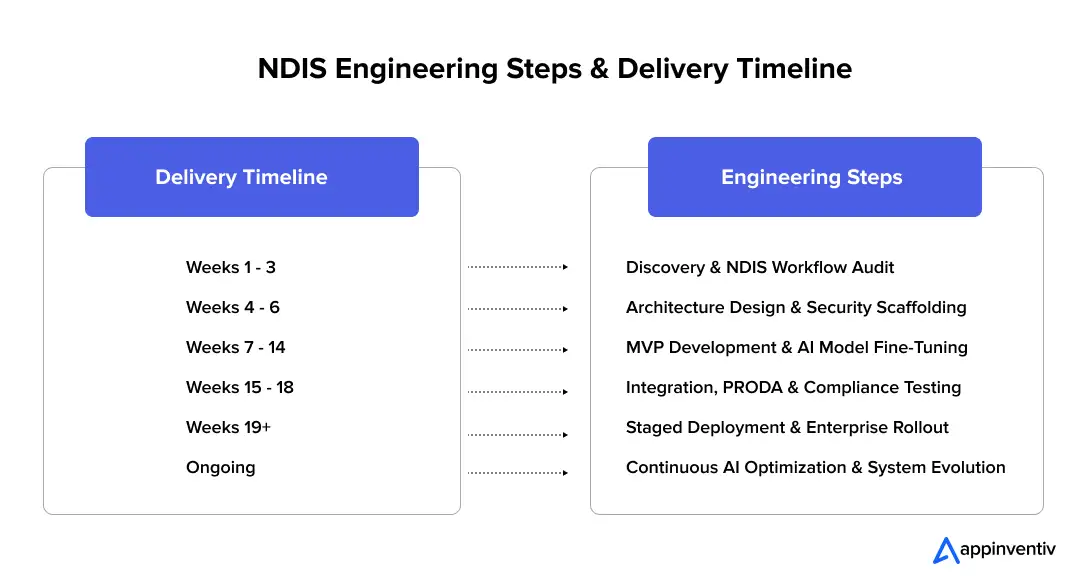
Phase 1: Discovery & NDIS Workflow Audit (Weeks 1–3)
At the initial stage, business analysts map current rostering, claims, and compliance workflows to pinpoint operational gaps and evaluate data quality before starting design work. This early audit establishes the project scope and pinpoints which AI use cases deliver immediate return on investment for the initial release.
Phase 2: Architecture Design & Security Scaffolding (Weeks 4–6)
System architects define the data model, hosting infrastructure, and security controls against ISO 27001 and IRAP baselines. Because reversing data sovereignty and access control decisions later drains significant budget, senior engineers lock in these technical foundations early.
Phase 3: MVP Development & AI Model Fine-Tuning (Weeks 7–14)
Developers build MVP (core platform modules) while data scientists fine-tune AI models on provider-specific datasets instead of generic training data. This ensures generated progress notes, ambient shift logs, and risk indicators accurately reflect the provider’s actual operational reality.
Phase 4: Integration & Compliance Testing (Weeks 15–18)
QA teams connect PRODA, PACE, accounting, and clinical systems, running rigorous verification checks against NDIS Practice Standards well before deployment. Rather than rushing this critical stage under deadline pressure, engineers thoroughly test every interface to catch and patch compliance gaps early.
Phase 5: Deployment (Week 19 Onward)
Implementation leads roll out the system in stages across individual care sites, pairing each launch with hands-on staff training. Avoiding a high-risk, simultaneous switchover isolates potential operational issues to a single site and keeps daily care delivery running smoothly.
Phase 6: Continuous AI Optimisation (Ongoing)
This is an ongoing phase where engineers retrain machine learning models as real-world usage data grows, refining workflows based on actual staff behavior rather than original static specs. This continuous feedback loop operates as an ongoing service to adapt the system as NDIS rules and business needs evolve.
Bring your AI-powered NDIS platform to life
Work with an AU team experienced in healthcare technology, enterprise AI, and compliance-driven software development.
NDIS Compliance Requirements Every Software Must Meet
A step-by-step AI-powered NDIS software development process only holds up if compliance testing sits inside the integration phase, not after deployment. The checklist below groups what a platform needs to evidence.
Regulatory & Practice Standards
☐ Alignment with the NDIS Practice Standards
☐ Compliance with NDIS Quality and Safeguards Commission requirements
☐ Reportable incident workflows matching Commission timeframes
Privacy & Data Governance
☐ Compliance with the Privacy Act 1988 and Australian Privacy Principles
☐ Consent management that is explicit and auditable at every data touchpoint
☐ Alignment with OAIC guidance on data handling
☐ My Health Record interoperability where clinical data applies
☐ Defined data retention schedules
Security, Hosting & Accessibility
☐ ISO 27001 and SOC 2 certification
☐ IRAP assessment for government-adjacent contracts
☐ Hosting within Australian data centres for data sovereignty
☐ WCAG 2.2 accessibility for participant-facing interfaces
☐ Controls mapped to the ACSC Essential Eight
AI Oversight & Audit
☐ Immutable audit logging across every workflow
☐ Documented AI transparency, including what a model recommends versus decides
☐ Mandatory human oversight of AI-generated outputs before action is taken
The federal government’s own posture signals how seriously this is treated: the 2024–25 Budget allocated AUD 160 million over four years, plus AUD 24.6 million a year ongoing, specifically to upgrade the NDIS Quality and Safeguards Commission’s IT systems and strengthen cyber security oversight (Source: GT Law, 2026). Provider platforms are increasingly held to a comparable standard.
How Much Does AI-Powered NDIS Software Development Cost in Australia?
The Cost to develop NDIS software in Australia typically ranges between AUD 70,000 and AUD 700,000 or more. However, it is just a rough estimate. The actual cost varies depending on several factors.
The key cost drivers include the number of integrations, particularly PRODA and PACE, the depth of AI model customisation, the complexity of legacy system modernisation, multi-site and multi-jurisdiction compliance requirements, and whether hosting needs to meet IRAP-level assessment.
For instance, a basic platform with a mobile app and admin portal sits at the lower end while an enterprise ecosystem with predictive AI and custom compliance engines sits considerably higher.
Here is a NDIS software development cost breakdown based on the project complexity in Australia:
| Complexity Tier | Scope | Estimated Cost (AUD) |
|---|---|---|
| Basic Core Platform | Mobile app + admin portal | $70,000 – $200,000 |
| Advanced AI-Powered Platform | PRODA + SCHADS + smart rostering | $200,000 – $400,000 |
| Enterprise Multi-Site Ecosystem | Full predictive AI + custom compliance engines | $400,000 – $700,000+ |
Providers evaluating NDIS software development cost in Australia should weigh it against measurable returns. Here is a typical quantitative ROI metrics:
- 40% Reduction in Claim Rejections: Saved capital via instant PRODA error validation.
- 100+ Administrative Hours Saved Monthly: Automated rostering and AI progress notes.
- Zero Non-Compliance Fines: Automated audit trails reducing penalty risks during Commission reviews.
Real-World AI Applications in Disability & Healthcare
Analyzing live deployments across enterprise healthcare platforms reveals clear architectural blueprints that disability care providers can directly adapt for NDIS operations.
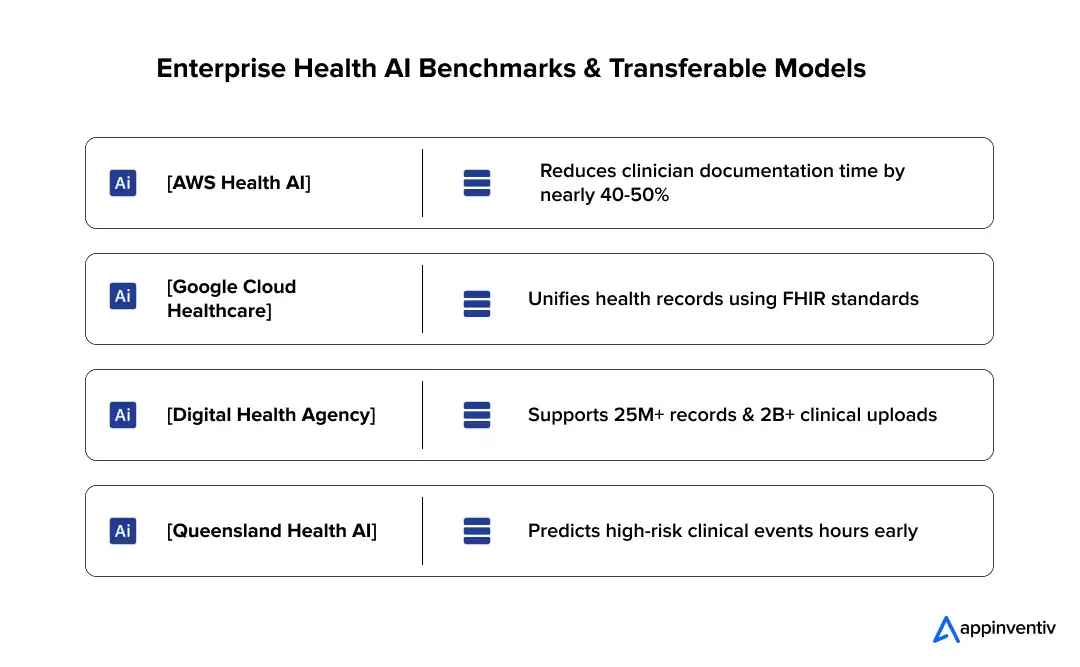
AWS Health AI
AWS HealthScribe utilises domain-trained speech recognition and generative AI to transcribe clinical consultations automatically, turning unstructured conversations into structured medical notes while maintaining HIPAA and Australian privacy compliance.
Google Cloud Healthcare
Google’s Healthcare Data Engine parses unstructured electronic health records using FHIR standards, enabling care teams to build real-time predictive analytics pipelines that track longitudinal patient care trajectories.
Australian Digital Health Agency
Under the National Digital Health Strategy, the Agency’s FHIR infrastructure supports over 25 million records and 2 billion clinical uploads, offering a proven model for secure data sharing across NDIS networks.
Queensland Health AI
Metro South Health’s implementation of ambient AI scribes and the Queensland Sepsis Prediction Algorithm automates shift documentation and highlights early clinical deterioration in complex care environments.
Common Mistakes to Avoid During AI NDIS Software Development
Most cost overruns and compliance findings trace back to a handful of avoidable decisions made early in the build, not to the technology itself.
- Building without compliance mapped from the outset, forcing expensive retrofitting once the Commission audits.
- Ignoring accessibility until late in the build, creating WCAG remediation costs that dwarf designing for it upfront.
- Feeding AI models poor-quality data, producing unreliable predictions that erode staff trust.
- Over-automating participant-facing decisions without human review, creating compliance and duty-of-care exposure.
- Buying generic AI bolted onto a legacy platform, which rarely fits NDIS-specific workflows.
- Leaving cybersecurity controls weak, inviting the breach scenarios the Essential Eight was designed to prevent.
- Skipping staff training, which undermines even a well-built platform.
- Operating without a clear AI governance framework, leaving no answer when an auditor asks who is accountable for an AI-generated recommendation.
Why Partner with Appinventiv for Your NDIS Software Journey?
Appinventiv, an experienced healthcare software development company in Australia, with 11+ years of experience, designs, develops and deploys custom NDIS software for enterprise organisations, high-growth disability providers, and government entities across the APAC region.
Our team of 1700+ tech experts bridges the gap between legacy operational bottlenecks and future-ready digital platforms by combining deep technical execution with local regulatory alignment.
An AI Practice Built Around NDIS-Specific Workflows
Our team of 200+ dedicated data scientists & AI engineers fine-tunes NLP models, predictive analytics, and decision engines against the actual documentation and claims patterns of disability support, rather than adapting generic healthcare tooling never built for PRODA, PACE, or SCHADS rules. That distinction usually separates an AI feature that gets used from one switched off after launch.
Proven Healthcare & HealthTech Engineering
We have a proven track record of engineering 3000+ secure, audit-ready digital platforms that handle sensitive medical and care data. Our engineering teams have shipped 500+ high-impact digital health solutions, including DiabeticU, Soniphi and Health-e-People.
Local Compliance Maturity
Our ISO 27001, ISO 9001, and SOC 2 certification sit behind a 99.5 per cent security compliance SLA, with approval on the Queensland Government ICTSS and Local Buy LGA procurement panels. In practice, this means audit logging, access control, and data sovereignty are part of how delivery teams build by default, rather than requested and retrofitted mid-project.
End-to-End Delivery Execution
Full lifecycle support from strategic discovery and UX design through to PRODA/PACE integration and long-term cloud maintenance.
Book a strategy session with Appinventiv’s NDIS software development team today to map cost, compliance, and timeline for your build.
FAQs
Q. How much does it cost to build AI-powered NDIS software in Australia?
A. The cost of custom AI-powered NDIS software development in Australia typically fall into three tiers. A basic platform with a mobile app and admin portal starts around AUD 70,000, while a mid-tier build adding PRODA integration, SCHADS-aware rostering, and AI features runs AUD 200,000 to 400,000. Enterprise multi-site ecosystems with predictive AI and custom compliance engines can exceed AUD 700,000, driven mainly by integration depth and the number of sites served.
Q. How long does it take to develop NDIS software in Australia?
A. A single-site platform typically takes around 4-12 months from discovery to deployment, covering workflow audit, architecture, MVP build, and compliance testing. Multi-site or multi-jurisdiction builds usually extend this to accommodate deeper PRODA and PACE testing and staged rollout. AI model fine-tuning then continues after launch rather than stopping at go-live.
Q. What features are essential for NDIS provider management software?
A. At minimum, an NDIS platform needs participant management, scheduling and rostering, billing and claims, care planning, and incident management as its operational core. Mobile access with offline mode and document management support field staff in low-connectivity regions. A compliance dashboard, role-based access, and audit logging turn a functional platform into an audit-ready one.
Q. How can NDIS software improve compliance for support workers?
A. Automated audit trails timestamp every action across rostering, claims, and incident reporting, so evidence stays continuously available rather than assembled under deadline before a Commission review. Structured incident capture prompts workers for required fields at the point of occurrence, reducing missing or late reports. AI-drafted progress notes also standardise documentation quality across a workforce.
Q. What compliance requirements apply to NDIS software in Australia?
A. NDIS platforms must strictly satisfy the NDIS Practice Standards, NDIS Quality and Safeguards Commission rules, Australian Privacy Principles (Privacy Act 1988), OAIC guidance on AI usage, and ACSC Essential Eight cybersecurity protocols.
Q. Does NDIS software need to integrate with PRODA and PACE?
A. Yes. Seamless integration with the NDIA’s PRODA portal and PACE API infrastructure is essential for automating bulk payment claims, verifying plan budgets, and eliminating manual submission errors.
Q. Can NDIS software include integrated billing and invoicing features?
A. Yes, most custom NDIS platforms embed billing and invoicing directly alongside claims automation rather than as a bolt-on. This typically syncs with accounting systems such as Xero or MYOB, so financial reporting and compliance records stay aligned without manual reconciliation, and multi-site providers get a consolidated view across locations.
Q. Can existing NDIS software be upgraded with AI?
A. Yes, existing NDIS software can be upgraded with AI capabilities without replacing core management infrastructure. Custom AI layers and modern integrations can wrap around legacy systems via REST APIs, allowing providers to add features like speech-to-text progress notes, automated SCHADS Award interpreters, and intelligent rostering directly into current operational workflows.
Q. What is the difference between PRODA and PACE?
A. PRODA (Provider Digital Access) is the Australian Government’s secure identity verification and authentication system used to access online services, including government portals like myplace.
PACE is the National Disability Insurance Agency’s (NDIA) updated customer relationship management system designed to manage participant plans, budgets, and provider endorsements.
While PRODA handles user identity and authentication, PACE represents the backend operating system that replaces older NDIA database structures to streamline bulk claim processing and improve plan flexibility.
[ad_2]
Source_link