
Key takeaways:
- Australia’s hospital sector is digitising fast on the back of interoperability mandates, AI adoption and persistent workforce shortages.
- AI-assisted documentation, predictive analytics and virtual care have moved from pilot projects to standard procurement requirements.
- Compliance with the Privacy Act, My Health Record rules and Essential Eight controls shapes architecture decisions from day one, not after launch.
- Hospital management system development cost in Australia ranges between AUD 70,000 and AUD 700,000 or more, depending on deployment model, integration depth and AI scope.
Most Australian hospitals are still running administrative workloads on patient administration systems that were never designed to talk to modern clinical tools. The result shows up in discharge delays, duplicate test orders and clinical staff re-entering the same data over and over again. None of this is a workforce problem. It is an architectural problem that has been allowed to compound for a decade.
The Australian Digital Health Agency’s National Healthcare Interoperability Plan has put a hard deadline on this drift, and the Modernising My Health Record reforms passed in February 2025 have made data-sharing a legislated obligation rather than a best-practice suggestion. Off-the-shelf platforms, built for generic markets, rarely flex to the credentialing rules, billing pathways and identifier standards that Australian healthcare runs on.
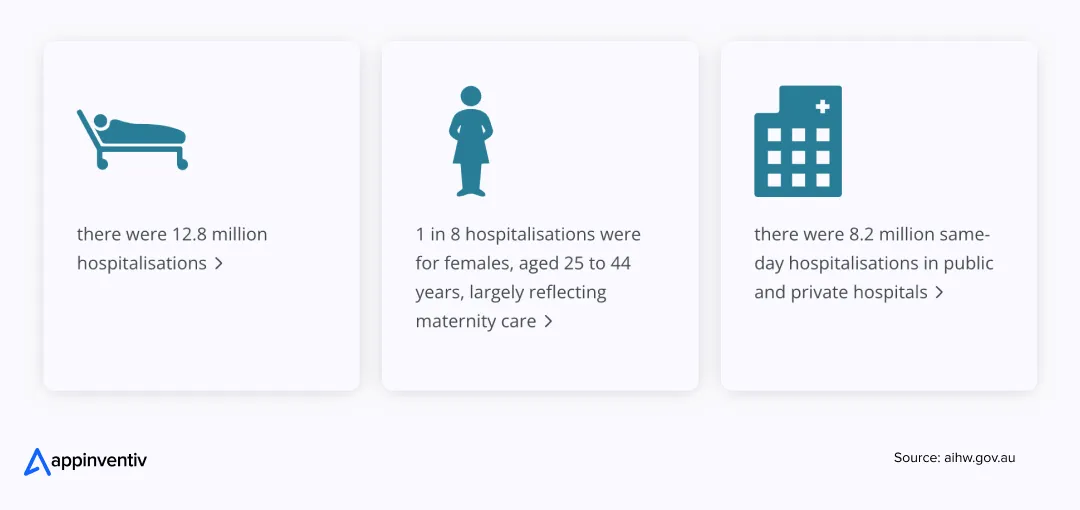
The sheer scale of the domestic healthcare sector makes relying on these rigid commercial tools impossible. According to the Australian Institute of Health and Welfare, Australia recorded 12.8 million hospitalisations during 2024-25. This highlights the growing operational complexity hospitals must manage through increasingly connected digital systems.
To handle this massive patient volume while meeting strict federal mandates, executive boards require a precise technical blueprint. This blog sets out what it actually takes to build a hospital management system in Australia: the modules that matter, the compliance layers that shape the build, the realistic cost range, and the development process required to take a hospital network from architecture review to go-live.
Managing Over 12 Million Annual Hospitalisations Requires Smarter Systems
Modern hospital management platforms help healthcare providers improve efficiency, interoperability, and patient care.

Why Australian Hospitals Are Investing in Modern Hospital Management Systems
Hospital boards are no longer weighing software upgrades against budget cycles alone. They are weighing the cost of fragmented systems against patient safety, funder compliance and the ability to scale across multiple facilities.
The Interoperability Crisis
Internal healthcare systems in Australia that cannot exchange data with pathology providers, radiology networks or specialist clinics force staff into manual workarounds. As of 30th June 2025, only 55% of the 44 actions under the National Healthcare Interoperability Plan had been completed, which signals how much integration work still sits ahead of most provider organisations.
Billing Inefficiencies
Hospitals that lack native Medicare, DVA and ECLIPSE integration carry billing friction that delays revenue recognition and frustrates patients at the point of discharge. Native claims integration is now treated as a baseline requirement rather than a premium feature.
Data Sovereignty and Security
Healthcare consistently tops the Office of the Australian Information Commissioner’s breach league table, accounting for 18% of all notifiable data breaches reported between January and June 2025. Boards are responding by demanding architectures that guarantee data residency and control rather than relying on multi-tenant SaaS defaults.
Scalability Across Facility Networks
Boxed software licensed per site rarely extends cleanly to multi-facility networks, specialised units or future acquisitions. Hospital groups planning expansion need architecture that scales horizontally without a re-platforming exercise every time a new site comes online.
Understanding the Role of A Hospital Management System in Australia
A hospital management system is the operational backbone that centralises hospital operations. It manages physical resources, financial cycles, and patient administration from admission to discharge. Executive teams must differentiate this core system from other digital health tools.
HMS vs EMR vs EHR vs Practice Management System vs HIS
| System Type | Core Purpose | Primary Users |
|---|---|---|
| Hospital Management System (HMS) | Manages end-to-end facility operations, bed allocation, and billing. | Administrators, finance teams, operations directors. |
| Electronic Medical Record (EMR) | Stores digital clinical histories for patients inside a single practice. | Attending physicians, ward nurses. |
| Electronic Health Record (EHR) | Aggregates health data intended for sharing across multiple care providers. | External specialists, allied health teams. |
| Practice Management System (PMS) | Handles basic reception scheduling and simple billing for small clinics. | Reception staff, clinic managers. |
| Hospital Information System (HIS) | Represents the complete overarching hospital IT infrastructure network. | Chief Information Officers, IT governance boards. |
Although these terms are sometimes used interchangeably, they address different operational needs. Most enterprise healthcare organisations require an integrated ecosystem where the HMS acts as the central platform while connecting with EMRs, EHRs, imaging systems, laboratories, finance applications, and external healthcare services.
Types of Hospital Management Systems: Deployment Models
Not every facility needs the same architecture. Thus, before investing in HMS development, the executive teams must evaluate how the system will physically operate before selecting software modules. The architectural foundation determines how clinical data is stored, protected, and accessed across your facility’s network.
On-Premise Systems
These platforms are hosted entirely on local hospital servers behind internal firewalls. This model provides absolute control over data residency and zero reliance on external internet connectivity. It remains a viable choice for isolated facilities with massive internal IT infrastructure and strict data isolation policies.
Cloud-Based or SaaS Systems
Hosted via remote domestic servers such as AWS Sydney or Microsoft Azure Australia East. This architecture significantly reduces upfront hardware costs and enables rapid deployment across multi-site regional clinics. It provides seamless remote access for mobile clinical staff and native support for external telehealth integrations.
Hybrid Systems
This is the standard architectural choice for modern Australian enterprise health networks. It retains highly sensitive patient records on local physical servers to satisfy strict internal privacy mandates. Simultaneously, it pushes front-facing patient portals and heavy administrative analytics to scalable public cloud environments.
Specialised Care Systems
These platforms cater to the needs of niche medical environments like oncology centers, mental health facilities, or rapid day surgeries. The architecture strips away generic hospital modules. Instead, it focuses entirely on hyper-specific clinical pathways, targeted regulatory reporting, and unique equipment integrations required for specialised patient care.
Integrated or Enterprise Systems
Built for large healthcare networks and multi-campus hospitals, enterprise platforms integrate clinical, operational, financial, and administrative functions across multiple facilities. They support complex workflows, interoperability, and high user volumes while enabling organisation-wide standardisation.
AI-Enabled Systems
These next-generation platforms combine traditional hospital management capabilities with artificial intelligence to automate clinical documentation, optimise resource allocation, predict patient demand, enhance decision support, and improve operational efficiency.
How to Build a Hospital Management System in Australia: A Step-by-Step Process
Hospital management system development process in Australia succeeds or fails based on the right sequencing. Skipping workflow mapping to chase a build date is the single most common cause of rework across modernisation projects.
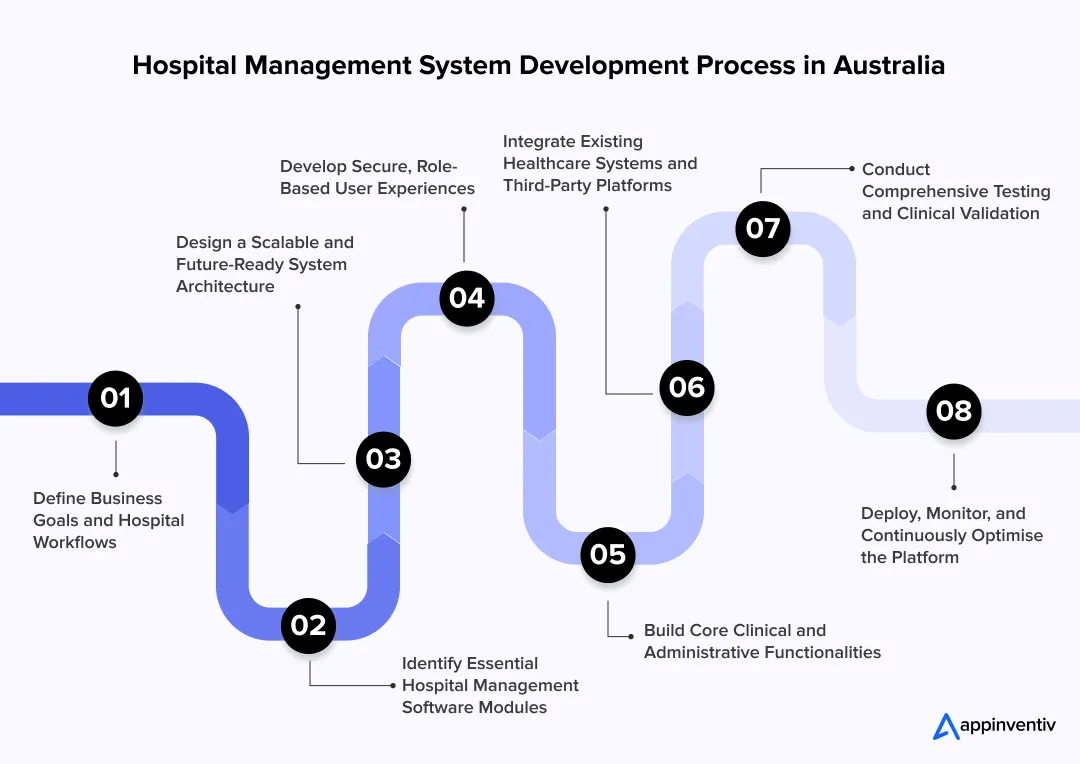
Step 1: Define Business Objectives and Hospital Workflows
Every hospital operates differently based on its size, specialties, funding model, and patient demographics. For example, a public hospital managing emergency services has vastly different needs from a private specialist hospital.
Therefore, the first step in building a hospital management system in Australia is documenting current workflows, identifying operational bottlenecks, and prioritising business objectives. This includes mapping patient journeys, administrative processes, departmental interactions, and reporting requirements.
Step 2: Identify Required Hospital Management Software Modules
Rather than developing every capability simultaneously, you should prioritise modules that deliver the greatest operational value.
It means, at this stage, you need to list every department, funding stream and patient volume tier before selecting modules. A 200-bed regional hospital and a single-specialty day surgery centre need entirely different module sets. So avoid copying a generic feature list from a vendor brochure.
Step 3: Design Scalable System Architecture
Choose microservices over a monolith so individual modules such as pharmacy or billing can scale, update or fail independently. Build the API layer first, since retrofitting integration points after core development locks in technical debt that resurfaces with every new facility.
Step 4: Develop Secure User Experience
Different users interact with HMS in different ways. Doctors require rapid access to patient histories, nurses need streamlined medication workflows, finance teams need billing accuracy, and administrators monitor operational performance.
So, when developing an HMS, your core priority should be to design role-specific dashboards that improve productivity while restricting data visibility.
Step 5: Build Core Functionalities
Once architecture and user experience designs have been finalised, it is time to start the actual task, i.e., ‘Development’. Begin the development with the platform’s core capabilities.
This phase typically includes patient registration, appointment management, admissions and discharge, electronic medical records, pharmacy workflows, billing, inventory management, reporting, user administration, notifications, and workflow automation.
Step 6: Integrate Existing Healthcare Systems
Connect EHR, EMR, PACS, LIS and pharmacy systems through standards-based FHIR interfaces, not custom point-to-point scripts that break with every vendor update. Extend the same integration discipline to Medicare, private insurers, billing platforms, wearables and telehealth tools from the outset.
Step 7: Conduct Testing and Clinical Validation
Testing extends well beyond verifying whether software functions correctly.
At this stage, your HMS undergoes functional testing, integration testing, security testing, performance testing, user acceptance testing, penetration testing, and clinical workflow validation before deployment.
Step 8: Deploy, Monitor, and Optimise the Platform
Roll the system out department by department rather than switching every ward over at once, so issues stay contained and easy to trace. Set up monitoring dashboards and a formal feedback loop from frontline staff to drive scheduled improvements after go-live.
Ready to Turn Your HMS Strategy into Reality?
From planning and architecture to deployment, the right development partner can help minimise risks and accelerate delivery.

What Are the Essential Modules and Features of a Modern Hospital Management System
When evaluating hospital management software in Australia, these baseline modules establish necessary operational control.
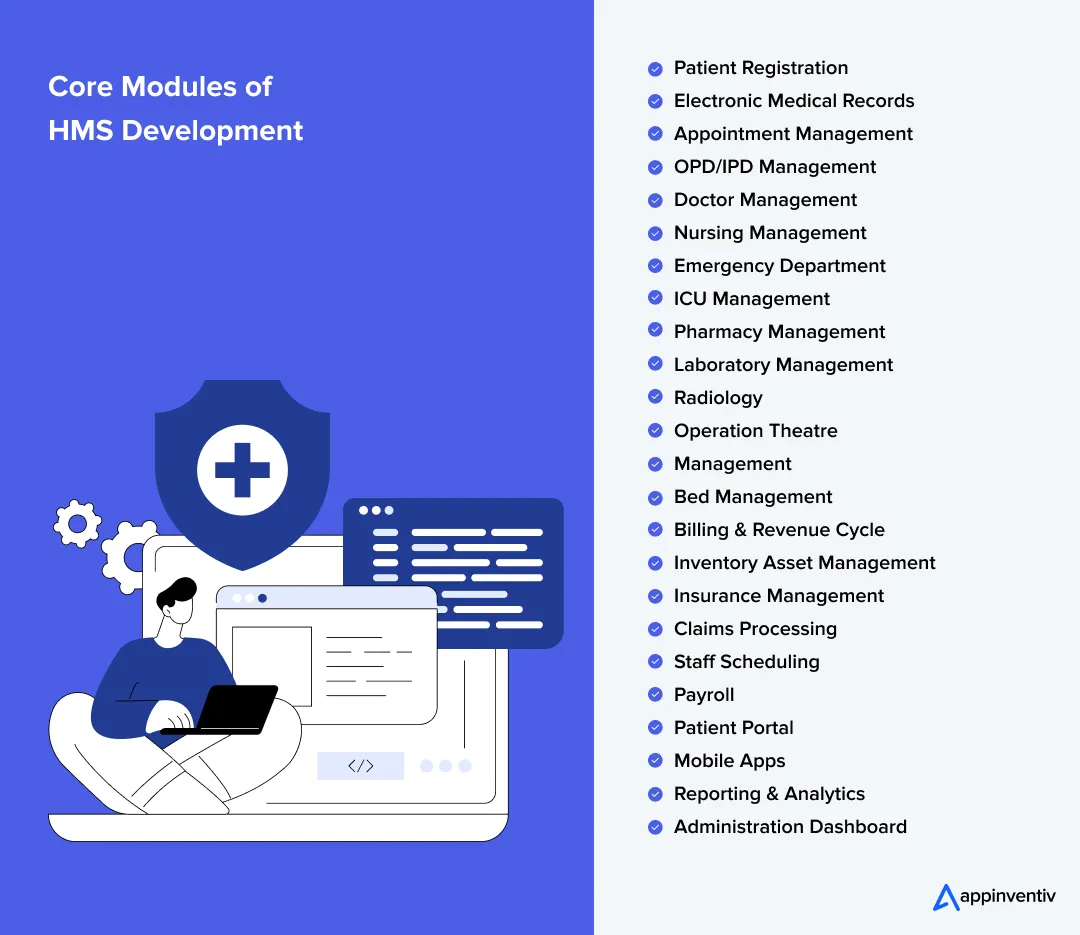
- Patient Registration: Secures baseline demographic information, validates identity credentials, and initiates the master patient record index.
- Electronic Medical Records: EMR digitises clinical histories, active diagnoses, medication regimens, and ongoing specialist treatment pathways securely.
- Appointment Management: Controls automated booking logic, synchronises specialist calendars, and dispatches automated SMS reminders.
- OPD/IPD Management: Tracks patient movement precisely from outpatient consultation rooms to inpatient ward bed allocations.
- Doctor Management: Monitors clinical credentialing, logs active consulting hours, and aligns specialist rosters with surgical theatre capacity.
- Nursing Management: Digitalises active care plans, logs medication administration times, and standardises shift handover documentation.
- Emergency Department: Prioritises rapid triage data entry, displays live bed tracking visuals, and pulls critical alerts instantly.
- ICU Management: Connects directly with life support hardware to stream real-time physiological data and trigger instant clinical alarms.
- Pharmacy Management: Audits medication inventory, processes digital prescriptions securely, and flags complex drug contraindications automatically.
- Laboratory Management: Automates diagnostic sample routing, links with testing hardware, and drops verified pathology results into files.
- Radiology: Integrates with PACS to manage imaging requests and serve high-resolution DICOM files directly to physician monitors.
- Operation Theatre Management: Optimises surgical space allocation, monitors sterile equipment inventory, and coordinates anaesthetist scheduling.
- Bed Management: Displays live ward occupancy metrics and tracks cleaning team schedules to accelerate patient admission rates.
- Billing & Revenue Cycle: Calculates complex tiered health fund pricing models, generates automated invoices, and tracks outstanding accounts.
- Inventory: Audits general medical supply levels and executes automated purchase orders before critical consumables run empty.
- Asset Management: Tracks physical location data and automated maintenance calibration schedules for high-value mobile medical hardware.
- Insurance Management: Cross-references clinical diagnostic codes against private health fund policies to block invalid claims upfront.
- Claims Processing: Transmits formatted financial data directly to Medicare and DVA endpoints via native ECLIPSE integration.
- Staff Scheduling: Builds nursing rosters, enforces mandatory fatigue management rules, and calculates legal nurse-to-patient ratios.
- Payroll: Synchronises shift attendance data with finance systems to calculate complex enterprise bargaining agreement penalty rates accurately.
- Patient Portal: Provides a secure external web gateway for individuals to check pathology results and pay invoices.
- Mobile Apps: Delivers highly encrypted, lightweight clinical data access to physician smartphones for rapid ward reviews.
- Reporting & Analytics: Extracts raw operational metrics to generate automated compliance audits and monitor departmental revenue targets.
- Administration Dashboard: Aggregates live facility performance data into a central interface for executive capacity monitoring.
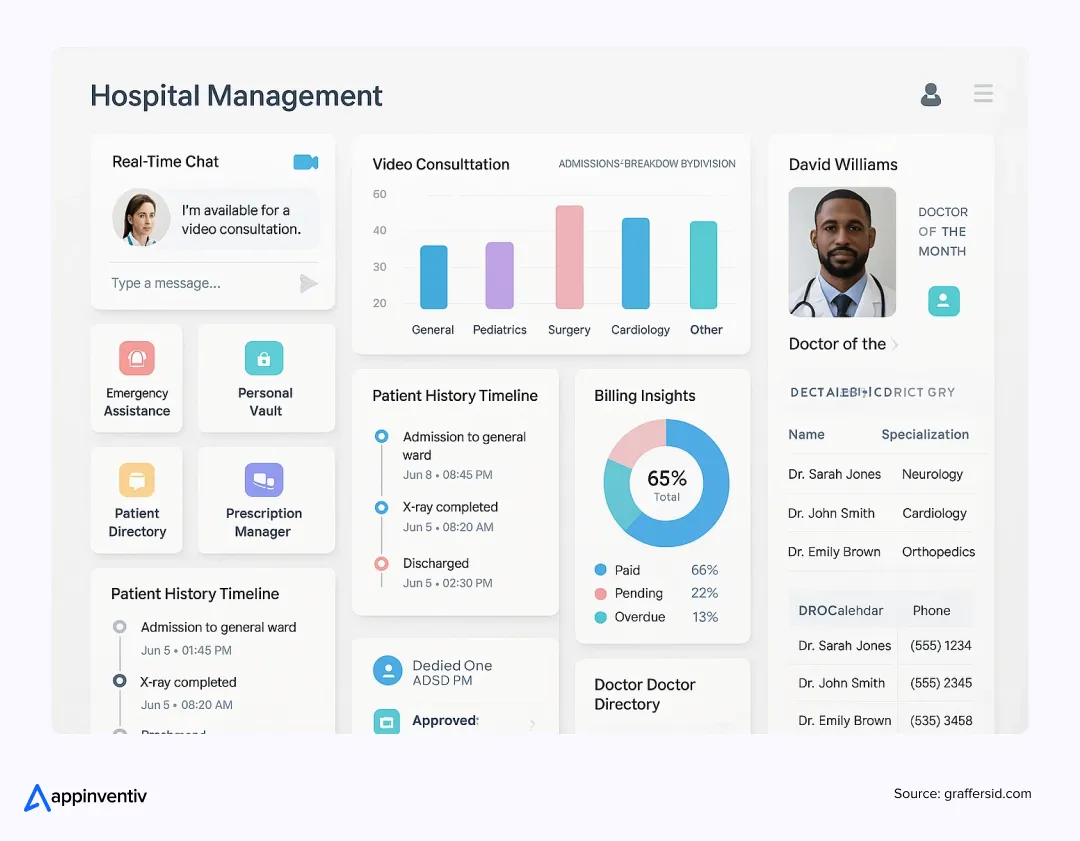
Advanced Features That Differentiate Enterprise Hospital Management Systems
Deploying the features of smart hospital management system frameworks requires significant AI integration. For example, deploying agentic AI across Australian healthcare revenue workflows dramatically lowers collection costs and payment errors.
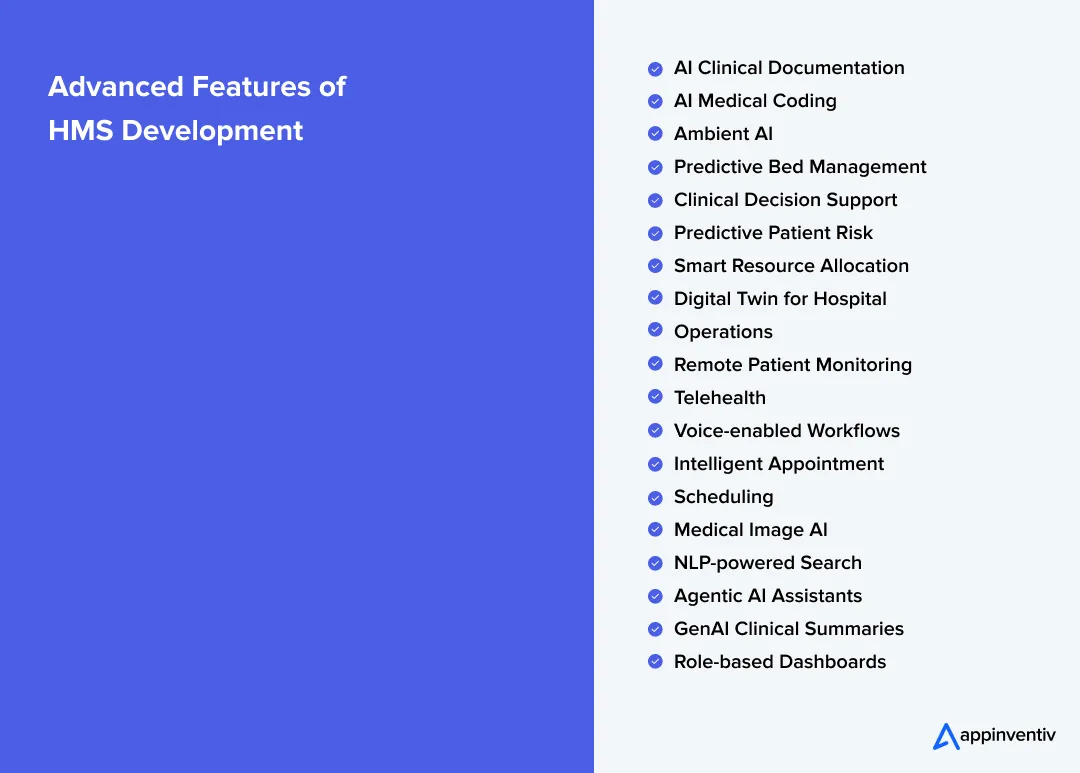
- AI Clinical Documentation: AI in Australian healthcare software transcribes live patient consultations automatically to generate correctly structured clinical notes without manual typing.
- AI Medical Coding: Scans physician notes to suggest accurate ICD-10-AM and SNOMED CT-AU billing codes instantly.
- Ambient AI: Deploys smart room sensors to detect patient falls or respiratory distress independent of manual nursing observations.
- Predictive Bed Management: Analyses historical admission data against regional weather patterns to forecast imminent bed shortages.
- Clinical Decision Support: Cross-references active patient prescriptions against global medical databases to alert physicians regarding treatment risks.
- Predictive Patient Risk: Monitors vital sign trends continuously to warn emergency response teams about potential sepsis onset.
- Smart Resource Allocation: Reassigns nursing staff dynamically across facility floors based on live patient acuity metrics.
- Digital Twin for Hospital Operations: Simulates hospital floor plans virtually to identify logistical bottlenecks in patient transport corridors.
- Remote Patient Monitoring: Collects continuous physiological data from discharged patients via wearables, flagging anomalies before readmission occurs.
- Telehealth Apps: Natively hosts encrypted virtual consultation rooms connected directly to the billing and EMR workflows.
- Voice-enabled Workflows: Permits surgical teams to log equipment updates using secure verbal commands within sterile environments.
- Intelligent Appointment Scheduling: Calculates required consultation lengths dynamically based on individual patient medical complexity scores.
- Medical Image AI: Evaluates structural radiology scans to highlight specific tissue anomalies for priority radiologist review.
- NLP-powered Search: Allows clinicians to query decades of unstructured historical records using standard natural language phrases.
- Agentic AI Assistants: Dispatches autonomous digital scripts to track missing pathology results and coordinate complex patient referrals.
- GenAI Clinical Summaries: Compress extensive historical medical files into concise, actionable bullet points for emergency triage doctors.
- Role-based Dashboards: Restricts interface data to display only the specific alerts and tools required for individual job functions.
Technology Stack Used to Build Hospital Management Software
Selecting an appropriate tech stack determines platform resilience and data defense capability. Enterprise systems require robust cloud hosting, secure database structures, and strict adherence to API standards. The correct technology stack ensures long-term operational stability.
| Layer | Representative Technologies |
|---|---|
| Frontend | React, Angular, Flutter for cross-platform clinician and patient apps |
| Backend | Node.js, Java Spring Boot, .NET for service orchestration |
| Cloud | AWS, Microsoft Azure, Google Cloud with Australian-region hosting |
| Databases | PostgreSQL, MongoDB, encrypted at rest and in transit |
| DevOps | Kubernetes, Docker, CI/CD pipelines with automated security scanning |
| AI | Python-based ML pipelines, LLM integrations for documentation and triage support |
| FHIR APIs | HL7 FHIR AU Base profiles for interoperability with My Health Record and providers |
| Cybersecurity | Zero Trust access, MFA, SIEM monitoring aligned to Essential Eight |
| Analytics | Power BI, Looker, custom dashboards for operational reporting |
| IoT | Connected monitors and wearables feeding remote patient monitoring modules |
What Are Mandatory Healthcare Compliance Requirements in Australia?
Hospital management system development in Australia demands strict compliance. Each requirement below shapes data flows, access controls and audit logging from the first architecture decision. Failing to embed these standards natively exposes the hospital network to severe legal penalties, data breaches, and reputational damage.
| Requirement | When It Applies |
|---|---|
| Privacy Act 1988 | Whenever personal and health information is collected, stored or disclosed |
| Australian Privacy Principles (APPs) | Governs consent, access, correction and cross-border disclosure of patient data |
| My Health Record Integration | Mandatory for prescribed providers under the Sharing by Default reforms passed in 2025 |
| ADHA / Digital Health Agency Standards | Applies to any system exchanging data within the national digital health ecosystem |
| HL7 and FHIR (AU Base) | Required for interoperable data exchange between hospitals, labs and My Health Record |
| SNOMED CT-AU | Applies to clinical terminology coding within EMR and HMS modules |
| ICD-10-AM | Required for diagnosis coding tied to funding and reporting obligations |
| ISO 27001 | Recommended baseline for information security management on enterprise builds |
| Essential Eight | Mandatory baseline cyber controls expected by the Australian Cyber Security Centre |
| SOC 2 | Common requirement for vendors hosting or processing patient data on behalf of providers |
| OWASP | Applies to application-layer security testing throughout development |
| Therapeutic Goods Regulations | Applies where AI features qualify as software-based medical devices under TGA rules |
The Therapeutic Goods Administration’s ongoing consultations on AI medical device regulation through 2025-2026 are directly relevant to any hospital deploying diagnostic or triage AI, since classification as a regulated device changes validation and reporting obligations.
Interoperability Requirements Every Australian Hospital Should Plan For
Interoperability is the difference between a system that reports data and one that actively reduces clinical risk by closing information gaps between providers.
An interoperable hospital management system communicates seamlessly with internal applications, external healthcare providers, and national digital health infrastructure. The following standards and integration capabilities form the foundation of connected healthcare in Australia:
- FHIR: the standards layer underpinning new interfaces across the national digital health ecosystem.
- HL7: legacy and modern messaging standards still in active use across pathology and radiology links.
- IHE: integration profiles that define how imaging and clinical systems exchange data consistently.
- My Health Record: the national repository hospitals must now share specified information with by default.
- Clinical Document Architecture: structured formats for discharge summaries and referral letters.
- API-first healthcare: architecture that treats every module as a connectable service rather than a closed silo.
- Medical device integrations: direct data feeds from monitors, infusion pumps and diagnostic equipment.
- Laboratory interoperability: standards-based result delivery between labs and ordering clinicians.
- Radiology interoperability: PACS and reporting systems exchanging studies across networks.
- Health Information Exchange: regional and state-level platforms connecting multiple provider organisations.
How Much Does Hospital Management System Development Cost in Australia?
On average, the cost to build a hospital management system in Australia ranges between AUD 70,000 and AUD 700,000 or more. However, it is just a rough estimate. Final expenditure depends on infrastructure deployment models, the complexity of legacy database migration, and the scope of embedded artificial intelligence.
Calculating the hospital management software development cost in Australia requires realistic scoping. Avoid underpriced estimates that ignore strict local compliance requirements.
Estimated Hospital Management System Development Cost in Australia
| Platform Complexity | Estimated Cost (AUD) | Estimated Timeline | Best Suited For |
|---|---|---|---|
| MVP | $70,000 – $150,000 | 4 – 6 Months | Specialist outpatient clinics requiring basic digital patient tracking. |
| Mid-sized | $150,000 – $300,000 | 6 – 9 Months | Regional hospitals needing departmental modules and laboratory integrations. |
| Advanced | $300,000 – $500,000+ | 9 – 12+ Months | Multi-facility networks demanding advanced interoperability and custom workflows. |
| AI-powered | $500,000 – $700,000+ | 12 – 24+ Months | Major health networks deploying predictive analytics and automated coding. |
Actual costs vary based on integration complexity, data migration scope and the depth of AI capability required. These figures are directional estimates, not fixed quotes, and should be validated against a detailed scoping exercise.
Hidden Cost Drivers
- Third-party API integration complexities across labs, insurers and government payment rails.
- Data migration securely moves decades of patient files without breaking referential integrity also requires significant investments.
- Ongoing maintenance and security patching required to maintain compliance posture post-launch.
Planning a Hospital Management System Project?
Share your project vision with us and get a realistic cost estimate based on your workflows, integration needs, compliance obligations, and long-term business goals.

What Are the Biggest Challenges in Hospital Management System Development and How to Solve Them
Most HMS delivery risk is predictable. Naming the failure modes early lets a board fund mitigation rather than discovering the cost during a delayed go-live.
| Challenge | Impact | Recommended Solution |
|---|---|---|
| Legacy systems | Data trapped in formats incompatible with modern platforms | Phased migration with parallel running before legacy decommissioning |
| Interoperability | Manual workarounds between hospital, lab and specialist systems | FHIR-based integration layer built before module rollout |
| Data migration | Risk of corrupted or incomplete patient histories | Staged migration with clinical sign-off at each checkpoint |
| Cybersecurity | Healthcare remains the most breached sector in Australia | Zero Trust architecture aligned to Essential Eight from day one |
| Change management | Clinical staff resistance slows adoption | Embedded training and phased rollout by department |
| Compliance | Regulatory gaps surface late and delay go-live | Compliance mapped into architecture decisions, not bolted on before audit |
On cybersecurity specifically, the threat is not theoretical. Ransomware incidents against the healthcare sector doubled in FY2024-25 compared with the previous year, and malicious actors succeeded in 95% of incidents the Australian Signals Directorate responded to in this sector.
Why Healthcare Organisations Partner with Appinventiv for Hospital Management Software Development
Healthcare software system development in Australia requires an experienced engineering partner who understands that clinical software cannot afford a single point of failure.
This is where we come. We bring 11+ years of APAC delivery experience to enterprise hospital management software development in Australia. We specialise in navigating the specific technical realities of the Australian healthcare ecosystem, moving hospital networks away from legacy silos and into fully interoperable, compliant digital environments.
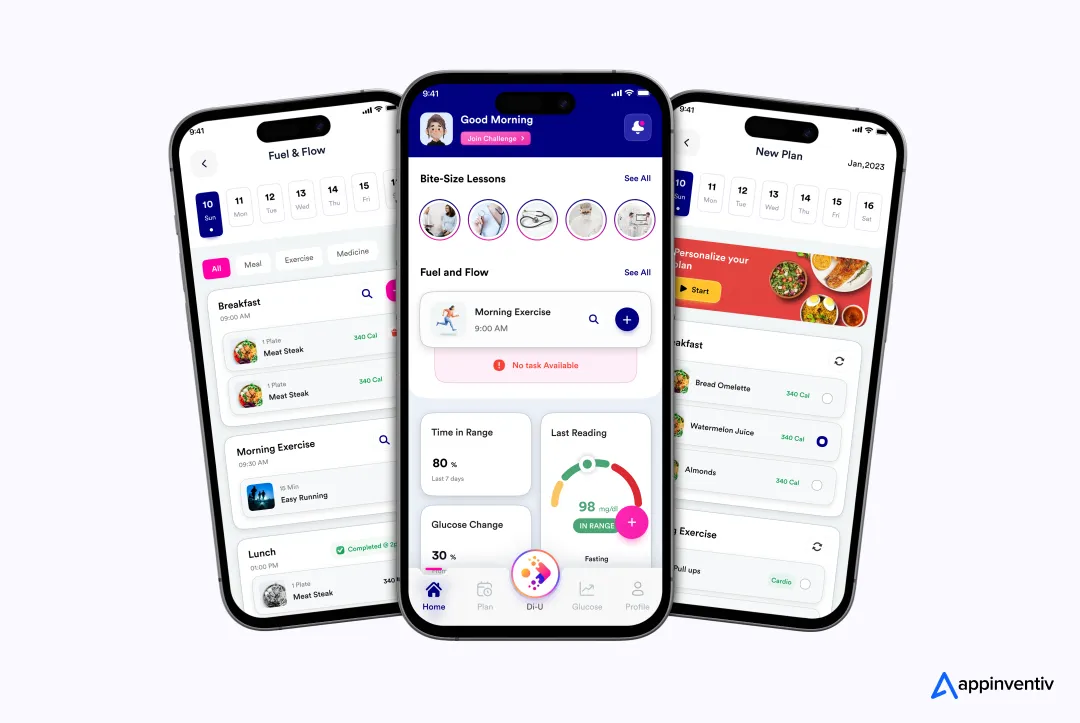
Our team of 1600+ tech experts carries the core competence in building and scaling 3000+ digital products, including health platforms like DiabeticU, Soniphi, YouComm and Health-e-People.
Our development approach is AI-first by default and secure-by-design throughout, covering everything from initial discovery to post-launch modernisation and ongoing support. Integration runs cleanly with existing EHRs, telehealth platforms, medical devices and cloud ecosystems, built for the multi-facility scale that Australian hospital networks increasingly require.
We design architecture from day one to align with the strict requirements of the Australian Digital Health Agency (ADHA), the Privacy Act, and My Health Record integration pathways. We ensure your data sovereignty is protected and your systems are fortified against modern cyber threats in alignment with the Essential Eight framework.
If your hospital network is looking to modernise its administrative and clinical workloads, contact our engineering team to schedule a technical consultation. We will review your existing system architecture and map out a practical roadmap under a strict non-disclosure agreement.
FAQs
Q. What is a hospital management system?
A. A hospital management system is software that coordinates a hospital’s operational functions, including admissions, scheduling, billing, inventory and staffing, working alongside clinical record systems such as EMR and EHR platforms.
Q. How to develop a hospital management system in Australia?
A. Hospital management system development in Australia follows a structured process: defining workflows, selecting modules, designing scalable architecture, building core functions, integrating existing healthcare systems, embedding security and compliance, then testing and phased deployment.
Q. How much does it cost to build a hospital management system in Australia?
A. Hospital management system development cost in Australia typically ranges from AUD 70,000 for an MVP to over AUD 700,000 for an enterprise AI-powered platform, depending on integration depth, compliance scope and the number of facilities involved.
Q. How long does it take to develop a hospital management system?
A. The timeline for a hospital management system ranges from 4 to 6 months for an MVP to 12 to 24 months or longer for an enterprise AI-powered platform, depending on module count, integration complexity and the number of facilities in scope.
Q. What Australian healthcare regulations apply to hospital management software?
A. Key requirements include the Privacy Act 1988, the Australian Privacy Principles, My Health Record integration obligations, HL7 FHIR AU Base standards, the Essential Eight cyber controls, and Therapeutic Goods Administration rules where AI features qualify as a medical device.
Q. How do hospital management systems integrate with EHR and EMR platforms?
A. Integration runs through FHIR-based APIs and HL7 messaging standards, allowing patient demographic, clinical and billing data to flow between the HMS, EMR, EHR and My Health Record without duplicate entry.
Q. How does AI improve hospital management software development?
A. AI improves hospital management software development through ambient clinical documentation, predictive bed and risk management, automated medical coding and decision support tools that reduce administrative load and support earlier clinical intervention.
Q. What is the ROI of implementing a hospital management system?
A. ROI of implementing hospital management system typically shows up through reduced administrative overhead, faster billing cycles, lower duplicate testing and improved bed utilisation, with efficiency gains compounding as integration depth and AI capability increase across departments.
Q. What are the biggest challenges in implementing a hospital management system?
A. The most common challenges are legacy system migration, interoperability gaps, cybersecurity exposure, clinical staff change management and ensuring compliance is embedded into architecture rather than addressed after launch.